


Exposition à la chaleur et à la lumière
Des colis chauds et un stockage lumineux peuvent créer des plaintes de clients évitables pour les soins de la peau à positionnement actif.
Les soins au rétinol sont généralement traités comme produits premium sensibles à la chaleur et à la lumière. La configuration doit protéger la promesse de formule, la texture de crème, la forme du tube ou pot et le carton imprimé, tout en évitant les marques de pression des packs gelés.
For cosmétique cold-chain delivery, le meilleur package est celui qui protège à la fois l’état de la formule et la présentation destinée au client. La configuration d'emballage ci-dessous donne un point de départ pratique avant les tests en voie.
Des colis chauds et un stockage lumineux peuvent créer des plaintes de clients évitables pour les soins de la peau à positionnement actif.
Les bocaux et les tubes peuvent montrer une séparation, ramollissement, bosselure, ou pression d'étanchéité si réfrigérant et inserts sont mal positionnés.
Premium soins de la peau depends on clean presentation; étiquettes humides, cartons écrasés, and cold-pack marks hurt the expérience de déballage.
| État de l'itinéraire | Objectif de température | Configuration d'emballage | Plage préliminaire de réfrigérant | Contrôle à réception |
|---|---|---|---|---|
| Itinéraire dans la même ville ou en magasin, 4-8 h | Protection contre la chaleur du véhicule, généralement sans congeler le produit. | Enveloppe ou carton isolé, carton intérieur de protection contre la lumière, petit gel accumulateur conditionné ou PCM séparé par planche. | À propos 0.3-0.8 kg pour un 0.5-2 kg de charge utile. | Joint de pot, forme du tube, sécheresse du carton, et heure de transfert. |
| Route chaleureuse du commerce électronique, 8-24 h | Un parcours sympa autour de l'exigence de la marque; éviter le contact direct du gel avec les tubes, pots, ou cartons imprimés. | Carton isotherme ou boîte EPP, insert vertical ou diviseur, réfrigérant latéral/top avec mousse ou tampon ondulé. | À propos 0.8-1.8 kg pour un 0,5-3 kg de charge utile. | Texture, carton écrasé, mouillage des étiquettes, et température minimale. |
| Itinéraire retardé en saison chaude, 24-36 h | Itinéraire de la chaîne fraîche validé en fonction des instructions de stockage du produit et de la promesse de livraison. | Isolation plus épaisse, more PCM or conditioned accumulateurs gel, produit dans la cavité centrale, Enregistreur optionnel pour les envois premium. | À propos 1.8-3.0 kg pour un chargeur compact; valider avec le carton réel. | Courbe de l'enregistreur, marques de pression du pot ou du tube, état du joint, and remaining réfrigérant state. |
Utilisez ces gammes pour la discussion sur l’emballage et l’échantillonnage. La masse finale du réfrigérant doit être confirmée avec la formule réelle, nombre d'unités, taille du flacon ou du pot, dimensions des cartons, durée de l'itinéraire, conditions ambiantes, et toute exigence d'activation.
Les pots et tubes au rétinol ne doivent pas être pressés contre des accumulateurs gelés. Utiliser une entretoise pour que le réfrigérant contrôle l'air sans toucher l'emballage.
Utilisez des cartons de vente au détail, manches, ou protection intérieure opaque lorsque le positionnement du produit dépend d'actifs photosensibles.
Un séparateur ou un plateau maintient les colis droits et réduit les frottements., bosses, et le mouvement du bouchon lors de la manutention du colis.
La température n'est qu'un contrôle. Vérifier aussi la séparation de crème, la déformation des tubes, les étiquettes mouillées et les cartons écrasés.
Ce sont les problèmes que la configuration d'emballage devrait réduire avant que l'expédition n'atteigne le client..
Utilisez la courbe de test comme comparaison de travail, puis validez avec le produit réel, réfrigérant mass, isolation, durée de l'itinéraire, et assaisonner. For soins de la peau, vérifiez également la présentation: séchage des étiquettes, état du carton, joint de bouchon, et la texture du produit.
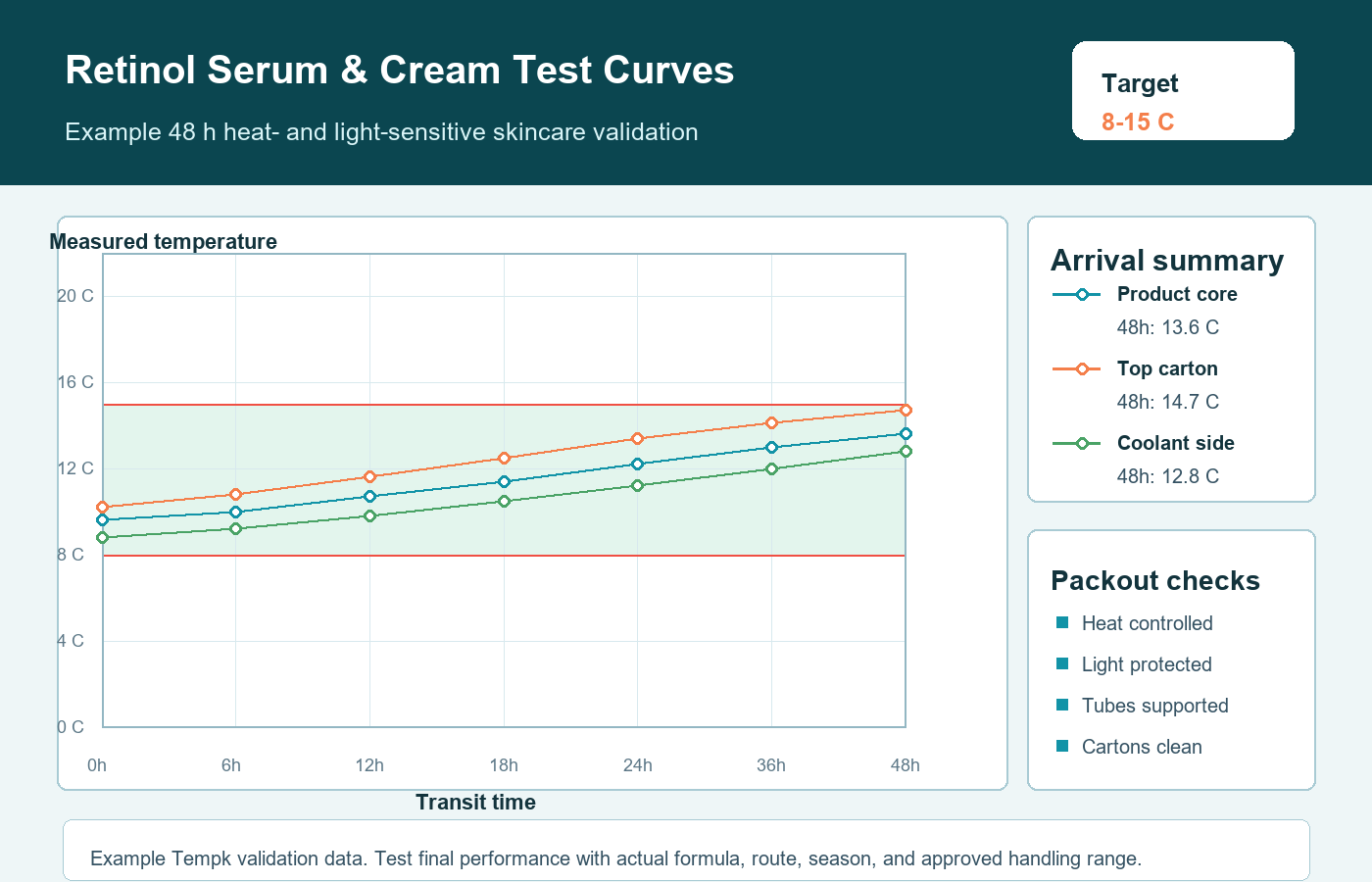
Utilisez ces pages pour comparer les itinéraires de produits à proximité, select réfrigérant, et vérifier le risque d'itinéraire avant l'échantillonnage.
Les crèmes et sérums au rétinol nécessitent une manipulation stable car la chaleur peut affecter la texture et la confiance des clients.. L'emballage doit également protéger les tubes, pots, et pompes airless à partir de pression.
Les échecs visibles sont séparés en crème, tubes ramollis, coloration des cartons, fuite de la pompe, et les dommages sur les étiquettes dus à la condensation.
Gardez les unités de vente au détail debout dans une cloison et utilisez un tampon d'humidité entre le réfrigérant et les cartons.. Ne laissez pas un gel accumulateur épais appuyer sur les têtes de pompe..
Utilisez du gel réfrigéré ou du PCM pour les voies chaudes. Si la formule n'est pas réfrigérée, concevoir la configuration d'emballage pour modérer la chaleur plutôt que de créer une charge utile très froide.
Vérifier la viscosité, fonctionnement de la pompe, état du carton, et adhésion des étiquettes après une simulation d'itinéraire estival.
Les crèmes et sérums au rétinol ont souvent besoin d'être protégés de la chaleur et de la lumière plutôt que d'être strictement réfrigérés.. Une configuration d'emballage pratique utilise une isolation et du gel réfrigéré ou PCM pour réduire les pics d'été tout en gardant les cartons de vente au sec.
Protéger les tubes, pots, et pompes sous pression. Un gel accumulateur épais directement sur une tête de pompe peut créer une fuite ou une déformation du carton même si la température semble acceptable..
Tempk peut comparer une configuration réfrigérée douce à une configuration réfrigérée plus forte. Vérifier la viscosité, fonctionnement de la pompe, coloration des cartons, adhésion d'étiquette, et présentation d'ouverture client après le parcours.
Prise en charge de la configuration d'emballage personnalisée
Pour des tailles de carton fixes, limites de charge utile, exigences en matière de marque, voies saisonnières, ou des cibles de validation, Tempk peut adapter cette solution dans une configuration d'emballage de chaîne du froid personnalisée.
Partagez les instructions de stockage, nombre d'unités, taille du carton, poids de charge utile, durée de l'itinéraire, conditions ambiantes, transfert de livraison, et si vous avez besoin d'un enregistreur de température. Tempk can help compare accumulateurs gel, PCM, PPE, cartons isothermes, couches tampons, et recevoir des chèques.
Demander une revue de configuration