


Exposition à la chaleur
Un séjour chaleureux peut miner la confiance des clients lorsque le produit est vendu en direct, fermenter, ou positionnement en principe actif.
Les expéditions de soins probiotiques exigent un emballage qui respecte l'allégation de stockage de la marque et protège le positionnement des actifs. La configuration doit réduire l'exposition à la chaleur, contrôler la condensation et garder pots, tubes, étiquettes et cartons présentables.
For cosmétique cold-chain delivery, le meilleur package est celui qui protège à la fois l’état de la formule et la présentation destinée au client. La configuration d'emballage ci-dessous donne un point de départ pratique avant les tests en voie.
Un séjour chaleureux peut miner la confiance des clients lorsque le produit est vendu en direct, fermenter, ou positionnement en principe actif.
Les compresses froides contenues dans de petits colis de produits cosmétiques peuvent créer de la condensation et mouiller le carton de vente au détail s'il n'y a pas de barrière contre l'humidité..
Un itinéraire réfrigéré peut toujours échouer aux contrôles de présentation si les accumulateurs de gel touchent les pots, tubes, étiquettes, ou des cartons directement.
| État de l'itinéraire | Objectif de température | Configuration d'emballage | Plage préliminaire de réfrigérant | Contrôle à réception |
|---|---|---|---|---|
| Livraison locale, 4-8 h | Utilisez les instructions de stockage de la marque; de nombreux itinéraires nécessitent une protection thermique et certains nécessitent une manipulation réfrigérée. | Enveloppe isolée ou petit carton, manchon anti-humidité, un ou deux accumulateurs conditionnés en gel ou PCM avec espaceur. | À propos 0.4-0.9 kg pour un 0.5-2 kg de charge utile. | Sceau du produit, sécheresse du carton, et transfert rapide. |
| Route chaleureuse du commerce électronique, 8-24 h | Itinéraire frais ou réfrigéré en fonction de l'étiquette et de la promesse de la marque; éviter de geler sauf validation explicite. | Carton isotherme ou boîte EPP compacte, cavité centrale du produit, buffered réfrigérant on side/top positions, couche de contrôle de l'humidité. | À propos 0.9-2.0 kg pour un 0,5-3 kg de charge utile. | Enregistrement de l'enregistreur si utilisé, condensation, carton écrasé, et la texture du produit. |
| Risque de route chaude ou de week-end, 24-36 h | Itinéraire frais ou réfrigéré validé avec une allocation de séjour supplémentaire. | Une isolation plus performante, conditioned accumulateurs gel or PCM, produit isolé du réfrigérant, enregistreur en option pour les voies DTC premium. | À propos 2.0-3.2 kg pour un chargeur compact; confirmer par test d'itinéraire. | Température minimale et maximale, remaining réfrigérant, séchage des étiquettes, et joint de bouchon. |
Utilisez ces gammes pour la discussion sur l’emballage et l’échantillonnage. La masse finale du réfrigérant doit être confirmée avec la formule réelle, nombre d'unités, taille du flacon ou du pot, dimensions des cartons, durée de l'itinéraire, conditions ambiantes, et toute exigence d'activation.
Confirmer si le produit exige une manutention réfrigérée, une protection fraîche ou seulement une réduction des pics de chaleur. Cela évite de trop refroidir une formule qui n'a besoin que d'une protection estivale.
Utiliser des manches, doublures, ou séparation absorbante afin que la condensation du réfrigérant n'endommage pas les cartons et les étiquettes.
Placer les accumulateurs conditionnés ou PCM autour de la charge, pas contre elle. Les petits colis de soin ont souvent plus besoin de séparation que de masse réfrigérante supplémentaire.
Testez le nombre réel de pots ou de tubes, inserts, isolation, réfrigérant mass, et la durée de l'itinéraire avant la mise à l'échelle de l'expédition DTC.
Ce sont les problèmes que la configuration d'emballage devrait réduire avant que l'expédition n'atteigne le client..
Utilisez la courbe de test comme comparaison de travail, puis validez avec le produit réel, réfrigérant mass, isolation, durée de l'itinéraire, et assaisonner. For soins de la peau, vérifiez également la présentation: séchage des étiquettes, état du carton, joint de bouchon, et la texture du produit.
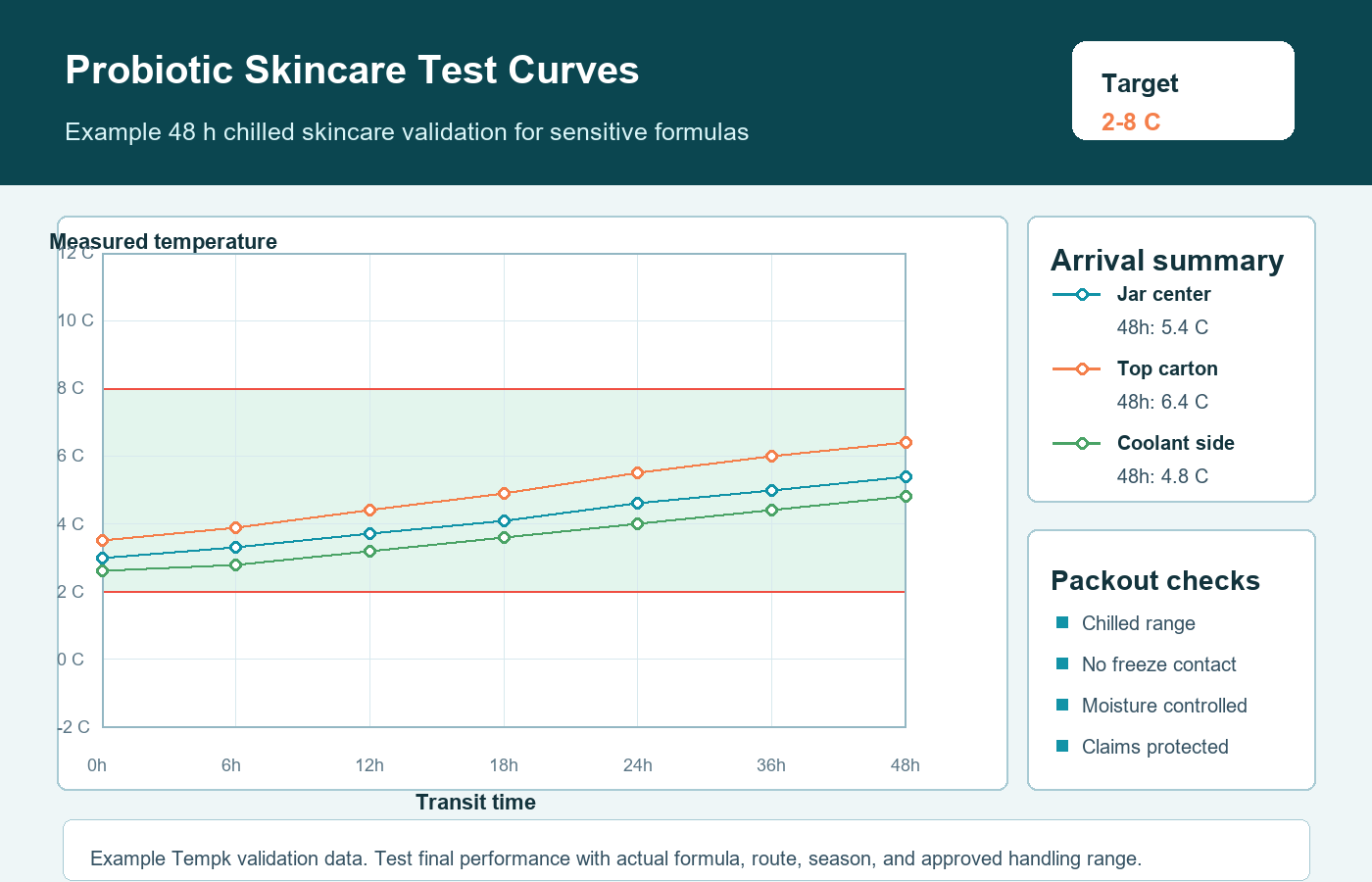
Utilisez ces pages pour comparer les itinéraires de produits à proximité, select réfrigérant, et vérifier le risque d'itinéraire avant l'échantillonnage.
Les soins de la peau probiotiques peuvent être commercialisés autour d'ingrédients vivants ou actifs, la confiance en la température et la présentation propre sont donc toutes deux importantes à la livraison.
La perte peut apparaître sous forme de séparation de formule, changement d'odeur, humidité du carton, levage d'étiquettes, et l'inquiétude du client concernant la livraison chaleureuse.
Utilisez un emballage de colis isotherme avec un séparateur de produit et une enveloppe intérieure résistante à l'humidité.. Conserver le réfrigérant suffisamment près pour stabiliser la charge utile mais séparé de la face du carton.
Utiliser du gel accumulateur réfrigéré ou du PCM selon l'étiquette de la formule. Pour les produits réfrigérés, valider 2 à 8 C et éviter tout contact direct avec les packs congelés.
Vérifier la texture visuelle, odeur, état de l'étiquette, et tout indicateur de stabilité requis. Enregistrez si le produit semble toujours de qualité supérieure une fois ouvert.
Certains produits soins probiotiques ne nécessitent qu'une modération thermique, tandis que d'autres nécessitent une manipulation réfrigérée. La configuration d'emballage doit suivre l'étiquette de formule et les données de stabilité plutôt que d'appliquer une règle d'expédition de cosmétiques à chaque SKU..
Utiliser une cavité de produit protégée, enveloppe intérieure résistante à l'humidité, et du gel réfrigéré ou du PCM selon les besoins. Si la formule nécessite 2 à 8 C, éviter le contact direct avec les emballages congelés et valider les voies chaudes et froides.
Les tests de route Tempk devraient vérifier la texture de la formule, odeur, état de l'étiquette, sécheresse du carton, et si le produit semble toujours de qualité supérieure une fois ouvert. Pour les produits de beauté, la présentation fait partie de la solution.
For soins probiotiques, commencer par l'exigence de stabilité. Si la formule nécessite 2 à 8 C, utiliser du PCM ou du gel accumulateurs conditionnés dans une zone réfrigérante séparée et valider les voies chaude et froide. Si le produit n'a besoin que d'une protection thermique, une disposition en gel réfrigéré plus douce peut protéger la formule sans mouiller le carton de beauté. L'emballage doit contenir des pots, tubes, ou pompes airless verticales et propres. La réception devrait vérifier l'odeur, texture, présentation en carton, état de l'étiquette, et si l'expérience d'ouverture soutient toujours une marque premium de soins de la peau.
Prise en charge de la configuration d'emballage personnalisée
Pour des tailles de carton fixes, limites de charge utile, exigences en matière de marque, voies saisonnières, ou des cibles de validation, Tempk peut adapter cette solution dans une configuration d'emballage de chaîne du froid personnalisée.
Partagez les instructions de stockage, nombre d'unités, taille du carton, poids de charge utile, durée de l'itinéraire, conditions ambiantes, transfert de livraison, et si vous avez besoin d'un enregistreur de température. Tempk can help compare accumulateurs gel, PCM, PPE, cartons isothermes, couches tampons, et recevoir des chèques.
Demander une revue de configuration