


Chaleur et soleil
L'attente chaude peut affecter couleur, odeur et confiance dans la marque, surtout lorsque les colis restent dans les véhicules, casiers ou devant la porte.
Les colis de sérum vitamine C exigent contrôle de la chaleur, protection lumière et maintien attentif des flacons. L'objectif est de réduire l'exposition estivale sans provoquer contact gelé, étiquettes mouillées, fuite de bouchon ou mouvement des flacons en verre.
Pour la livraison chaîne du froid cosmétique, le meilleur emballage protège à la fois l'état de la formule et la présentation client. La configuration ci-dessous donne un point de départ pratique avant les tests de voie.
L'attente chaude peut affecter couleur, odeur et confiance dans la marque, surtout lorsque les colis restent dans les véhicules, casiers ou devant la porte.
Un accumulateur froid placé trop près du carton retail peut mouiller les étiquettes et boîtes imprimées même si la température produit semble acceptable.
Les flacons et compte-gouttes en verre nécessitent un support dans la cavité centrale afin que le produit ne vibre pas., ébrécher, ou presser dans un gel accumulateur.
| État de l'itinéraire | Objectif de température | Configuration d'emballage | Plage préliminaire de réfrigérant | Contrôle à réception |
|---|---|---|---|---|
| Courrier local, 4-8 h | Protection contre la chaleur; suivre les instructions de stockage sur l'étiquette si une manipulation réfrigérée est requise. | Enveloppe isolée ou petit carton isolé, manchon de flacon, 1-2 petits accumulateurs conditionnés en gel ou PCM avec intercalaire. | À propos 0.3-0.7 kg pour un 0.5-2 kg sérum payload. | Mouvement de la bouteille, joint de bouchon, séchage des étiquettes, et un temps de transfert chaleureux. |
| Route chaleureuse du commerce électronique, 8-24 h | Souvent planifié comme un itinéraire frais comme 8-15°C lorsque la marque a besoin de réduction de chaleur; Évitez le gel. | Carton isotherme ou boîte EPP compacte, cavité centrale du produit, conditioned réfrigérant on side/top positions, tampon ondulé ou en mousse. | À propos 0.7-1.5 kg pour un 0,5-3 kg de charge utile. | Température minimale, humidité de l'étiquette, carton écrasé, et tout problème de couleur ou d'odeur. |
| Risque de route chaude ou de retard, 24-36 h | Utilisez une cible fraîche ou réfrigérée testée en fonction de l'étiquette du produit et de la promesse du client.. | Isolation plus épaisse, masse de PCM ou de gel-pack plus élevée, produit isolé des surfaces froides, activateur optionnel pour les voies premium. | À propos 1.5-2.6 kg pour un chargeur compact; valider avant le lancement. | Courbe de l'enregistreur, remaining réfrigérant state, fuite du bouchon, et l'apparence du produit. |
Utilisez ces gammes pour la discussion sur l’emballage et l’échantillonnage. La masse finale du réfrigérant doit être confirmée avec la formule réelle, nombre d'unités, taille du flacon ou du pot, dimensions des cartons, durée de l'itinéraire, conditions ambiantes, et toute exigence d'activation.
Ne pas congeler ni trop refroidir le flacon, sauf si l'étiquette et le processus de qualité interne le permettent.. Condition réfrigérante avant configuration d'emballage afin que le produit ne soit pas choqué par une surface gelée.
Placer les flacons dans une pochette, plateau, ou diviseur. Conservez un matériau absorbant ou résistant à l'humidité entre le carton de vente au détail et le réfrigérant..
Utiliser le placement latéral et supérieur pour les allées d'été, mais gardez un espaceur physique entre le réfrigérant et le flacon ou la boîte de vente au détail.
Contrôle à réceptions should include temperature record if used, séchage des étiquettes, état du bouchon, mouvement du verre, et des indices de couleur ou d'odeur visibles.
Ce sont les problèmes que la configuration d'emballage devrait réduire avant que l'expédition n'atteigne le client..
Utilisez la courbe de test comme comparaison de travail, puis validez avec le produit réel, réfrigérant mass, isolation, durée de l'itinéraire, et assaisonner. For soins de la peau, vérifiez également la présentation: séchage des étiquettes, état du carton, joint de bouchon, et la texture du produit.
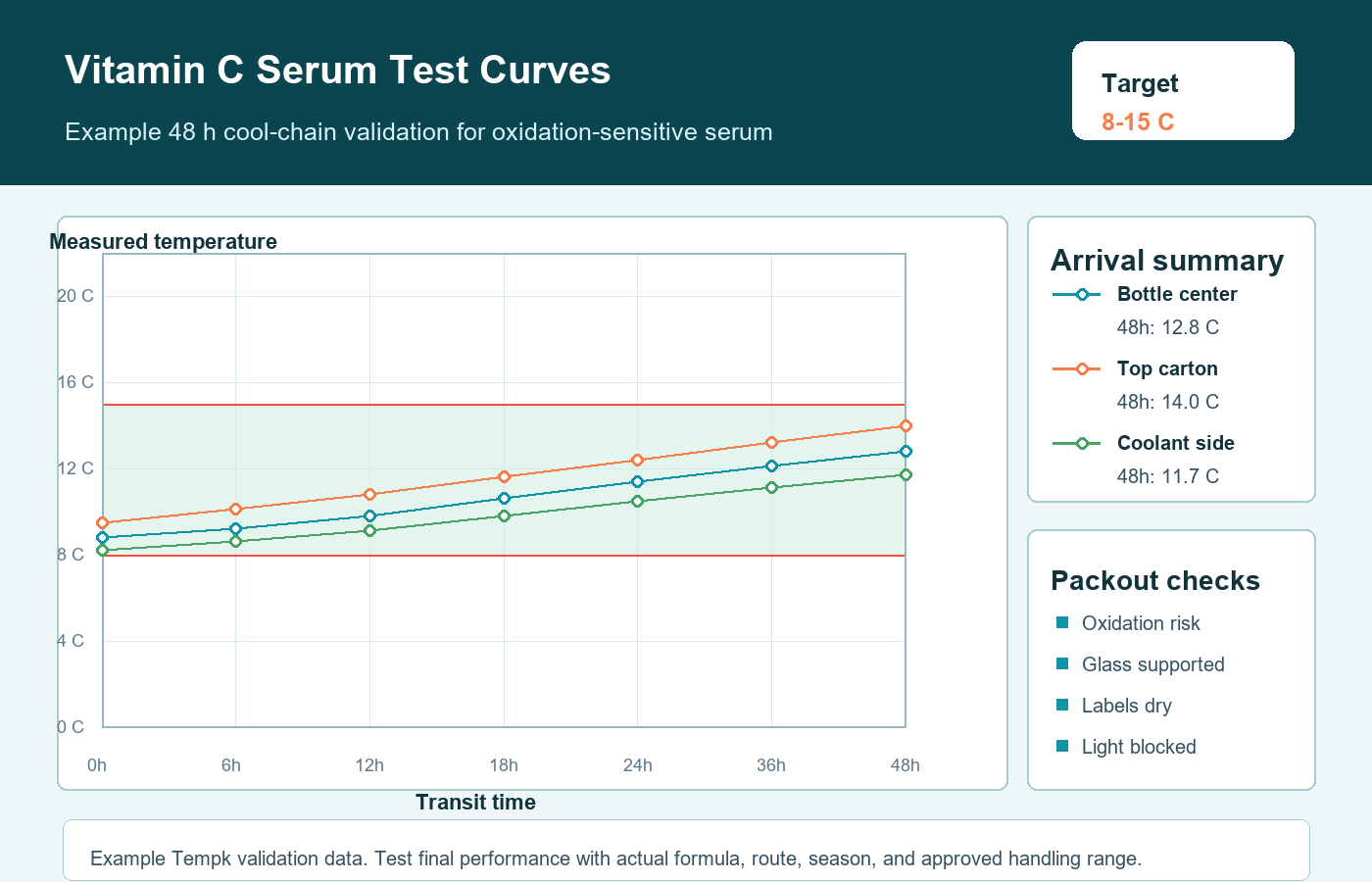
Utilisez ces pages pour comparer les itinéraires de produits à proximité, select réfrigérant, et vérifier le risque d'itinéraire avant l'échantillonnage.
le sérum vitamine C peut foncer ou perdre de son attrait lorsqu'il est exposé à la chaleur et à la lumière. La configuration d'emballage doit modérer la température tout en protégeant les flacons en verre, compte-gouttes, et cartons de vente au détail.
Surveillez le changement de couleur, fuite des compte-gouttes, gonflement du carton, levage d'étiquettes, et verre brisé par contact direct avec un réfrigérant dur.
Utilisez un diviseur ou une cellule de flacon, ajouter une barrière contre l'humidité autour du carton de vente au détail, et placer le réfrigérant à côté d'un tampon plutôt que contre une vitre.
Utilisez du gel accumulateur réfrigéré ou du PCM pour la livraison de colis en saison chaude. Évitez de trop refroidir si la formule n'est pas étiquetée pour le transport réfrigéré..
Comparer la couleur, clarté, viscosité, et fonction compte-gouttes avant et après l'itinéraire. Un enregistrement photo est utile pour l'évaluation de la qualité de la marque.
Pour sérum à la vitamine C dans des flacons compte-gouttes en verre, utiliser des séparateurs ou des cellules de flacon à l'intérieur du colis isotherme. Le gel réfrigéré ou le PCM peuvent réduire les pics de chaleur estivale, mais le réfrigérant ne doit pas toucher directement les cartons de verre ou de papier. Ajoutez une barrière contre l'humidité là où les étiquettes ou les cartons font face à la zone froide. Si le produit n'est pas étiqueté comme étant réfrigéré, valider une configuration d'emballage à chaleur modérée plutôt qu'une charge utile très froide. Comparer la couleur, clarté, viscosité, fonction compte-gouttes, adhésion d'étiquette, et la sécheresse du carton avant et après le parcours.
Prise en charge de la configuration d'emballage personnalisée
Pour des tailles de carton fixes, limites de charge utile, exigences en matière de marque, voies saisonnières, ou des cibles de validation, Tempk peut adapter cette solution dans une configuration d'emballage de chaîne du froid personnalisée.
Partagez les instructions de stockage, nombre d'unités, taille du carton, poids de charge utile, durée de l'itinéraire, conditions ambiantes, transfert de livraison, et si vous avez besoin d'un enregistreur de température. Tempk can help compare accumulateurs gel, PCM, PPE, cartons isothermes, couches tampons, et recevoir des chèques.
Demander une revue de configuration