


Intention de températurePrise 2-8 C et éviter une exposition inférieure à zéro. Conserver le produit dans son carton d'origine lorsque l'étiquette l'exige.
Solution d'emballage pour la chaîne du froid des vaccins contre le VPH
Les colis de vaccins contre le VPH sont généralement plus petits que les expéditions massives de vaccins saisonniers, mais la valeur du produit et l'impact sur le calendrier de la clinique peuvent être élevés. L'emballage doit protéger les cartons d'origine, Évitez le gel, réduire l’exposition à la lumière et aux manipulations, et donnez au récepteur une preuve claire de la température.
Ce que le package doit contrôler
Règle du liquide de refroidissementUtilisez des packs de gel conditionnés ou du PCM autour de la cavité de la charge utile, avec une entretoise pour qu'aucune surface gelée n'appuie sur les cartons.
Focus sur l'emballageProtection contre l'écrasement des cartons, visibilité de l'étiquette, manipulation sensible à la lumière, et un enregistrement clair de l'enregistreur pour la réception.
Choisissez le pack par condition d'itinéraire
| État de l'itinéraire | Configuration de l'emballage | Gamme préliminaire de liquide de refroidissement | Réception du chèque |
|---|---|---|---|
| Transfert de clinique, 4-12 h | Petit expéditeur EPP ou carton isotherme, plateau intérieur en carton, liquide de refroidissement latéral. | 0.6-1.2 kg de packs de gel conditionnés ou de PCM pour un 0.5-2 Charge utile L. | Utilisez une couche tampon entre le liquide de refroidissement et le carton; éviter la pression directe du haut. |
| Voie parcellaire, 12-24 h | Plateau intérieur rigide, liquide de refroidissement sur les côtés/en haut, pochette pour documents hors zone froide. | 1.2-2.4 kg de packs de gel conditionnés ou PCM en fonction du volume de l'expéditeur. | Vérifier le minimum de l'enregistreur, coins des cartons, et si le liquide de refroidissement s'est déplacé. |
| Itinéraire étendu, 24-36 h | Isolation plus épaisse, liquide de refroidissement équilibré, couche d'espacement supplémentaire à proximité de la charge utile. | 2.4-3.8 kg de packs de gel conditionnés ou PCM pour les charges utiles petites à moyennes. | Si un carton écrasé apparaît, améliorer le plateau intérieur avant d'augmenter la masse de liquide de refroidissement. |
Utilisez ces plages comme point de départ pour l’examen des emballages. Confirmez la masse finale du liquide de refroidissement avec l'étiquette du produit, taille de l'expéditeur, durée de l'itinéraire, profil ambiant, et un test d'enregistreur de température qualifié.
Comment Tempk construirait l'expédition
Gardez l’identité du produit lisible
Les expéditions de vaccins contre le VPH reposent souvent sur les cartons d'origine et les étiquettes de lot à la réception.. Protéger la face de l'étiquette de la condensation et de l'abrasion.
Séparer la source froide du carton
Un emballage plus froid peut créer un risque de gel. Utilisez du liquide de refroidissement conditionné et des entretoises pour maintenir la charge utile dans la plage réfrigérée.
Réduisez la pression sur les petits cartons
Utilisez un plateau rigide ou une cavité centrale afin que les packs de gel ne se pressent pas directement dans les cartons de flacons pendant la manipulation des colis..
Confirmer avec un enregistreur
Placez la sonde de l'enregistreur près de la cavité du produit et vérifiez la température minimale., pas seulement la sensation d'arrivée ou l'état du liquide de refroidissement.
Points de défaillance courants à éviter
Le but n'est pas seulement une glacière. Le récepteur a besoin d'un nettoyage, lisible, expédition documentée qui est restée dans la plage réfrigérée requise.
- Lectures inférieures à zéro de l'enregistreur à partir d'un contact direct avec un gel congelé.
- Coins de carton écrasés lors de la manutention de petits colis.
- Étiquettes mouillées ou éraflées qui ralentissent la réception en clinique.
- Retard d'acheminement qui pousse un petit expéditeur au-delà du temps d'attente validé.
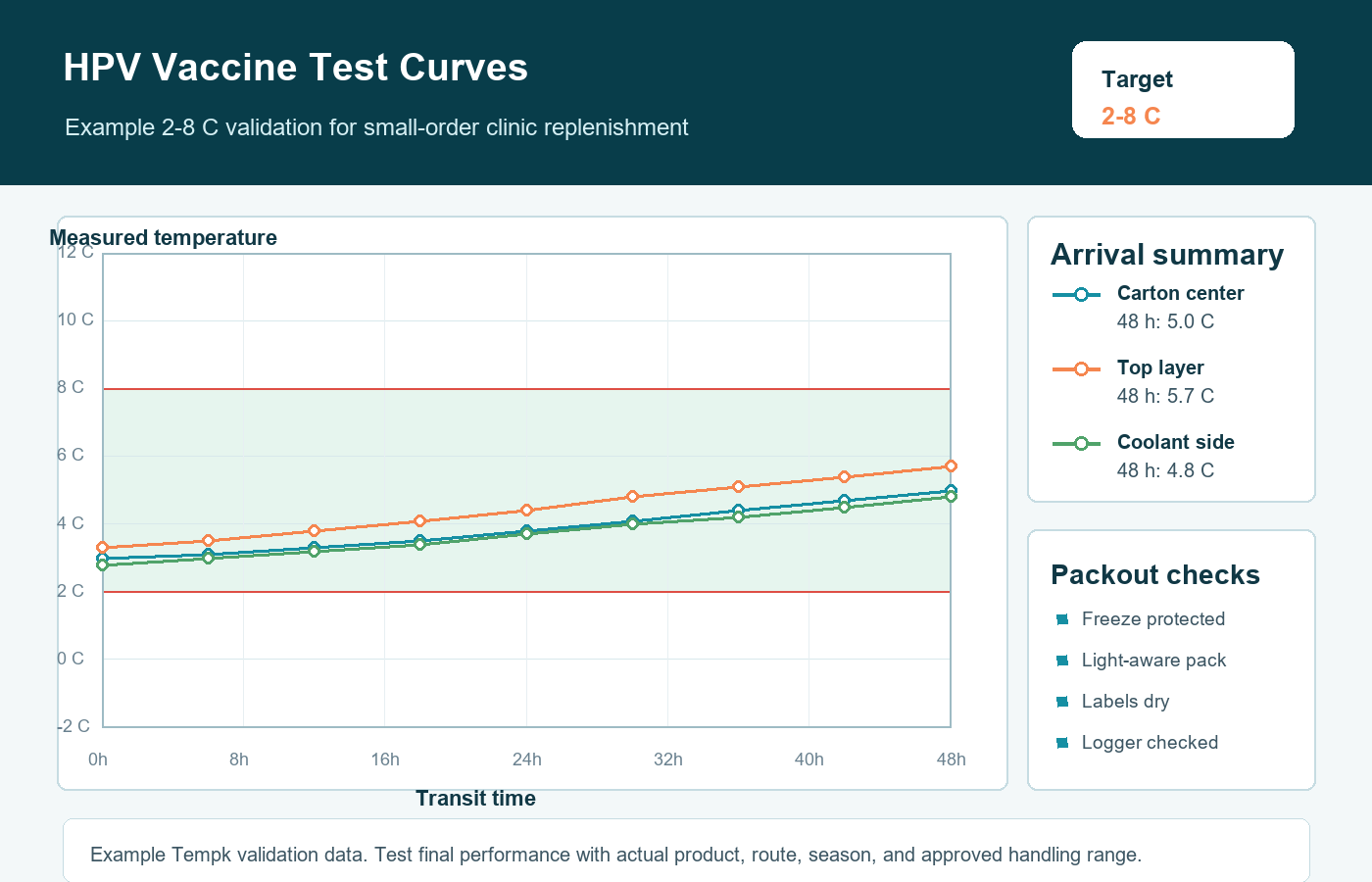
Courbe de validation et réception de preuves
Examinez la courbe avec la charge utile réelle du vaccin, masse de liquide de refroidissement, taille de l'expéditeur, durée de l'itinéraire, et assaisonner. Pour les vaccins, la température minimale et l'enregistrement de réception sont aussi importants que la température finale.
Pages connexes pour la planification des emballages
Catégorie vaccinsVaccins contre la grippeVaccins contre l'hépatite BGuide du vaccin contre la rageBoîtes médicales sous chaîne du froid pour les expéditions de vaccins contre le VPHPacks PCM et briques de glace pour les expéditions de vaccins contre le VPHExpéditeurs isolés VIP pour les expéditions de vaccins contre le VPHOutils de la chaîne du froidContacter Tempk
Notes d'itinéraire pratiques
Protégez les cartons de vaccin contre le VPH lors des itinéraires cliniques multi-sites
Les expéditions de vaccins contre le VPH soutiennent souvent le réapprovisionnement programmé des cliniques pour adolescents ou des pharmacies.. L'emballage doit rester stable malgré des fenêtres de réception courtes et des manipulations répétées..
Où ce produit échoue habituellement
Les principaux risques sont le contact gelé, transfert retardé de la clinique, éraflures des cartons, et le personnel laissant l'expéditeur fermé trop longtemps après la réception.
Configuration de l'emballage à tester en premier
Conservez les cartons à la verticale dans un manchon de charge utile avec un tampon sur chaque côté orienté vers le liquide de refroidissement.. Ajoutez des instructions de réception claires afin que la clinique déplace rapidement les cartons vers la réfrigération..
Choix de liquide de refroidissement
Utiliser 2 à 8 C PCM ou packs de gel conditionnés. N'ajoutez pas de sachets congelés directement à côté des cartons de vaccin contre le VPH pour prolonger la durée.
Contrôle de validation d'itinéraire
Exécutez l'itinéraire avec le nombre réel de cartons et le temps de séjour à la clinique. Vérifier les données de l'enregistreur, état du carton, et le délai entre la livraison et la mise en réfrigérateur.
Détails de l'emballage
Les expéditions de vaccins contre le VPH doivent être prêtes à être reçues en clinique
Cas d'utilisation
Les livraisons de vaccins contre le VPH sont souvent effectuées dans des cliniques, pharmacies, ou sites de vaccination pour adolescents où le personnel peut recevoir plusieurs cartons à la fois. L'expéditeur doit être facile à ouvrir, avec des cartons de vaccins clairement séparés du liquide de refroidissement et des instructions visibles immédiatement.
Choix du packaging
Utiliser 2 à 8 C PCM ou packs de gel correctement conditionnés, avec des entretoises sur chaque côté orienté vers le liquide de refroidissement. N'ajoutez pas de paquets congelés supplémentaires à côté des cartons pour prolonger la durée; cela peut créer un risque de gel avant que l'itinéraire ne tombe en panne en raison de la chaleur.
Ce que Tempk devrait valider
La validation Tempk doit inclure le nombre de cartons, retard de réception, ambiance été et hiver, et placement de l'enregistreur à l'intérieur de la charge utile. Vérifiez d’abord la température minimale, puis température maximale et état du carton.
Scénario d'emballage sur le terrain
Exemple de configuration pour les livraisons en clinique de vaccination contre le VPH
Pour les livraisons de vaccins contre le VPH aux cliniques ou aux pharmacies, concevoir la charge utile afin que le personnel puisse identifier et réfrigérer rapidement les cartons. Utilisez une entretoise sur chaque côté orienté vers le liquide de refroidissement, garder les cartons à la verticale, et placez l'enregistreur parmi les cartons plutôt que contre la compresse froide. Si un itinéraire comprend plusieurs arrêts cliniques, tester le délai de réception le plus long et la charge utile la plus petite. Utiliser 2 à 8 C PCM ou packs de gel correctement conditionnés; ne résolvez pas la durée en ajoutant des paquets congelés non conditionnés à côté des cartons. Le contrôle de réception doit confirmer l'absence d'événement de gel et clarifier les instructions de transfert..
Prise en charge des emballages personnalisés
Besoin de cette voie construite autour de votre produit et de votre itinéraire?
Pour des tailles de carton fixes, limites de charge utile, exigences en matière de marque, voies saisonnières, ou des cibles de validation, Tempk peut adapter cette solution dans un emballage personnalisé pour la chaîne du froid.
Cette voie vaccinale doit-elle être vérifiée avant expédition?
Envoyer l'exigence d'étiquette du produit, volume de charge utile, type de destination, durée de l'itinéraire, conditions ambiantes, et rapport d'enregistreur requis. Tempk peut aider à comparer l'isolation, placement du liquide de refroidissement, et étapes de validation avant l'expédition.
Demander une révision de l'emballage