


Vaccins contre la grippe
Les expéditions saisonnières à grand volume doivent être stables 2-8 Manipulation C, réception rapide en clinique, contrôle d'identité des cartons, et protection contre le contact direct avec le gel gelé.
La plupart des itinéraires de colis de vaccins de routine sont prévus autour 2-8 C, mais la véritable décision en matière d'emballage n'est pas seulement la température. Les flacons et cartons doivent être protégés du gel, gain de chaleur, dommages à l'étiquette, contact liquide de refroidissement, long temps de transfert, et des retards de réception.
Pour la distribution des vaccins, un emballage plus fort n'est pas toujours un emballage plus froid. De nombreux vaccins réfrigérés nécessitent un stockage stable 2-8 Environnement C et doit être tenu à l’écart de tout contact direct avec le gel congelé. Tempk construit le package autour du conditionnement du liquide de refroidissement, épaisseur d'isolation, support flacon/carton, et la preuve d'itinéraire dont le récepteur a besoin.
Les expéditions saisonnières à grand volume doivent être stables 2-8 Manipulation C, réception rapide en clinique, contrôle d'identité des cartons, et protection contre le contact direct avec le gel gelé.
Plus petit, les colis de plus grande valeur doivent être protégés contre le gel, protection du carton d'origine, clarté de l'étiquette, et une manipulation sensible à la lumière pendant le réapprovisionnement de la clinique.
Les vaccins avec adjuvant nécessitent une forte prévention contre le gel, liquide de refroidissement conditionné, support de flacon, et une preuve claire de la température à la réception.
| Itinéraire du produit | Intention de température | Configuration de l'emballage | Gamme préliminaire de liquide de refroidissement | Chèque à réception |
|---|---|---|---|---|
| Réapprovisionnement des cliniques de vaccination contre la grippe | 2-8 C, éviter le gel lors des pics de volume saisonniers. | Carton isotherme ou expéditeur EPP, carton du flacon au centre, packs de gel conditionnés ou 5 C PCM séparé par une carte tampon. | À propos 1.0-2.5 kg de packs de gel conditionnés ou de PCM pour un 1-4 L charge utile réfrigérée sur 8-24 voies h. | Enregistrement de l'enregistreur, sécheresse du carton du flacon, clarté de l'étiquette, emplacement du liquide de refroidissement, et temps hors stockage. |
| Colis de vaccin contre le VPH ou transfert en clinique | 2-8 C avec un gel fort et une manipulation sensible à la lumière. | Cartons d'origine protégés dans un plateau intérieur rigide, liquide de refroidissement sur les côtés/en haut, aucune surface directement gelée sur le carton. | À propos 1.2-3.2 kg de packs de gel conditionnés ou PCM pour 12-36 voies h, ajusté en fonction de la taille de l'expéditeur et de la saison. | Température minimale, carton écrasé, état de l'étiquette, exposition à la lumière lors de la manipulation, et état restant du liquide de refroidissement. |
| Distribution du vaccin contre l'hépatite B | 2-8 C, avec une attention particulière à la prévention du gel. | Charge utile centrale tamponnée, liquide de refroidissement conditionné, couche absorbante ou de séparation où la condensation peut affecter les cartons. | À propos 1.0-3.0 kg de packs de gel conditionnés ou PCM pour 8-36 voies h; éviter que le gel congelé non conditionné ne touche la charge utile. | Toute lecture inférieure à zéro, humidité du flacon/carton, mouvement du produit, et heure de transfert documentée. |
Ces gammes sont des gammes de planification pour la discussion sur l'emballage, pas de critères de publication. L'emballage final doit être confirmé par l'étiquette du vaccin., profil d'itinéraire, Taille de la charge utile, enregistreur de température, et les exigences de manutention locales.
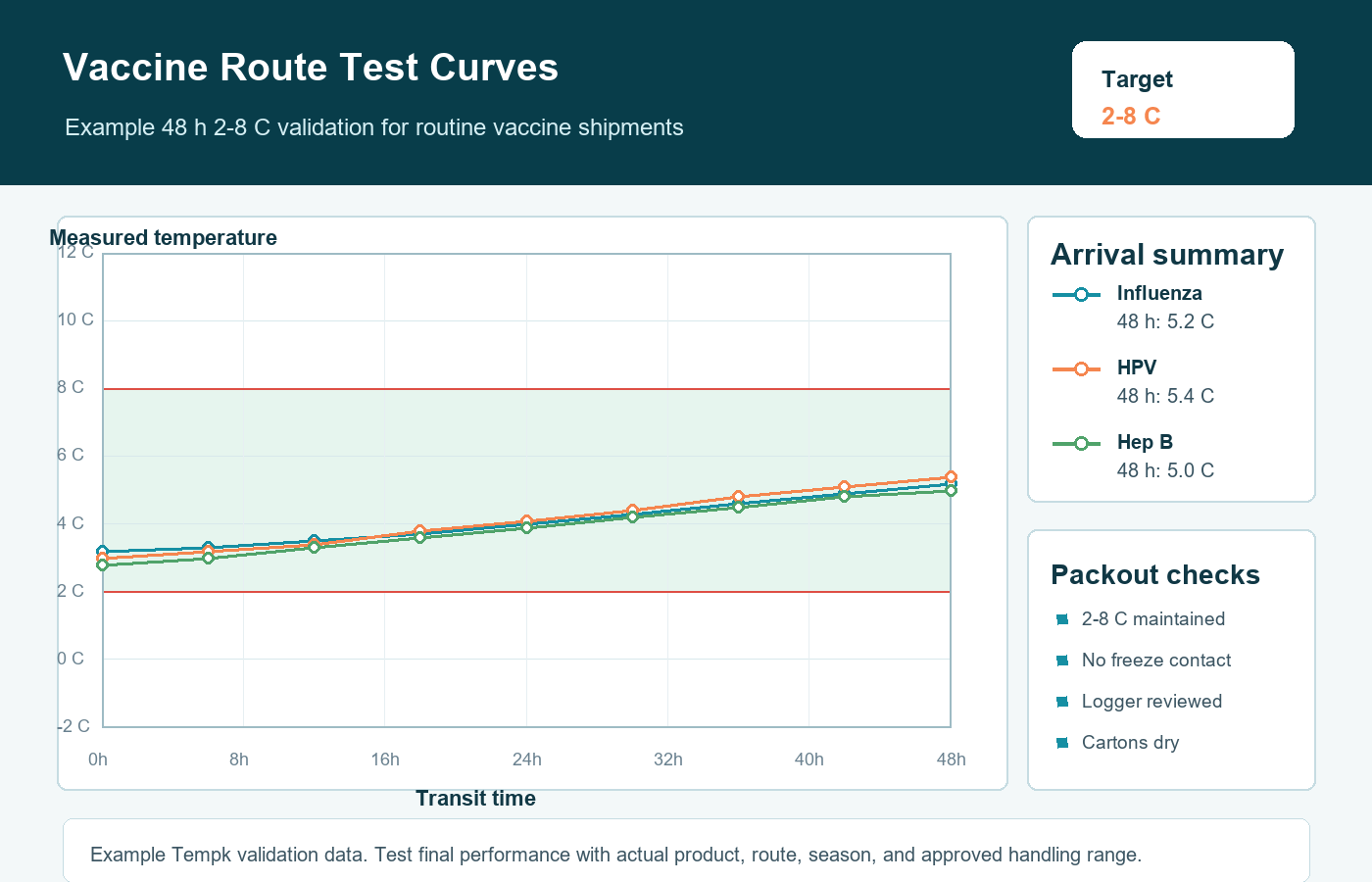
Utiliser la courbe de validation avec les contrôles de réception des produits. L’emballage des vaccins doit être jugé en fonction de l’historique des températures, évitement du gel, état du carton, et avec quelle facilité le destinataire peut confirmer l'expédition.
Pour les produits qui n'ont pas encore besoin d'une page de solution dédiée, ces guides maintiennent le centre de solutions utile sans créer trop de pages lourdes de maintenance.
Utiliser cet article lorsque le produit ne fait pas partie des trois pages dédiées aux solutions vaccinales, ou lorsque le couloir nécessite une note d'emballage distincte spécifique au vaccin.
Utiliser cet article lorsque le produit ne fait pas partie des trois pages dédiées aux solutions vaccinales, ou lorsque le couloir nécessite une note d'emballage distincte spécifique au vaccin.
Utiliser cet article lorsque le produit ne fait pas partie des trois pages dédiées aux solutions vaccinales, ou lorsque le couloir nécessite une note d'emballage distincte spécifique au vaccin.
Utilisez ces pages lorsque la voie, température ambiante, ou la sélection du liquide de refroidissement nécessite une deuxième vérification rapide avant le test.
La plupart des vaccins de routine sont plus vulnérables au gel qu’aux températures légèrement fraîches. Le plan d'emballage doit conserver 2 à 8 C tout en évitant le contact direct du froid avec les flacons ou les cartons.
Geler l'exposition, retards d'ouverture de la clinique, formats de cartons mélangés, et un mauvais placement des enregistreurs sont les principales raisons pour lesquelles un paquet de vaccins échoue à la validation.
Utiliser du liquide de refroidissement conditionné, un panier de produits, et une séparation claire entre le liquide de refroidissement et les cartons de vaccins. Gardez l'enregistreur de données dans la zone de charge utile, pas contre le liquide de refroidissement.
Utiliser 2 à 8 C PCM ou packs de gel correctement conditionnés. Évitez la glace carbonique à moins que le produit ne soit spécifiquement étiqueté et validé pour le transport congelé..
Valider les voies d'été et d'hiver séparément. La réception doit vérifier la position de l'enregistreur, état du carton, température minimale, et temps hors réfrigération.
Pour les vaccins de routine, la première question de conception n'est généralement pas de savoir comment ajouter plus de refroidissement, mais comment éviter le gel en maintenant 2 à 8 C. La charge utile doit être placée à l'intérieur d'une cavité protégée entourée d'un liquide de refroidissement conditionné ou d'un PCM qualifié..
Les couloirs d'hiver nécessitent une attention particulière, car un expéditeur qui réussit un test de saison chaude peut encore trop refroidir les cartons lors du transfert à l'extérieur.. L'emplacement de l'enregistreur doit représenter les cartons de vaccins, ce n'est pas le mur le plus froid de l'expéditeur.
Tempk devrait valider la température minimale, température maximale, nombre de charges utiles, conditionnement du liquide de refroidissement, et retard de réception. Le contrôle d'acceptation doit inclure les données de l'enregistreur, état du carton, et si le personnel de la clinique peut déballer rapidement.
Prise en charge des emballages personnalisés
Pour des tailles de carton fixes, limites de charge utile, exigences en matière de marque, voies saisonnières, ou des cibles de validation, Tempk peut adapter cette solution dans un emballage personnalisé pour la chaîne du froid.
Partagez le type de vaccin, volume de charge utile, taille de l'expéditeur, durée de la voie, conditions ambiantes, et exigeait la réception des chèques. Tempk peut aider à comparer l'isolation, masse de liquide de refroidissement, placement du liquide de refroidissement, et le plan de validation avant expédition en direct.
Demander une révision de l'emballage