


Intention de températurePlanifier 2-8 C sauf si l'étiquette du produit exige quelque chose de différent; protéger contre la chaleur et le gel.
Solution d'emballage pour la chaîne du froid des vaccins contre la grippe
Les expéditions de vaccins contre la grippe sont souvent saisonnières, sensible au temps, et répété dans de nombreuses destinations cliniques. L'emballage doit être facile à construire de manière cohérente pour les équipes de l'entrepôt., tout en gardant les cartons de vaccins à 2-8 C et loin du contact direct avec le liquide de refroidissement gelé.
Ce que le package doit contrôler
Règle du liquide de refroidissementUtilisez des packs de gel conditionnés ou 5 C PCM avec une couche tampon. Ne placez pas de gel congelé non conditionné directement contre les cartons de vaccins..
Focus sur l'emballageEmballage répétable, identité du carton, étiquettes sèches, et une réception rapide lors des pics de volume saisonniers.
Choisissez le pack par condition d'itinéraire
| État de l'itinéraire | Configuration de l'emballage | Gamme préliminaire de liquide de refroidissement | Réception du chèque |
|---|---|---|---|
| Courrier le jour même ou local, 4-12 h | Carton isotherme, plateau de charge utile central, liquide de refroidissement latéral avec panneau tampon. | 0.6-1.2 kg de packs de gel conditionnés ou de PCM pour un 1-3 Charge utile L. | Gardez la sonde de l'enregistreur à proximité de la charge utile, pas contre le liquide de refroidissement. |
| Itinéraire des colis de la clinique, 12-24 h | PPE ou carton isotherme, liquide de refroidissement supérieur/latéral, couche d'espacement au-dessus des cartons. | 1.2-2.5 kg de packs de gel conditionnés ou de PCM pour un 1-4 Charge utile L. | Vérifier la température minimale, sécheresse du carton, et heure d'arrivée avant stockage. |
| Itinéraire de réapprovisionnement plus long, 24-36 h | Isolation plus épaisse, liquide de refroidissement équilibré sur les côtés/en haut, cavité centrale de charge utile. | 2.5-4.0 kg de packs de gel conditionnés ou PCM, ajusté par voie et ambiant. | Si l'itinéraire s'approche 0 C, augmenter le tampon avant d'ajouter plus de liquide de refroidissement. |
Utilisez ces plages comme point de départ pour l’examen des emballages. Confirmez la masse finale du liquide de refroidissement avec l'étiquette du produit, taille de l'expéditeur, durée de l'itinéraire, profil ambiant, et un test d'enregistreur de température qualifié.
Comment Tempk construirait l'expédition
Conception pour un emballage répété
Les routes de la grippe saisonnière impliquent souvent de nombreux envois similaires. Utilisez un schéma de chargement fixe et des positions claires pour les liquides de refroidissement afin que les équipes de l'entrepôt n'improvisent pas.
Protéger les cartons des surfaces gelées
Conservez les cartons de vaccins au centre avec du carton ondulé., mousse, ou séparateurs moulés entre le produit et le liquide de refroidissement.
Contrôler la condensation
Utilisez des doublures sèches ou des pochettes en carton lorsque le carton et les étiquettes sont importants pour la réception et les contrôles d'inventaire de la clinique..
Valider les voies de haute saison
Testez les itinéraires probables les plus chauds et les plus froids, puis confirmez le placement de l'enregistreur, heure de réception, et état restant du liquide de refroidissement.
Points de défaillance courants à éviter
Le but n'est pas seulement une glacière. Le récepteur a besoin d'un nettoyage, lisible, expédition documentée qui est restée dans la plage réfrigérée requise.
- Excursion de gel causée par des packs de gel non conditionnés touchant des cartons.
- Arrivée au chaud après un long séjour à quai ou un retard du week-end.
- Cartons mouillés ou étiquettes illisibles à cause de la condensation.
- Emballage incohérent lorsque le volume des commandes saisonnières augmente.
Courbe de validation et réception de preuves
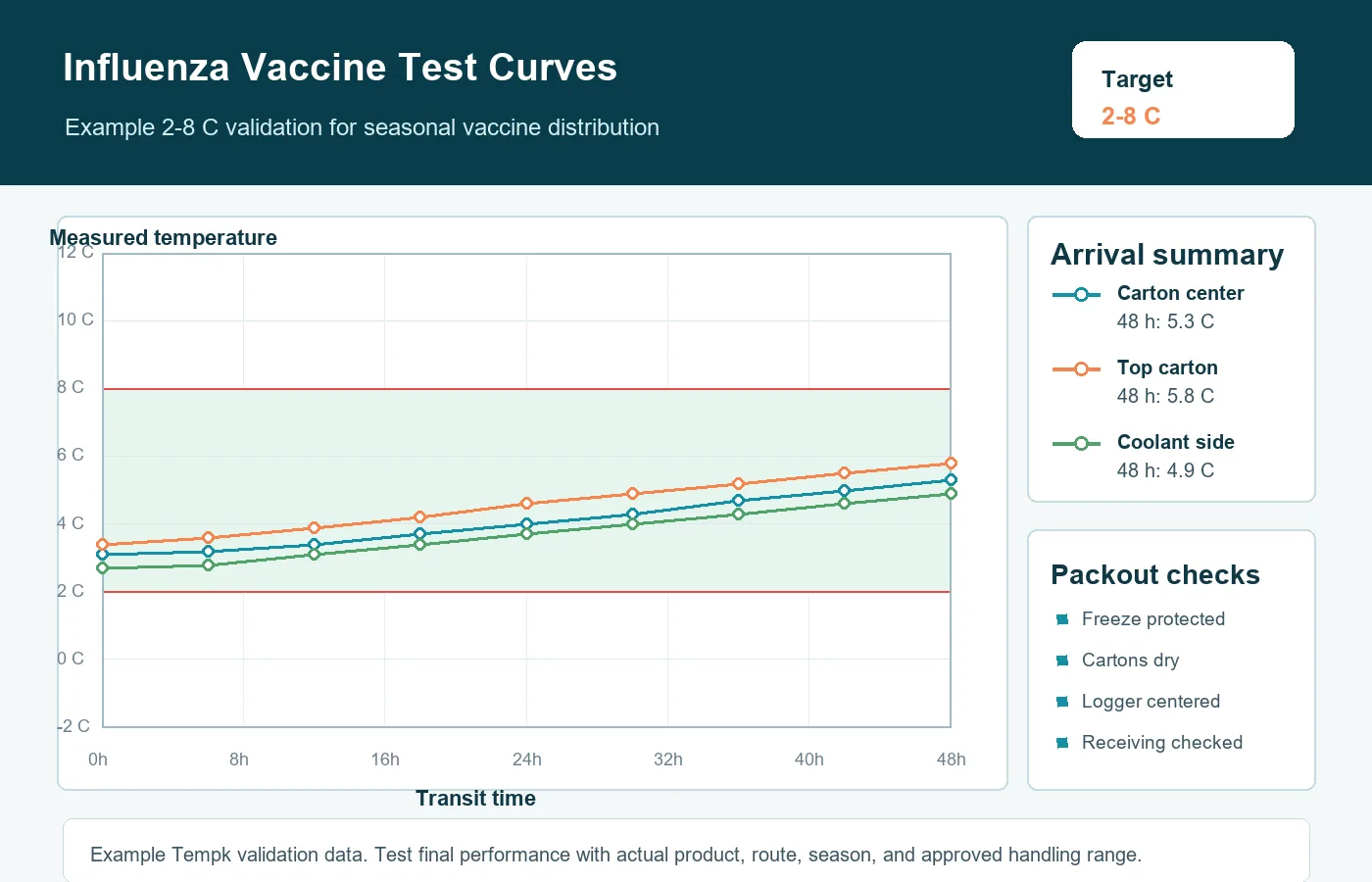
Examinez la courbe avec la charge utile réelle du vaccin, masse de liquide de refroidissement, taille de l'expéditeur, durée de l'itinéraire, et assaisonner. Pour les vaccins, la température minimale et l'enregistrement de réception sont aussi importants que la température finale.
Pages connexes pour la planification des emballages
Catégorie vaccinsVaccins contre le VPHVaccins contre l'hépatite BGuide du vaccin contre la COVID-19Medical cold-chain boxes for influenza vaccine shipmentsPCM packs and ice bricks for influenza vaccine shipmentsVIP insulated shippers for influenza vaccine shipmentsOutils de la chaîne du froidContacter Tempk
Notes d'itinéraire pratiques
Planifier l'emballage des vaccins contre la grippe en fonction du volume saisonnier
Les itinéraires de vaccination contre la grippe atteignent souvent leur maximum rapidement avant la saison des cliniques. Le pack doit être reproductible 2 à 8 Performances C sur un plus grand nombre de colis quotidiens et plusieurs destinations cliniques.
Où ce produit échoue habituellement
Les pannes saisonnières incluent un conditionnement précipité du liquide de refroidissement, cartons trop serrés, alarmes de gel en hiver, et des excursions chaleureuses pendant la réception à la clinique.
Configuration de l'emballage à tester en premier
Utilisez un panier de produits ou un puits de charge utile ondulé entouré de packs de gel conditionnés.. Laissez suffisamment d’espace pour que les cartons de vaccins ne soient pas poussés contre la paroi du liquide de refroidissement.
Choix de liquide de refroidissement
Utiliser des produits qualifiés 2 à 8 Packs C ou packs de gel conditionnés pour les itinéraires de nuit et de deux jours. Ajoutez une protection hivernale lorsque les voies incluent des conditions ambiantes glaciales.
Contrôle de validation d'itinéraire
Testez le nombre de cartons le plus élevé et le nombre de cartons le plus petit. Placez l'enregistreur parmi les cartons de vaccins et examinez les températures minimales et maximales..
Détails de l'emballage
Les programmes de vaccination contre la grippe nécessitent un emballage saisonnier reproductible
Cas d'utilisation
L’expédition des vaccins contre la grippe s’effectue souvent par vagues saisonnières, l'emballage doit donc être facile à répéter pour le personnel de l'entrepôt. Utiliser un processus de conditionnement du liquide de refroidissement fixe, une cavité de charge utile définie, et des instructions d'emballage qui ne changent pas selon l'opérateur.
Choix du packaging
Pour le réapprovisionnement des petites cliniques, testez le nombre minimum de cartons, car une cavité de charge utile sous-remplie peut trop refroidir. Pour les grandes commandes, testez le nombre maximum de cartons, car les charges utiles denses peuvent se réchauffer lentement mais peuvent cacher des points chauds près du sommet.
Ce que Tempk devrait valider
Tempk peut créer des profils ambiants chauds et froids pour le même expéditeur. Le chèque de réception doit confirmer 2 à 8 Résultats de l'enregistreur, pas d'alarme de gel, sécheresse du carton, et transfert rapide au réfrigérateur.
Scénario d'emballage sur le terrain
Exemple de configuration pour le réapprovisionnement en vaccins contre la grippe saisonnière
Pour les programmes de vaccination contre la grippe, construire une station d'emballage reproductible. Utilisation conditionnée 2 à 8 Liquide de refroidissement C ou PCM qualifié, une cavité de charge utile fixe, et une séquence écrite du dossier que le personnel saisonnier peut suivre sans improviser. Testez à la fois un faible nombre de cartons et un nombre complet de cartons, car les expéditeurs sous-remplis peuvent trop refroidir et les expéditeurs trop remplis peuvent se réchauffer près du haut.. Inclure un profil hivernal pour le risque de gel et un profil chaud pour le retard de livraison en clinique. La réception doit vérifier le minimum de l'enregistreur, maximum de l'enregistreur, sécheresse du carton, et le délai de livraison au réfrigérateur.
Prise en charge des emballages personnalisés
Besoin de cette voie construite autour de votre produit et de votre itinéraire?
Pour des tailles de carton fixes, limites de charge utile, exigences en matière de marque, voies saisonnières, ou des cibles de validation, Tempk peut adapter cette solution dans un emballage personnalisé pour la chaîne du froid.
Cette voie vaccinale doit-elle être vérifiée avant expédition?
Envoyer l'exigence d'étiquette du produit, volume de charge utile, type de destination, durée de l'itinéraire, conditions ambiantes, et rapport d'enregistreur requis. Tempk peut aider à comparer l'isolation, placement du liquide de refroidissement, et étapes de validation avant l'expédition.
Demander une révision de l'emballage