


Vacunas contra la influenza
Los envíos estacionales de gran volumen necesitan estabilidad 2-8 manejo C, recepción clínica rápida, control de identidad del cartón, y protección contra el contacto directo con gel congelado.
La mayoría de las rutas habituales de paquetes de vacunas se planifican alrededor 2-8 do, pero la verdadera decisión sobre el envasado no es sólo la temperatura. Los viales y cajas deben protegerse de la congelación., ganancia de calor, daño en la etiqueta, contacto con refrigerante, largo tiempo de transferencia, y retrasos en la recepción.
Para la distribución de vacunas, un paquete más fuerte no siempre es un paquete más frío. Muchas vacunas refrigeradas necesitan un lugar estable. 2-8 Entorno C y debe mantenerse alejado del contacto directo con el gel congelado.. Tempk construye el paquete en torno al acondicionamiento del refrigerante, espesor de aislamiento, soporte para vial/cartón, y la evidencia de ruta que el receptor necesita.
Los envíos estacionales de gran volumen necesitan estabilidad 2-8 manejo C, recepción clínica rápida, control de identidad del cartón, y protección contra el contacto directo con gel congelado.
Menor, los paquetes de mayor valor necesitan protección contra congelación, protección del cartón original, claridad de la etiqueta, y manejo consciente de la luz durante el reabastecimiento de la clínica.
Las vacunas con adyuvante necesitan una fuerte prevención de congelación, refrigerante acondicionado, soporte para viales, y evidencia clara de temperatura al recibir.
| Ruta del producto | Intención de temperatura | Configuración de embalaje | Rango de refrigerante preliminar | Consultar al recibir |
|---|---|---|---|---|
| Reposición de clínicas de vacunación contra la influenza | 2-8 do, Evite la congelación durante los picos de volumen estacionales.. | Caja de cartón aislada o transportador de EPP, caja de viales en el centro, paquetes de gel acondicionados o 5 C PCM separado por placa de amortiguación. | Acerca de 1.0-2.5 paquetes de gel acondicionado de kg o PCM para un 1-4 L carga útil refrigerada encendida 8-24 h carriles. | Registro del registrador, sequedad del cartón del vial, claridad de la etiqueta, posición del refrigerante, y tiempo fuera de almacenamiento. |
| Paquete de vacuna contra el VPH o traslado a clínica | 2-8 C con fuerte congelación y manejo consciente de la luz. | Cajas originales protegidas en una bandeja interior rígida., refrigerante alrededor de los lados/parte superior, sin superficie congelada directamente en el cartón. | Acerca de 1.2-3.2 paquetes de gel acondicionado de kg o PCM para 12-36 h carriles, ajustado por tamaño y temporada del remitente. | Temperatura mínima, aplastamiento de cartón, condición de la etiqueta, exposición a la luz durante el manejo, y estado restante del refrigerante. |
| Distribución de vacuna contra la hepatitis B | 2-8 do, con especial atención a la prevención de heladas. | Carga útil central amortiguada, refrigerante acondicionado, Capa absorbente o divisoria donde la condensación puede afectar las cajas.. | Acerca de 1.0-3.0 paquetes de gel acondicionado de kg o PCM para 8-36 h carriles; Evite que el gel congelado no acondicionado toque la carga útil.. | Cualquier lectura bajo cero, humedad del vial/cartón, movimiento de producto, y tiempo de entrega documentado. |
Estos rangos son rangos de planificación para la discusión sobre empaques., no publicar criterios. El embalaje final debe confirmarse con la etiqueta de la vacuna., perfil de ruta, tamaño de carga útil, registrador de temperatura, y requisitos de manipulación locales.
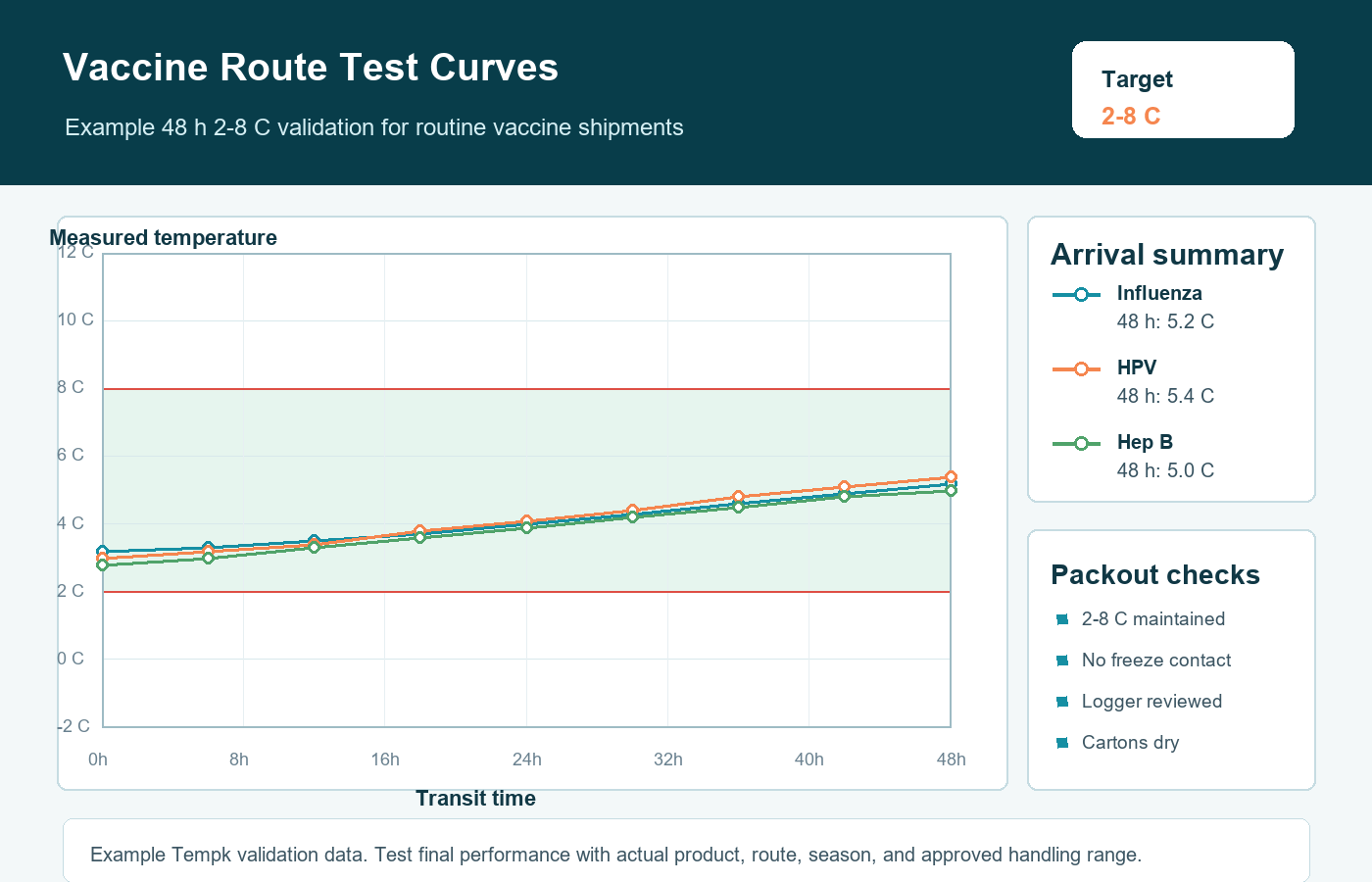
Utilice la curva de validación junto con los controles de recepción de productos.. Los envases de las vacunas deben juzgarse por el historial de temperaturas, evitar la congelación, condición del cartón, y con qué facilidad el destinatario puede confirmar el envío.
Para productos que aún no necesitan una página de solución dedicada, estas guías mantienen útil el centro de soluciones sin crear demasiadas páginas que requieren mucho mantenimiento.
Utilice este artículo cuando el producto no esté en una de las tres páginas dedicadas a soluciones de vacunas., o cuando el carril necesita una nota de embalaje específica de la vacuna por separado.
Utilice este artículo cuando el producto no esté en una de las tres páginas dedicadas a soluciones de vacunas., o cuando el carril necesita una nota de embalaje específica de la vacuna por separado.
Utilice este artículo cuando el producto no esté en una de las tres páginas dedicadas a soluciones de vacunas., o cuando el carril necesita una nota de embalaje específica de la vacuna por separado.
Utilice estas páginas cuando el carril, temperatura ambiente, o la selección del refrigerante necesita una segunda verificación rápida antes de realizar la prueba..
La mayoría de las vacunas de rutina son más vulnerables a la congelación que a condiciones de frío leve.. El plan de embalaje debe mantener 2 a 8 C y al mismo tiempo evita el contacto frío directo con viales o cajas.
Congelar la exposición, retrasos en la apertura de la clínica, tamaños de cartón mixtos, y la mala ubicación del registrador son las principales razones por las que un paquete de vacuna no pasa la validación.
Utilice refrigerante acondicionado, una cesta de productos, y separación clara entre los cartones de refrigerante y vacunas. Mantenga el registrador de datos en la zona de carga útil, no contra el refrigerante.
Usar 2 a 8 C PCM o paquetes de gel debidamente acondicionados. Evite el hielo seco a menos que el producto esté específicamente etiquetado y validado para el transporte congelado..
Validar carriles de verano e invierno por separado. La recepción debe verificar la posición del registrador, condición del cartón, temperatura mínima, y tiempo fuera de refrigeración.
Para vacunas de rutina, La primera pregunta de diseño no suele ser cómo añadir más refrigeración., pero cómo evitar la congelación mientras se sostiene 2 a 8 do. La carga útil debe ubicarse dentro de una cavidad protegida con refrigerante acondicionado o PCM calificado a su alrededor..
Los carriles de invierno necesitan atención especial porque un transportista que pasa una prueba de temporada cálida aún puede enfriar demasiado las cajas durante la entrega al aire libre.. La ubicación del registrador debe representar los cartones de vacunas., No es la pared más fría del cargador..
Tempk debería validar la temperatura mínima., temperatura máxima, recuento de carga útil, acondicionamiento del refrigerante, y retraso en la recepción. La verificación de aceptación debe incluir datos del registrador., condición del cartón, y si el personal de la clínica puede desempacar rápidamente.
Soporte de paquete personalizado
Para tamaños de cartón fijos, límites de carga útil, requisitos de marca, carriles estacionales, o objetivos de validación, Tempk puede adaptar esta solución a un paquete de cadena de frío personalizado.
Compartir el tipo de vacuna, volumen de carga útil, tamaño del listón, duración del carril, condición ambiental, y requirió recibir cheques. Tempk puede ayudar a comparar el aislamiento, masa refrigerante, colocación de refrigerante, y el plan de validación antes del envío en vivo.
Solicite una revisión del paquete