


Exécutez l'estimation du liquide de refroidissement
Utiliser le poids de la charge utile, taille de boîte, temps de parcours, et température saisonnière avant de finaliser le pack de gel ou la masse PCM.
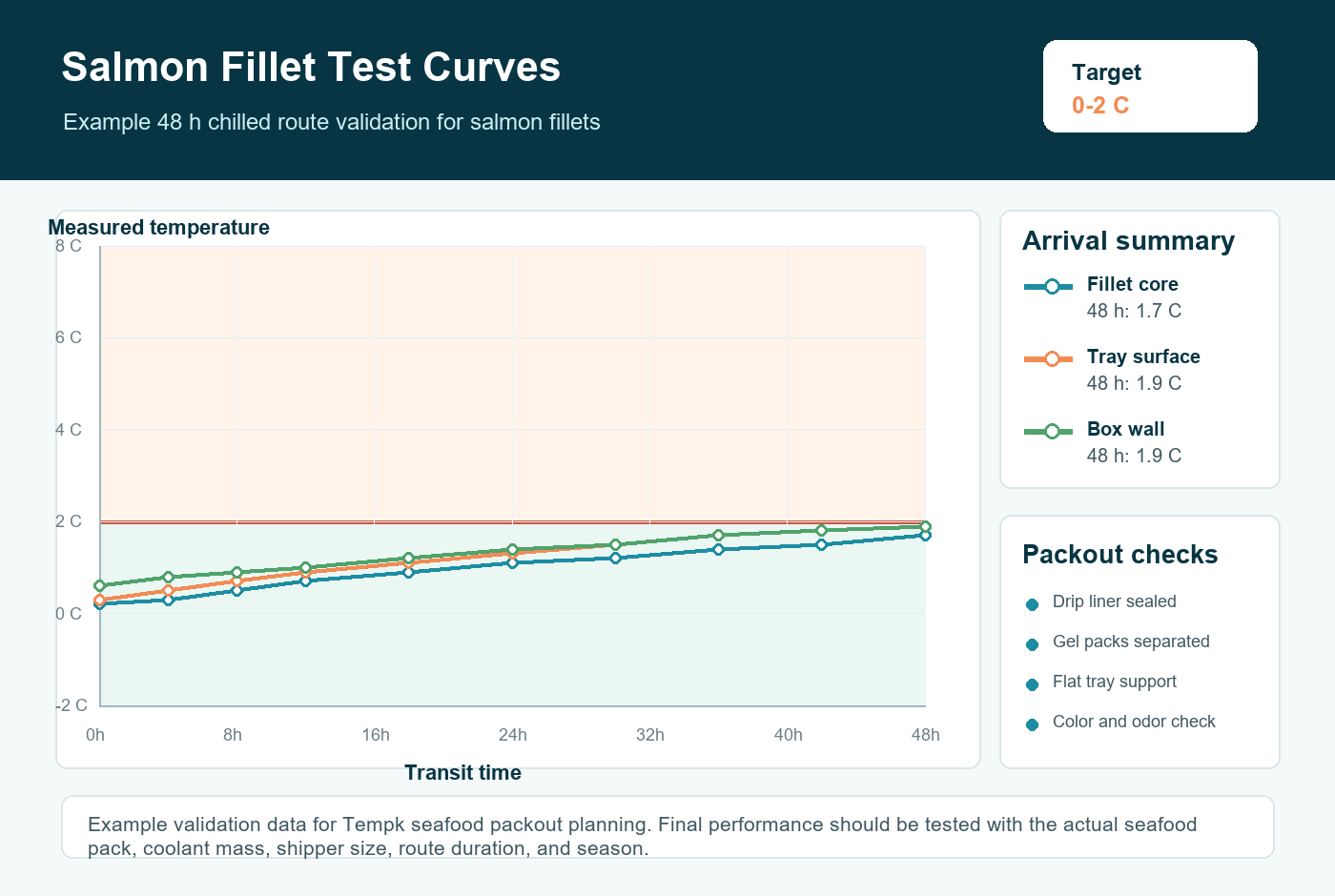
Les filets de saumon ont besoin d'une route froide qui protège leur texture, couleur, et propreté des cartons. L'emballage doit maintenir le filet à une température proche de la glace., séparer le liquide de refroidissement du pack de poisson, absorber la purge, et évitez les marques de pression causées par les packs de gel gelés ou les charges supérieures lourdes.
Les quantités de liquide de refroidissement ci-dessous constituent des plages de départ pour la planification.. Le package final doit être validé avec la charge utile exacte, taille de l'isolation, voie porteuse, et assaisonner.
| État de l'itinéraire | Intention de température | Configuration de l'emballage Tempk | Plage de planification du liquide de refroidissement | Emplacement du liquide de refroidissement |
|---|---|---|---|---|
| Échantillon de vente au détail ou livraison locale, 8-18 h | 0-2 C réfrigéré | Boîte EPP ou carton isotherme, doublure scellée, tampon absorbant, barquette ou emballage sous vide. | 0.6-1.2 kg de packs de gel conditionnés ou 0 C PCM pour 1-3 kg de charge utile. | Liquide de refroidissement latéral et périmétrique avec séparateur; garder la couche supérieure légère pour éviter la pression du filet. |
| Colis de fruits de mer pour la nuit, 18-36 h | 0-2 C avec séjour chaud limité | Isolation plus épaisse, doublure intérieure, couche absorbante, enregistreur dans l'espace aérien du produit. | 1.2-2.2 kg de packs de gel ou PCM pour 1-3 kg de charge utile. | Liquide de refroidissement supérieur et latéral séparé du produit; laisser un petit passage d'air autour de la chambre du produit. |
| Risque de chaleur ou de retard, 36-48 h | Voie réfrigérée validée | Isolation supérieure, espace libre réduit, double contrôle des fuites, vérification du niveau de service. | 2.2-3.8 kg de packs de gel ou PCM pour 1-3 kg de charge utile. | Évitez le contact direct. Envisagez un volume de boîte plus petit, service de transporteur plus rapide, ou taille d'expéditeur pré-qualifié. |
Pour une première estimation plus serrée, Utiliser le Calculateur de banquise puis comparez les familles de liquides de refroidissement dans le Liquide de refroidissement & Référence PCM.
De petits changements de présentation peuvent décider si le destinataire voit un colis de fruits de mer propre et réfrigéré ou un colis humide., sous pression, produit partiellement congelé.
Charger le saumon déjà réfrigéré. Plateaux chauds, doublures, et les cartons peuvent consommer du liquide de refroidissement avant que le colis ne quitte l'origine.
Utilisez un revêtement anti-fuite et un tampon absorbant pour que la purge n'atteigne pas le carton extérieur ou l'étiquette destinée au client..
Placez des packs de gel ou du PCM autour de la paroi latérale et au-dessus de la chambre uniquement avec un séparateur. Évitez que les emballages surgelés lourds ne se pressent sur les bords des filets..
Enregistrer la température du produit, niveau d'égouttement, odeur, carton mouillé, état de l'étiquette, et toutes marques de gel avant de changer la masse de liquide de refroidissement.
Utilisez ces chèques de réception lors du réglage de la quantité de liquide de refroidissement, épaisseur d'isolation, ou séparation interne.
Utilisez la page produit pour la logique d'emballage, utilisez ensuite les outils pour dimensionner le premier pack d'essai avant un test de voie.
Utiliser le poids de la charge utile, taille de boîte, temps de parcours, et température saisonnière avant de finaliser le pack de gel ou la masse PCM.
Comparez les packs de gel congelés, packs de gel conditionnés, et 0 C PCM pour que le produit soit refroidi sans blessure directe par le gel.
Vérifier le temps de couloir, ramassage en direct, retard du dernier kilomètre, et processus de réception avant le lancement.
Partager le formulaire fruits de mer, poids de charge utile, taille de boîte, niveau de service, température d'origine, saison des voies, et fenêtre de réception. Tempk peut aider à comparer l'isolation, masse de liquide de refroidissement, placement, et étapes de validation.
Prise en charge des emballages personnalisés
Pour des tailles de carton fixes, limites de charge utile, exigences en matière de marque, voies saisonnières, ou des cibles de validation, Tempk peut adapter cette solution dans un emballage personnalisé pour la chaîne du froid.