


Filets de saumon
Protéger la texture réfrigérée, présentation côté peau, contrôle des gouttes, et la sécheresse du carton sans laisser les packs de gel congelés toucher directement le pack de poisson.
Les expéditions de fruits de mer échouent pour différentes raisons: les filets frais peuvent couler et perdre leur texture, les steaks de thon nécessitent un contrôle plus strict du maintien au chaud, les huîtres doivent rester froides sans geler, et les fruits de mer surgelés nécessitent un plan d'itinéraire surgelé distinct. Cette page permet de faire correspondre le type de fruits de mer à l'isolation, placement du liquide de refroidissement, contrôle de l'humidité, et validation de l'itinéraire.
Poisson frais, coquillages vivants, et les fruits de mer surgelés nécessitent un comportement de refroidissement différent. L'emballage doit protéger la température, humidité, fuite, odeur, et la pression du produit en même temps. For fully frozen lanes, voir frozen foods emballage chaîne du froid solutions.
Protéger la texture réfrigérée, présentation côté peau, contrôle des gouttes, et la sécheresse du carton sans laisser les packs de gel congelés toucher directement le pack de poisson.
Contrôler le temps chaud, couleur de la surface, transfert d'odeur, et marques de pression pour les programmes de thons sensibles à l'histamine qui transitent par des routes colis ou aériennes.
Conserver les huîtres au frais, humide, et protégé du gel, eau de fonte stagnante, force d'écrasement, et des étiquettes de coquillages illisibles.
Ces plages de planification aident à décider quel pack Tempk valider en premier. La masse finale du liquide de refroidissement doit être testée avec la charge utile réelle, taille de boîte, température des voies, et niveau de service.
| Route des fruits de mer | Cible commune | Structure de l'emballage | Point de départ du liquide de refroidissement | Regardez d'abord |
|---|---|---|---|---|
| Filets frais, 8-18 h | Tenez-vous près de 0-2 C for quality while staying within the shipper’s sécurité alimentaire program. | Revêtement de fuite, tampon absorbant, barquette de produit ou sac sous vide, liquide de refroidissement latéral/périmétrique, PPE ou carton isotherme. | À propos 0.6-1.2 kg de packs de gel conditionnés ou 0 C PCM pour 1-3 kg de charge utile. | Marques de gel directes, goutte, cartons humides, transfert d'odeur. |
| Poisson frais, 18-36 h | Itinéraire presque glacé avec un séjour moins chaud au ramassage et à la livraison. | Isolation plus forte, doublure intérieure scellée, liquide de refroidissement supérieur et latéral séparé, enregistreur dans l'espace aérien du produit. | À propos 1.2-2.4 kg de packs de gel ou PCM pour 1-3 kg de charge utile. | Contact liquide de refroidissement, compression de boîte, température de réception. |
| Coquillages vivants, 8-30 h | Froid et humide, mais pas gelé ou immergé dans l'eau de fonte. | Conception d'expéditeur respirante ou non hermétique selon les besoins, doublure humide, protection de la coque, liquide de refroidissement séparé au-dessus ou à côté du produit. | À propos 0.5-1.8 kg de packs de gel conditionnés, ajusté au volume et à la saison des coquillages. | Blessure due au gel, eau stagnante, bris de coque, lisibilité des balises. |
| Fruits de mer gelés | -18 C ou inférieur lorsque l'itinéraire est spécifié comme gelé. | Expéditeur gelé, plan de glace carbonique ou de liquide de refroidissement gelé, trou de vapeur, contrôles des étiquettes et du transporteur. | Utiliser la planification de la glace carbonique par taille de boîte, charge utile, temps de parcours, et limite du transporteur. | Sublimation sur glace carbonique, marquage réglementaire, dégel au dernier kilomètre. |
Utilisez-les comme plages de planification, puis valider. Pour les palettes de fruits de mer surgelés, voir Palettes de fruits de mer surgelés.
Une vérification de l'acheminement des produits de la mer doit montrer à la fois le contrôle de la température et l'état du produit à la réception.: goutte, odeur, pression de coquille ou de filet, état de l'étiquette, et si le liquide de refroidissement est resté séparé du produit.
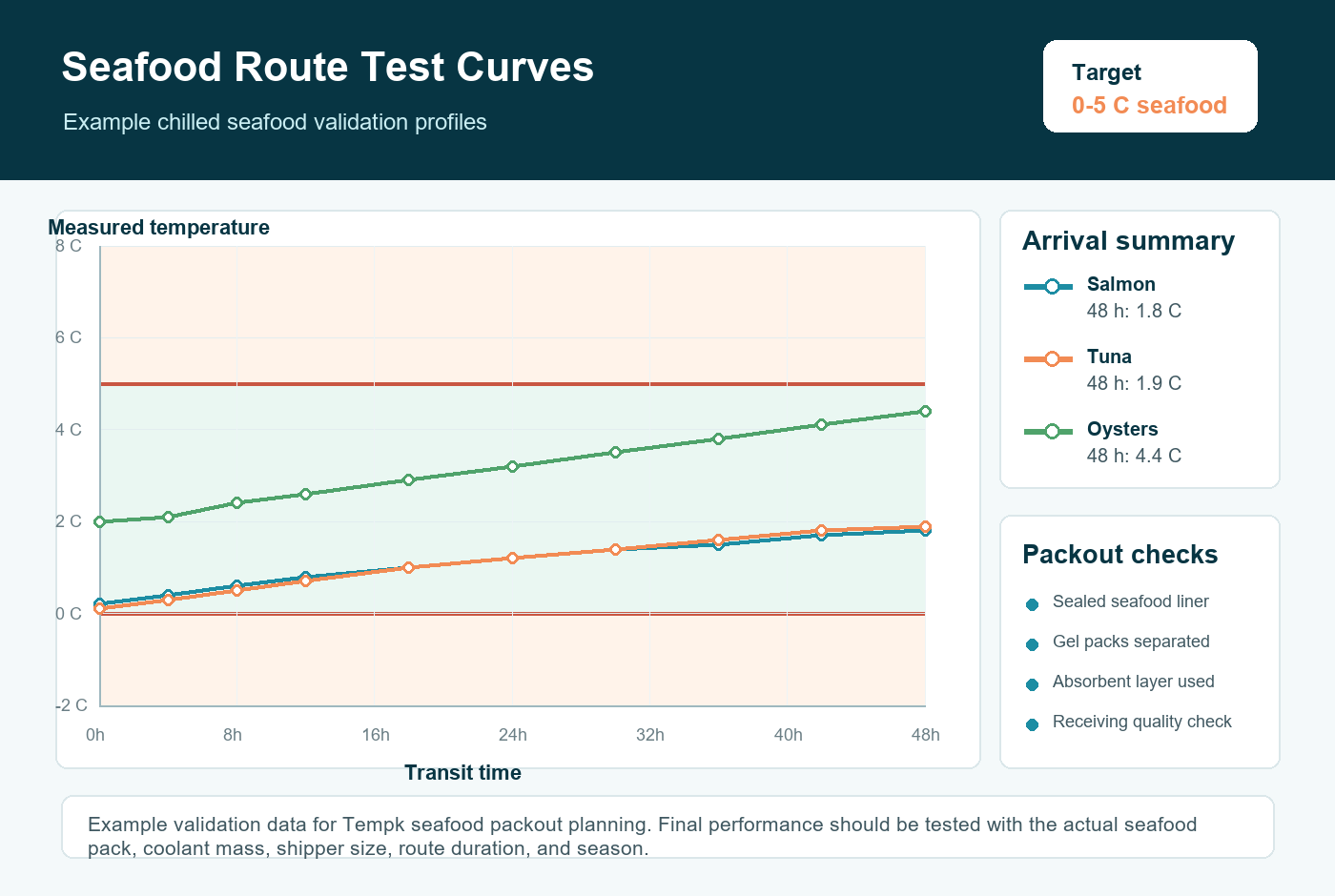
Utilisez ces notes de produit lorsque le type de fruits de mer ne fait pas partie des trois pages prioritaires mais nécessite néanmoins une humidité différente., pression, ou décisions de placement du liquide de refroidissement.
Pour les petits programmes de produits de la mer qui nécessitent néanmoins des notes de manipulation spécifiques au produit, consultez le guide d'emballage avant de créer le test de voie.
Pour les petits programmes de produits de la mer qui nécessitent néanmoins des notes de manipulation spécifiques au produit, consultez le guide d'emballage avant de créer le test de voie.
Pour les petits programmes de produits de la mer qui nécessitent néanmoins des notes de manipulation spécifiques au produit, consultez le guide d'emballage avant de créer le test de voie.
Pour les petits programmes de produits de la mer qui nécessitent néanmoins des notes de manipulation spécifiques au produit, consultez le guide d'emballage avant de créer le test de voie.
Pour les petits programmes de produits de la mer qui nécessitent néanmoins des notes de manipulation spécifiques au produit, consultez le guide d'emballage avant de créer le test de voie.
Effectuer un premier calcul, choisir la famille de liquide de refroidissement, puis validez l'itinéraire avec le pack de fruits de mer lui-même. Pour les voies colis et express, voir solutions de chaîne du froid pour la livraison de colis et express.
Programmes associés: Coffrets d'abonnement aux fruits de mer et toutes les solutions chaîne du froid.
Partager le formulaire fruits de mer, poids de charge utile, taille de boîte, niveau de service, température d'origine, saison des voies, et fenêtre de réception. Tempk peut aider à comparer l'isolation, masse de liquide de refroidissement, placement, et étapes de validation.
Les expéditions de fruits de mer ne doivent pas utiliser une recette de boîte fixe pour chaque produit. Commencer par 0-2 C contrôle réfrigéré pour les fruits de mer frais ou -18 Contrôle C pour les formats figés, puis séparez les produits par charge thermique, résistance de l'emballage, et comment ils sont reçus. Pour les programmes mixtes, Tempk compare généralement un itinéraire local court, un itinéraire de colis de nuit, et la saison la plus chaude prévue avant de confirmer l'expéditeur.
Utilisez une doublure résistante aux fuites, couche absorbante, expéditeur isolé, et carton extérieur avec contrôle d'orientation clair. Le plan de refroidissement devrait commencer par des packs de glace en gel pour les fruits de mer réfrigérés, glace carbonique ou PCM congelé uniquement lorsque le produit est vendu congelé. Lorsque la charge utile contient des cartons de vente au détail délicats, texture douce, matériel vivant, ou documentation médicale, protéger d'abord la charge utile, puis ajouter de la capacité de refroidissement. Si l'expédition est retardée au moment de l'emballage, remettre, douane, ou transfert à quai, le profil de l'itinéraire doit être revérifié au lieu de simplement augmenter le poids du liquide de refroidissement.
La validation doit inclure la vérification de la perte au goutte-à-goutte, contrôle des odeurs, sécheresse superficielle, et l'enregistreur enregistre au point le plus chaud du produit. Un test utile enregistre le point de charge utile le plus chaud, le point le plus froid près du liquide de refroidissement, et l'état de réception après manipulation. Cela donne à l'équipe des opérations une instruction pratique sur l'emballage., pas seulement un tableau de température.
Prise en charge des emballages personnalisés
Pour des tailles de carton fixes, limites de charge utile, exigences en matière de marque, voies saisonnières, ou des cibles de validation, Tempk peut adapter cette solution dans un emballage personnalisé pour la chaîne du froid.