


Es kering depletion
Jalur yang tampak pendek dapat kehilangan es kering cepat saat cuaca panas, transfer pesawat, atau waktu tunggu penerimaan yang panjang.
Vektor terapi gen sering kali bergerak dalam keadaan beku, beku suhu sangat rendah, or kriogenik lanes. Pengaturan yang tepat bergantung pada rentang label dan format botol: pengirim es kering mungkin cocok untuk satu jalur, sedangkan rute lain perlu tervalidasi dry shipper.
Pengiriman vektor memerlukan kontrol suhu dan kontrol fisik pada saat yang bersamaan. Rute tersebut harus mencegah pencairan, pembekuan ulang, gerakan botol, sebagai kerusakan kontak kering, dan masalah dokumen.
Jalur yang tampak pendek dapat kehilangan es kering cepat saat cuaca panas, transfer pesawat, atau waktu tunggu penerimaan yang panjang.
Pemeriksaan pintu terbuka berulang kali atau serah terima yang lambat dapat menghangatkan botol cukup untuk membuat pengecualian rute.
Rak longgar, kontak langsung es kering, dan dokumen yang basah beku dapat menyebabkan masalah penerimaan meskipun es kering masih ada.
| Kondisi rute | Tujuan suhu | Pengaturan kemasan | Perencanaan media pendingin atau dry shipper | Pemeriksaan penerimaan |
|---|---|---|---|---|
| Rute es kering, 0-24 H | Use the product-approved frozen or sangat rendah range and avoid pencairan during konfigurasi kemasan. | Pengirim es kering berventilasi, dukungan rak botol, es kering barrier, penyerap atau penahanan sekunder, dan selongsong dokumen yang dilindungi. | Untuk paket kecil, tes awal sering kali dimulai 3-7 kg adalah kering, lalu sesuaikan dengan suhu jalur, beban massal, dan aturan operator. | Kurva data Pencatat, remaining es kering, posisi botol, tidak ada dokumen basah, dan transfer freezer segera. |
| Rute es kering, 24-48 jam atau musim panas | Pertahankan rentang beku melalui pengambilan, transfer, risiko akhir pekan, dan menerima penundaan. | Pengirim berkapasitas lebih tinggi, penempatan es kering atas dan samping dengan pemisahan, tinjauan risiko rute, dan janji temu penerima. | Banyak uji coba kecil hingga menengah dimulai 8-15 kg adalah kering. Gunakan kalkulator es kering, kemudian validasi pengirim dan jalur sebenarnya. | Es kering remaining, no pencairan evidence, kondisi rak, integritas karton luar, dan menerima stempel waktu. |
| Kriogenik atau rute produk tertentu | Gunakan dry shipper yang tervalidasi bila label produk atau SOP mensyaratkan kondisi LN2. | Pengirim kering yang sudah diisi sebelumnya, vial kaset atau dukungan kanister, rantai kustodi records, segel tamper, and orientasi control. | Rencanakan berdasarkan cadangan waktu tunggu pengirim kering, bukan massa es kering. Jangan mengganti es kering dengan rute kriogenik kecuali pemilik produk menyetujuinya. | Status pengirim kering, catatan kustodian, orientasi, serah terima notes, dan perpindahan penyimpanan. |
Gunakan nilai-nilai ini sebagai titik awal untuk pengambilan sampel dan kutipan. Pendingin terakhir, PCM, es kering, isolasi, pengirim kering, pencatat data, dan pilihan handling harus tervalidasi dengan muatan sebenarnya, jalur, proses pembawa, musim, dan prosedur penerimaan.
Pilih es kering, sangat rendah, atau logika pengirim kering dari label produk dan SOP sebelum memilih kotak.
Gunakan penyangga rak dan pembatas agar vial tidak langsung ditekan ke dalam balok es kering atau pelet lepas.
Letakkan dokumen di wadah yang kering dan jauh dari zona es kering sehingga penerima dapat membaca label dan mengeluarkan dokumen.
Jalur terapi gen harus sampai ke freezer yang ditentukan, penerima terlatih, dan proses transfer terdokumentasi.
Ini adalah masalah yang terlihat dan operasional yang harus dikurangi oleh konfigurasi kemasan sebelum kiriman mencapai penerima.
Gunakan kurva tes sebagai perbandingan kerja, kemudian validasi dengan muatan sebenarnya, pengirim, konfigurasi pengirim pendingin atau kering, durasi jalur, profil lingkungan, dan proses penerimaan.
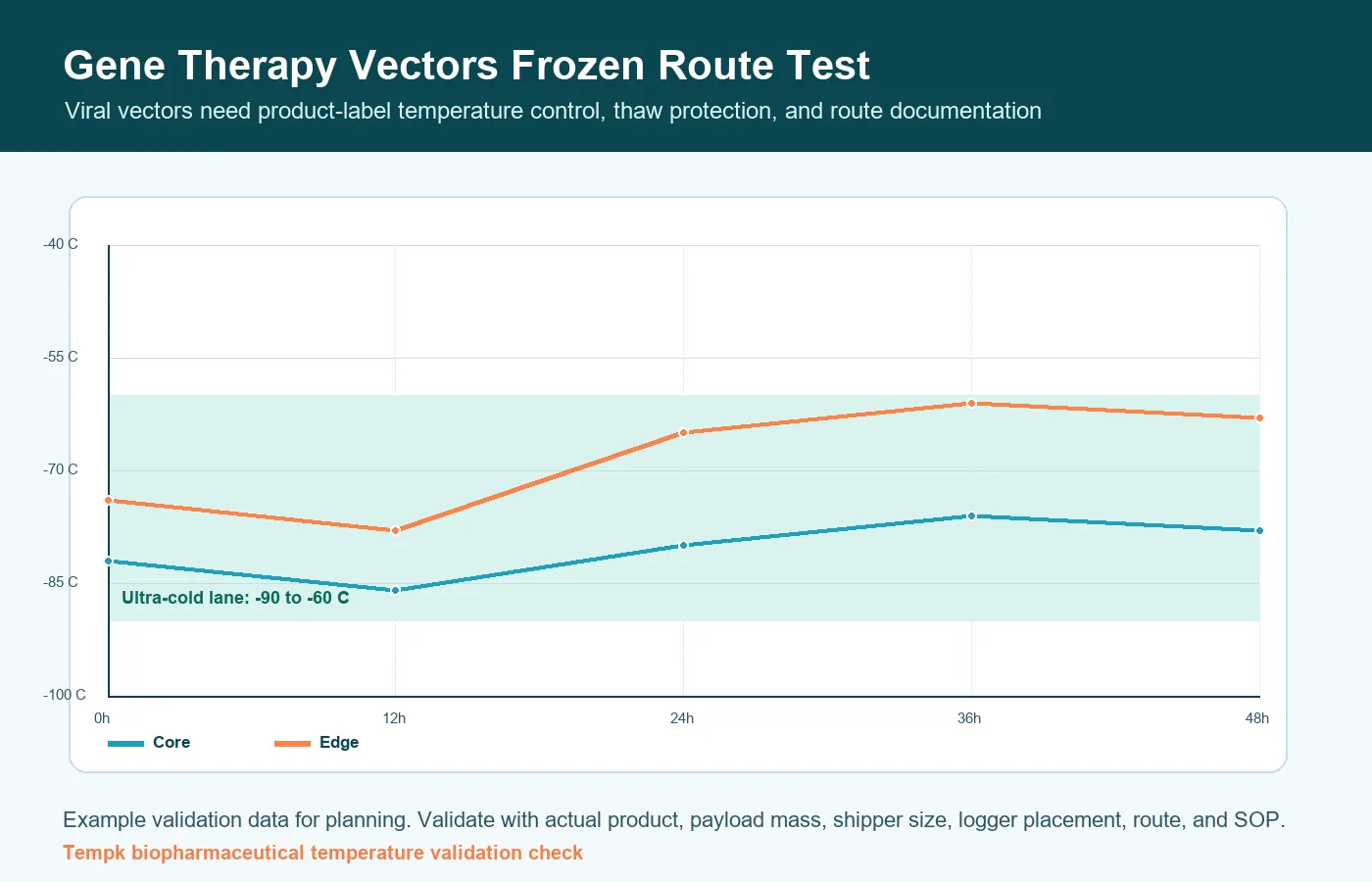
Gunakan halaman ini untuk membandingkan rute produk biologiceutical terdekat, pilihan pendingin, pilihan isolasi, dan pertanyaan risiko rute sebelum pengambilan sampel.
Vektor terapi gen mungkin memerlukan transportasi beku atau kriogenik, tergantung pada formulasi. Konfigurasi kemasan harus dipilih dari persyaratan stabilitas produk, bukan dari praktik farmasi umum.
Risiko utama adalah habisnya es kering, vial pecah, pencairan saat keterlambatan bea cukai, kegagalan pencatat data, dan hilangnya dokumentasi kustodi.
Gunakan rak botol, penahanan sekunder, dan zona kargo yang menjaga sampel tetap stabil selama penanganan. Dokumentasi harus tetap dapat diakses tanpa membuka zona dingin.
Use es kering or kriogenik equipment according to the tervalidasi lane. Standar 2 ke 8 Kemasan C tidak cocok untuk pengiriman vektor deep frozen.
Check es kering margin, beban suhu, integritas botol, tinggal adat, dan pencatatan rantai kustodi sebelum menyetujui jalur tersebut.
Custom konfigurasi kemasan support
Untuk ukuran karton tetap, batasan muatan, persyaratan merek, jalur musiman, atau target validasi, Tempk can adapt this solution into a custom cold-chain konfigurasi kemasan.
Bagikan jenis vektor, rentang penyimpanan berlabel, format botol atau rak, durasi rute, kondisi sekitar, es kering allowance, langkah pembawa, dan menerima paket freezer. Tempk dapat membantu membandingkan massa es kering, struktur pengirim, pemisah, dan pemeriksaan validasi.
Request a konfigurasi kemasan review