


Risiko pembekuan wajah dingin
Pak gel beku dapat membuat titik dingin lokal meskipun pencatat data di tengah tetap dalam rentang yang diharapkan.
Antibodi monoklonal are often shipped as refrigerated produk biologis, di mana masalah utama pengemasan bukan sekadar tetap dingin. The konfigurasi kemasan has to prevent heat exposure, membeku di permukaan cairan pendingin, naksir karton, kondensasi, dan stres terkait getaran selama serah terima.
Label produk dan SOP sponsor menentukan kisaran akhir. Untuk perencanaan pengemasan, risiko umum di bawah ini adalah risiko yang harus dihilangkan sebelum validasi rute.
Pak gel beku dapat membuat titik dingin lokal meskipun pencatat data di tengah tetap dalam rentang yang diharapkan.
Menjemput, perpindahan pesawat, tempat tinggal gudang, dan penundaan penerimaan sering kali menciptakan titik terhangat di dekat bagian atas atau dinding luar.
Kelembaban, pembatas yang ketat, atau cairan pendingin yang berat dapat merusak karton sekunder, Label, dan dokumen berseri.
| Kondisi rute | Tujuan suhu | Pengaturan kemasan | Perencanaan media pendingin atau dry shipper | Pemeriksaan penerimaan |
|---|---|---|---|---|
| Pengiriman kurir atau klinik yang dikontrol, 0-8 H | Menjaga 2-8 C merencanakan sambil menghindari kontak beku. | EPP pra-kondisi atau pengirim karton terisolasi, lengan kargo, penghalang kelembaban, dan satu perekam data di dekat beban. | Untuk a 3-8 L pengirim, uji coba 0.8-1.5 kg dikondisikan 2-8 C PCM atau pak gel pendingin di belakang sekat. | Tidak ada tanda dingin, label kering, karton utuh, catatan suhu, and serah terima time. |
| Paket atau kurir khusus, 8-24 H | Tahan jangkauan berpendingin melalui pengambilan, penyortiran, dan menerima penundaan. | Isolasi lebih tinggi, bantalan penyangga atas dan samping, lapisan PCM terpisah, dua posisi data pencatat untuk tepi hangat dan permukaan dingin. | Mulai uji coba jalur kecil 1.5-3.5 kg 2-8 C PCM. Tingkatkan cairan pendingin hanya setelah tinjauan titik dingin. | Tepi yang hangat, wajah dingin, naksir karton, kondensasi, dan penundaan penerima. |
| Musim panas atau rute internasional, 24-48 H | Cegah paparan panas tanpa menimbulkan risiko pembekuan selama pengondisian awal atau transfer penerbangan. | Pengirim tervalidasi, profil jalur musiman, beban pengatur jarak, lapisan penyerap atau pengatur kelembapan, and receiver-ready serah terima plan. | Jalur yang lebih panjang mungkin diperlukan 3-6 kg PCM di pengirim yang lebih besar. Gunakan pengujian rute sebelum pengiriman komersial langsung. | Tinjauan kurva penuh, kondisi pendingin yang tersisa, tidak ada dokumen basah, dan penandatanganan penerima. |
Gunakan nilai-nilai ini sebagai titik awal untuk pengambilan sampel dan kutipan. Pendingin terakhir, PCM, es kering, isolasi, pengirim kering, pencatat data, dan pilihan handling harus tervalidasi dengan muatan sebenarnya, jalur, proses pembawa, musim, dan prosedur penerimaan.
Load the antibodi kartons into a stable konfigurasi kemasan. Jangan gunakan pengirim untuk mendinginkan muatan hangat.
Simpan PCM atau pak gel pendingin di balik busa, bergelombang, atau jarak yang dibentuk sehingga karton tidak dapat menyentuh permukaan yang beku atau terlalu dingin.
Gunakan pembagi yang menahan karton tanpa kompresi dan jauhkan dokumen dari zona kondensasi.
Selama pengujian, letakkan sensor di tepi yang kemungkinan hangat dan titik risiko di sisi cairan pendingin, tidak hanya di tengah.
Ini adalah masalah yang terlihat dan operasional yang harus dikurangi oleh konfigurasi kemasan sebelum kiriman mencapai penerima.
Gunakan kurva tes sebagai perbandingan kerja, kemudian validasi dengan muatan sebenarnya, pengirim, konfigurasi pengirim pendingin atau kering, durasi jalur, profil lingkungan, dan proses penerimaan.
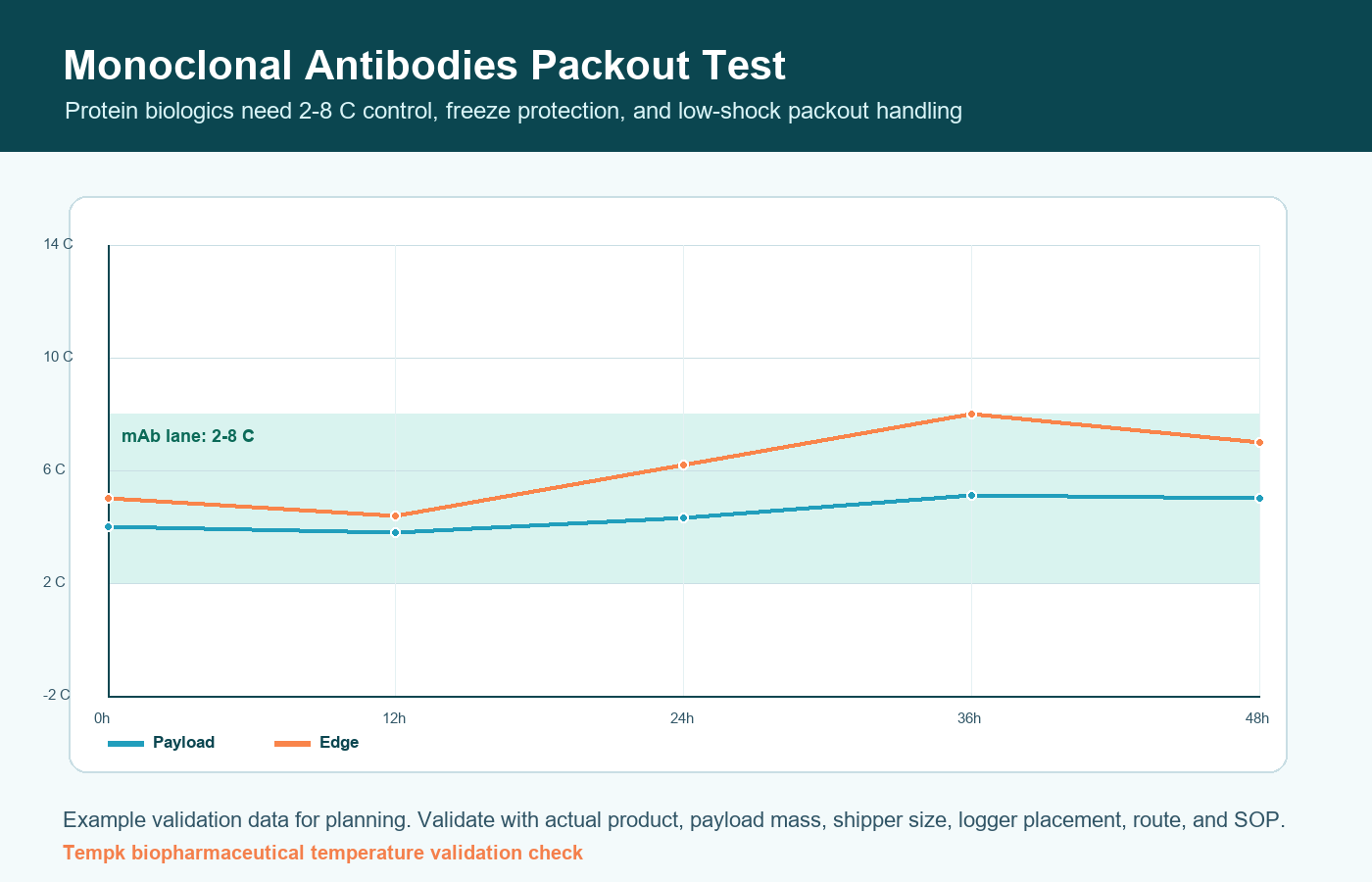
Gunakan halaman ini untuk membandingkan rute produk biologiceutical terdekat, pilihan pendingin, pilihan isolasi, dan pertanyaan risiko rute sebelum pengambilan sampel.
Antibodi monoklonal umumnya merupakan produk biologi berpendingin dimana paparan beku dan getaran dapat mengancam kualitas produk. Kemasan harus menahan suhu dan melindungi vial atau unit yang sudah diisi sebelumnya.
Risiko utama adalah kontak beku, vial pecah, karton penyok, penempatan pencatat data suhu yang salah, dan penerimaan rumah sakit terlambat.
Gunakan rongga muatan yang memenuhi syarat dengan pembagi botol atau dukungan karton. Simpan cairan pendingin di belakang spacer dan tambahkan bantalan di jalur yang memiliki intensitas penanganan tinggi.
Menggunakan 2 ke 8 C PCM or conditioned pak gel pendingin for tervalidasi refrigerated lanes. Hindari es kering kecuali produk diberi label untuk pengangkutan beku.
Check pencatat data data, kondisi botol, integritas karton, dan menerima waktu. Sertakan jalur yang sensitif terhadap getaran jika diperlukan penanganan ekspres udara.
Antibodi monoklonal memerlukan pengangkutan berpendingin yang stabil dan perlindungan dari pembekuan. Konfigurasi kemasan harus menampung vial atau karton dengan aman sehingga getaran dan benturan tidak menjadi risiko tersembunyi.
Menggunakan 2 ke 8 C PCM atau pak gel pendingin yang dikondisikan di belakang spacer. Tambahkan pembagi botol, rongga muatan yang terlindungi, dan data pencatat ditempatkan bersama obat, bukan di samping cairan pendingin.
Validasi tempk harus mencakup jumlah botol, ukuran karton, durasi rute, penanganan udara ekspres, dan menerima penundaan. Tinjau suhu minimum, kerusakan yang sensitif terhadap getaran, integritas karton, and pencatat data data.
Custom konfigurasi kemasan support
Untuk ukuran karton tetap, batasan muatan, persyaratan merek, jalur musiman, atau target validasi, Tempk can adapt this solution into a custom cold-chain konfigurasi kemasan.
Bagikan presentasi antibodi, jumlah karton, jangkauan sasaran, Ukuran pengirim, durasi rute, profil lingkungan, serah terima points, dan kebutuhan data pencatat. Tempk dapat membantu membandingkan massa PCM, isolasi, struktur pembagi, dan tata letak validasi.
Request a konfigurasi kemasan review