


Trockeneis depletion
Eine scheinbar kurze Strecke kann bei Hitze, Flugzeugtransfer oder langer Empfangswartezeit schnell Trockeneis verlieren.
Gentherapie-Vektoren often move in frozen, ultratief gefroren, oder Kryogenspuren. Die richtige Einrichtung hängt vom etikettierten Sortiment und dem Fläschchenformat ab: Für eine Spur kann ein Trockeneis-Versender geeignet sein, während eine andere Route einen validierten Trockenshipper benötigt.
Vektorsendungen erfordern gleichzeitig eine Temperaturkontrolle und eine physische Kontrolle. Die Route sollte Antauen verhindern, Wiedereinfrieren, Fläschchenbewegung, Trockeneiskontaktschäden, und Probleme mit dem Papierkram.
Eine scheinbar kurze Strecke kann bei Hitze, Flugzeugtransfer oder langer Empfangswartezeit schnell Trockeneis verlieren.
Wiederholte Türöffnungskontrollen oder langsame Übergabe können Fläschchen so weit erwärmen, dass eine Routenausnahme entsteht.
Lose Gestelle, direkter Trockeneis-Kontakt, und frostnasse Unterlagen können zu Empfangsproblemen führen, selbst wenn Trockeneis zurückbleibt.
| Routenbedingung | Temperaturziel | Verpackungsaufbau | Planung von Kühlelementen oder Trockenshipper | Empfangskontrolle |
|---|---|---|---|---|
| Trockeneis route, 0-24 H | Verwenden Sie das vom Produkt zugelassene Tiefkühl- oder Ultratiefsortiment und vermeiden Sie Antauen beim Verpackungsaufbau. | Entlüfteter Trockeneis-Versender, Halterung für Fläschchengestell, Trockeneis barrier, absorbierende oder sekundäre Eindämmung, und geschützter Dokumentenhülle. | Für kleine Pakete, Erste Tests beginnen oft um 3-7 kg Trockeneis, dann entsprechend der Spurtemperatur anpassen, Nutzlast mass, und Spediteurregeln. | Temperaturschreiber curve, verbleibendes Trockeneis, Fläschchenposition, Nein warten Dokument, and immediate Tiefkühler transfer. |
| Trockeneis route, 24-48 h oder heiße Jahreszeit | Halten Sie die gefrorene Reichweite durch Abholung aufrecht, überweisen, Wochenendrisiko, und Empfangsverzögerung. | Verlader mit höherer Kapazität, Obere und seitliche Trockeneisplatzierung mit Trennung, Überprüfung des Routenrisikos, und Empfängertermin. | Viele kleine bis mittlere Studien beginnen um 8-15 kg Trockeneis. Nutzen Sie den Trockeneis-Rechner, Überprüfen Sie dann den tatsächlichen Versender und die Spur. | Trockeneis bleibt übrig, offensichtlich kein Antauen, Zustand des Gestells, äußere Integrität des Kartons, und Zeitstempel empfangen. |
| Kryogen oder produktspezifische Route | Verwenden Sie einen validierten Trockenversender, wenn das Produktetikett oder die SOP LN2-Bedingungen erfordern. | Vorgeladener Trockenshipper, Vial Kassette or Kanister support, Besitzkette records, Originalitätssiegel, and Ausrichtung control. | Planung durch Trockenshipper-Haltezeitreserve, not Trockeneis mass. Ersetzen Sie Trockeneis nicht durch eine Kryogen-Route, es sei denn, der Produktbesitzer genehmigt dies. | Trockenshipper-Status, Besitz records, Ausrichtung, Übergabe notes, und Speicherübertragung. |
Verwenden Sie diese Werte als Ausgangspunkt für die Bemusterung und Angebotserstellung. Letztes Kühlmittel, PCM, Trockeneis, Isolierung, Trockenverlader, Temperaturschreiber, and handling choices must be validiert with the real Nutzlast, Fahrbahn, Trägerprozess, Jahreszeit, und Empfangsverfahren.
Wählen Sie Trockeneis, ultrativ, oder Trockenshipper-Logik vom Produktetikett und SOP, bevor Sie eine Box auswählen.
Verwenden Sie Gestellstützen und Barrieren, damit die Fläschchen nicht direkt in Trockeneisblöcke oder lose Pellets drücken.
Legen Sie Dokumente in eine trockene Hülle und außerhalb der Trockeneiszone, damit der Empfang die Etiketten lesen und den Papierkram freigeben kann.
Gentherapie-Spuren sollten an einem zugewiesenen Tiefkühler ankommen, ausgebildeter Empfänger, und dokumentierten Transferprozess.
Dies sind die sichtbaren und betrieblichen Probleme, die der Verpackungsaufbau reduzieren sollte, bevor die Sendung den Empfänger erreicht.
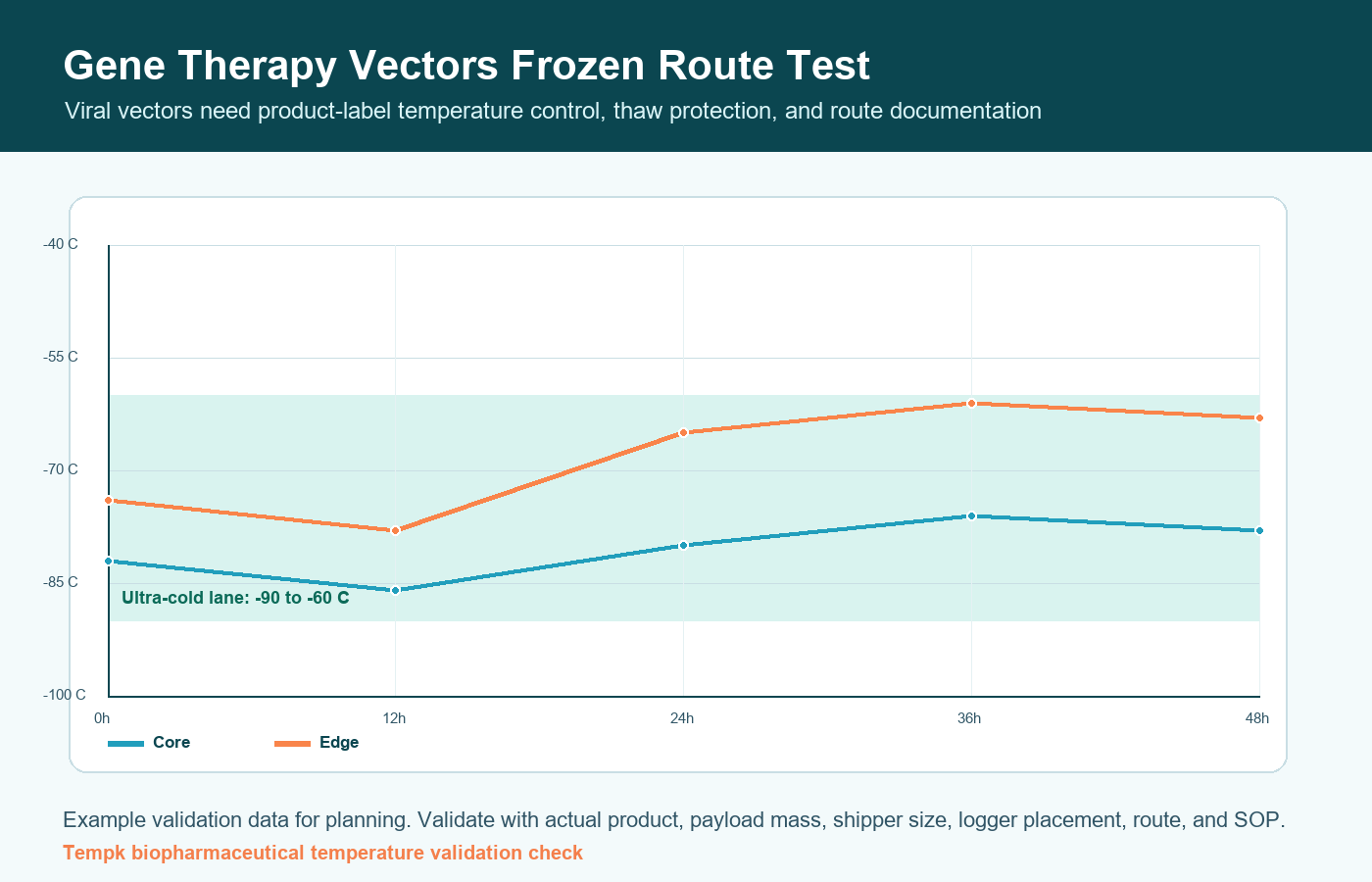
Nutzen Sie die Testkurve als Arbeitsvergleich, dann mit der tatsächlichen Nutzlast validieren, Absender, Kühlmittel- oder Trockenshipper-Konfiguration, Spurdauer, Umgebungsprofil, und Empfangsprozess.
Nutzen Sie diese Seiten, um nahegelegene biologische Arzneimittelrouten zu vergleichen, Kühlmittelauswahl, Isolierungsmöglichkeiten, und Routenrisikofragen vor der Probenahme.
Gentherapie-Vektoren may require deep frozen or kryogen transport, Abhängig von der Formulierung. Der Verpackungsaufbau sollte nach den Anforderungen an die Produktstabilität ausgewählt werden, nicht aus der allgemeinen pharmazeutischen Praxis.
Die Hauptrisiken sind Trockeneisverbrauch, Fläschchen-Bruch, Antauen während Zollverzögerungen, Ausfall des Temperaturschreibers und Verlust der Besitzkettendokumentation.
Verwenden Sie Fläschchenständer, sekundäre Eindämmung, und eine Nutzlastzone, die die Proben während der Handhabung stabil hält. Die Dokumentation sollte zugänglich bleiben, ohne dass die Kaltzone geöffnet werden muss.
Verwenden Sie Trockeneis- oder Kryogengeräte entsprechend der validierten Spur. Standard 2 Zu 8 C-Verpackungen sind für tiefgekühlte Vektor-Sendungen nicht geeignet.
Check Trockeneis margin, Nutzlast temperature, Integrität der Fläschchen, Zoll wohnen, und Besitzkettenaufzeichnungen vor der Genehmigung der Fahrspur.
Custom Verpackungsaufbau support
Für feste Kartongrößen, Nutzlast limits, Branding-Anforderungen, Saisonspuren, oder Validierungsziele, Tempk kann diese Lösung in einen maßgeschneiderten Kühlketten-Verpackungsaufbau umwandeln.
Teilen Sie den Vektor-Typ, Beschrifteter Lagerbereich, Fläschchen- oder Rackformat, Streckendauer, Umgebungsbedingungen, Trockeneis allowance, Trägerstufen, und Erhalt des Tiefkühlerplans. Tempk kann helfen, die Trockeneis-Masse zu vergleichen, Verladerstruktur, Separatoren, und Validierungsprüfungen.
Request a Verpackungsaufbau review