


TemperaturabsichtPlanen Sie herum 2-8 C unless the product label requires something different; protect against both heat and freezing.
Influenza Vaccines Cold Chain Packaging Solution
Influenza vaccine shipments are often seasonal, zeitkritisch, and repeated across many clinic destinations. The packaging should be easy for warehouse teams to build consistently, while keeping vaccine cartons at 2-8 C and away from direct frozen coolant contact.
Was das Paket steuern muss
KühlmittelregelVerwenden Sie konditionierte Gelpackungen oder 5 C PCM with a buffer layer. Do not place unconditioned frozen gel directly against vaccine cartons.
Schwerpunkt VerpackungRepeatable packout, carton identity, trockene Etiketten, and fast receiving during seasonal volume spikes.
Wählen Sie die Packout-by-Routen-Bedingung
| Streckenzustand | Verpackungsaufbau | Vorläufiger Kühlmittelbereich | Empfangsscheck |
|---|---|---|---|
| Same-day or local courier, 4-12 H | Isolierter Karton, center payload tray, side coolant with buffer board. | 0.6-1.2 kg konditionierte Gelpackungen oder PCM für a 1-3 L Nutzlast. | Keep logger probe near the payload, nicht gegen das Kühlmittel. |
| Clinic parcel route, 12-24 H | EPP oder Isolierkarton, Kühlmittel oben/seitlich, spacer layer above cartons. | 1.2-2.5 kg konditionierte Gelpackungen oder PCM für a 1-4 L Nutzlast. | Mindesttemperatur prüfen, Kartontrockenheit, and arrival time before storage. |
| Longer replenishment route, 24-36 H | Dickere Isolierung, balanced coolant on sides/top, mittlerer Nutzlasthohlraum. | 2.5-4.0 kg konditionierte Gelpackungen oder PCM, adjusted by lane and ambient. | If the route dips near 0 C, increase buffer before adding more coolant. |
Nutzen Sie diese Bereiche als Ausgangspunkt für die Verpackungsüberprüfung. Bestätigen Sie die endgültige Kühlmittelmasse anhand des Produktetiketts, Versendergröße, Streckendauer, Umgebungsprofil, und ein qualifizierter Temperaturlogger-Test.
Wie Tempk die Lieferung bauen würde
Design for repeated packing
Seasonal flu routes often involve many similar shipments. Use a fixed loading pattern and clear coolant positions so warehouse teams do not improvise.
Protect cartons from frozen surfaces
Keep vaccine cartons in the center with corrugated, Schaum, or molded dividers between product and coolant.
Kondensation kontrollieren
Use dry liners or carton sleeves where paperboard and labels are important for receiving and clinic inventory checks.
Validate peak-season lanes
Test the warmest and coldest likely routes, then confirm logger placement, Empfangszeit, und Kühlmittelrestzustand.
Häufige Fehlerquellen, die es zu vermeiden gilt
Das Ziel ist nicht nur eine Kühlbox. Der Empfänger muss gereinigt werden, lesbar, dokumentierte Sendung, die innerhalb des erforderlichen Kühlbereichs blieb.
- Freeze excursion caused by unconditioned gel packs touching cartons.
- Warm arrival after long dock dwell or weekend delay.
- Wet cartons or unreadable labels from condensation.
- Inconsistent packout when seasonal order volume rises.
Validierungskurve und Erhalt von Beweisen
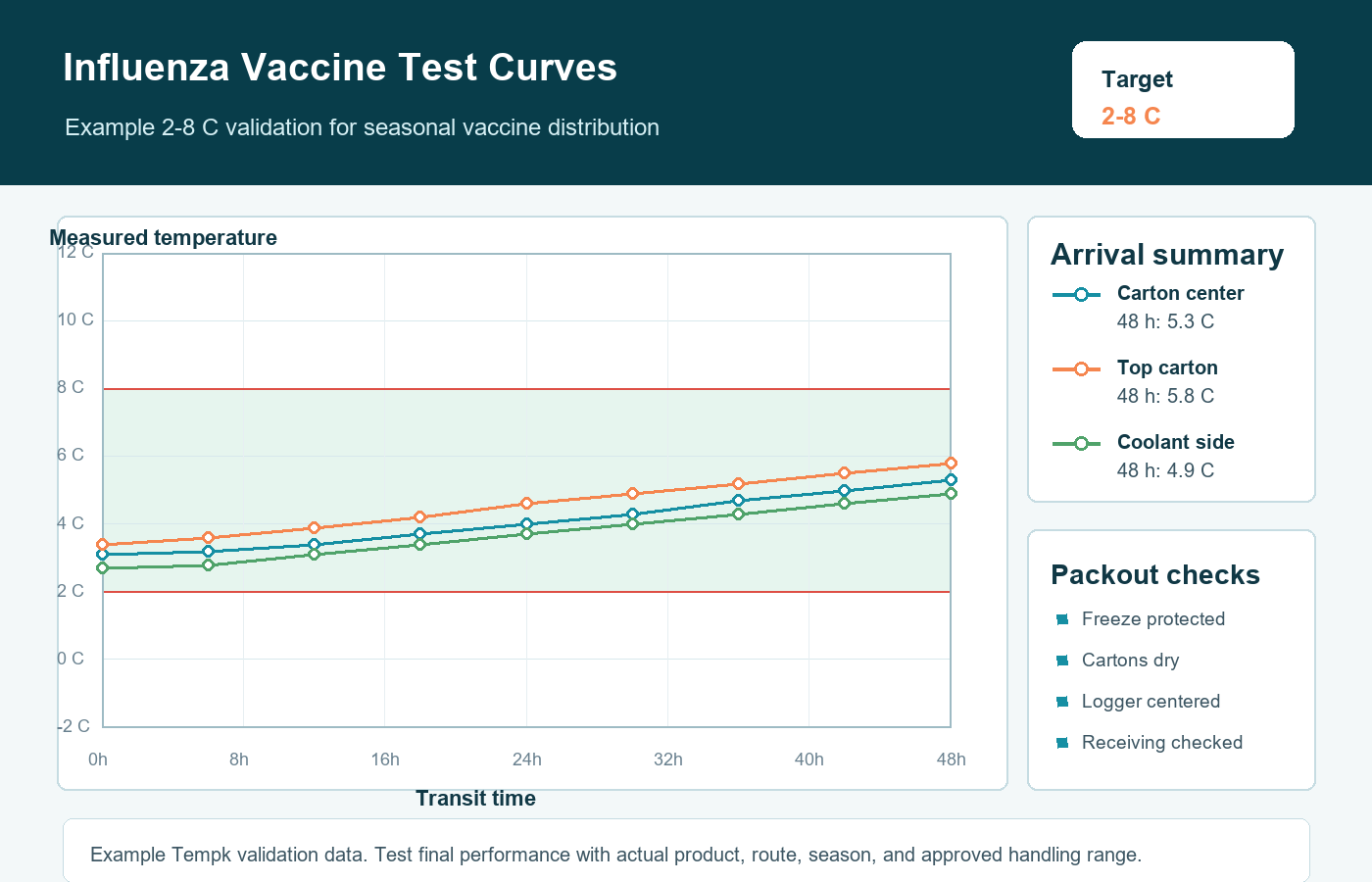
Überprüfen Sie die Kurve mit der tatsächlichen Impfstoffnutzlast, Kühlmittelmasse, Versendergröße, Streckendauer, und Jahreszeit. Für Impfstoffe, Die Mindesttemperatur und die Empfangsaufzeichnung sind ebenso wichtig wie die Endtemperatur.
Verwandte Seiten zur Packout-Planung
Praktische Routenhinweise
Plan influenza vaccine packing for seasonal volume
Influenza vaccine routes often peak quickly before clinic season. The packout needs repeatable 2 Zu 8 C performance across larger daily parcel counts and multiple clinic destinations.
Wo dieses Produkt normalerweise versagt
Seasonal failures include rushed coolant conditioning, cartons packed too tightly, freeze alarms in winter, and warm excursions during clinic receiving.
Verpackungsaufbau zum ersten Testen
Use a product basket or corrugated payload well with conditioned gel packs around it. Leave enough spacing so vaccine cartons are not pushed against the coolant wall.
Kühlmittelauswahl
Qualifiziert verwenden 2 Zu 8 C packs or conditioned gel packs for overnight and two-day routes. Add winter protection when lanes include freezing ambient conditions.
Überprüfung der Routenvalidierung
Test the highest carton count and the smallest carton count. Place the logger among the vaccine cartons and review both minimum and maximum temperatures.
Verpackungsdetails
Influenza vaccine programs need repeatable seasonal packing
Anwendungsfall
Influenza vaccine shipping often happens in seasonal waves, so the packout must be easy for warehouse staff to repeat. Use a fixed coolant conditioning process, a defined payload cavity, and pack instructions that do not change by operator.
Wahl der Verpackung
For small clinic replenishment, test the minimum carton count because an underfilled payload cavity can overcool. Für Großaufträge, test the maximum carton count because dense payloads can warm slowly but may hide hot spots near the top.
Was Tempk validieren sollte
Tempk can build hot and cold ambient profiles for the same shipper. The receiving check should confirm 2 Zu 8 C logger results, no freeze alarm, Kartontrockenheit, and quick transfer into refrigeration.
Szenario der Feldauspackung
Example setup for seasonal flu vaccine replenishment
For influenza vaccine programs, build a repeatable packing station. Konditioniert verwenden 2 Zu 8 C coolant or qualified PCM, a fixed payload cavity, and a written pack sequence that seasonal staff can follow without improvising. Test both a low carton count and a full carton count because underfilled shippers can overcool and overfilled shippers can warm near the top. Include a winter profile for freeze risk and a hot profile for clinic delivery delay. Receiving should check logger minimum, logger maximum, Kartontrockenheit, and time from delivery to refrigerator.
Unterstützung für benutzerdefinierte Pakete
Diese Spur muss rund um Ihr Produkt und Ihre Route aufgebaut sein?
Für feste Kartongrößen, Nutzlastgrenzen, Branding-Anforderungen, Saisonspuren, oder Validierungsziele, Tempk kann diese Lösung in eine individuelle Kühlkettenverpackung umwandeln.
Dieser Impfweg muss vor dem Versand überprüft werden?
Senden Sie die Produktetikettenanforderung, Nutzlastvolumen, Zieltyp, Streckendauer, Umgebungsbedingungen, und erforderlicher Logger-Bericht. Tempk kann beim Vergleich von Isolierungen helfen, Kühlmittelplatzierung, und Validierungsschritte vor dem Versand.
Fordern Sie eine Packout-Bewertung an