


Geler le contact en face réfrigérante
Les accumulateurs de gel congelés ou briques de glace peuvent créer un point froid invisible avec un seul enregistreur au centre.
Les expéditions de globules rouges nécessitent un contrôle réfrigéré sans congeler le composant ni presser les sacs contre un réfrigérant dur.. La configuration d'emballage doit protéger le composant, l'étiquette, l'ensemble de documents, et l'enregistrement de la température en même temps.
Les expéditions de produits sanguins doivent être jugées en fonction de l'historique de température et de l'état de réception.. Les détails ci-dessous sont des conseils pour la planification de l'emballage.; la manipulation finale doit suivre la procédure de votre installation et les exigences locales.
Les accumulateurs de gel congelés ou briques de glace peuvent créer un point froid invisible avec un seul enregistreur au centre.
Transfert porte ouverte, temps d'attente du courrier, et le retard de réception peut lever la charge externe utile plus rapidement que prévu.
Inserts serrés, heavy réfrigérant, ou la condensation peut endommager les sacs, étiquettes, et les documents nécessaires à la réception.
| Condition de route | Objectif de température | Configuration d'emballage | Planification du réfrigérant ou de la glace carbonique | Contrôle à la réception |
|---|---|---|---|---|
| Véhicule contrôlé ou coursier court, 0-6 h | Maintenir la manutention réfrigérée et éviter la congélation; s'aligner sur la procédure de l'établissement pour les globules rouges. | Pre-conditioned insulated emballage médical, doublure absorbante, support de sac, one enregistreur near charge utile, réfrigérant separated by divider. | Often no congelé réfrigérant against charge utile. Pour un 3-8 Colis L, test 0.8-1.5 kg conditionné 2-8 Gel C ou PCM derrière une barrière. | Courbe de température, pas de marques de froid, étiquette sèche, maintien des poches, et heure de remise. |
| Colis standard ou itinéraire d'été, 6-24 h | Itinéraire réfrigéré avec une protection renforcée du côté chaud et sans contact direct avec la glace. | Expéditeur isotherme EPP ou carton, diviseur plus épais, confinement secondaire absorbant, deux activateurs pour les positions chaudes et froides. | Commencer les essais autour 1.5-3.5 kg conditionné 2-8 Gel C ou PCM pour les petits colis; augmenter seulement après un examen des points froids. | Bord chaud, visage froid, condensation, lisibilité de l'étiquette, et retard de réception. |
| Itinéraire hivernal froid ou transfert aérien | Empêcher le gel dû à l'exposition ambiante tout en maintenant le contrôle réfrigéré. | Expéditeur à haute isolation, réfrigérant réduit ou tamponné, disposition des contacts non directs, charge utile enveloppée dans une pochette de support. | Utilisez du PCM conditionné plutôt que du gel congelé là où le risque de refroidissement est élevé.. Testez la température ambiante la plus basse attendue avant l'expédition en direct. | Température minimale, emplacement du point froid, flexibilité du sac, sécheresse du carton extérieur, et temps de séjour du courrier. |
Utilisez ces plages comme point de départ pour l'échantillonnage et la cotation. Final réfrigérant, PCM, glace carbonique, isolation, et les choix de surveillance doivent être validés avec la charge utile réelle, taille de l'expéditeur, durée de l'itinéraire, processus de transport, saison, et procédure de réception.
Le composant doit entrer dans une configuration d'emballage réfrigérée stable. Ne comptez pas sur la boîte pour ramener une charge chaude utile à portée.
Utilisez un diviseur, espaceur en mousse, ou pochette de charge utile pour que les accumulateurs de gel ou PCM ne puissent pas toucher directement les sacs.
Placer les documents en dehors des zones humides et utiliser un confinement absorbant ou étanche autour de la charge utile.
Placez un capteur près du bord chaud probable et un autre près du point à risque côté réfrigérant pendant la validation.
Ce sont les problèmes visibles et opérationnels que la configuration d'emballage devrait réduire avant que l'envoi n'atteigne le destinataire..
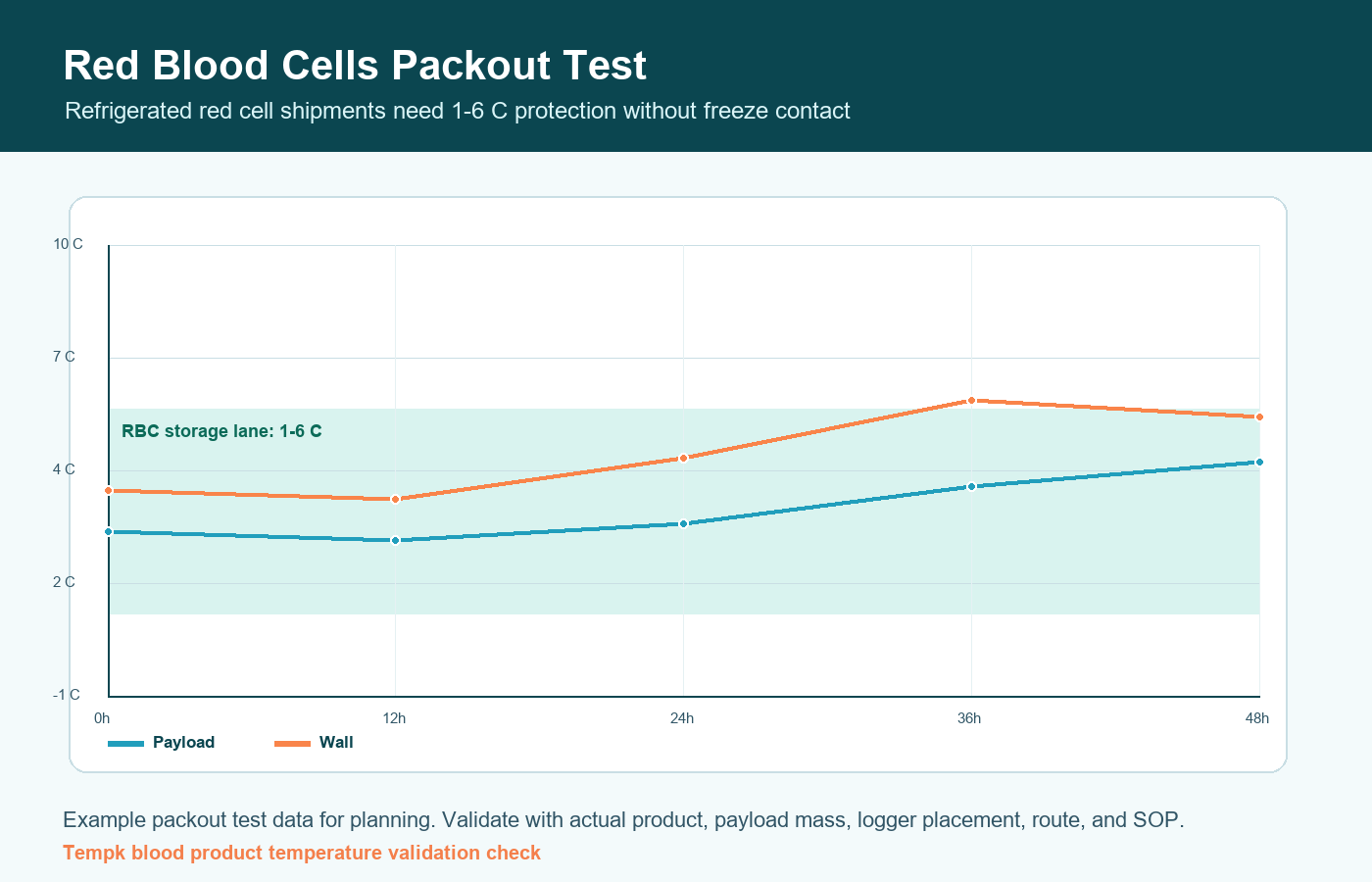
Utilisez la courbe de test comme comparaison de travail, puis validez avec le montant effectivement facturé, expéditeur, réfrigérant or glace carbonique mass, durée de la voie, profil ambiant, et processus de réception.
Utilisez ces pages pour comparer les itinéraires de produit sanguin à proximité, réfrigérant choices, options d'isolation, et des questions sur les risques d'itinéraire avant l'échantillonnage.
Les globules rouges exigent un transport réfrigéré contrôlé avec positionnement soigné des enregistreurs. L'emballage doit prévenir le réchauffement et la congélation accidentelle pendant la remise.
Geler l'exposition, délais de réception chaleureux, pression sur les poches points, et une mauvaise séparation des charges utiles sont les principaux modes de défaillance.
Utiliser un emballage sanguin qualifié avec compartiment de charge, doublure absorbante et séparation du réfrigérant. Garder les poches assez plates pour éviter les dommages par pression.
Utiliser des produits qualifiés 1 à 6 Composants d'emballage C. Do not substitute accumulateurs de gel congelés standard without full validation.
Examiner les données d'activation minimales et maximales, état du sac, contrôle des fuites, et le délai entre la livraison et le stockage contrôlé.
Globules rouges require a qualified réfrigéré route, pas une boîte à glace générique. La zone de charge utile doit protéger les sacs du réfrigérant direct et inclure suffisamment de contrôle absorbant pour le risque de fuite..
Utilisation validée 1 à 6 C components and keep the enregistreur de température in the charge utile zone. Un activateur contre la paroi froide peut surestimer le risque de gel, alors qu'un activateur hors charge utile risque de manquer le réchauffement.
L'examen Tempk devrait couvrir le nombre de sacs, charge utile masse, durée de l'itinéraire, remise time, et flux de travail de réception. Vérifier la température minimale et maximale, état du sac, fuite, et transfert dans un stockage contrôlé.
Prise en charge de la configuration d'emballage personnalisée
Pour des tailles de carton fixes, limites de charge utile, exigences en matière de marque, voies saisonnières, ou des cibles de validation, Tempk peut adapter cette solution dans une configuration d'emballage de chaîne du froid personnalisée.
Partager le type de composant, charge utile, taille du sac ou du contenant, plage cible, durée de l'itinéraire, conditions ambiantes, étapes de messagerie, remise limit, and contrôles à la réception. Tempk peut aider à comparer l'expéditeur, réfrigérant layout, insert de support, poste de surveillance, et plan de validation.
Demander une révision de configuration d'emballage