


Globules rouges
Protéger la plage réfrigérée tout en évitant le contact direct avec réfrigérant congelé, la pression sur les poches, les étiquettes mouillées et les dossiers d'arrivée manquants.
L'emballage des produits sanguins commence par le composant, pas la taille de la boîte. Globules rouges, plaquettes, and plasma frais congelé need different temperature logic, réfrigérant contact protection, maintien des poches, remise control, et réception des dossiers.
Un emballage médical universel peut créer un risque réel lorsque la charge utile change. The same réfrigérant that supports globules rouges can chill plaquettes, et la glace carbonique utilisée pour le plasma congelé peut endommager les sacs ou les documents si elle n'est pas séparée.
Protéger la plage réfrigérée tout en évitant le contact direct avec réfrigérant congelé, la pression sur les poches, les étiquettes mouillées et les dossiers d'arrivée manquants.
Utiliser un plan de route sans exposition au froid avec tampons à température ambiante contrôlée, maintien stable des poches et fenêtres de remise courtes validées.
Maintenir l'état congelé avec glace carbonique ou support de route congelée, tout en éloignant poches, étiquettes et documents des dommages directs par glace carbonique.
| Route du composant | Objectif de température | Configuration d'emballage | Planification du réfrigérant ou de la glace carbonique | Contrôle à la réception |
|---|---|---|---|---|
| Globules rouges, itinéraire d’établissement à établissement ou de messagerie | Planifier autour de la manutention réfrigérée, communément 1-6 C pour un contrôle aligné sur le stockage. Eviter le gel et éviter les retards de remises chauds. | Qualified medical emballage isotherme, confinement secondaire absorbant, maintien des poches insert, réfrigérant barrier, enregistreur near charge utile but not touching réfrigérant. | Utiliser des accumulateurs de gel réfrigérés conditionnés ou 2-8 C PCM derrière un diviseur. Pour un 3-8 L expéditeur, de nombreux essais commencent 0.8-2.5 kg réfrigérant; les voies plus grandes nécessitent des tests de voie. | Enregistrement de température à l’arrivée, état du sac, aucune marque de contact avec la glace, documents secondes, intact étiquettes, et heure de remise. |
| Plaquettes, short température ambiante contrôlée lane | Planifier 20-24 Gestion C lorsque cela est requis par SOP. Do not use réfrigéré parcel logic. | Controlled température ambiante emballage isotherme, maintien des poches, no accumulateurs de gel congelés, activateur dans des positions probablement chaudes et froides. | Utiliser 20-24 C PCM seulement après validation. Pour les petits colis, les épreuves commencent souvent par 0.8-2 kg température ambiante PCM; les voies douces du même jour peuvent avoir besoin d'isolation et enregistrent plus de réfrigérant. | Aucune exposition au froid, pas de surchauffe, position stable du sac, durée de l'itinéraire, remise notes, and enregistreur curve. |
| Plasma frais congelé, congelé courier or air lane | Maintain congelé condition, communément -18 C or colder for congelé plasma handling. Prévenir la décongélation pendant le transfert et le retard. | Congelé emballage médical, glace carbonique separation layer, rigid maintien des poches, doublure absorbante ou résistante aux fuites, expéditeur aéré et documents protégés du gel. | Les essais de glace carbonique commencent souvent vers 1-3 kg pour les voies courtes, 3-8 kg pour 8-24 voies h, et plus pour les itinéraires longs ou chauds. Utilisez le calculateur de glace carbonique et validez avec le vrai couloir. | Enregistrement de température, congelé arrival condition, no bag puncture or glace carbonique burn, remaining glace carbonique, documents secondes, et retard de réception. |
Ce sont des plages de planification pour la discussion sur l'emballage. L'acceptation définitive doit suivre le centre de transfusion, hôpital, laboratoire, courrier, et procédure réglementaire locale pour le composant et l'itinéraire exacts.
Utilisez la courbe de validation pour comparer les produits réfrigérés, température ambiante contrôlée, et geler le comportement avant de mettre à l'échelle un itinéraire. La courbe doit être revue avec les notes de réception, pas comme une réussite ou un échec autonome.
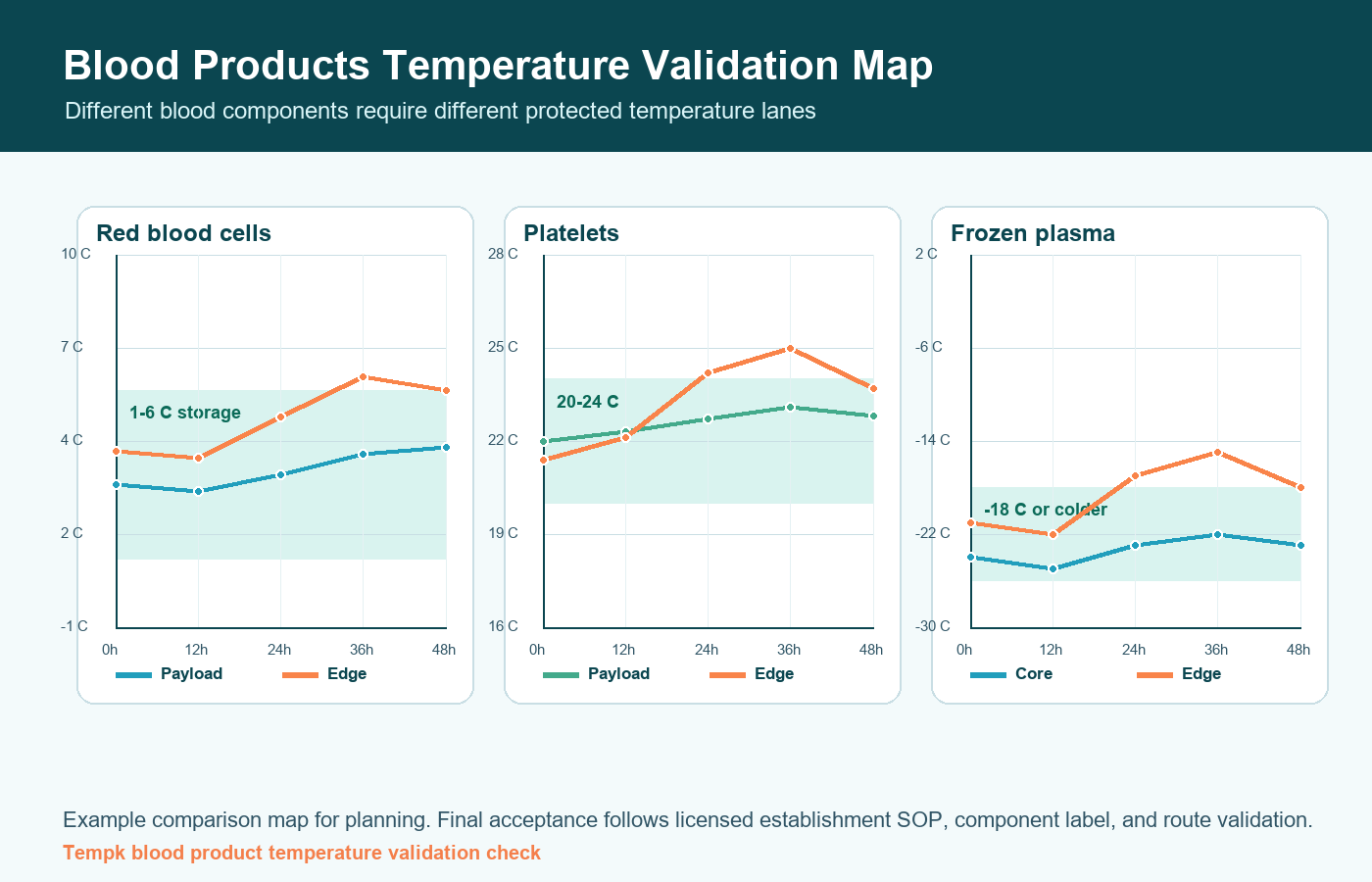
Le sang total et le cryoprécipité exigent des décisions de manutention séparées; ils sont donc mieux traités dans des guides ciblés plutôt que regroupés dans une page générique.
Controlled refrigerated sang total transport with maintien des poches, protection contre le gel, surveillance, et des enregistrements.
Congelé cryoprécipité transport with décongélation protection, glace carbonique separation, prise en charge des conteneurs, et validation.
Utilisez ces pages pour vérifier les risques liés à l'itinéraire, réfrigérant choice, structure d'isolation, itinéraires médicaux à proximité, et questions de configuration d'emballage finale avant validation.
Les expéditions de Produits sanguins ne doivent pas utiliser une recette de boîte fixe pour chaque produit.. Commencez par un contrôle spécifique aux composants, tel que 1-6 C globules rouges, 20-24 C plaquettes, or congelé plasma conditions, puis séparez les produits par charge thermique, résistance de l'emballage, et comment ils sont reçus. Pour les programmes mixtes, Tempk compare généralement un itinéraire local court, un itinéraire de colis de nuit, et la saison la plus chaude prévue avant de confirmer l'expéditeur.
Use validated emballage médical, confinement secondaire absorbant, enregistreur, et une documentation de remise propre. Le plan réfrigérant doit commencer par un PCM correspondant aux composants, accumulateurs de gel, or glace carbonique with separation from bags and étiquettes. Lorsque la charge utile dispose de cartons de vente au détail délicats, texture douce, matériel vivant, ou documentation médicale, protéger d'abord la charge utile, puis ajouter de la capacité de refroidissement. Si l'expédition est retardée au moment de l'emballage, remise, douane, ou transfert à quai, le profil de l'itinéraire doit être revérifié au lieu d'augmenter uniquement le poids du réfrigérant.
La validation doit inclure la vérification de la température des composants, protection du sac, dossier de traçabilité, et recevoir des critères d'acceptation. Un test utile enregistre le point utile de charge le plus chaud, the coldest point near réfrigérant, et l'état de réception après manipulation. Cela donne à l'équipe d'exploitation une instruction pratique de configuration d'emballage., pas seulement un tableau de température.
Prise en charge de la configuration d'emballage personnalisée
Pour des tailles de carton fixes, limites de charge utile, exigences en matière de marque, voies saisonnières, ou des cibles de validation, Tempk peut adapter cette solution dans une configuration d'emballage de chaîne du froid personnalisée.
Partager le type de composant, charge utile, taille du sac ou du contenant, plage cible, durée de la voie, conditions ambiantes, étapes de messagerie, remise limit, and contrôles à la réception. Tempk peut aider à comparer l'expéditeur, réfrigérant layout, insert de support, poste de surveillance, et plan de validation.
Demander une révision de configuration d'emballage