


Exposition au froid
Une configuration réfrigérée ou un accumulateur de gel congelé peut faire descendre les plaquettes sous la plage de température ambiante contrôlée prévue.
Le transport de plaquettes n'est pas une configuration d'emballage réfrigérée. It needs température ambiante contrôlée planning, no congelé réfrigérant contact, stable maintien des poches, voies courtes validées, et effacer les dossiers de remise.
Les expéditions de produits sanguins doivent être jugées en fonction de l'historique de température et de l'état de réception.. Les détails ci-dessous sont des conseils pour la planification de l'emballage.; la manipulation finale doit suivre la procédure de votre installation et les exigences locales.
Une configuration réfrigérée ou un accumulateur de gel congelé peut faire descendre les plaquettes sous la plage de température ambiante contrôlée prévue.
Véhicules chauds, long temps d'attente, ou la lumière directe du soleil peut réchauffer rapidement l'expéditeur si l'isolation et le PCM ne sont pas validés.
Sacs en vrac, manipulation brutale du courrier, et les arrêts non enregistrés rendent les contrôles d'arrivée plus difficiles à faire confiance.
| Condition de route | Objectif de température | Configuration d'emballage | Planification du réfrigérant ou de la glace carbonique | Contrôle à la réception |
|---|---|---|---|---|
| Coursier intérieur ou itinéraire sur le même campus, 0-4 h | Maintain température ambiante contrôlée handling according to the facility procedure. | Support isolé propre, maintien des poches, no congelé réfrigérant, enregistreur near the charge utile. | Souvent, aucun réfrigérant actif n'est nécessaire si la voie reste stable. Utiliser un tampon de température ambiante seulement après validation. | Courbe de température, temps de parcours, position du sac, et signature de remise. |
| Courrier le jour même, 4-12 h | Contrôlez l'exposition au chaud et au froid sans utiliser la logique de configuration d'emballage réfrigéré. | Expéditeur isolé, 20-24 C PCM si validé, pochette charge utile, activer près des côtés probablement chauds et froids. | Les essais de petits colis commencent souvent par 0.8-2 kg température ambiante contrôlée PCM, placed away from direct pression sur les poches. | Pas de trempette relaxante, pas de surchauffe, maintien des poches, et l'exhaustivité du dossier d'arrivée. |
| Itinéraire saisonnier ou interurbain, 12-24 h | Use a qualified température ambiante contrôlée system rather than improvised accumulateurs de gel. | Higher-performance emballage isotherme, masse PCM validée, bouclier de température externe, examen des risques liés à l'itinéraire. | Test 2-4 kg 20-24 C PCM pour les voies de parcelles plus grandes, puis ajustez en fonction des courbes d'activation et du profil ambiant. | Température minimale et maximale, retard de remise, mouvement du sac, et notes d'itinéraire. |
Utilisez ces plages comme point de départ pour l'échantillonnage et la cotation. Final réfrigérant, PCM, glace carbonique, isolation, et les choix de surveillance doivent être validés avec la charge utile réelle, taille de l'expéditeur, durée de l'itinéraire, processus de transport, saison, et procédure de réception.
Les plaquettes ne doivent pas être emballées comme des globules rouges. Évitez la glace, accumulateurs de gel congelés, et sources de refroidissement directes.
If réfrigérant is required, utiliser un PCM conçu pour la bande de température ambiante prévue et valider la voie réelle.
Utilisez un manchon ou un plateau pour que les sacs restent stables mais ne soient pas pressés contre des panneaux PCM ou des inserts durs.
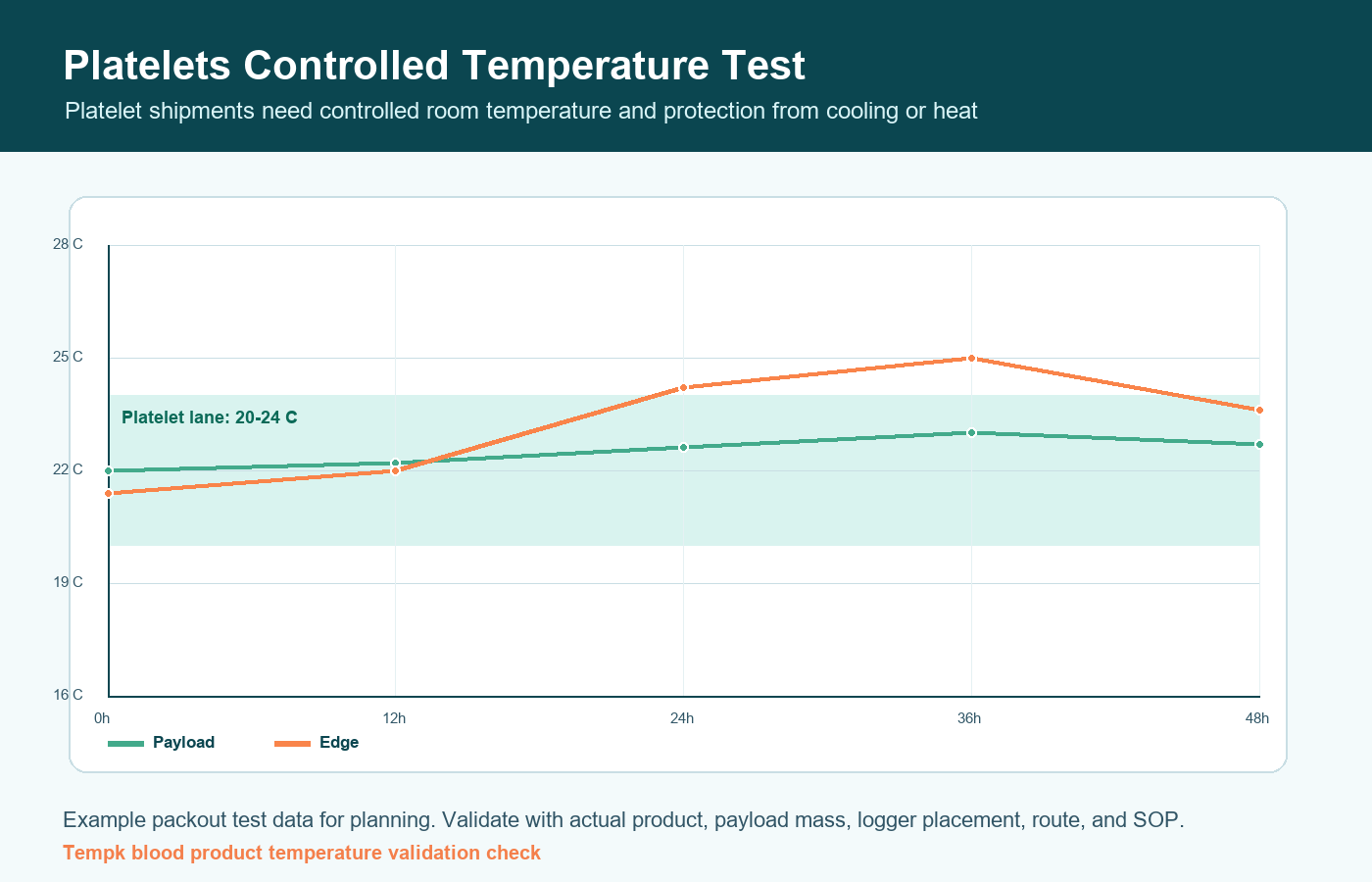
Les expéditions de plaques nécessitent un timing de remise clair et une courbe d'activation qui montre à la fois les risques chauds et froids..
Ce sont les problèmes visibles et opérationnels que la configuration d'emballage devrait réduire avant que l'envoi n'atteigne le destinataire..
Utilisez la courbe de test comme comparaison de travail, puis validez avec le montant effectivement facturé, expéditeur, réfrigérant or glace carbonique mass, durée de la voie, profil ambiant, et processus de réception.
Utilisez ces pages pour comparer les itinéraires de produit sanguin à proximité, réfrigérant choices, options d'isolation, et des questions sur les risques d'itinéraire avant l'échantillonnage.
Plaquettes are usually transported at température ambiante contrôlée, not in the same réfrigéré configuration d'emballage as globules rouges. L'emballage doit empêcher l'exposition au froid tout en maintenant la plage requise.
Les plus grands risques sont le refroidissement accidentel, une mauvaise planification du mouvement contrôlé, les retards de livraison et le placement par erreur de l'emballage au réfrigérateur.
Utiliser un emballage à température contrôlée avec calage qui maintient les contenants de plaquettes sans les comprimer. Ajouter des étiquettes de manutention claires pour une réception non réfrigérée.
Utiliser des composants à changement de phase validés pour la voie à température ambiante requise. Les accumulateurs de froid standard ne conviennent pas au transport de plaquettes.
Vérifier le journal de température, état du conteneur, clarté de l'étiquette, et flux de travail de réception. Le contrôle d'acceptation doit confirmer que l'expéditeur n'a pas été réfrigéré.
Plaquettes are a special case because many lanes require température ambiante contrôlée rather than a réfrigéré configuration d'emballage. L'ajout de blocs de glace standards peut créer un grave problème d'exposition au froid.
Utiliser un PCM à température ambiante validé ou un expéditeur qualifié à température contrôlée. Le colis doit clairement indiquer au personnel de réception de ne pas réfrigérer l'envoi à moins que sa procédure ne l'exige spécifiquement..
La validation Tempk doit inclure la plage cible, temps de transit, orientation, remise, and any mouvement contrôlé requirement. Review enregistreur data, état du conteneur, clarté de l'étiquette, et recevoir des actions.
Prise en charge de la configuration d'emballage personnalisée
Pour des tailles de carton fixes, limites de charge utile, exigences en matière de marque, voies saisonnières, ou des cibles de validation, Tempk peut adapter cette solution dans une configuration d'emballage de chaîne du froid personnalisée.
Partager le type de composant, charge utile, taille du sac ou du contenant, plage cible, durée de l'itinéraire, conditions ambiantes, étapes de messagerie, remise limit, and contrôles à la réception. Tempk peut aider à comparer l'expéditeur, réfrigérant layout, insert de support, poste de surveillance, et plan de validation.
Demander une révision de configuration d'emballage