


Partial décongélation during transfer
Un retard au quai, un transfert aérien ou une quantité insuffisante de glace carbonique peut réchauffer les bords avant que le cœur ne réagisse.
Plasma frais congelé needs a congelé route that prevents décongélationing without letting glace carbonique damage bags, étiquettes, ou des documents. La configuration d'emballage doit contrôler la température, maintien des poches, espace de vapeur, et recevoir des preuves ensemble.
Les expéditions de produits sanguins doivent être jugées en fonction de l'historique de température et de l'état de réception.. Les détails ci-dessous sont des conseils pour la planification de l'emballage.; la manipulation finale doit suivre la procédure de votre installation et les exigences locales.
Un retard au quai, un transfert aérien ou une quantité insuffisante de glace carbonique peut réchauffer les bords avant que le cœur ne réagisse.
Le contact direct peut rendre les sacs cassants, damage étiquettes, ou provoquer des problèmes localisés de refroidissement excessif et de manipulation.
Gel, eau de fonte, ou la gestion des vapeurs de glace carbonique peut rendre difficile l'examen des documents de réception et de l'état du carton..
| Condition de route | Objectif de température | Configuration d'emballage | Planification du réfrigérant ou de la glace carbonique | Contrôle à la réception |
|---|---|---|---|---|
| Short congelé courier, 0-8 h | Maintain congelé condition and prevent surface décongélation during remise. | Congelé emballage médical, plateau à sacs rigides, glace carbonique séparée des sacs, doublure absorbante ou résistante aux fuites, one enregistreur near charge utile edge. | Les essais de petits colis commencent souvent par 1-3 kg de glace carbonique lorsque cela est autorisé par le transporteur et les règles d'itinéraire. | Congelé arrival, pas de crevaison, documents secondes, remaining glace carbonique, et heure de remise. |
| Standard congelé parcel or air lane, 8-24 h | Hold congelé condition through transfer, retard, et file d'attente de réception. | Expéditeur à haute isolation, glace carbonique au-dessus ou autour d'une zone de charge utile protégée, expéditeur ventilé, documents isolés du gel. | Test 3-8 kg glace carbonique for common parcel lanes, puis ajuster pour la masse de charge utile, taille de l'expéditeur, et exposition ambiante. | Enregistreur curve, remaining glace carbonique, fragilité du sac, gel des cartons, et lisibilité des étiquettes. |
| Longue voie ou perturbation de la saison chaude, 24-48 h | Itinéraire de congélation validé avec suffisamment de réserve de glace carbonique et des règles de manipulation claires. | Larger emballage isotherme, glace carbonique reserve zone, couches d'espacement, glace carbonique marking, examen des risques liés à l'itinéraire, procédure de réception. | Certaines voies plus longues ou plus chaudes peuvent nécessiter 8-15 kg or more glace carbonique; calculer et valider avant utilisation. | Congelé condition, température minimale, remaining glace carbonique, maintien des poches, et retard de réception. |
Utilisez ces plages comme point de départ pour l'échantillonnage et la cotation. Final réfrigérant, PCM, glace carbonique, isolation, et les choix de surveillance doivent être validés avec la charge utile réelle, taille de l'expéditeur, durée de l'itinéraire, processus de transport, saison, et procédure de réception.
La configuration doit préserver un composant déjà congelé, non congeler le produit pendant le transport.
Utiliser des plateaux, espaceurs, ou des doublures pour que la glace carbonique ne touche pas les sacs, étiquettes, ou de la paperasse directement.
Utilisez un expéditeur ventilé et suivez la procédure de transport pour le poids de la glace carbonique, étiquetage, et documents.
La réception doit examiner les données de l'enregistreur avec l'état du sac, remaining glace carbonique, documents, et notes de retard.
Ce sont les problèmes visibles et opérationnels que la configuration d'emballage devrait réduire avant que l'envoi n'atteigne le destinataire..
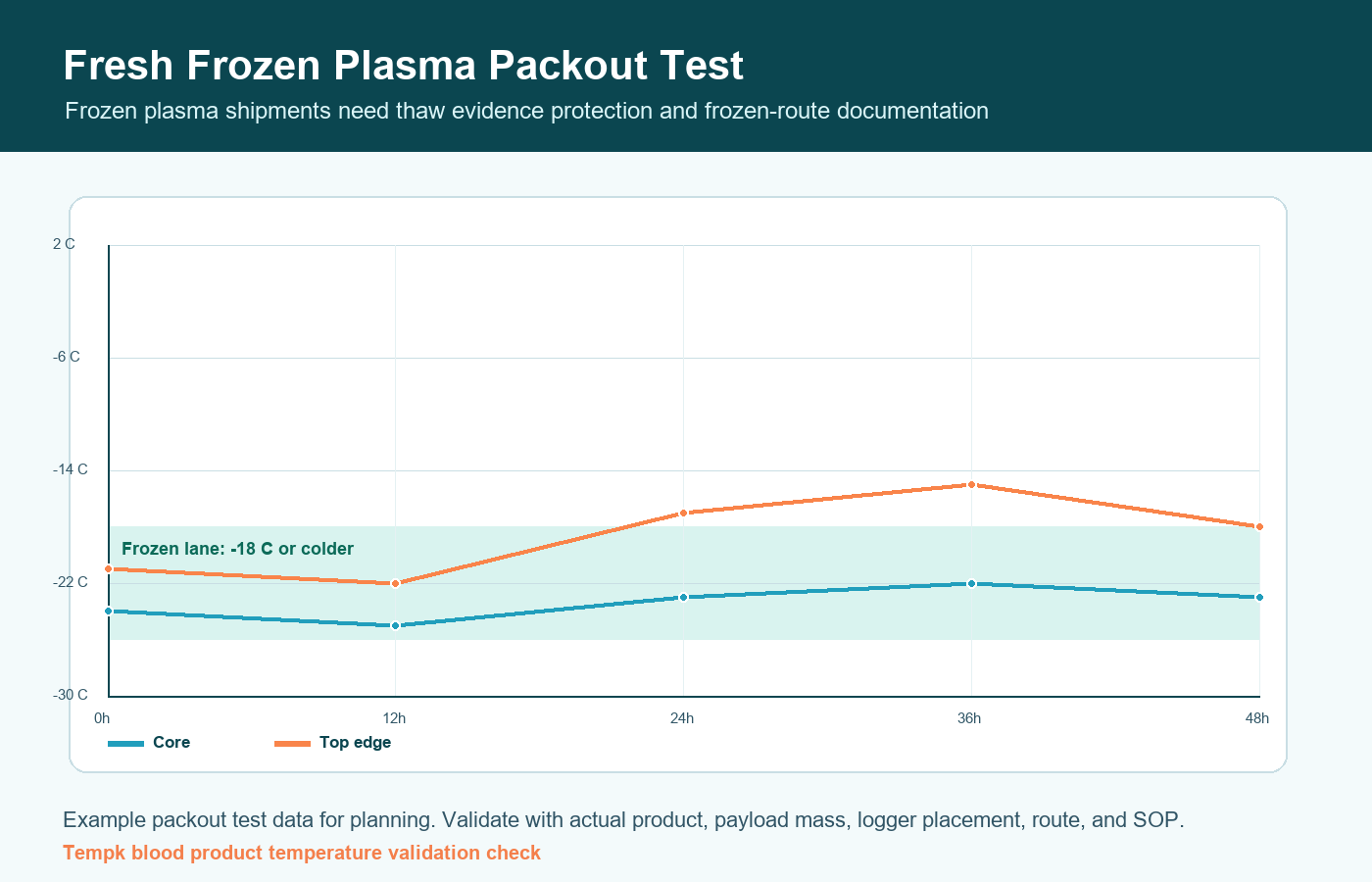
Utilisez la courbe de test comme comparaison de travail, puis validez avec le montant effectivement facturé, expéditeur, réfrigérant or glace carbonique mass, durée de la voie, profil ambiant, et processus de réception.
Utilisez ces pages pour comparer les itinéraires de produit sanguin à proximité, réfrigérant choices, options d'isolation, et des questions sur les risques d'itinéraire avant l'échantillonnage.
Plasma frais congelé needs a congelé route with enough réfrigérant capacity for delays. The configuration d'emballage should avoid décongélation partielle at the top layer and protect bags from glace carbonique pressure points.
Common failures include décongélation des bords, fragilité du sac, glace carbonique depletion, étiquette dégâts dus au gel, et cartons mouillés après trempe.
Utiliser un emballage isotherme qualifié pour le congelé, des séparateurs de poches et une barrière plate entre glace carbonique et poches de plasma. Garder les documents secs et hors de la zone la plus froide.
Utiliser de la glace carbonique ou un emballage congelé validé pour la durée requise. Dimensionner la glace carbonique pour la route plus le retard de réception, pas seulement le temps de transit prévu.
Vérifier la dureté du sac, glace carbonique remaining, enregistreur data, lisibilité de l'étiquette, and any signs of décongélation partielle.
Les itinéraires de plasma frais congelé doivent être dimensionnés pour le transit prévu et pour un délai de réception réaliste.. La couche supérieure et les sacs de bord se réchauffent généralement en premier, ils nécessitent donc une attention particulière dans le test de configuration d'emballage.
Use a congelé-qualified shipper, séparateurs de sacs, et une barrière de glace carbonique qui empêche les marques de pression ou les dommages causés par le gel sur les étiquettes. Gardez les documents au sec et en dehors de la zone la plus froide.
Tempk should validate glace carbonique mass, nombre de sacs, charge utile arrangement, et retard d'itinéraire. Check glace carbonique remaining, dureté du sac, enregistreur data, lisibilité de l'étiquette, and any décongélation partielle signs.
Prise en charge de la configuration d'emballage personnalisée
Pour des tailles de carton fixes, limites de charge utile, exigences en matière de marque, voies saisonnières, ou des cibles de validation, Tempk peut adapter cette solution dans une configuration d'emballage de chaîne du froid personnalisée.
Partager le type de composant, charge utile, taille du sac ou du contenant, plage cible, durée de l'itinéraire, conditions ambiantes, étapes de messagerie, remise limit, and contrôles à la réception. Tempk peut aider à comparer l'expéditeur, réfrigérant layout, insert de support, poste de surveillance, et plan de validation.
Demander une révision de configuration d'emballage