


Le ramollissement et la recongélation modifient la qualité
Les pots peuvent paraître gelés à la livraison alors que le produit a déjà perdu sa texture lisse..
Chaîne du froid des bacs à glace
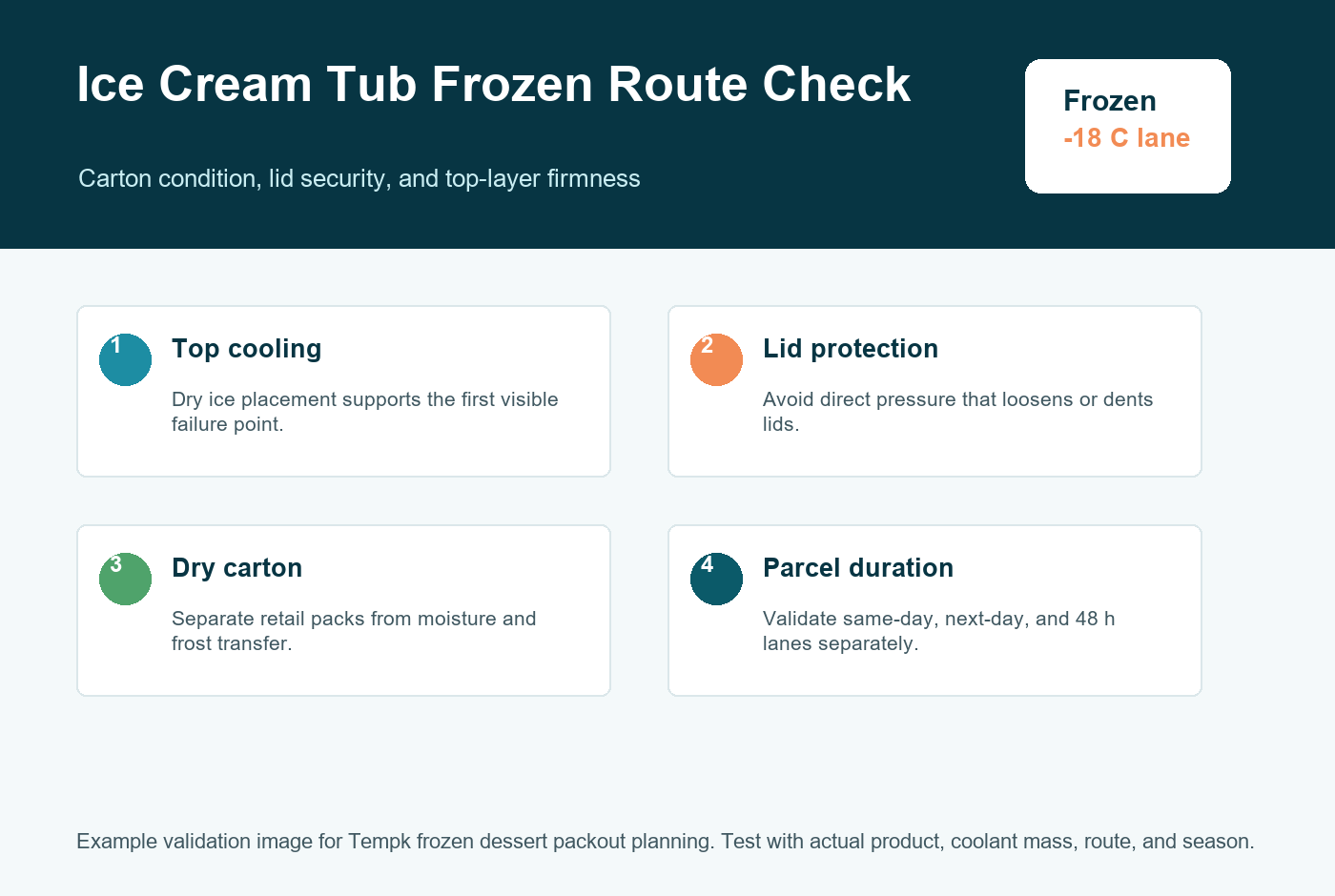
Les pots de glace sont plus robustes que les gâteaux décorés, mais ils échouent toujours lorsque les couvercles se desserrent, les cartons sont mouillés, le produit adoucit, ou la pression de la neige carbonique endommage l'emballage de vente au détail. L'emballage doit contenir un itinéraire gelé et protéger la pile de cuves.
Risque produit
Le bon colis doit protéger la qualité à l’arrivée, non seulement afficher une trace d'enregistreur froid. Les points de risque ci-dessous déterminent la masse de neige carbonique, isolation, assistance produit, ventilation, et recevoir des chèques.
Les pots peuvent paraître gelés à la livraison alors que le produit a déjà perdu sa texture lisse..
Glace sèche, séparateurs, et les autres baignoires ne doivent pas pousser les couvercles hors de leur position..
Le gel et la condensation peuvent affaiblir les pochettes en papier, étiquettes, et cartons extérieurs.
L'emballage doit être dimensionné de manière à ce qu'il reste une protection gelée à l'heure de réception prévue..
Recommandation basée sur l'itinéraire
Ce sont des plages de départ pratiques pour les tests d'itinéraire. La masse finale de glace carbonique et l'épaisseur de l'isolation doivent être vérifiées avec la charge utile réelle., expéditeur, mode transporteur, itinéraire, et recevoir la norme.
| Conditions d'expédition | Forfait Tempk recommandé | Démarrage de la direction de la glace carbonique | Position de la glace carbonique | Que valider |
|---|---|---|---|---|
| Livraison surgelée le jour même 8-18h itinéraire, ambiance ci-dessous 22 C, bacs surgelés | Expéditeur EPS ou EPP, diviseurs de baignoire, doublure, zone de glace carbonique, et carton extérieur ventilé | À propos 1.5-2.5 kg de neige carbonique pour un 2-5 kg de charge utile de la cuve comme plage de test initiale. Utilisez le calculateur de glace carbonique pour connaître la charge utile et l'itinéraire réels. | Zone de glace carbonique supérieure ou latérale avec séparateur; gardez la glace carbonique et les sacs lourds hors des couvercles de la baignoire. | Dureté de la baignoire, joint du couvercle, sécheresse de l'étiquette, état du carton, et glace carbonique restante |
| Itinéraire de colis de nuit 18-36h itinéraire, manutention du dépôt, ambiant 22-30 C | Expéditeur EPS/EPP plus épais, pile de baignoire fixe, doublure anti-humidité, diviseur de glace carbonique, et enregistreur | À propos 3.0-5.0 kg de neige carbonique pour un test de petite parcelle. Ajuster en fonction du nombre de cuves, volume de la boîte, niveau d'isolation, et limites des transporteurs. | Disposition de glace sèche sur le dessus et sur le côté avec un séparateur solide et un chemin d'évacuation des gaz. | Baignoire la plus chaude, mouvement du couvercle, gel, carton mouillé, et le reste de la neige carbonique |
| Itinéraire par temps chaud ou sujet aux retards 30-35 C ambiant, 36-48h risque, séjour le week-end possible | Expéditeur isolé plus performant, marge de glace carbonique plus grande, carton renforcé, expéditeur ventilé, et enregistreur d'itinéraire | À propos 5.0-8.0 kg de neige carbonique pour des tests prolongés. Confirmer l'espace libre, règles d'étiquetage, et les restrictions des opérateurs avant la mise à l'échelle. | Glace carbonique périmétrique avec séparateurs et sans pression directe sur le couvercle; garder les baignoires droites et stables. | Température maximale, glace carbonique restant en cas de livraison retardée, texture du produit, état de l'étiquette, et compression des cartons |
La masse de glace carbonique est un point de départ, pas une garantie. Ajuster en fonction de la température du produit à l'emballage, poids de charge utile, taille de l'expéditeur, matériau isolant, forme de glace carbonique, durée de l'itinéraire, profil ambiant, et les règles du transporteur. La neige carbonique ne doit pas être scellée dans un contenant hermétique, et les expéditions aériennes ou par colis peuvent nécessiter un étiquetage et une documentation spécifiques..
Structure du paquet
Les emballages de desserts glacés nécessitent un support produit et une séparation par glace carbonique avant que l'expéditeur ne soit scellé.. Commencez par l'état du produit, force du paquet de vente au détail, et ventilation, puis dimensionnez la neige carbonique et l'isolation.
Processus d'emballage
L'expéditeur doit conserver un produit congelé, pas sauver celui qui s'est déjà ramolli. Une bonne manipulation avant le scellage réduit la demande de glace carbonique et évite les défauts visibles du produit.
Ne laissez pas les bacs à température ambiante pendant la préparation du conditionnement..
Gardez les baignoires verticales, réduire l'espace vide, et évitez la pression du couvercle sur la glace carbonique.
Utilisez des séparateurs et une doublure pour que les étiquettes et les cartons ne gèlent pas et ne soient pas mouillés..
Examiner la dureté, joint du couvercle, sécheresse de l'étiquette, état du carton, trace de température, et le reste de la neige carbonique.
Quand changer la conception
Améliorer la doublure, diviseur de glace carbonique, et gestion de l'humidité avant de modifier la température de l'itinéraire.
Réduire la pression de la pile, ajouter des séparateurs, et éloignez la glace carbonique des couvercles.
Augmenter la marge d'isolation, ajuster la masse de glace carbonique, réduire la durée du trajet, ou modifier la taille de l'expéditeur.
Ressources connexes
Partager la taille de la baignoire, format carton, nombre de charges utiles, température du produit, temps de parcours, plage ambiante, mode transporteur, et recevoir des chèques. Tempk peut vous aider à choisir l'expéditeur, disposition de la glace carbonique, séparateurs, ventilation, et étapes de validation.
Demander une révision d'itinéraire geléPrise en charge des emballages personnalisés
Pour des tailles de carton fixes, limites de charge utile, exigences en matière de marque, voies saisonnières, ou des cibles de validation, Tempk peut adapter cette solution dans un emballage personnalisé pour la chaîne du froid.