


steak
Pilih paket gel dingin atau logika es kering beku berdasarkan apakah steak harus tiba dalam keadaan segar, sangat dingin, atau beku padat.
Pengiriman daging dan unggas bukanlah satu-satunya masalah pengemasan. Steak premium bisa didinginkan atau dibekukan, ayam mentah membutuhkan penahan kebocoran yang lebih kuat, dan daging deli membutuhkan presentasi ritel yang bersih. Kemasannya harus sesuai dengan bentuk produk, suhu target, perilaku pendingin, durasi rute, dan menerima pemeriksaan kualitas.
Suhu penting, namun program daging juga gagal karena kebocoran pembersihan, nampan yang dihancurkan, label basah, kontak pendingin, dan tujuan rute dingin-versus-beku yang tidak jelas.
Pilih paket gel dingin atau logika es kering beku berdasarkan apakah steak harus tiba dalam keadaan segar, sangat dingin, atau beku padat.
Kendalikan kebocoran unggas mentah, kapasitas penyerap, integritas kapal, dan risiko kontak silang saat memegang a 0-4 C rute dingin.
Melindungi 0-4 suhu C, keterbacaan label, penampilan paket ritel, kondensasi, dan pemisahan bau tanpa membekukan permukaan produk.
Gunakan rentang perencanaan ini untuk memilih paket Tempk pertama untuk pengujian. Massa pendingin akhir harus divalidasi dengan muatan yang tepat, ukuran isolasi, rute, dan musim.
| Rute produk | Sasaran bersama | Struktur kemasan | Titik awal cairan pendingin | Tonton dulu |
|---|---|---|---|---|
| Steak dingin premium, 8-36 H | 0-2 C untuk presentasi dingin berkualitas tinggi, atau 0-4 C jika program keamanan pangan memungkinkan. | Paket vakum atau baki, lapisan penyerap, kebocoran kapal, EPP atau karton terisolasi, paket gel terpisah atau 0 C PCM. | Tentang 0.8-2.8 paket gel kg atau PCM untuk 1-4 muatan kg. | Tanda beku, membersihkan, penyok baki, perubahan warna. |
| Dada ayam mentah, 8-36 H | 0-4 C rute dingin dengan kontrol kebocoran yang ketat. | Paket tersegel primer, lapisan sekunder, dasar penyerap, pendingin dipisahkan dari kemasan unggas. | Tentang 0.8-2.6 paket gel terkondisi kg atau PCM untuk 1-4 muatan kg. | Kebocoran, karton basah, risiko lintas kontak, lapisan atas yang hangat. |
| Sosis dan daging deli, 8-36 H | 0-4 C rute dingin untuk kemasan olahan atau siap makan. | Kantong atau nampan eceran, penghalang kondensasi, perlindungan label, pendingin samping dan atas dengan pembagi. | Tentang 0.6-2.2 paket gel kg atau PCM untuk 1-4 muatan kg. | Kondensasi, kerusakan label, perpindahan bau, pembekuan permukaan. |
| Pengiriman daging beku | -18 C atau lebih rendah ketika rute ditetapkan sebagai beku. | Pengirim beku, rencana es kering atau pendingin beku, celah uap, pemeriksaan label dan operator. | Gunakan perencanaan es kering berdasarkan ukuran kotak, berat daging, waktu rute, dan batas pembawa. | Sublimasi es kering, mencair pada mil terakhir, penandaan peraturan. |
Untuk palet beku atau program massal, melihat Palet Daging Beku. Untuk program berlangganan, melihat Kotak Daging DTC.
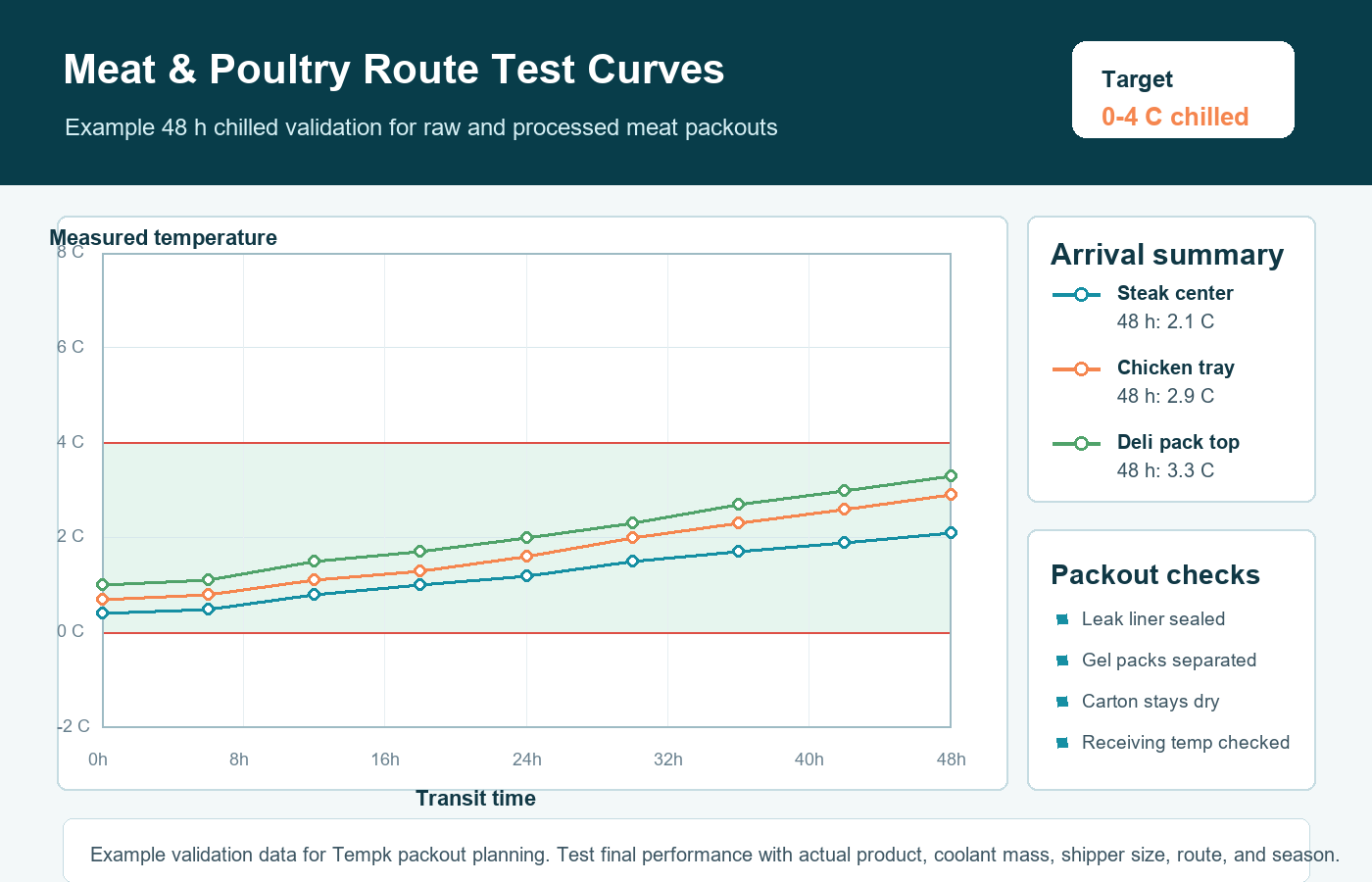
Kurva suhu hanya berguna bila dipasangkan dengan cek penerimaan: membersihkan, kebocoran, kondisi label, kekeringan karton, posisi pendingin, dan kualitas permukaan produk.
Panduan produk ini mendukung halaman kategori tanpa memaksa setiap produk ke halaman solusi terpisah.
Gunakan panduan ini ketika produk bukan merupakan salah satu dari tiga halaman prioritas namun masih memerlukan keputusan pengemasan daging khusus produk.
Gunakan panduan ini ketika produk bukan merupakan salah satu dari tiga halaman prioritas namun masih memerlukan keputusan pengemasan daging khusus produk.
Gunakan panduan ini ketika produk bukan merupakan salah satu dari tiga halaman prioritas namun masih memerlukan keputusan pengemasan daging khusus produk.
Gunakan panduan ini ketika produk bukan merupakan salah satu dari tiga halaman prioritas namun masih memerlukan keputusan pengemasan daging khusus produk.
Gunakan alat untuk mengukur percobaan pertama, kemudian validasi dengan muatan daging asli dan penerimaan cek.
Bagikan formulir produk, target dingin atau beku, berat muatan, ukuran kotak, durasi rute, musim, dan menerima cek. Tempk dapat membantu memilih isolasi, massa pendingin, struktur kapal, dan langkah validasi.
Daging & Pengiriman unggas tidak boleh menggunakan satu kotak resep tetap untuk setiap produk. Mulailah dengan 0-4 C kontrol dingin untuk potongan segar atau -18 C untuk program daging beku, kemudian pisahkan produk berdasarkan beban panas, kekuatan kemasan, dan bagaimana mereka diterima. Untuk program campuran, Tempk biasanya membandingkan rute lokal yang pendek, rute paket semalam, dan perkiraan musim terpanas sebelum mengonfirmasi pengirim.
Gunakan dukungan paket vakum, bantalan penyerap, kebocoran kapal, karton terisolasi, dan perlindungan sudut. Rencana pendingin harus dimulai dengan kemasan gel untuk kemasan dingin dan es kering atau PCM beku untuk jalur beku yang memerlukan waktu penahanan lebih lama.. Ketika muatan memiliki karton eceran yang halus, tekstur lembut, materi hidup, atau dokumentasi medis, lindungi muatannya terlebih dahulu lalu tambahkan kapasitas pendinginan. Jika pengiriman mengalami keterlambatan saat pengepakan, serah terima, bea cukai, atau transfer dermaga, profil rute harus diperiksa ulang daripada hanya menambah berat cairan pendingin.
Validasi harus mencakup kontrol pembersihan pembersihan, suhu permukaan, kompresi karton, dan waktu bongkar di tempat tujuan. Tes yang berguna mencatat titik muatan terpanas, titik terdingin di dekat cairan pendingin, dan kondisi penerimaan setelah penanganan. Ini memberi tim operasi instruksi paket praktis, bukan hanya grafik suhu.
Dukungan paket khusus
Untuk ukuran karton tetap, batas muatan, persyaratan merek, jalur musiman, atau target validasi, Tempk dapat mengadaptasi solusi ini ke dalam paket rantai dingin khusus.