


Risco de congelamento do rosto frio
Gel refrigerante congelado pode criar um ponto frio local mesmo quando o registrador central permanece na faixa esperada.
Anticorpos monoclonais are often shipped as refrigerated produtos biológicos, onde o principal problema da embalagem não é simplesmente permanecer frio. The configuração de embalagem has to prevent heat exposure, congelando na face do refrigerante, esmagamento de cartucho, condensação, e estresse relacionado à vibração durante a transferência.
O rótulo do produto e o SOP do patrocinador decidem a linha final. Para planejamento de embalagens, os riscos comuns abaixo são aqueles que devem ser removidos antes da validação da rota.
Gel refrigerante congelado pode criar um ponto frio local mesmo quando o registrador central permanece na faixa esperada.
Escolher, transferência de aeronave, morada em armazém, e o atraso de recebimento geralmente cria o ponto mais quente próximo ao topo ou à parede externa.
Umidade, divisórias apertadas, ou refrigerante pesado pode danificar os cartuchos secundários, rótulos, e documentação serializada.
| Condição da rota | Objetivo de temperatura | Configuração de embalagem | Planejamento de refrigerante ou dry shipper | Verificação no recebimento |
|---|---|---|---|---|
| Correio controlado ou entrega clínica, 0-8 h | Manter 2-8 Planejamento C evitando qualquer contato congelado. | EPP pré-condicionado ou carregador de cartucho isolado, manga de carga útil, barreira de umidade, and one registrador near carga útil. | Por um 3-8 eu expedidor, julgamento 0.8-1.5 kg condicionado 2-8 C PCM ou gel refrigerante refrigerado atrás de uma divisória. | Sem marcas de frio, rotulo seco, cartucho intacto, registro de temperatura, e tempo de transferência. |
| Pacote ou correio especializado, 8-24 h | Mantenha o intervalo refrigerado durante a coleta, classificação, e atraso no recebimento. | Maior isolamento, almofadas de buffer superior e lateral, camada PCM separada, duas posições de registrador para borda quente e face fria. | Inicie testes em pistas pequenas 1.5-3.5 kg 2-8 PCM. Aumente o líquido refrigerante somente após a revisão do ponto frio. | Borda quente, cara fria, esmagamento de cartucho, condensação, e atraso do receptor. |
| Estação quente ou rota internacional, 24-48 h | Evite a exposição ao calor sem criar risco de congelamento durante o pré-condicionamento ou transferência de voo. | Remetente validado, perfil de pista sazonal, espaçador de carga útil, camada absorvente ou de controle de umidade, e plano de transferência pronto para o receptor. | Faixas mais longas podem precisar 3-6 kg PCM em um remetente maior. Use testes de rota antes de remessas comerciais ao vivo. | Revisão completa da curva, condição restante do líquido refrigerante, sem papelada molhada, e aprovação do receptor. |
Use esses valores como pontos de partida para amostragem e cotação. Líquido refrigerante final, PCM, gelo seco, isolamento, expedidor seco, gravador, e as escolhas de manuseio devem ser validadas com a carga útil real, faixa, processo de transporte, temporada, e procedimento de recebimento.
Load the anticorpo cartuchos into a stable configuração de embalagem. Não use o carregador para resfriar uma carga quente útil.
Mantenha PCM ou gel refrigerante atrás da espuma, ondulado, ou espaçamento moldado para que os cartuchos não possam tocar uma superfície congelada ou muito fria.
Utilize divisórias que seguram o cartucho sem compressão e mantenham a papelada longe de zonas de condensação.
Durante o teste, coloque os sensores na provável borda quente e no ponto de risco do lado do refrigerante, não só no centro.
Estes são os problemas visíveis e operacionais que a configuração de embalagem deve reduzir antes que a remessa chegue ao destinatário.
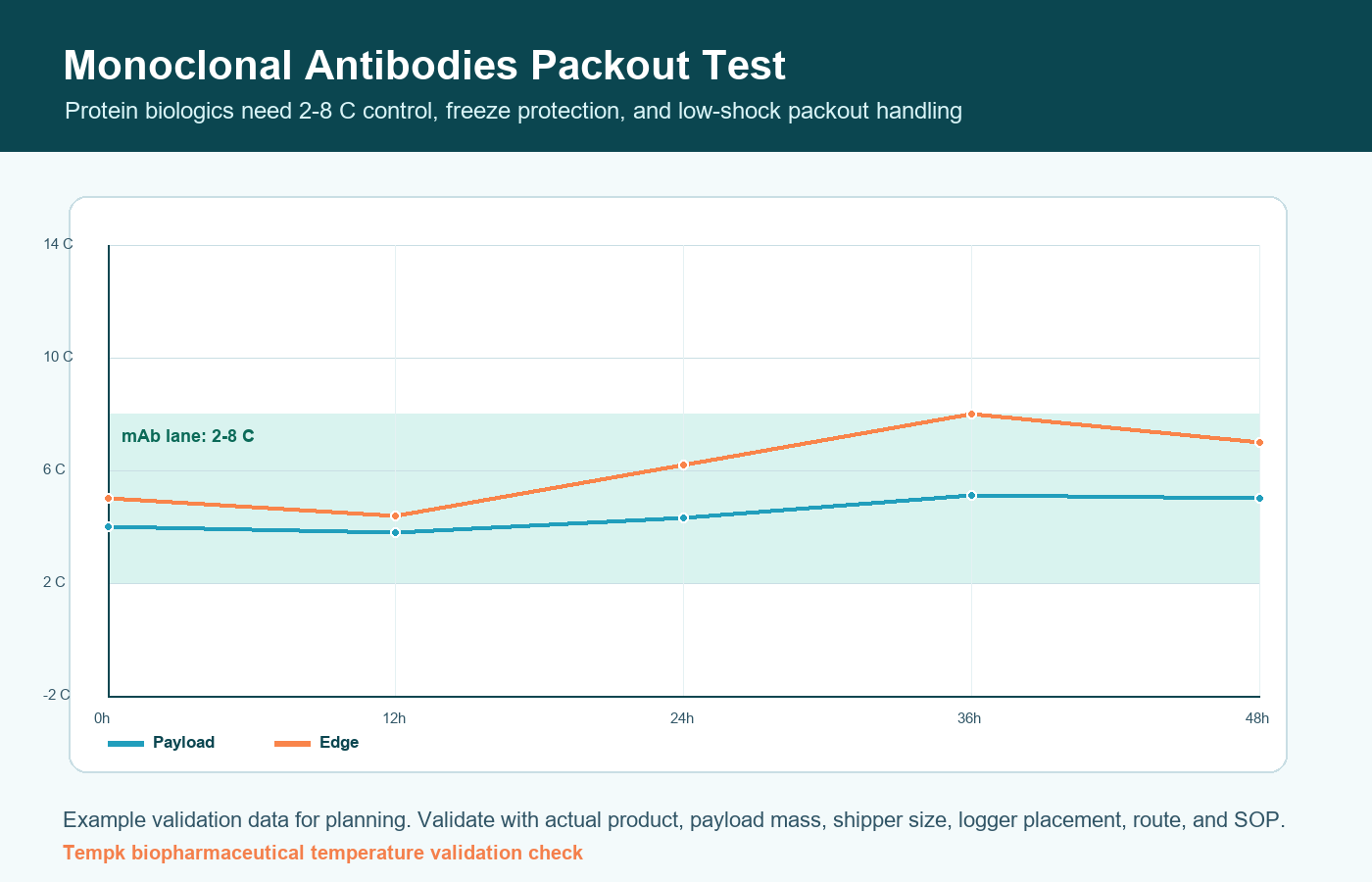
Use a curva de teste como uma comparação funcional, então valide com a carga útil real, remetente, configuração de refrigerante ou despachante seco, duração da pista, perfil ambiente, e processo de recebimento.
Use estas páginas para comparar rotas biofármacoscêuticas próximas, escolhas de refrigerante, opções de isolamento, e perguntas sobre risco de rota antes da amostragem.
Anticorpos monoclonais são comumente produtos biológicos refrigerados onde a exposição ao congelamento e a vibração podem ameaçar a qualidade do produto. A embalagem deve manter a temperatura e proteger frascos ou unidades pré-cheias.
Os principais riscos são contato com congelamento, quebra de frascos, amassamento de cartuchos, posicionamento incorreto do registrador de temperatura e recebimento hospitalar atrasado.
Use uma cavidade de carga útil qualificada com divisórias de frasco ou suporte de cartucho. Mantenha o líquido refrigerante atrás dos espaçadores e adicione amortecimento onde a pista tiver alta intensidade de manuseio.
Usar 2 para 8 C PCM ou gel refrigerante condicionado para pistas refrigeradas validadas. Evite gelo seco, a menos que o produto esteja etiquetado para transporte congelado.
Check registrador data, condição do frasco, integridade do cartucho, e tempo de recebimento. Incluir uma faixa sensível à vibração se for esperado manuseio expresso aéreo.
Anticorpos monoclonais necessitam de transporte refrigerado estável e proteção contra congelamento. The configuração de embalagem should hold frascos or cartuchos securely so vibration and impact do not become a hidden risk.
Usar 2 para 8 C PCM ou gel refrigerante condicionado atrás dos espaçadores. Adicione divisórias de frasco, uma cavidade de carga útil protegida, e um registrador colocado com o medicamento em vez de ao lado do refrigerante.
A validação temporária deve incluir a contagem do frasco, tamanho do cartucho, duração da rota, manuseio expresso aéreo, e atraso no recebimento. Revise a temperatura mínima, danos sensíveis à vibração, integridade do cartucho, and registrador data.
Custom configuração de embalagem support
Para tamanhos de cartuchos fixos, carga útil limits, requisitos de marca, pistas sazonais, ou alvos de validação, Tempk can adapt this solution into a custom cold-chain configuração de embalagem.
Compartilhe a apresentação do anticorpo, contagem de cartuchos, faixa alvo, tamanho do remetente, duração da rota, perfil ambiente, pontos de transferência, e exigência do registrador. Tempk pode ajudar a comparar a massa do PCM, isolamento, estrutura divisória, e layout de validação.
Request a configuração de embalagem review