


Filetes de Salmão
Proteja a textura gelada, apresentação do lado da pele, controle de gotejamento, e secura da caixa sem permitir que os pacotes de gel congelado toquem diretamente no pacote de peixe.
As remessas de frutos do mar falham por diferentes motivos: filés frescos podem vazar e perder textura, bifes de atum precisam de um controle mais rígido de permanência quente, ostras devem ficar frias sem congelar, e frutos do mar congelados precisam de um plano de rota de congelamento separado. Esta página ajuda a combinar o tipo de frutos do mar com o isolamento, colocação de refrigerante, controle de umidade, e validação de rota.
Peixe fresco, marisco vivo, e frutos do mar congelados precisam de um comportamento de refrigeração diferente. A embalagem deve proteger a temperatura, umidade, vazamento, odor, e pressão do produto ao mesmo tempo. For fully frozen lanes, ver frozen foods embalagem de cadeia de frio solutions.
Proteja a textura gelada, apresentação do lado da pele, controle de gotejamento, e secura da caixa sem permitir que os pacotes de gel congelado toquem diretamente no pacote de peixe.
Controlar a permanência quente, cor da superfície, transferência de odor, e marcas de pressão para programas de atum sensíveis à histamina que se deslocam através de encomendas ou rotas aéreas.
Mantenha ostras frias, úmido, e protegido do congelamento, água derretida em pé, força esmagadora, e etiquetas de marisco ilegíveis.
Esses intervalos de planejamento ajudam a decidir qual pacote Tempk validar primeiro. A massa final do líquido refrigerante deve ser testada com a carga útil real, Tamanho da caixa, temperatura da pista, e nível de serviço.
| Rota dos frutos do mar | Alvo comum | Estrutura da embalagem | Ponto de partida do refrigerante | Assista primeiro |
|---|---|---|---|---|
| Filetes frescos, 8-18 h | Segure perto de 0-2 C para qualidade enquanto permanece dentro do programa de segurança alimentar do expedidor. | Forro de vazamento, almofada absorvente, bandeja de produto ou saco de vácuo, refrigerante lateral/perimetral, EPP ou caixa isolada. | Sobre 0.6-1.2 kg de pacotes de gel condicionado ou 0 CPCM para 1-3 kg de carga útil. | Marcas de congelamento direto, pingar, caixas molhadas, transferência de odor. |
| Peixe fresco, 18-36 h | Rota quase gelada com menos permanência quente na coleta e entrega. | Isolamento mais forte, forro interno selado, refrigerante superior e lateral separados, registrador no espaço aéreo do produto. | Sobre 1.2-2.4 kg de pacotes de gel ou PCM para 1-3 kg de carga útil. | Contato de refrigerante, compressão de caixa, temperatura de recepção. |
| Marisco vivo, 8-30 h | Frio e úmido, mas não congelado ou submerso em água derretida. | Design de expedidor respirável ou não hermético, conforme necessário, forro úmido, proteção de casca, refrigerante separado acima ou ao lado do produto. | Sobre 0.5-1.8 pacotes de gel condicionado kg, ajustado ao volume e à estação do marisco. | Lesão por congelamento, água parada, quebra de casca, legibilidade da etiqueta. |
| Frutos do mar congelados | -18 C ou inferior quando a rota é especificada como congelada. | Remetente Congelado, plano de gelo seco ou refrigerante congelado, lacuna de vapor, verificações de etiqueta e transportadora. | Use o planejamento de gelo seco por tamanho de caixa, carga útil, tempo de rota, e limite da operadora. | Sublimação com gelo seco, marcação regulamentar, descongelar na última milha. |
Use-os como intervalos de planejamento, então valide. Para paletes de frutos do mar congelados, ver Paletes de frutos do mar congelados.
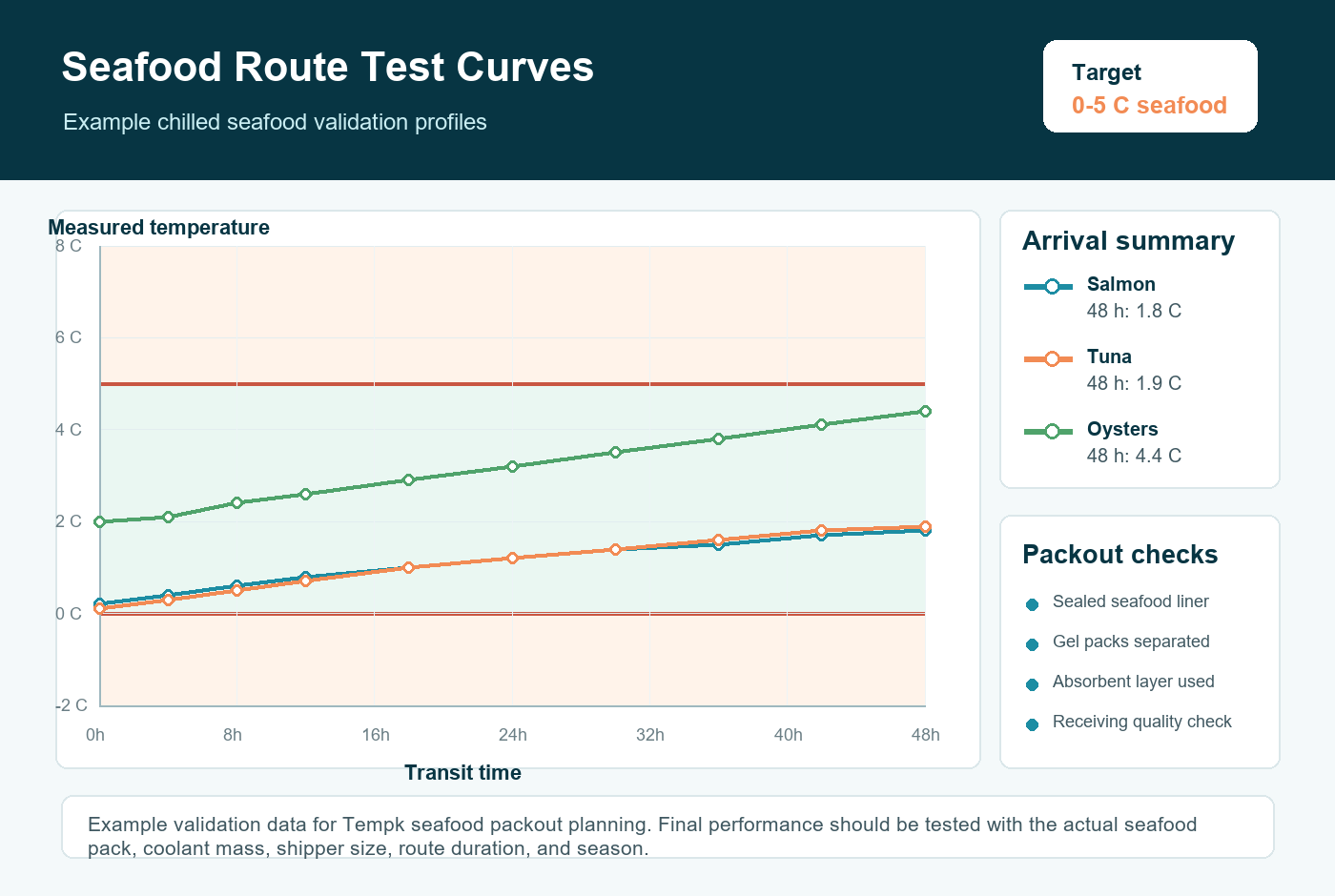
Uma verificação da rota de frutos do mar deve mostrar tanto o controle da temperatura quanto a condição do produto no recebimento: pingar, odor, pressão de casca ou filé, condição do rótulo, e se o refrigerante permaneceu separado do produto.
Use estas notas de produto quando o tipo de frutos do mar não for uma das três páginas prioritárias, mas ainda precisar de umidade diferente, pressão, ou decisões de colocação de refrigerante.
Para programas menores de frutos do mar que ainda precisam de notas de manuseio específicas do produto, revise o guia de embalagem antes de construir o teste de pista.
Para programas menores de frutos do mar que ainda precisam de notas de manuseio específicas do produto, revise o guia de embalagem antes de construir o teste de pista.
Para programas menores de frutos do mar que ainda precisam de notas de manuseio específicas do produto, revise o guia de embalagem antes de construir o teste de pista.
Para programas menores de frutos do mar que ainda precisam de notas de manuseio específicas do produto, revise o guia de embalagem antes de construir o teste de pista.
Para programas menores de frutos do mar que ainda precisam de notas de manuseio específicas do produto, revise o guia de embalagem antes de construir o teste de pista.
Execute um primeiro cálculo, escolha a família do refrigerante, e depois valide a rota com o pacote de frutos do mar real. For parcel and express lanes, ver parcel and express delivery cold chain solutions.
Programas relacionados: Caixas de assinatura de frutos do mar e todas as soluções de cadeia de frio.
Compartilhe a forma de frutos do mar, peso da carga útil, Tamanho da caixa, nível de serviço, temperatura de origem, temporada de pista, e janela de recebimento. Tempk pode ajudar a comparar o isolamento, massa de refrigerante, colocação, e etapas de validação.
Os envios de frutos do mar não devem usar uma receita de caixa fixa para cada produto. Comece com 0-2 Controle refrigerado C para frutos do mar frescos ou -18 Controle C para formatos congelados, em seguida, separe os produtos por carga de calor, força da embalagem, e como eles são recebidos. Para programas mistos, Tempk geralmente compara uma rota local curta, uma rota noturna de encomendas, e a estação mais quente esperada antes de confirmar o remetente.
Use um forro resistente a vazamentos, camada absorvente, expedidor isolado, e caixa externa com controle de orientação claro. O plano de refrigeração deve começar com bolsas de gelo em gel para frutos do mar resfriados, gelo seco ou PCM congelado somente quando o produto for vendido congelado. Quando a carga contém caixas de varejo delicadas, textura macia, material ao vivo, ou documentação médica, proteja a carga útil primeiro e depois adicione capacidade de resfriamento. Se a remessa atrasar na embalagem, não interferir, alfândega, ou transferência de doca, o perfil da rota deve ser verificado novamente em vez de apenas aumentar o peso do líquido refrigerante.
A validação deve incluir a verificação da perda de gotejamento, controle de odor, secura superficial, e registros do registrador no ponto mais quente do produto. Um teste útil registra o ponto de carga útil mais quente, o ponto mais frio perto do refrigerante, e a condição de recebimento após o manuseio. Isso dá à equipe de operações uma instrução prática de embalagem, não apenas um gráfico de temperatura.
Suporte a pacotes personalizados
Para tamanhos de caixa fixos, limites de carga útil, requisitos de marca, pistas sazonais, ou alvos de validação, A Tempk pode adaptar esta solução em um pacote personalizado de cadeia de frio.