


Glace carbonique depletion
Une voie qui semble courte peut perdre rapidement sa glace carbonique par temps chaud, lors d'un transfert aérien ou avec une longue attente à réception.
Vecteurs de thérapie génique often move in frozen, congelé à ultra-basse température, or cryogénique lanes. La bonne configuration dépend de la gamme étiquetée et du format du flacon: un expéditeur de glace carbonique peut convenir pour une voie, tandis qu'une autre route nécessite un expéditeur sec validé.
Les expéditions vectorielles nécessitent à la fois un contrôle de la température et un contrôle physique. The route should prevent décongélation, recongélation, mouvement du flacon, glace carbonique contact damage, et problèmes de paperasse.
Une voie qui semble courte peut perdre rapidement sa glace carbonique par temps chaud, lors d'un transfert aérien ou avec une longue attente à réception.
Des contrôles répétés d'ouverture des portes ou une remise lente peuvent réchauffer suffisamment les flacons pour créer une exception d'itinéraire..
Supports lâches, direct glace carbonique contact, et les documents mouillés par le gel peuvent causer des problèmes de réception même lorsque la glace carbonique reste.
| Condition de route | Objectif de température | Configuration d'emballage | Planification du réfrigérant ou du dry shipper | Contrôle à la réception |
|---|---|---|---|---|
| Glace carbonique route, 0-24 h | Use the product-approved frozen or ultra-basse température range and avoid décongélation during configuration d'emballage. | Vented glace carbonique shipper, support de support pour flacons, glace carbonique barrier, confinement absorbant ou secondaire, et pochette pour documents protégée. | Pour les petits colis, les premiers tests commencent souvent vers 3-7 kg glace carbonique, puis ajustez par température de voie, charge utile masse, et les règles du transporteur. | Enregistreur curve, remaining glace carbonique, position du flacon, pas de documents mouillés, and immediate congélateur transfer. |
| Glace carbonique route, 24-48 h ou saison chaude | Maintenir la gamme surgelée grâce au ramassage, transfert, risque du week-end, et retard de réception. | Expéditeur de plus grande capacité, placement de glace carbonique supérieure et latérale avec séparation, examen des risques liés à l'itinéraire, et rendez-vous du séquestre. | De nombreux essais de petite et moyenne envergure commencent vers 8-15 kg glace carbonique. Use the glace carbonique calculator, puis validez le véritable expéditeur et la voie. | Glace carbonique remaining, no décongélation evidence, état du support, intégrité du carton extérieur, et horodatage de réception. |
| Cryogénique or product-specific route | Utiliser un expéditeur sec validé lorsque l’étiquette du produit ou la SOP requiert des conditions LN2. | Expéditeur sec préchargé, support de cassette ou de canister pour flacons, chaîne de possession records, sceau d'inviolabilité, et contrôle d'orientation. | Planifier par réserve de temps de rétention de l'expéditeur sec, not glace carbonique mass. Do not substitute glace carbonique for a cryogénique route unless the product owner approves. | Statut d'expéditeur sec, registres de possession, orientation, remise notes, et transfert de stockage. |
Utilisez ces valeurs comme points de départ pour l'échantillonnage et la cotation. Liquide de refroidissement final, PCM, glace carbonique, isolation, expéditeur sec, enregistreur, et les choix de manipulation doivent être validés à la charge réelle utile, voie, processus de transport, saison, et procédure de réception.
Choose glace carbonique, ultra-basse température, ou la logique de l'expéditeur à sec à partir de l'étiquette du produit et des SOP avant de choisir une boîte.
Utilisez un support et des barrières pour que les flacons ne s'enfoncent pas directement dans les blocs de glace carbonique ou les granulés en vrac..
Placez les documents dans une pochette sèche et à l'écart de la zone de glace carbonique afin que le destinataire puisse lire les étiquettes et libérer les documents..
Thérapie génique lanes should arrive to an assigned congélateur, récepteur formé, et processus de transfert documenté.
Ce sont les problèmes visibles et opérationnels que la configuration d'emballage devrait réduire avant que l'envoi n'atteigne le destinataire..
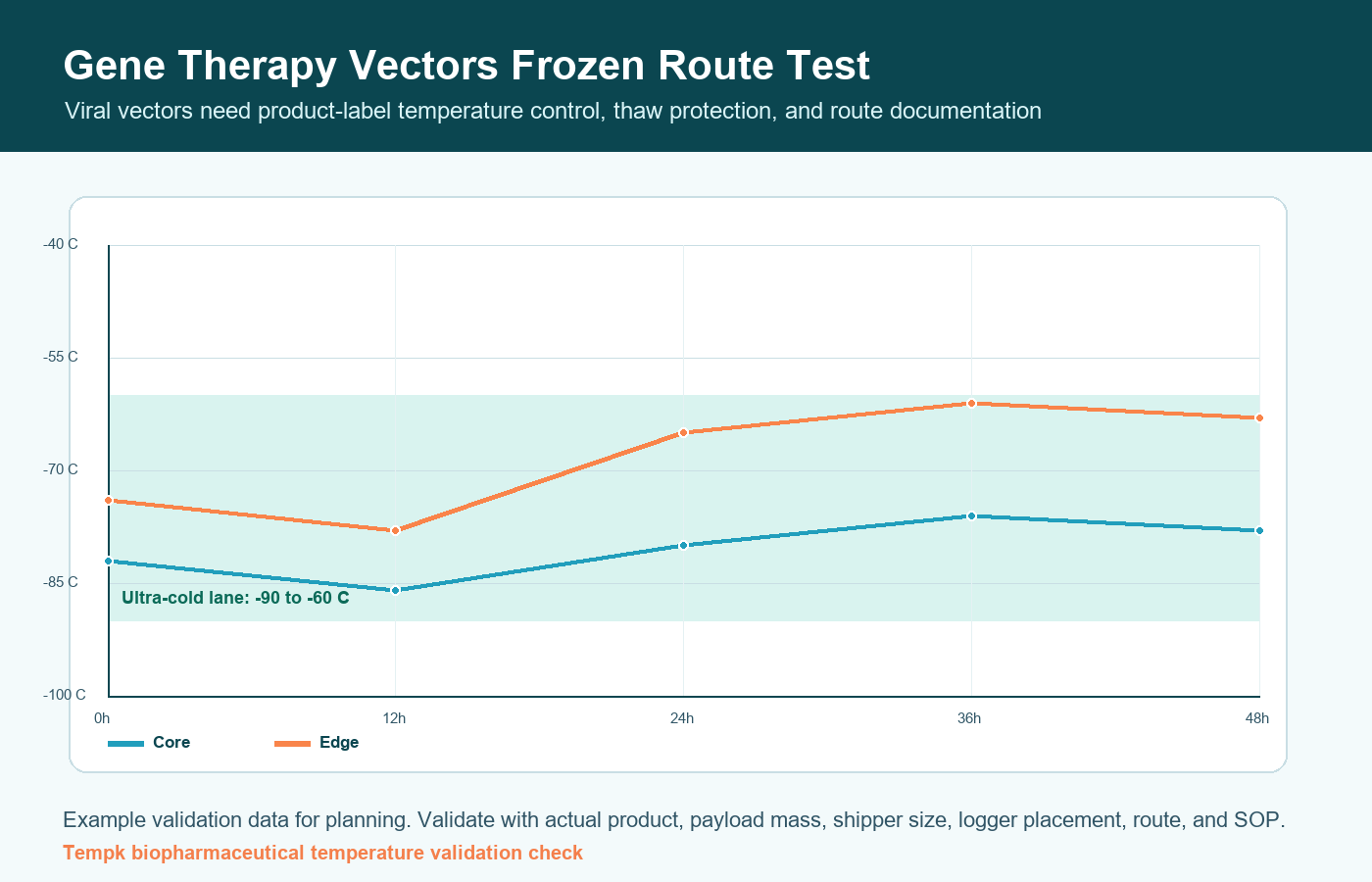
Utilisez la courbe de test comme comparaison de travail, puis validez avec le montant effectivement facturé, expéditeur, configuration de liquide de refroidissement ou d'expéditeur sec, durée de la voie, profil ambiant, et processus de réception.
Utilisez ces pages pour comparer les itinéraires de médicaments biologiques à proximité, choix de liquide de refroidissement, options d'isolation, et des questions sur les risques d'itinéraire avant l'échantillonnage.
Vecteurs de thérapie génique may require deep frozen or cryogénique transport, selon la formule. La configuration d'emballage doit être sélectionnée à partir de l'exigence de stabilité du produit, pas de médecine générale.
Les risques principaux sont l'épuisement de la glace carbonique, la casse de flacons, la décongélation pendant un retard douanier, la panne d'enregistreur et la perte de documents de possession.
Utiliser des supports à flacons, confinement secondaire, et une zone de charge utile qui maintient les échantillons stables pendant la manipulation. La documentation doit rester accessible sans ouvrir la zone froide.
Use glace carbonique or cryogénique equipment according to the validé lane. Standard 2 à 8 Les emballages C ne sont pas adaptés aux envois de vecteurs surgelés.
Check glace carbonique margin, température utile de charge, intégrité du flacon, les douanes habitent, et les enregistrements de la chaîne de possession avant d'approuver la voie.
Prise en charge de la configuration d'emballage personnalisée
Pour des tailles de carton fixes, limites de charge utile, exigences en matière de marque, voies saisonnières, ou des cibles de validation, Tempk peut adapter cette solution dans une configuration d'emballage de chaîne du froid personnalisée.
Partager le type de vecteur, étiquetteed storage range, format flacon ou rack, durée de l'itinéraire, conditions ambiantes, glace carbonique allowance, étapes du transporteur, et réception du plan congélateur. Tempk can help compare glace carbonique mass, structure de l'expéditeur, séparateurs, et contrôles de validation.
Demander une révision de configuration d'emballage