


Risque de gel du visage froid
Les accumulateurs de gel congelés peuvent créer un point froid local même si l'enregistreur central reste dans la plage attendue.
Anticorps monoclonaux are often shipped as refrigerated médicaments biologiques, où le principal problème de l'emballage n'est pas simplement de rester froid. La configuration d'emballage doit empêcher l'exposition à la chaleur, gel au niveau de la face du liquide de refroidissement, carton écrasé, condensation, et stress lié aux vibrations lors de la remise.
L'étiquette du produit et la SOP du sponsor décident de la gamme finale. Pour la planification de l'emballage, les risques courants ci-dessous sont ceux à supprimer avant validation de route.
Les accumulateurs de gel congelés peuvent créer un point froid local même si l'enregistreur central reste dans la plage attendue.
Ramasser, transfert d'avion, séjour dans l'entrepôt, et le retard de réception crée souvent le point le plus chaud près du mur supérieur ou extérieur.
Humidité, diviseurs serrés, ou un liquide de refroidissement lourd peut endommager les cartons secondaires, étiquettes, et documents sérialisés.
| Condition de route | Objectif de température | Configuration d'emballage | Planification du réfrigérant ou du dry shipper | Contrôle à la réception |
|---|---|---|---|---|
| Livraison contrôlée par courrier ou en clinique, 0-8 h | Maintenir 2-8 C planifier en évitant tout contact gelé. | Expéditeur en EPP ou carton isotherme préconditionné, pochette charge utile, barrière contre l'humidité, and one enregistreur near charge utile. | Pour un 3-8 L expéditeur, procès 0.8-1.5 kg conditionné 2-8 C PCM ou accumulateurs de gel réfrigérés derrière une cloison. | Pas de marques de froid, étiquette dry, carton intact, enregistrement de température, et heure de remise. |
| Courrier de colis ou spécialisé, 8-24 h | Conserver la cuisinière réfrigérée jusqu'au ramassage, tri, et retard de réception. | Isolation supérieure, tampons supérieurs et latéraux, couche PCM séparée, deux positions d'activation pour bord chaud et face froide. | Commencer des essais sur petites voies 1.5-3.5 kg 2-8 CPCM. Augmentez le liquide de refroidissement uniquement après un examen du point froid. | Bord chaud, visage froid, carton écrasé, condensation, et retard du récepteur. |
| Saison chaude ou itinéraire international, 24-48 h | Empêche l'exposition à la chaleur sans créer de risque de gel pendant le préconditionnement ou le transfert en vol. | Expéditeur validé, profil de voie saisonnier, charge utile spacer, couche absorbante ou de contrôle de l'humidité, et plan de remise prêt à être réceptionné. | Des voies plus longues peuvent être nécessaires 3-6 kg PCM chez un expéditeur plus important. Utiliser les tests d'itinéraire avant les expéditions commerciales en direct. | Examen complet de la courbe, état restant du liquide de refroidissement, pas de paperasse mouillée, et approbation du destinataire. |
Utilisez ces valeurs comme points de départ pour l'échantillonnage et la cotation. Liquide de refroidissement final, PCM, glace carbonique, isolation, expéditeur sec, enregistreur, et les choix de manipulation doivent être validés à la charge réelle utile, voie, processus de transport, saison, et procédure de réception.
Charger les cartons d'anticorps dans une configuration d'emballage stable. N'utilisez pas l'expéditeur pour refroidir une charge chaude utile.
Gardez le PCM ou les accumulateurs de gel derrière la mousse, ondulé, ou espacement moulé afin que les cartons ne puissent pas toucher une surface gelée ou trop froide.
Utilisez des séparateurs qui maintiennent le carton sans compression et éloignent les documents des zones de condensation..
Pendant les tests, placer les capteurs sur le bord chaud probable et le point à risque côté liquide de refroidissement, pas seulement au centre.
Ce sont les problèmes visibles et opérationnels que la configuration d'emballage devrait réduire avant que l'envoi n'atteigne le destinataire..
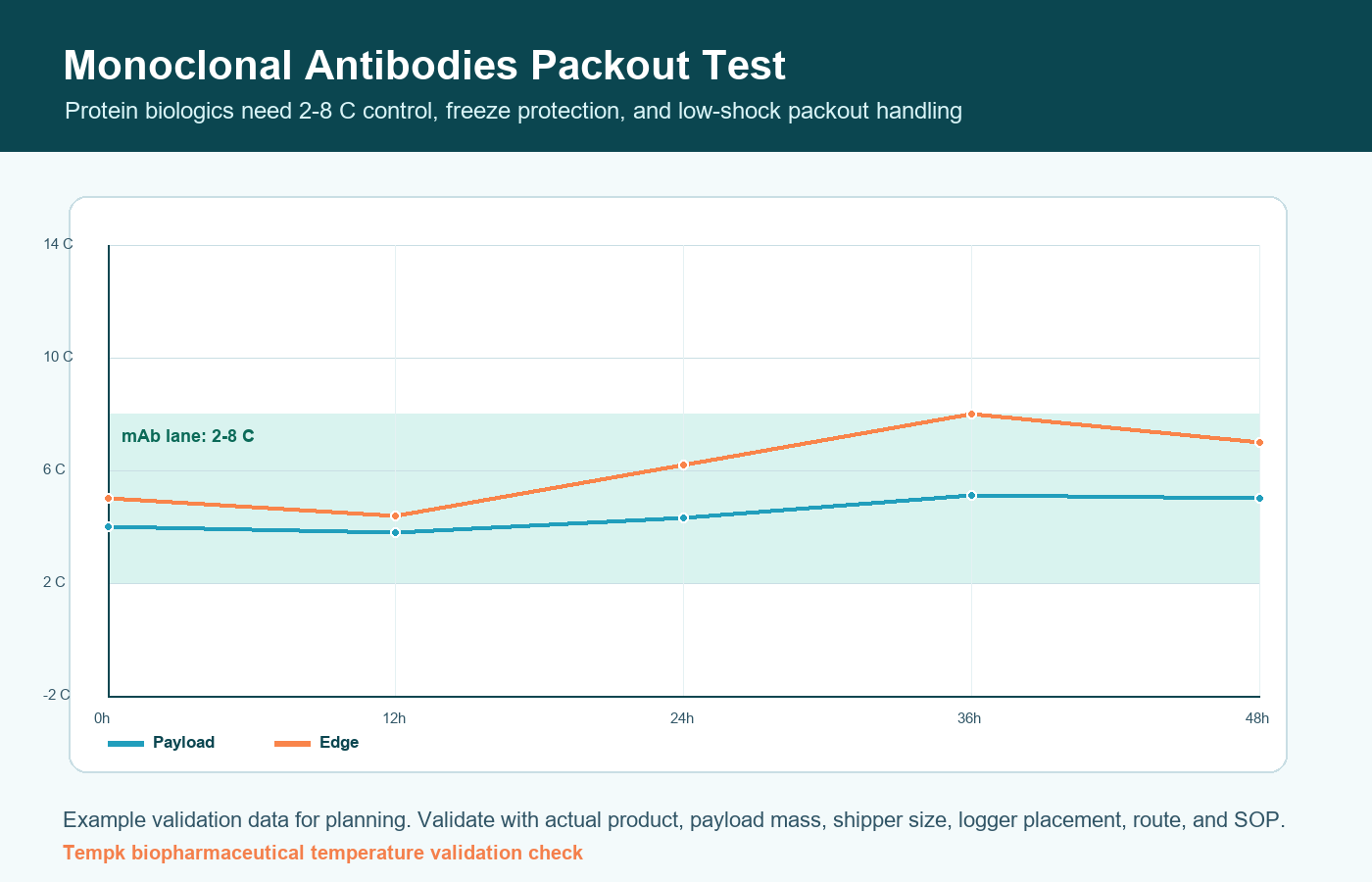
Utilisez la courbe de test comme comparaison de travail, puis validez avec le montant effectivement facturé, expéditeur, configuration de liquide de refroidissement ou d'expéditeur sec, durée de la voie, profil ambiant, et processus de réception.
Utilisez ces pages pour comparer les itinéraires de médicaments biologiques à proximité, choix de liquide de refroidissement, options d'isolation, et des questions sur les risques d'itinéraire avant l'échantillonnage.
Les anticorps monoclonaux sont des médicaments biologiques généralement réfrigérés où l'exposition au gel et aux vibrations peuvent menacer la qualité du produit.. L'emballage doit maintenir la température et protéger les flacons ou les unités préremplies.
Les risques clés sont le contact avec le gel, la casse de flacons, l'écrasement des cartons, le mauvais placement de l'enregistreur de température et le retard de réception hospitalière.
Utiliser une cavité de charge utile qualifiée avec des séparateurs de flacons ou un support de carton. Gardez le liquide de refroidissement derrière les entretoises et ajoutez un amorti là où la voie présente une intensité de manipulation élevée..
Utiliser 2 à 8 C PCM or conditioned accumulateurs de gel for validé refrigerated lanes. Avoid glace carbonique unless the product is étiquetteed for frozen transport.
Check enregistreur data, état du flacon, intégrité du carton, et heure de réception. Inclure une voie sensible aux vibrations si une manutention aérienne express est prévue.
Les Anticorps monoclonaux nécessitent un transport réfrigéré stable et une protection contre le gel. La configuration d'emballage doit maintenir les flacons ou les cartons en toute sécurité afin que les vibrations et les impacts ne deviennent pas un risque caché..
Utiliser 2 à 8 C PCM or conditioned accumulateurs de gel behind spacers. Ajouter des séparateurs de flacons, une cavité de charge utile protégée, et un activateur placé avec le médicament plutôt qu'à côté du liquide de refroidissement.
La validation Tempk doit inclure le nombre de flacons, taille du carton, durée de l'itinéraire, traitement aérien express, et retard de réception. Vérifier la température minimale, dommages sensibles aux vibrations, intégrité du carton, and enregistreur data.
Prise en charge de la configuration d'emballage personnalisée
Pour des tailles de carton fixes, limites de charge utile, exigences en matière de marque, voies saisonnières, ou des cibles de validation, Tempk peut adapter cette solution dans une configuration d'emballage de chaîne du froid personnalisée.
Partager la présentation des anticorps, nombre de cartons, plage cible, taille de l'expéditeur, durée de l'itinéraire, profil ambiant, remise points, and enregistreur requirement. Tempk peut aider à comparer la masse du PCM, isolation, structure de séparation, et mise en page de validation.
Demander une révision de configuration d'emballage