


Steaks
Choisissez un pack de gel réfrigéré ou une logique de glace sèche congelée selon que le steak doit arriver frais, profondément glacé, ou solide congelé.
Les expéditions de viande et de volaille ne constituent pas un seul problème d’emballage. Les steaks de qualité supérieure peuvent être réfrigérés ou congelés, le poulet cru a besoin d'un confinement plus fort des fuites, et les charcuteries ont besoin d'une présentation propre au détail. L'emballage doit correspondre à la forme du produit, température cible, comportement du liquide de refroidissement, durée de l'itinéraire, et recevoir des contrôles de qualité.
La température compte, mais les programmes de viande échouent également à cause des fuites de purge, plateaux écrasés, étiquettes humides, contact liquide de refroidissement, et intention d'itinéraire réfrigérée ou congelée peu claire.
Choisissez un pack de gel réfrigéré ou une logique de glace sèche congelée selon que le steak doit arriver frais, profondément glacé, ou solide congelé.
Contrôler les fuites de volaille crue, capacité d'absorption, intégrité de la doublure, et risque de contact croisé tout en détenant un 0-4 Itinéraire C frais.
Protéger 0-4 Température C, lisibilité de l'étiquette, apparence du pack de vente au détail, condensation, et séparation des odeurs sans geler la surface du produit.
Utilisez ces plages de planification pour choisir le premier pack Tempk à tester. La masse finale du liquide de refroidissement doit être validée avec la charge utile exacte, taille de l'isolation, itinéraire, et assaisonner.
| Itinéraire du produit | Cible commune | Structure de l'emballage | Point de départ du liquide de refroidissement | Regardez d'abord |
|---|---|---|---|---|
| Steaks réfrigérés de qualité supérieure, 8-36 h | 0-2 C pour une présentation réfrigérée de haute qualité, ou 0-4 C lorsque le programme de salubrité des aliments le permet. | Emballage sous vide ou en barquette, couche absorbante, doublure de fuite, PPE ou carton isotherme, packs de gel séparés ou 0 CPCM. | À propos 0.8-2.8 kg de packs de gel ou PCM pour 1-4 kg de charge utile. | Marques de gel, purge, bosses du plateau, changement de couleur. |
| Poitrine de poulet crue, 8-36 h | 0-4 Voie réfrigérée C avec contrôle strict des fuites. | Emballage scellé primaire, doublure secondaire, fond absorbant, liquide de refroidissement séparé des packs de volailles. | À propos 0.8-2.6 kg de packs de gel conditionnés ou PCM pour 1-4 kg de charge utile. | Fuites, carton mouillé, risque de contact croisé, couche supérieure chaude. |
| Saucisses et charcuteries, 8-36 h | 0-4 Voie réfrigérée C pour les emballages transformés ou prêts à consommer. | Pochette ou plateau de vente au détail, barrière contre la condensation, protection des étiquettes, liquide de refroidissement latéral et supérieur avec séparateur. | À propos 0.6-2.2 kg de packs de gel ou PCM pour 1-4 kg de charge utile. | Condensation, dommages à l'étiquette, transfert d'odeur, gel superficiel. |
| Expéditions de viande congelée | -18 C ou inférieur lorsque l'itinéraire est spécifié comme gelé. | Expéditeur gelé, plan de glace carbonique ou de liquide de refroidissement gelé, trou de vapeur, contrôles des étiquettes et du transporteur. | Utiliser la planification de la glace carbonique par taille de boîte, poids de la viande, temps de parcours, et limite du transporteur. | Sublimation sur glace carbonique, dégel au dernier kilomètre, marquage réglementaire. |
Pour les programmes de palettes surgelées ou de vrac, voir Palettes de viande surgelée. Pour les programmes d'abonnement, voir Boîtes de viande DTC.
Les courbes de température ne sont utiles que lorsqu'elles sont associées à des chèques de réception: purge, fuite, état de l'étiquette, sécheresse du carton, emplacement du liquide de refroidissement, et la qualité de la surface du produit.
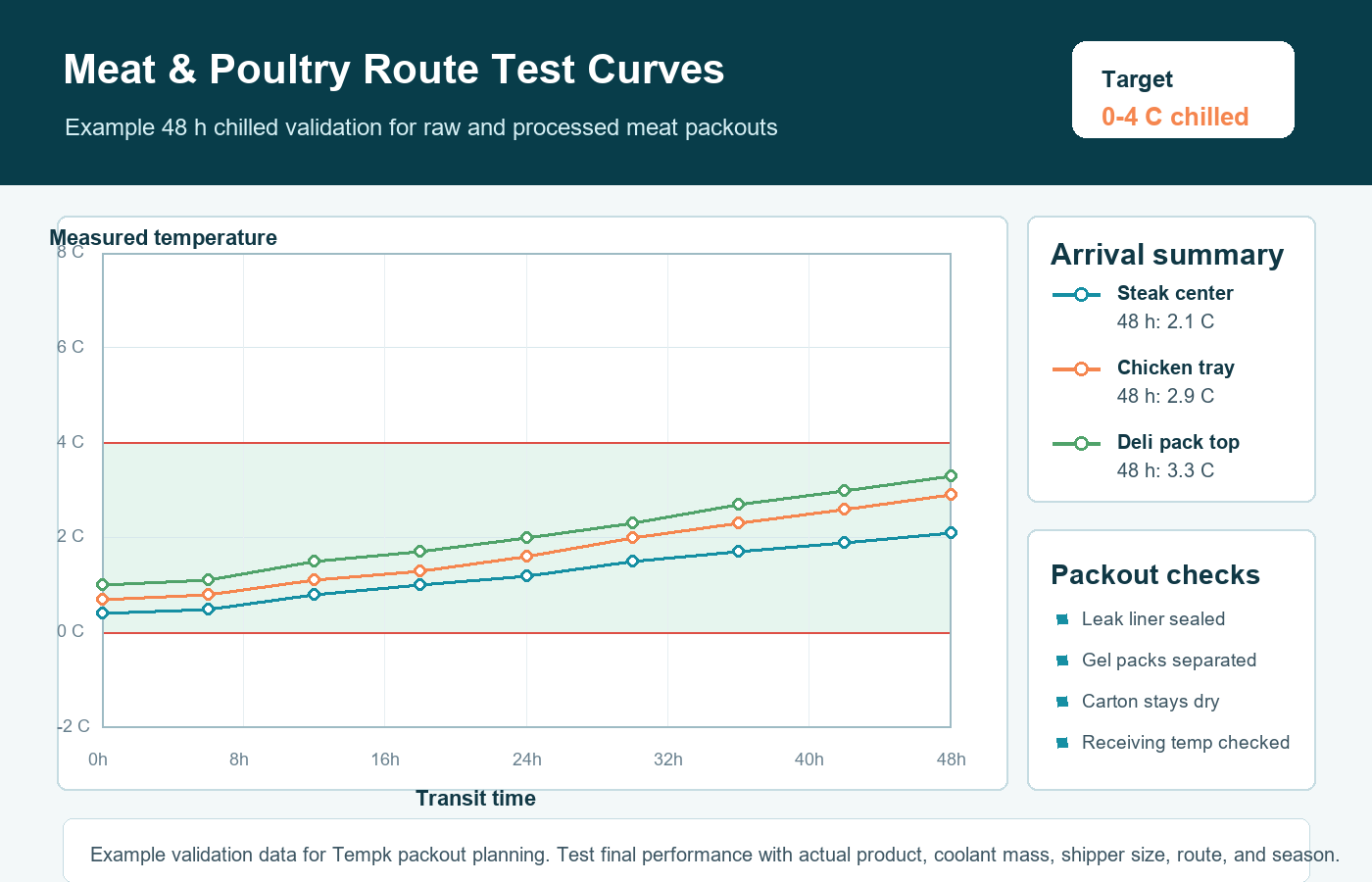
Ces guides de produits prennent en charge la page de catégorie sans forcer chaque produit dans une page de solution distincte.
Utilisez ce guide lorsque le produit ne fait pas partie des trois pages prioritaires mais nécessite néanmoins une décision d'emballage de viande spécifique au produit..
Utilisez ce guide lorsque le produit ne fait pas partie des trois pages prioritaires mais nécessite néanmoins une décision d'emballage de viande spécifique au produit..
Utilisez ce guide lorsque le produit ne fait pas partie des trois pages prioritaires mais nécessite néanmoins une décision d'emballage de viande spécifique au produit..
Utilisez ce guide lorsque le produit ne fait pas partie des trois pages prioritaires mais nécessite néanmoins une décision d'emballage de viande spécifique au produit..
Utiliser les outils pour dimensionner le premier essai, puis validez avec la vraie charge utile de viande et recevez les chèques.
Partager le formulaire produit, cible réfrigérée ou congelée, poids de charge utile, taille de boîte, durée de l'itinéraire, saison, et recevoir des chèques. Tempk peut vous aider à choisir l'isolation, masse de liquide de refroidissement, structure du revêtement, et étapes de validation.
Viande & Les expéditions de volaille ne doivent pas utiliser une recette de boîte fixe pour chaque produit.. Commencer par 0-4 C contrôle réfrigéré pour les coupes fraîches ou -18 C pour les programmes de viande surgelée, puis séparez les produits par charge thermique, résistance de l'emballage, et comment ils sont reçus. Pour les programmes mixtes, Tempk compare généralement un itinéraire local court, un itinéraire de colis de nuit, et la saison la plus chaude prévue avant de confirmer l'expéditeur.
Utiliser le support d'emballage sous vide, tampons absorbants, doublure de fuite, carton isolé, et protection des coins. Le plan de refroidissement doit commencer par des packs de gel pour les packs réfrigérés et de la neige carbonique ou du PCM congelé pour les voies gelées qui nécessitent un temps de maintien prolongé.. Lorsque la charge utile contient des cartons de vente au détail délicats, texture douce, matériel vivant, ou documentation médicale, protéger d'abord la charge utile, puis ajouter de la capacité de refroidissement. Si l'expédition est retardée au moment de l'emballage, remettre, douane, ou transfert à quai, le profil de l'itinéraire doit être revérifié au lieu de simplement augmenter le poids du liquide de refroidissement.
La validation doit inclure le contrôle de la purge des chèques, température superficielle, compression des cartons, et temps de déchargement à destination. Un test utile enregistre le point de charge utile le plus chaud, le point le plus froid près du liquide de refroidissement, et l'état de réception après manipulation. Cela donne à l'équipe des opérations une instruction pratique sur l'emballage., pas seulement un tableau de température.
Prise en charge des emballages personnalisés
Pour des tailles de carton fixes, limites de charge utile, exigences en matière de marque, voies saisonnières, ou des cibles de validation, Tempk peut adapter cette solution dans un emballage personnalisé pour la chaîne du froid.