


Tabung membeku atau terpapar panas
Pak gel beku, dinding dingin, penyerahan musim panas, dan penerimaan yang lama dapat menimbulkan risiko suhu lokal.
Pengiriman spesimen darah harus direncanakan berdasarkan persyaratan pengujian dan format tabung. The konfigurasi kemasan has to protect the temperature range, tabung caps, Label, penyerap layer, dan menerima catatan pada saat yang sama.
Spesimen darah dapat tiba dengan suhu rata-rata baik tetapi tetap ditolak jika tabung membeku di sisi pendingin, bocor ke kantong, atau kehilangan catatan kustodi.
Pak gel beku, dinding dingin, penyerahan musim panas, dan penerimaan yang lama dapat menimbulkan risiko suhu lokal.
Loose tabung, pendingin berat, atau tidak ada penyangga rak yang dapat menekan penutup, kaca retak, atau membasahi dokumen.
Laboratorium membutuhkan catatan yang jelas: sampel list, kurva suhu, waktu serah terima, dan kondisi kontainer.
| Kondisi rute | Tujuan suhu | Pengaturan kemasan | Perencanaan pendingin atau es kering | Pemeriksaan penerimaan |
|---|---|---|---|---|
| Kurir lokal di hari yang sama, 0-8 H | Ikuti protokol laboratorium. Untuk pengujian berpendingin, rencanakan sekitar 2-8 C tanpa membekukan tabung. | EPP kecil atau pengirim karton terisolasi, upright tabung rack, tas sekunder yang disegel, penyerap layer, pembagi pendingin, dan satu pencatat di dekat tepi hangat. | Uji coba 0.6-1.5 kg pak gel yang dikondisikan atau 2-8 C PCM untuk a 3-8 L pengirim. Kurangi cairan pendingin jika risiko pembekuan musim dingin tinggi. | Tidak ada kebocoran, kekencangan tutup, tabung support, tidak ada tanda beku, keterbacaan label, dan waktu pengambilan hingga penerimaan. |
| Kurir atau parsel regional, 8-24 H | Pertahankan suhu yang diperlukan melalui penyortiran, tempat tinggal kendaraan, dan keterlambatan penerimaan laboratorium. | Isolasi lebih tinggi, pembagi tabung yang lebih kuat, penyerap kemasan sekunder, pendingin atas dan samping dipisahkan dari tabung, dan dua posisi pencatat. | Mulailah 1.5-3 kg dikondisikan 2-8 C pendingin untuk pengirim kecil; uji tepi hangat dan permukaan dingin sebelum digunakan langsung. | Catatan suhu, kondisi tabung sisi dingin, dokumen kering, menerima catatan, dan penyerahan rantai. |
| Fraksi darah beku atau tes beku khusus protokol | Gunakan rentang beku yang diminta dan hindari pencairan-pembekuan ulang selama serah terima. | Pengirim beku, rak sampel terlindungi, es kering separation layer, kemasan luar berventilasi, penyerap secondary containment, dan selongsong dokumen jauh dari embun beku. | Gunakan es kering hanya jika protokol dan peraturan operator mengizinkan. Jalur percobaan kecil sering kali dimulai 2-6 kg adalah kering untuk 0-24 H, lalu validasi. | Remaining es kering, tidak ada bukti pencairan, stabilitas rak, label yang dapat dibaca, dan transfer freezer segera. |
Gunakan nilai-nilai ini sebagai titik awal untuk pengambilan sampel dan kutipan. Pendingin terakhir, PCM, es kering, isolasi, kemasan sekunder, pencatat, dan pilihan penanganan harus divalidasi dengan wadah sampel sebenarnya, rute, proses pembawa, musim, klasifikasi, dan prosedur penerimaan.
Jangan memilih cairan pendingin sampai memenuhi persyaratan lab, jenis tabung, waktu pengangkutan maksimum, dan jendela penerimaan jelas.
Gunakan rak atau selongsong agar tabung tidak saling bertabrakan, terbalik, atau tekan langsung pada cairan pendingin.
Gunakan kantong sekunder yang tertutup rapat dan bahan penyerap secukupnya untuk volume tabung dan risiko rute.
Selama validasi, periksa posisi tepi hangat dan sisi dingin dekat dengan cairan pendingin, tidak hanya pusatnya.
Ini adalah masalah yang terlihat dan operasional yang harus dikurangi oleh konfigurasi kemasan sebelum kiriman mencapai penerima.
Gunakan kurva tes sebagai perbandingan kerja, kemudian validasi dengan wadah sampel sebenarnya, pengirim, konfigurasi pendingin atau es kering, durasi jalur, profil lingkungan, dan proses penerimaan.
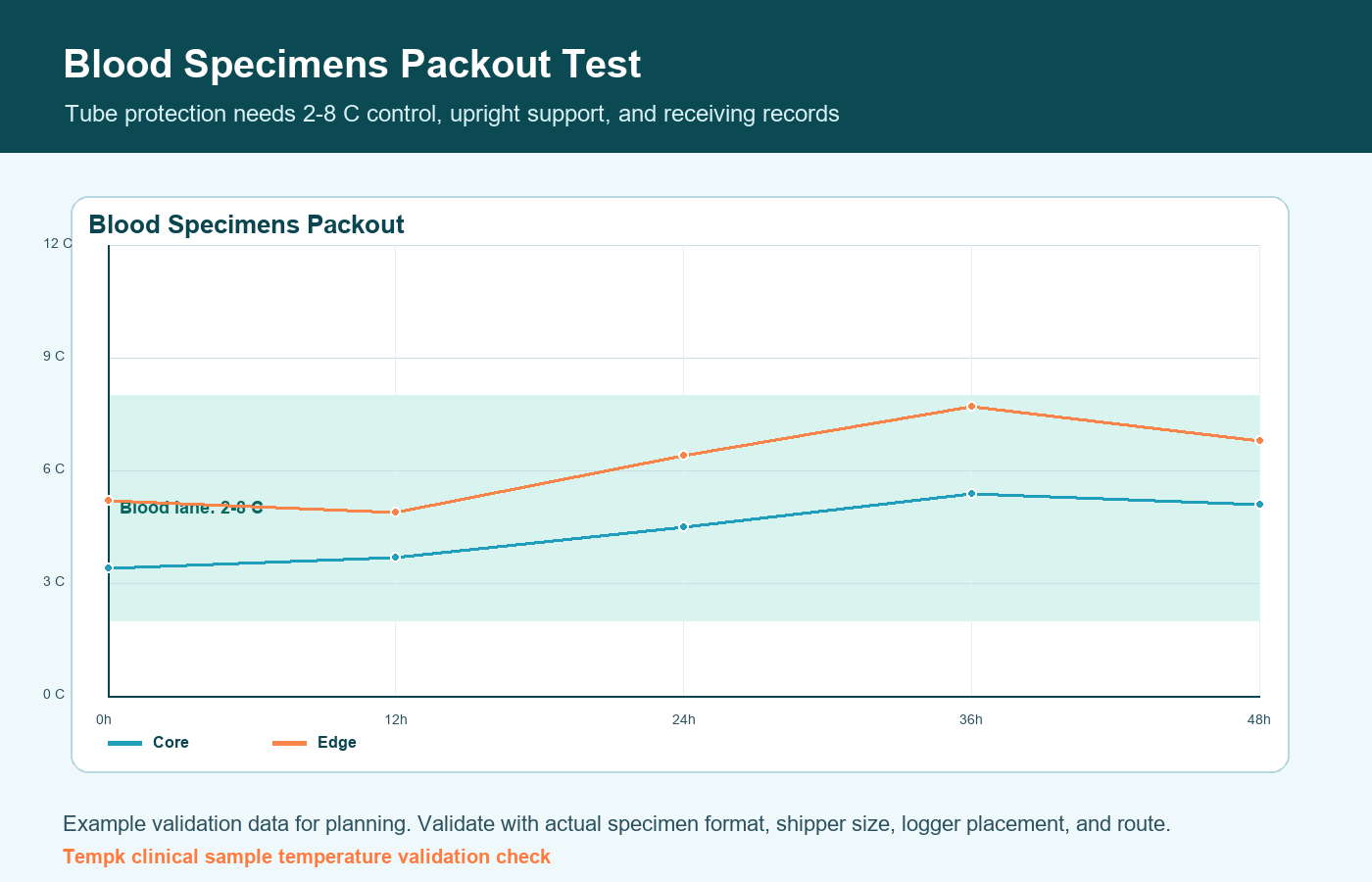
Gunakan halaman ini untuk membandingkan rute klinis dan medis terdekat, pilihan pendingin, pilihan isolasi, dan pertanyaan risiko rute sebelum pengambilan sampel.
Spesimen darah memerlukan pengaturan suhu yang sesuai dengan pengujian sekaligus mencegah kerusakan tabung dan hemolisis. The konfigurasi kemasan must also keep paperwork and labels readable.
Masalah yang umum terjadi adalah hemolisis akibat penanganan yang kasar, tabung bocor, penerimaan laboratorium tertunda, dan cairan pendingin menyentuh tabung agar tidak membeku.
Gunakan rak atau selongsong tabung, penyerap kemasan sekunder, dan pengirim luar yang kaku. Simpan formulir permintaan di luar zona basah atau dingin.
Gunakan pak gel dingin hanya jika pengujian memerlukannya 2 ke 8 C. Untuk pengujian sekitar, gunakan kemasan pelindung tanpa kompres dingin yang tidak perlu.
Periksa integritas tabung, keterbacaan label, kebocoran, suhu, dan penerimaan lab setelah jalur uji coba.
Custom konfigurasi kemasan support
Untuk ukuran karton tetap, batasan muatan, persyaratan merek, jalur musiman, atau target validasi, Tempk can adapt this solution into a custom cold-chain konfigurasi kemasan.
Bagikan jenis tabung, sampel count, suhu protokol, durasi rute, profil lingkungan, langkah kurir, klasifikasi, and pemeriksaan penerimaans. Tempk dapat membantu membandingkan pengirimnya, massa pendingin, tabung support, penyerap layer, pencatat position, dan rencana validasi.
Request a konfigurasi kemasan review