


Tabung bocor atau tekanan tutup
Tabung yang longgar dan pengirim yang terlalu penuh dapat menekan penutup pada pembagi atau paket pendingin.
Pengiriman spesimen usap PCR biasanya dinilai berdasarkan suhu, tabung integrity, identifikasi sampel, dan handoff diagnostik cepat. The konfigurasi kemasan should prevent leakage, tekanan tutup, pencampuran tabung, dan hindari pencairan-pembekuan ulang jika penanganan beku diperlukan.
Rute usap PCR seringkali terlihat sederhana karena muatannya kecil. Risikonya adalah tabung kecil berpindah, tutup menekan cairan pendingin atau pembagi, catatan menjadi tercampur, atau sampel hangat selama penundaan penerimaan.
Tabung yang longgar dan pengirim yang terlalu penuh dapat menekan penutup pada pembagi atau paket pendingin.
Beberapa protokol menerima transportasi jangka pendek yang didinginkan sementara protokol lainnya memerlukan penanganan beku jika terjadi penundaan.
Rute penggunaan bervolume tinggi memerlukan pelabelan yang bersih, daftar spesimen, dan catatan serah terima sehingga laboratorium dapat menerima dengan cepat.
| Kondisi rute | Tujuan suhu | Pengaturan kemasan | Perencanaan pendingin atau es kering | Pemeriksaan penerimaan |
|---|---|---|---|---|
| Rute diagnostik berpendingin pada hari yang sama, 0-12 H | Ikuti protokol pengumpulan. Banyak rute penggunaan pendek yang direncanakan 2-8 C. | Pengirim terisolasi kecil, upright tabung divider, tas sekunder yang disegel, penyerap layer, penghalang pendingin, dan daftar sampel sederhana. | Uji coba 0.5-1.5 kg gel terkondisi atau 2-8 C PCM untuk pengirim kecil. Jauhkan cairan pendingin dari kontak tabung langsung. | Tidak ada kebocoran, tutup tabung aman, daftar sampel cocok, tidak ada pembekuan, dan serah terima lab yang cepat. |
| Rute berisiko regional atau akhir pekan, 12-48 H | Pertahankan jangkauan yang diperlukan melalui tempat tinggal kendaraan, penyortiran, dan keterlambatan penerimaan laboratorium. | Isolasi lebih tinggi, pendingin sisi atas dengan pembagi, baki tabung yang lebih kuat, dua posisi pencatat, dan dokumen yang dilindungi. | Mulailah 1.5-3 kg pendingin terkondisi untuk pengirim kecil hingga menengah, kemudian sesuaikan dengan rute tes dan musim. | Suhu hangat, tanda tekanan tabung, keterbacaan label, hitungan yang diterima, dan waktu serah terima. |
| Rute penggunaan yang dibekukan atau pengujian tertunda | Gunakan penanganan beku hanya ketika protokol memerlukannya dan cegah pencairan-pembekuan ulang. | Es kering shipper or frozen konfigurasi kemasan, dukungan rak tabung, es kering separation, kemasan luar berventilasi, dan dokumen yang dilindungi dari embun beku. | Jika es kering diperbolehkan, jalur kecil mungkin dimulai 2-5 kg untuk 0-24 jam dan lebih banyak lagi untuk rute tertunda. Validasi dengan proses operator sebenarnya. | Remaining es kering, tidak ada tanda-tanda mencair, tabung rack stable, dokumen kering, dan transfer freezer segera. |
Gunakan nilai-nilai ini sebagai titik awal untuk pengambilan sampel dan kutipan. Pendingin terakhir, PCM, es kering, isolasi, kemasan sekunder, pencatat, dan pilihan penanganan harus divalidasi dengan wadah sampel sebenarnya, rute, proses pembawa, musim, klasifikasi, dan prosedur penerimaan.
VTM, UTM, penggunaan kering, dan perlengkapan khusus studi dapat memiliki jendela transportasi yang berbeda.
Gunakan pembatas tabung atau baki agar tabung tetap terpisah, tutupnya tidak dikompresi, dan ID sampel tetap dapat dibaca.
Tempatkan pak gel, PCM, atau es kering di balik pembatas agar tabung tidak menyentuh permukaan yang dingin.
Program usap bervolume tinggi harus membuat sampel dihitung, dokumen, akses penacat, dan serah terima lab dengan mudah.
Ini adalah masalah yang terlihat dan operasional yang harus dikurangi oleh konfigurasi kemasan sebelum kiriman mencapai penerima.
Gunakan kurva tes sebagai perbandingan kerja, kemudian validasi dengan wadah sampel sebenarnya, pengirim, konfigurasi pendingin atau es kering, durasi jalur, profil lingkungan, dan proses penerimaan.
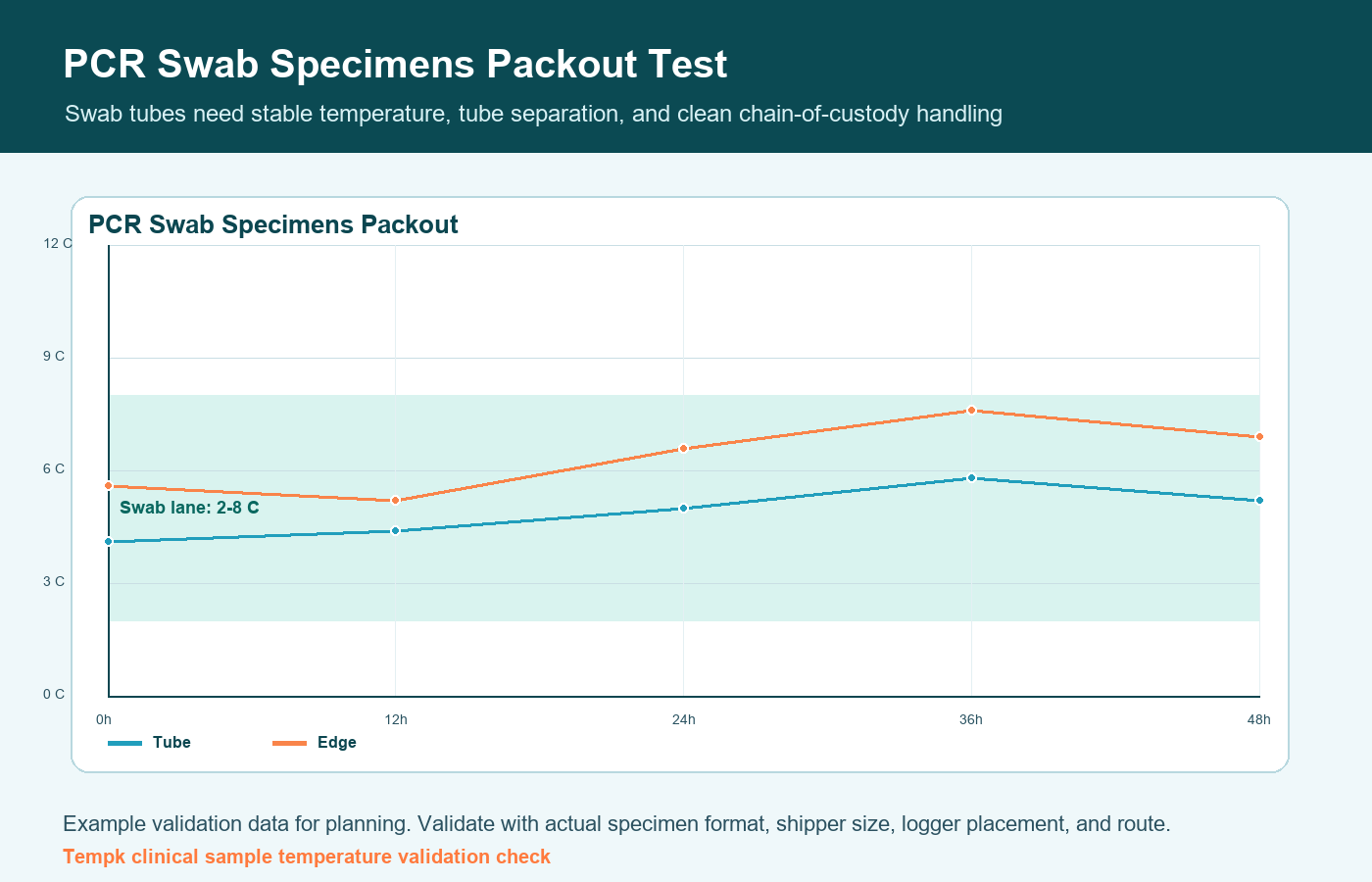
Gunakan halaman ini untuk membandingkan rute klinis dan medis terdekat, pilihan pendingin, pilihan isolasi, dan pertanyaan risiko rute sebelum pengambilan sampel.
Spesimen usap PCR seringkali sensitif terhadap waktu dan bervolume tinggi. The konfigurasi kemasan should prevent tabung leakage, menjaga label tetap dapat dibaca, dan memenuhi suhu yang disyaratkan laboratorium.
Kegagalan termasuk bocornya media transportasi, label yang tidak dapat dibaca, tamasya hangat, tabung beku bila tidak diperbolehkan, dan keterlambatan pengiriman di luar jendela pengujian.
Gunakan selongsong tabung, penyerap kemasan sekunder, dan pengirim yang kaku. Jaga agar kantong sampel tetap teratur sehingga laboratorium dapat memprosesnya tanpa perlu mencari melalui kemasan basah.
Singkatnya, gunakan pak gel dingin 2 ke 8 C rute bila diperlukan. Jangan gunakan es kering kecuali laboratorium menentukan pengangkutan beku.
Periksa integritas segel tabung, keterbacaan label, catatan suhu, dan waktu pengiriman ke laboratorium pengujian.
Custom konfigurasi kemasan support
Untuk ukuran karton tetap, batasan muatan, persyaratan merek, jalur musiman, atau target validasi, Tempk can adapt this solution into a custom cold-chain konfigurasi kemasan.
Bagikan media usap, tabung count, suhu target, jendela transportasi, profil lingkungan, langkah kurir, es kering allowance, dan proses penerimaan. Tempk dapat membantu membandingkan pengirimnya, tata letak pendingin, tabung tray, penyerap layer, pencatat position, dan rencana validasi.
Request a konfigurasi kemasan review