How to Choose Cold Chain Frozen Foods Container Insulation in 2025
When you ship frozen food, keeping the internal temperature stable is as important as the food itself. In 2025 the global cold chain market is expected to reach about US$252.89 billion, yet poor temperature control still causes roughly 14 % of the world’s food to be lost between harvest and retail. The right container insulation prevents thawing, preserves nutrients and reduces waste. This guide explains different insulation materials, shows how to operate insulated containers properly and highlights the latest innovations so you can make smart, sustainable choices.
This guide will answer:
Why does container insulation matter for frozen foods? – Understand how temperature control protects quality and prevents spoilage.
Which insulation materials are best? – Compare expanded polystyrene (EPS), polyurethane (PUR), vacuum insulated panels (VIPs) and natural alternatives such as straw, wool and recycled cotton.
How do you operate insulated containers correctly? – Learn pre cooling, loading and monitoring techniques to maintain temperature.
What are the latest trends for 2025? – Review market forecasts, sustainability mandates and technological innovations shaping cold chain packaging.
Why Does Cold Chain Frozen Foods Container Insulation Matter?
Proper insulation is the backbone of a reliable frozen food supply chain. Frozen foods must stay below certain temperatures to prevent microbial growth and maintain texture. Without continuous insulation during storage and transport, products can thaw, nutrients degrade and ice crystals form. MarketDataForecast reports that nearly 14 % of global food is lost due to inadequate temperature management. Meanwhile, the U.S. Census Bureau noted that more than US$2.7 trillion worth of temperature controlled goods were shipped by truck in 2022, representing 90 % of all temperature controlled shipments. Those figures show the economic scale of the cold chain and the high cost of failure.
Key reasons to prioritise insulation
Quality and safety: Frozen foods need to stay within specific temperature ranges (often –10 °C to –20 °C or below –25 °C for deep frozen products) to maintain texture, flavour and nutritional value. Proper insulation keeps temperatures stable throughout the journey.
Waste reduction: Poor insulation leads to temperature excursions and product spoilage. With 14 % of food lost in the cold chain, improved insulation directly reduces waste and protects margins.
Regulatory compliance: Laws such as the U.S. Food Safety Modernization Act (FSMA) Rule 204 require 24 hour traceability and continuous temperature monitoring for high risk foods. Adequate insulation combined with monitoring helps meet these requirements.
Energy efficiency: Better insulation reduces the cooling load, saving energy and lowering greenhouse gas emissions. Modernising insulation and refrigeration systems is a key strategy for improving efficiency.
Customer satisfaction: Consistent quality builds trust. Delivering products that arrive frozen and fresh improves customer loyalty and brand reputation.
Comparing Insulation Materials: Foam, VIPs and Natural Alternatives
Different materials offer different trade offs between performance, cost and sustainability. Below you’ll find an overview of conventional foams, high performance vacuum panels and natural materials. Understanding their properties will help you select the right container insulation for your frozen food shipments.
Which material is right for you?
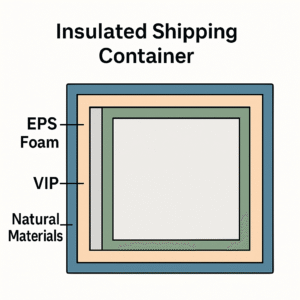
Expanded polystyrene (EPS) and polyurethane (PUR): Traditional refrigerated containers often use EPS or PUR foam. These materials are inexpensive and easy to mould, but they allow more heat transfer than vacuum panels and require thicker walls. EPS, for example, has a thermal conductivity around 36 mW/m·K and typically needs 30–40 mm thick walls to maintain temperature for two to three days. PUR performs slightly better with thermal conductivity around 22 mW/m·K and 25–35 mm walls, offering three to five days of hold time. Both materials are widely available but bulky, and disposal or recycling can be challenging.
Vacuum insulated panels (VIPs): VIP technology uses evacuated microporous cores sealed in airtight envelopes. Removing air dramatically reduces heat transfer: thermal conductivity is around 5 mW/m·K, about seven times lower than PUR foam. VIP boxes can maintain temperatures for 7–10 days with walls only 10–15 mm thick, freeing up internal volume and reducing the amount of refrigerant needed. Vacuum panels deliver thermal resistance more than twice that of EPS or PUR, leading to thinner, lighter containers and lower freight costs. The downside is higher cost and fragility—panels need protective shells and cannot be easily cut or curved.
Natural and biodegradable options: Sustainability pressures have spurred innovation in bio based insulation materials. Landpack’s straw panels are pressed into boards, wrapped in a compostable covering and inserted into boxes. Straw provides good insulation, absorbs shocks and regulates moisture; because it is a residual crop, it can be composted or used for biogas after use. Wool liners offer insulation performance comparable to polystyrene. Wool’s hygroscopic fibres absorb moisture and cushion products during transit. Recycled cotton mailers and cotton shippers are biodegradable and take up less space than EPS foam, reducing storage and transport emissions. While natural materials may not match VIPs for extreme hold times, they are compostable and support circular economy goals.
Insulation material comparison
| Insulation material | Thermal conductivity | Typical wall thickness | Practical meaning |
| Expanded Polystyrene (EPS) | ~36 mW/m·K | 30–40 mm | Low cost, easy to mould and supports ~2–3 days of temperature control; bulky and not easily recyclable. Suitable for short trips or low value goods. |
| Polyurethane (PUR) | ~22 mW/m·K | 25–35 mm | Moderate cost with 3–5 day hold time; moderate rigidity. Good for medium distance shipments with moderate sensitivity. |
| Vacuum Insulated Panel (VIP) | ≈5 mW/m·K | 10–15 mm | High upfront cost but offers 7–10 day hold times, increases usable volume and reduces coolant weight. Ideal for high value pharmaceuticals and deep frozen foods. |
| Straw panels | ~? mW/m·K (moderate) | 30–40 mm | Made from pressed straw with compostable covers; provide thermal insulation and shock absorption. After use, panels can be composted or converted to biogas. Good for shipments requiring up to 72 hours of cold chain time and for companies seeking to reduce plastic waste. |
| Wool liners | ~similar to EPS | 10–35 mm | Natural fibres capture air pockets, providing insulation and moisture absorption. Biodegrades within 18 months when wrapped in biodegradable film. Suited to shipments under two days and for brands emphasizing sustainability. |
| Recycled cotton mailers | n/a | Thin two panel liner | Recyclable and compostable insulation made from recycled cotton; requires less space than EPS and reduces carbon emissions during transport. Ideal for last mile delivery and e commerce shipments. |
Practical tips and recommendations
Match the material to your cargo and route. For short local deliveries or low value goods, EPS or PUR foam may suffice. For high value or ultra cold shipments (e.g., ice cream, tuna, vaccines), VIP containers provide superior performance.
Consider sustainability goals. If your organisation prioritises environmental impact, natural materials such as straw or wool can reduce plastic waste and support circular economy initiatives. Cotton mailers or recycled paper liners also decrease landfill waste.
Evaluate the total cost of ownership. Although VIPs cost more upfront, they save money over time through reduced coolant usage, lower freight weight and reusability. Studies indicate that combining polyurethane and VIP insulation can cut total transport costs by about 20 %.
Protect delicate materials. VIP panels are fragile. Always use rigid outer shells, avoid punctures and plan return logistics for reusable units.
Use case based approach. For shipments requiring extended hold times (such as 72 hours or more), test VIP or hybrid insulation. For deliveries within 48 hours, wool or cotton liners may provide sufficient insulation while meeting sustainability targets.
Real world example: QIAGEN partnered with Landpack to replace Styrofoam with straw insulated boxes for medical shipments. Straw panels provided good insulation, absorbed shocks and regulated moisture; the straw is pressed into panels, wrapped in compostable covers and inserted into packaging boxes. After use, the panels can be composted or converted to biogas, reducing waste and supporting a natural cycle.
How to Operate and Maintain Insulated Containers
Selecting the right insulation material is only half the battle; you must also operate containers correctly. Proper handling ensures that the insulation performs as designed and that frozen foods remain safe.
Best practices for container operation
Pre cool the container and cargo: Before loading, pre cool the container to its target temperature. Pre cooling minimises thermal shock and prevents an initial temperature spike. Similarly, ensure your frozen food is already within the required range to avoid stressing the insulation or refrigerant.
Strategic loading: Place temperature sensitive items in the centre of the container and near air outlets for better airflow. Use pallets or spacers to maintain gaps between boxes and the container walls. Avoid stacking boxes directly against the walls, which can create thermal bridges.
Monitor temperature continuously: Integrate data loggers or IoT sensors that record temperature and humidity at regular intervals. Modern monitoring solutions offer one to five minute measurements and send alerts when temperatures deviate. Real time visibility supports prompt corrective action and helps meet traceability requirements.
Carry backup cooling: Keep spare gel packs, dry ice or portable generators on hand in case of equipment failure or unexpected delays. Backup supplies prevent temperature excursions during transit disruptions.
Plan for different temperature zones: Use multi zone or partitioned vehicles to transport mixed loads at different temperature ranges. Dual temperature containers allow you to carry frozen foods alongside chilled products, reducing the number of required containers and cutting shipping costs by around 30 %.
Train your team: Provide training on proper packing techniques, sensor use and emergency procedures. Document any temperature excursions, noting their cause and corrective actions. Regular audits and protocol updates ensure continuous improvement and compliance.
Operating VIP containers specifically
VIP containers require special care because of their unique construction. Always pre cool VIP panels and pair them with appropriate phase change materials (PCMs). Match the PCM melting point to your required temperature band—for example, use PCMs that melt at –20 °C for frozen shipments. Protect the panels with rigid outer shells to avoid punctures and coordinate reverse logistics for reusable units.
2025 Developments and Trends in Cold Chain Container Insulation
The cold chain industry continues to evolve rapidly. Below are the most important developments that will influence container insulation decisions in 2025 and beyond.
Trend overview
Market growth and investment: The thermal insulation packaging market is valued at around US$99.7 billion in 2025 and is projected to reach US$338.4 billion by 2035, representing a 13 % compound annual growth rate (CAGR). Expanded polystyrene is expected to account for 34.6 % of the market in 2025, while pharmaceuticals and biotechnology will command 38.1 %. This growth reflects rising demand for temperature sensitive shipping across food, pharma and electronics industries.
VIP adoption and energy efficiency: VIP containers are gaining popularity because they offer thermal resistance more than twice that of conventional foam. A case study by Titan Containers showed that combining VIP insulation with solar ready roofs reduces total energy consumption by about 55 %. Hybrid PU VIP designs can reduce transport costs by roughly 20 % and are designed for reusability.
Sustainability and circular economy: Regulators are targeting greenhouse gas emissions and encouraging reuse of packaging. The European Union’s extended producer responsibility policies promote durable containers and recycled materials. Natural and biodegradable insulation options—such as straw, wool and recycled cotton—are becoming mainstream. Cotton mailers and cotton shippers reduce waste and space requirements, while straw panels can be composted or turned into biogas.
Digital transformation: Wider adoption of IoT sensors, predictive analytics and cloud platforms provides real time temperature visibility, better route optimisation and predictive maintenance. Advanced monitoring reduces spoilage and ensures compliance; by 2025, 74 % of logistics data is expected to be standardised, facilitating integration between partners.
Built to suit infrastructure and resilience: Companies are investing in customised facilities and diversified supply chains to mitigate disruptions. Investments include modernised insulation, renewable energy and natural refrigerants. The shift to –15 °C storage, rather than –18 °C, can save 10 % in energy consumption but requires careful shelf life management and thicker packaging.
Latest progress at a glance
Market expansion: Thermal insulation packaging to grow at 13 % CAGR, reaching US$338.4 billion by 2035.
VIP efficiency: Solar ready VIP containers cut energy use by about 55 %, and hybrid PU VIP designs reduce total costs by ~20 %.
Sustainable materials: Straw panels, wool liners and recycled cotton shippers offer compostable or biodegradable insulation, reducing plastic waste.
Regulatory focus: FSMA Rule 204 demands 24 hour traceability and continuous monitoring, driving investments in smart packaging and data integration.
Energy innovation: Using –15 °C storage temperatures can cut energy consumption by around 10 % but may shorten shelf life by 30 %.
Market insights
The thermal insulation packaging market’s growth is driven by several forces. The rise of e commerce grocery delivery and increasing demand for biologics and specialty foods are expanding the need for reliable cold chain packaging. EPS remains the leading material due to its cost and ease of moulding, but VIPs and sustainable materials are gaining share. East Asia is the fastest growing region with a CAGR of 13.6 %. Pharmaceutical and biotechnology shipments make up the largest end use segment, commanding 38.1 % of the insulation market as strict temperature requirements drive adoption of advanced solutions.
Frequently Asked Questions
How thick should insulation be for frozen food containers? It depends on the material and desired hold time. EPS containers typically require 30–40 mm walls, while PUR needs 25–35 mm. VIP panels achieve similar or longer hold times with only 10–15 mm thickness.
Is vacuum insulation worth the extra cost? For high value cargo or long transit times, yes. VIP panels provide thermal resistance more than twice that of conventional foams, extend hold times to 7–10 days and free up internal space, which can reduce freight costs. When reused, the total cost of ownership often drops below that of single use foam.
Can natural materials like straw or wool maintain frozen temperatures? Natural insulators such as straw or wool offer good thermal performance and moisture regulation, but they typically support shorter hold times (around 72 hours for straw boxes). They are ideal for last mile delivery or for companies prioritising sustainability.
How do I ensure regulatory compliance? Combine good insulation with continuous monitoring. FSMA Rule 204 requires 24 hour traceability and rapid data access. Use IoT sensors or data loggers to capture temperature data, document any excursions and train staff in proper handling.
What’s the environmental impact of VIP manufacturing? Producing VIPs involves energy intensive processes (e.g., pyrogenic silica), leading to higher embodied carbon. However, recycling the silica core can reduce emissions by up to 95 %, and initiatives to recycle end of life panels could save 55,704 tons of CO₂e globally.
Summary and Recommendations
In 2025 the frozen food supply chain is evolving fast. Proper container insulation is essential to maintaining product quality, reducing waste and meeting regulatory demands. Traditional foams (EPS, PUR) remain cost effective for short routes, but high performance VIP panels deliver superior thermal resistance and longer hold times. Sustainable alternatives such as straw, wool and recycled cotton reduce environmental impact and are well suited to last mile delivery. Best practices—pre cooling, strategic loading and continuous monitoring—ensure the chosen insulation performs effectively. Market forecasts show double digit growth in insulation packaging through 2035, indicating both opportunity and competition. Companies should evaluate insulation options holistically, considering material performance, sustainability, cost, and regulatory compliance.
Actionable next steps
Assess your current insulation strategy. Analyse temperature data, spoilage rates and energy consumption to identify weaknesses.
Perform a material comparison. Test EPS, PUR, VIP and natural alternatives for your specific products and routes. Use our Insulation Selection Tool (interactive widget recommended) to compare hold times, cost and environmental impact.
Integrate monitoring technology. Implement IoT sensors and predictive analytics to gain real time visibility and meet FSMA traceability requirements.
Develop a sustainability plan. Evaluate opportunities to adopt recycled or compostable insulation materials and build return logistics for reusable containers. Communicate your efforts to customers to enhance brand value.
Train and audit. Provide regular training for staff on proper packing, loading and monitoring, and perform audits to ensure procedures remain effective.
About Tempk
Tempk is a global innovator in cold chain solutions, offering reusable insulation systems, ice packs and smart packaging designed to keep products at precise temperatures. Our research and development centre focuses on eco friendly cold chain products and we hold Sedex and other quality certifications. Serving food, pharmaceutical and biotech industries worldwide, we help clients reduce waste, comply with regulations and improve customer satisfaction.
Call to action: If you’re ready to enhance your cold chain operations, contact the Tempk team for a custom assessment. Discover how our reusable packaging and smart monitoring systems can protect your frozen foods and boost sustainability.