Cold Chain Meat Temperature Control in 2025?
Last updated: 2025-12-12
If your cold chain meat temperature control slips, you do not just lose shelf life. You also raise safety risk, returns, and customer complaints. Globally, unsafe food is linked to 600 million illnesses and 420,000 deaths each year, which is why temperature discipline matters. In practical terms, regulators keep repeating the same core message: keep cold food cold, and keep it out of the “danger zone.”
This article will help you:
Set clear targets for cold chain meat temperature control (chilled vs frozen) using easy-to-audit rules. ()
Build a meat transport temperature monitoring checklist that works at docks, in trailers, and in last mile. ()
Handle temperature excursion handling for meat shipments with less guesswork and better documentation. ()
Improve HACCP temperature records for meat cold chain so audits feel routine, not scary.
What does cold chain meat temperature control really mean?
Cold chain meat temperature control means keeping meat within defined temperature limits from “plant to plate,” and proving it with records. You are managing both safety and quality at the same time. Public-health agencies stress keeping refrigerators at 40°F (4°C) or below and freezers at 0°F (-18°C) or below as a simple baseline. () When you run professional operations, you turn that baseline into targets, alarms, and corrective actions.
Cold chain meat temperature control is not one device or one truck setting. It is a system: people, process, packaging, equipment, and data. Your biggest enemy is “small warm time” that hides in staging, loading, and last mile. Once you measure those minutes, you can start removing them.
How cold is “cold enough” for meat across major markets?
Different markets use different rule language, but the pattern is consistent: keep meat cold, control handling time, and document it. In the EU hygiene framework, specific processing rules reference meat temperatures such as ≤4°C for poultry, ≤3°C for offal, and ≤7°C for other meat in certain preparation contexts. That does not replace your own risk assessment, but it helps you set “compliance-aware” targets.
| Market example (illustrative) | Common referenced limits | Where it shows up | What it means for you |
| Public-health home/retail guidance | Fridge ≤40°F (4°C); freezer ≤0°F (-18°C) () | Storage basics | Use as a simple training anchor for teams |
| EU hygiene rules (processing contexts) | Poultry ≤4°C, offal ≤3°C, other meat ≤7°C | Preparation/processing controls | Design targets that won’t fight your audit |
| Frozen storage principle | Frozen at 0°F (-18°C) or below can be kept indefinitely (quality changes) () | Freezer management | Separate “safety” from “quality” discussions |
Practical tips you can apply today
Dock rule: If it is not moving, it should be in a controlled zone (chill room or reefers), not on the floor.
One target, one owner: Assign a clear owner for each temperature zone (chill room, staging, truck, last mile).
Make training real: Teach “what happens if we drift into the danger zone” using simple examples. ()
Real-world example: A retailer reduced meat rejections by moving labeling and paperwork into the chill area. That single change removed repeated door-open cycles during peak receiving.
Which temperatures matter most for cold chain meat temperature control?
The temperatures that matter most are the product temperature and the time spent above your limit. The fastest failures usually happen when meat sits at room temperature during handling. The CDC warns bacteria multiply rapidly in the “danger zone” between 40°F and 140°F, which is why your staging time matters. () For operations, the goal is simple: keep exposure short, and keep product cold.
You will also manage two temperatures at once: air temperature (in rooms and trailers) and core product temperature (inside cartons or pallets). Air reacts fast; core changes slower. Great cold chain meat temperature control uses both signals, not just one.
What are practical target bands for chilled vs frozen meat?
Use this table as a starting point, then tune it to your product, packaging, and destination rules. Keep it simple enough that every shift can follow it.
| Use case | Target you can train on | How to verify | What it means for you |
| Chilled meat handling | Keep storage ≤40°F (4°C) as a baseline rule () | Appliance/room thermometers + periodic product checks | Reduces growth risk and protects shelf life |
| Frozen meat handling | Keep freezers ≤0°F (-18°C) () | Freezer probes + shipment loggers | Safety stable; focus shifts to quality and thaw control |
| EU-style processing controls | Keep within referenced limits (e.g., 4/3/7°C by category) | Room controls + product checks at workstations | Helps align SOPs with audit expectations |
Practical tips you can apply today
Measure the slow spot: Put a sensor in the warmest trailer location, not the coldest.
Use “time out of temp” alarms: A short spike may be less risky than long mild warmth.
Avoid tight packing in fridges/freezers: Crowding blocks airflow, and FDA guidance warns about airflow limits. ()
Real-world example: A meat distributor found 70% of excursions happened during loading. They added a staged “ready lane” inside the chill room and cut alarms in half.
How do you map cold chain meat temperature control to critical control points?
Mapping cold chain meat temperature control means identifying where temperature can change, then adding controls and proof. Think in stations: chill, stage, load, transport, receive, store, pick, and deliver. The CDC’s “refrigerate promptly” message translates into business terms as: keep transitions short and planned. () The FDA also reinforces the “two-hour rule” concept for perishables, which helps you communicate urgency. ()
Once you map the chain, you can decide where monitoring must be continuous and where spot checks are enough. You do not need a sensor everywhere. You need sensors where mistakes are expensive.
Where do temperature spikes hide in real operations?
Here are the usual “silent killers” of cold chain meat temperature control:
Open-door staging: pallets waiting while teams “finish paperwork.”
Cross-dock congestion: too many inbound loads, not enough cold space.
Last-mile handoff: drivers waiting at customer sites with doors open.
| Critical point | Typical risk | Control you can add | What you gain |
| Receiving dock | Warm queues | Appointment windows + cold receiving zone | Fewer disputes, less shrink |
| Staging | Door-open cycles | “Clock starts now” timer + supervisor checks | Less hidden warm time |
| Transport | Reefer drift | Pre-trip checks + in-transit alerts | Faster recovery actions |
| Customer receipt | Delay at unloading | Require receiving temp check + sign-off | Stronger claims defense |
Practical tips you can apply today
Put a timer where people can see it: time pressure changes behavior fast.
Standardize “handoff”: define who owns temperature at each handoff point.
Make receiving easy: a simple receiving checklist reduces arguments later.
Real-world example: A food producer added “arrival temperature photo + logger ID” at receipt. Chargebacks dropped because evidence was clear.
How can monitoring prove cold chain meat temperature control in audits?
Monitoring proves cold chain meat temperature control when it is calibrated, consistent, and easy to retrieve. Auditors do not want 10,000 data points. They want to see you control risk and respond to problems. Codex guidance emphasizes risk-based thinking and using frameworks like HACCP (Hazard Analysis and Critical Control Points) to decide what controls are necessary.
So your monitoring system must answer three questions fast: What happened? When? What did you do? If your team cannot answer in five minutes, your system is too complex.
What should a “2025-ready” temperature record include?
Think of your records as a story, not a spreadsheet dump.
| Record element | Minimum you need | Why auditors care | What it does for you |
| Device identity | Logger ID + calibration status | Trust in the measurement | Fewer disputes and re-tests |
| Time + location | Route, zone, dock, trailer | Traceability of exposure | Faster root-cause fixes |
| Thresholds | Target + alarm limits | Proof of control plan | Clear expectations per lane |
| Corrective action | Quarantine / evaluate / release | Proof you manage risk | Lower recall and complaint risk |
Interactive self-check: Cold Chain Meat Temperature Control Readiness Score
Give your site 1 point for each “yes.” Total your score and act on the lowest areas.
Do you have written targets for chilled and frozen meat by lane?
Do you track time in staging, not just room temperature?
Are devices calibrated and documented before use?
Can you pull last week’s excursion report in under 10 minutes?
Do drivers and receivers use the same receiving checklist?
Do you have a written decision path for excursions (hold/release/dispose)?
0–2: High risk. Fix process before buying more tech.
3–4: Medium risk. Add monitoring at critical points and improve training.
5–6: Strong. Optimize KPIs and reduce waste next.
Real-world example: A retail DC cut audit findings by standardizing one “excursion form” used by both warehouse and transport teams.
What packaging and loading tactics improve cold chain meat temperature control?
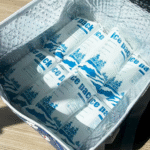
Packaging and loading improve cold chain meat temperature control when they protect product temperature during transitions. The cold chain usually fails during the “gaps” between controlled rooms and controlled vehicles. If your packaging cannot buffer those gaps, you will see temperature spikes. This is especially true for parcel and direct-to-consumer meat delivery, where you do not have a full reefer trailer.
Your best tactic is simple: reduce transition time first. Then use packaging to protect what remains. That order saves money and improves compliance.
Decision tool: How do you choose packaging for last-mile meat delivery?
Answer these three questions, then pick the simplest option that works.
Transit time: 0–12h, 12–48h, or 48–72h?
Outside temperature: mild, hot, or very hot?
Product: chilled meat, frozen meat, or mixed?
| Scenario | What to prioritize | Typical solution pattern | Why it helps you |
| 0–12h chilled | Fast handoff | Insulated shipper + gel packs + tight packing | Buffers short warm exposure |
| 12–48h chilled | Buffer time | Higher insulation + more coolant + fewer voids | Slows warming during delays |
| 48–72h frozen | Prevent thaw | Strong insulation + enough frozen coolant | Protects quality and avoids refreeze risk |
| Mixed chilled/frozen | Separation | Partitioned zones or separate shippers | Avoids one product “ruining” the other |
Practical tips you can apply today
Pre-cool the load space: loading into a warm trailer defeats good chill-room work.
Avoid blocking airflow: leave space where reefer air must circulate.
Label “open time”: teach teams that doors are a temperature control tool.
Real-world example: A producer reduced customer complaints by switching from “more ice” to “less empty space.” Less air inside the shipper meant slower warming.
How do you manage exceptions and recover cold chain meat temperature control after an alarm?
Exception handling is where cold chain meat temperature control becomes real. Alarms will happen. Traffic happens. Door seals fail. Power trips. The difference between strong and weak operations is what you do next, and how fast you document it.
The FDA’s storage guidance emphasizes rules like limiting time at room temperature and using thermometers to check actual conditions. () In EU hygiene contexts, temperature requirements for meat processing and storage are explicitly stated, which makes documentation even more important.
Can you ever accept “slightly over temperature” meat?
Sometimes regulations allow controlled approaches, but you should treat this as a risk decision, not a comfort decision. Use a simple rule: product temperature + exposure time + intended use (ready-to-eat vs cook-before-eat) drive the outcome. When in doubt, hold and escalate.
| Excursion scenario | First action | What to document | Typical outcome pattern |
| Short spike during unloading | Move to cold zone fast | Time, highest temp, cause | Often recoverable if brief |
| Long staging delay | Quarantine | Time out of control + product temp checks | Higher chance of rejection |
| Reefer failure in transit | Stop and correct | Reefer data + corrective action | Depends on duration and product |
Practical tips you can apply today
Use a “two-step” decision: (1) protect product now, (2) decide disposition later.
Do not rely on smell: FDA warns food can be unsafe without obvious spoilage signs. ()
Keep one form: a single excursion report reduces missed details.
Real-world example: A logistics team reduced write-offs by training drivers to call immediately on alarms. Early action saved loads that would have warmed for hours.
How do you set KPIs for cold chain meat temperature control and shelf-life?
KPIs make cold chain meat temperature control measurable, not emotional. If you only track “average temperature,” you will miss the real damage. Short warm spikes can be fine, while long mild warmth can be worse. Track both time and temperature.
Also separate two goals: food safety compliance and quality protection. Frozen foods held continuously at 0°F (-18°C) or below can be kept indefinitely from a safety perspective, while quality still changes over time. () That distinction prevents bad arguments inside teams.
Which KPIs reduce waste without increasing risk?
| KPI | Simple definition | How to measure | Benefit to you |
| Time out of range | Minutes above your limit | Logger + dock timers | Cuts hidden handling losses |
| Excursions per lane | Alarms per route or customer | Weekly report | Finds “problem lanes” fast |
| Recovery time | Minutes to correct an alarm | Dispatch logs | Measures operational maturity |
| Claims with evidence | % claims with complete data | Audit of claims files | Stronger customer relationships |
Practical tips you can apply today
Set “lane rules,” not only product rules: a hot route needs different buffers.
Review weekly, not monthly: temperature issues compound quickly.
Reward prevention: celebrate fewer excursions, not more paperwork.
Real-world example: A retailer linked bonuses to “time out of range” reduction. Waste fell because behavior changed at the dock.
2025 cold chain meat temperature control trends: what’s changing?
Cold chain meat temperature control is getting less forgiving, because buyers want proof. Public health messaging also stays consistent, and the CDC continues to emphasize cold storage and the danger zone in its updated guidance (dated Nov 24, 2025). () At the same time, consumer delivery keeps growing, which increases the number of handoffs you must control.
The result is clear: your advantage will come from tighter handoffs, better records, and faster exception response. You do not need “fancy.” You need consistent.
Latest progress overview (what strong operators are doing)
More continuous monitoring at transitions: docks, staging, and last mile, not just trailers.
Simpler SOPs with stronger proof: one checklist, one form, one owner per step.
Risk-based inspection logic: aligning internal controls with HACCP-style thinking.
Market insight in plain terms: brands that can prove cold chain meat temperature control win shelf space and reduce disputes. Brands that cannot prove it pay more in returns and rejections.
Frequently asked questions
Q1: What is the biggest mistake in cold chain meat temperature control?
Letting meat sit in staging during busy periods. Warm minutes hide there, and alarms start later. ()
Q2: What refrigerator and freezer settings should we train teams to remember?
Use 40°F (4°C) or below for refrigeration and 0°F (-18°C) or below for freezers as an easy baseline. ()
Q3: How do we handle temperature excursion handling for meat shipments?
Protect product first (move to cold), then document time, peak temperature, and corrective action. Escalate disposition decisions.
Q4: Do we need continuous loggers on every shipment?
No. Use continuous monitoring on high-risk lanes, new lanes, and where you have repeated disputes. Spot checks can cover stable lanes.
Q5: How can we improve last-mile refrigerated meat delivery temperature control?
Reduce door-open time, pre-cool containers, and standardize customer handoff checks. Add alerts for delays.
Q6: What should HACCP temperature records for meat cold chain include?
Device ID, calibration status, time/location, thresholds, and corrective actions. Make retrieval fast for audits.
Q7: Why does “food can be unsafe without looking spoiled” matter?
Because relying on smell or appearance delays action. FDA warns pathogens can be present even when food seems fine. ()
Summary and recommendations
Cold chain meat temperature control works when you control the transitions, not just the storage rooms. Keep meat cold, keep staging short, and track time out of range. Use simple, repeatable targets like 40°F (4°C) for chilled storage and 0°F (-18°C) for frozen, then tune them to your market needs. () Build records that tell a clear story, and make exception handling routine instead of stressful.
Next steps (simple 7-day plan):
Write chilled/frozen targets per product and lane.
Add a dock timer + staging rules.
Monitor one “problem lane” with loggers for a week.
Create one excursion form and train all shifts.
Review results weekly and remove the biggest warm-time bottleneck.
About Tempk
At Tempk, we help teams make cold chain meat temperature control easier to run and easier to prove. We focus on practical tools like temperature data loggers, real-time alerts, and audit-friendly reports. We also support consistent calibration workflows, so your readings are trusted across sites. The goal is simple: fewer excursions, fewer disputes, and more predictable shelf life.
CTA: If you want, share your product type (chilled/frozen), lanes (hours), and pain point (dock, trailer, last mile). We can suggest a monitoring layout and an excursion SOP that fits your workflow.