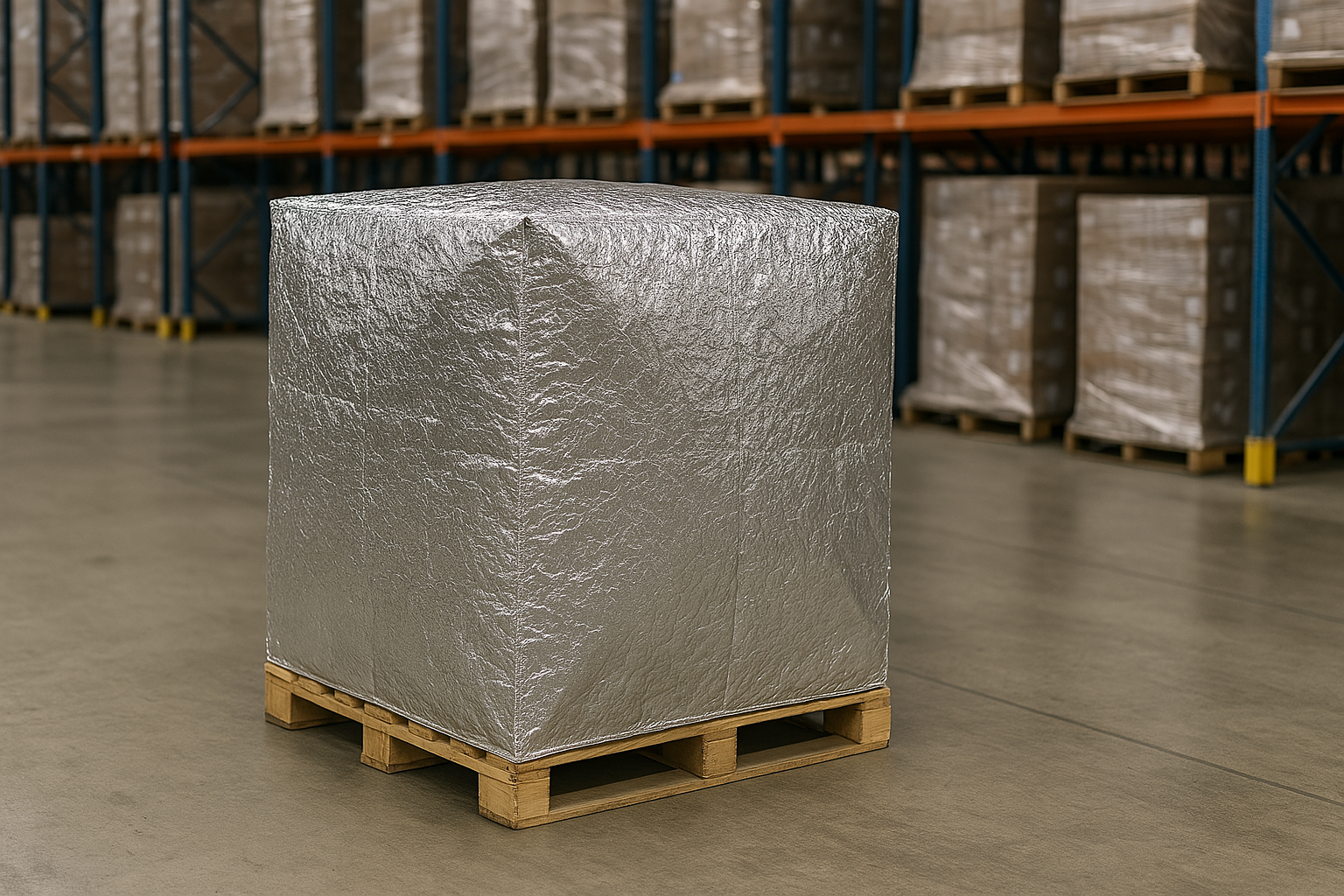
Pallet Insulation Covers For Hazardous Materials Shipping: Selection Framework
Selecting Pallet Insulation Covers For Hazardous Materials Shipping by Cargo, Lane, and Evidence
The right pallet insulation covers for hazardous materials shipping are specified from the shipment backward. Begin with the condition that properly classified and packaged paints, coatings, chemicals, batteries, laboratory materials, and other regulated dangerous goods that may also have temperature limits must maintain, identify the uncontrolled segment that threatens it, and decide whether a passive cover can reduce that risk without interfering with active equipment, handling, safety, or compliance. A pallet cover does not change a material’s classification, packing group, authorized packaging, quantity limit, marking, label, shipping paper, segregation, stowage, or emergency-response requirement. A sound purchasing process therefore combines route mapping, pallet fit, material and closure review, representative evidence, and a clear operating procedure.
Design for the worst plausible segment the cover must address
Draw the route as a sequence of environments rather than a line between cities. Mark product conditioning, pallet build, controlled storage, dock staging, loading, terminal dwell, customs or security inspection, line haul, transfer, destination staging, and receiving. For each step, record the likely ambient challenge, normal duration, credible delay, custody, and whether the cover is closed, opened, or removed.
The critical exposure may be short and intense or long and moderate. Direct sun on the top of a pallet can create a different design problem from a cold floor, wind at an airport, humidity inside a container, or a weekend delay at an LTL terminal. A single average ambient temperature hides these differences. Specification should focus on the worst plausible segment that the cover is intended to address.
Also identify the next environment. If the pallet enters active refrigeration, the cover may need to open or come off to allow airflow. If a cold pallet enters warm humid air, removal may need to be delayed or managed to limit condensation. If inspectors require access, the cover needs a repeatable opening and reclosure method. The downstream process is part of the cover design.
Decide between buffering, active control, and monitoring
The strongest use case is a defined exposure between controlled steps. In temperature-sensitive hazardous materials logistics, that exposure may involve trying to add thermal protection without obscuring hazard communication, changing package behavior, restricting required ventilation, or confusing an overpack with an authorized hazardous-material package. A cover can slow the pallet’s response while the team completes loading, transfer, inspection, or receiving. It is less convincing when the route lacks suitable temperature control for a long period or when the product starts outside its required condition.
This distinction supports a simple decision. Use passive insulation to manage a bounded thermal challenge that remains after good process controls are in place. Use active refrigeration, heating, conditioned storage, or a different service when the environment must be controlled rather than merely buffered. Use monitoring when evidence of exposure is needed. These tools can complement one another, but they do not perform the same function.
The cargo requirement must be specific. Thermal control can interact with chemical stability, vapor pressure, battery behavior, cure chemistry, and container pressure. Because those effects are product-specific, the safety data sheet, technical data, regulatory classification, and packaging authorization take priority over a generic thermal-cover recommendation. The shipper should define the acceptable starting condition, excursion policy, quality or safety concern, and receiving decision. Without that information, the supplier can offer only a generic cover, and the buyer cannot determine whether the result is suitable.
The six specification areas procurement should connect
Specification area
Information to provide
Evidence or decision needed
Cargo requirement
Product, package, starting condition, acceptable exposure, and consequence of deviation
Ambient profile, solar or wind exposure, dwell, delay, floor contact, and mode changes
Normal and worst-plausible lane map
Cover design
Layers, finished dimensions, closure, overlap, access, windows, base and top protection
Approved sample and production tolerances
Performance evidence
Payload, start condition, ambient test, sensors, openings, and acceptance rule
Representative comparison, chamber study, or pilot
Operation and reuse
Application, removal, inspection, cleaning, drying, repair, storage, return, and retirement
SOP, training, and ownership
This framework helps prevent purchasing by a single number. Thermal conductivity, thickness, or a stated duration can inform the decision, but none is sufficient without the test and assembly context. Procurement should be able to trace each important claim to a product drawing, material declaration, test condition, or operating rule.
Document the conditions behind every performance statement
Use testing that matches the decision. A side-by-side screening study can show which cover slows temperature change more effectively under one controlled exposure. A chamber study can reproduce a defined ambient profile and delay. A monitored pilot can show whether employees apply the cover correctly and whether the route includes unplanned openings. High-risk shipments may require a more formal, documented qualification under the owner’s quality system.
Any test should document the payload, starting condition, pallet dimensions, cover sample, ambient challenge, floor contact, sensor locations, opening events, and acceptance criteria. Temperature curves without this context are hard to interpret. A stated protection time should never be separated from the conditions that produced it.
Monitoring is not a substitute for protection, and protection is not evidence of condition. Decide what the sensors are intended to show. An ambient sensor supports route analysis; a surface sensor shows the exposed edge; a center sensor may respond slowly; a product simulator can approximate thermal behavior. The disposition process should state who reviews the data and how it relates to product acceptance.
Seams, overlap, windows, and restraint need one review
Measure the finished loaded pallet. Standard base dimensions do not capture load overhang, uneven stacking, corner boards, top caps, or height changes. The cover needs enough overlap to close consistently without dragging excessively or blocking forklift access. If multiple pallet builds are expected, decide whether one adjustable design or several dedicated sizes produces better control.
Examine the cover as a finished article. Look at seams, corners, windows, handles, flaps, zipper ends, hook-and-loop areas, and the bottom perimeter. These locations concentrate mechanical stress and can become heat-flow paths. Apply the cover with the planned straps, stretch wrap, nets, or container securing so that compression and snagging are visible before approval.
Access is another trade-off. A window can preserve barcode scanning, but it may need reinforcement and can differ thermally from the surrounding panel. A flap can support inspection, but only if handlers know how to close it. A sealed one-way cover may be simpler, while a reusable design may justify repairable closures. Select features that solve known tasks rather than adding complexity for hypothetical convenience.
Material data is useful only with assembly context
A reflective surface, foam layer, bubble structure, or heavy textile does not independently establish shipment performance. Reflective layers mainly address radiant heat under appropriate orientation and condition. Insulating layers reduce conductive heat flow but may lose effectiveness when compressed or wet. Reinforcement improves durability but can add stiffness, seams, and weight. The finished cover must balance thermal resistance with application, access, cleaning, and route safety.
Request a clear layer description and ask what may change between sample and production. Adhesives, films, foams, coatings, thread, closures, and panel dimensions can affect behavior. A change-control agreement is especially important for repeat orders or qualified applications. Incoming inspection can include dimensions, seam condition, closure function, cleanliness, odor, visible defects, and any critical material declarations.
Hazardous materials must be prepared under the rules that apply to the material and transport mode. Any cover or overpack arrangement should be reviewed by trained personnel, with required marks and labels visible or reproduced as required, and with compatibility, heat, ignition, and ventilation hazards considered. Product-specific limits and current transport requirements should be verified by the responsible quality, regulatory, food-safety, EHS, or dangerous-goods team. The safest supplier language describes the cover’s construction and test conditions without implying universal approval.
Write escalation into the routine before deviations occur
At origin, verify the product and pallet are ready for closure. Check cover identity and condition, apply it in the defined orientation, close all overlaps, keep labels and required marks visible, place monitoring devices as approved, and inspect the base and corners. Record the application when traceability or quality procedures require it.
During transport, specify whether handlers may open the cover and what they must do afterward. Provide an escalation rule for tears, wetting, contamination, leaks, missed connections, extended dwell, active-equipment failure, or a load found outside the planned environment. The instruction should direct the shipment to suitable control rather than relying on the cover beyond its evaluated use.
At destination, inspect before opening, follow any acclimation or airflow procedure, evaluate temperature or condition records, and segregate damaged or contaminated reusable covers. Clean and dry covers under an approved method, inspect closures and insulation, record repairs if needed, and retire units that cannot provide consistent fit or hygiene.
Common mistakes to remove from the purchase order
Asking for a fixed number of protection hours without defining the payload and ambient profile.
Specifying only the pallet base while ignoring loaded height, overhang, closure overlap, and access.
Treating reflective appearance, thickness, or “reusable” language as proof of finished performance.
Leaving labels, restraint, airflow, inspection, sanitation, or dangerous-goods interaction for operations to discover later.
Approving a sample without controlling production materials, dimensions, seams, and closures.
Running a temperature test but not recording handling events or visible condition.
Using the cover to justify longer exposure instead of escalating the shipment when conditions exceed the plan.
A realistic application
A manufacturer ships regulated coating products that must not freeze. The authorized inner and outer packages are palletized, marked, labeled, and documented. A cover may add a passive cold-weather buffer, but only after the dangerous-goods team confirms visibility, closure, static and ignition concerns, compatibility, and emergency access.
This application succeeds only if the cover remains one defined control within the broader lane. The starting condition, active transport, handover timing, inspection, and escalation process continue to carry responsibility for product protection.
Buyer questions before approval
What is the exact regulatory classification and authorized packaging instruction?
Does the safety data sheet or manufacturer data specify temperature, ventilation, or incompatibility limits?
Will the cover make any required marking, label, orientation arrow, or handling instruction hard to see?
Could the cover affect heat dissipation, pressure, static control, fire response, or spill access?
Has a trained dangerous-goods professional approved the complete pallet configuration for the transport mode?
Frequently asked questions
Does a thermal pallet cover count as hazardous-material packaging?
Usually it is an additional cover or overpack component, not the authorized inner or outer package. The exact regulatory treatment depends on the configuration and jurisdiction. A trained dangerous-goods professional should review the finished pallet.
Can a cover hide hazardous-material labels during transport?
Required hazard communication must remain visible or be reproduced as applicable. Do not assume that a transparent window or a shipping document elsewhere on the load solves every marking and labeling requirement.
Can pallet insulation prevent a dangerous chemical reaction?
It may slow ambient heat transfer, but it is not a safety control for an unstable or reactive material unless a qualified technical and regulatory assessment says so. Product-specific temperature control may require active equipment, monitoring, segregation, or other measures.
What should happen if a package leaks under the cover?
Follow the emergency, spill, carrier, and regulatory procedures for the material. Do not remove or reuse a contaminated cover through the normal return process until authorized personnel have assessed it.
Conclusion
Choose pallet insulation covers for hazardous materials shipping by connecting five things: the cargo requirement, the exposed route segment, the finished pallet geometry, the operating process, and evidence that represents the intended use. A cover is most defensible when it has a narrow, explicit role and when its limitations are written into the shipment plan.
The next step is not a bulk order. It is a representative sample on the actual pallet, followed by fit and handling review and an appropriate thermal comparison or pilot. Once the team understands how the cover performs and how employees use it, procurement can scale a controlled specification rather than a marketing claim.
About Tempk
Tempk supplies cold-chain packaging and thermal pallet cover options for B2B shipping applications. For passive thermal protection for regulated cargo without blurring dangerous-goods packaging and labeling responsibilities, we can help organize a discussion around pallet size, material construction, closures, access, one-way or reusable use, and sample evaluation. We do not treat a passive cover as a replacement for the customer’s required transport controls or product-specific qualification.
Share your pallet build, cargo requirement, route exposure, and handling process with Tempk to compare a practical sample and define the checks needed before production.
Pallet Insulation Covers For Freight: Selection Framework
Selecting Pallet Insulation Covers For Freight by Cargo, Lane, and Evidence
The right pallet insulation covers for freight are specified from the shipment backward. Begin with the condition that industrial goods, packaged food, healthcare supplies, specialty chemicals, electronics, and other freight affected by short thermal excursions must maintain, identify the uncontrolled segment that threatens it, and decide whether a passive cover can reduce that risk without interfering with active equipment, handling, safety, or compliance. An insulation cover moderates the rate of temperature change. It does not create a controlled temperature, replace refrigerated equipment, or guarantee that the center and surface of every case will remain within specification. A sound purchasing process therefore combines route mapping, pallet fit, material and closure review, representative evidence, and a clear operating procedure.
The cover’s most defensible place in the lane
The strongest use case is a defined exposure between controlled steps. In general temperature-sensitive freight, that exposure may involve uncontrolled docks, trailer transfers, LTL terminals, weather exposure, and uncertainty about how long a pallet remains outside its preferred environment. A cover can slow the pallet’s response while the team completes loading, transfer, inspection, or receiving. It is less convincing when the route lacks suitable temperature control for a long period or when the product starts outside its required condition.
This distinction supports a simple decision. Use passive insulation to manage a bounded thermal challenge that remains after good process controls are in place. Use active refrigeration, heating, conditioned storage, or a different service when the environment must be controlled rather than merely buffered. Use monitoring when evidence of exposure is needed. These tools can complement one another, but they do not perform the same function.
The cargo requirement must be specific. A pallet is a three-dimensional load with warm and cool zones, air gaps, conductive paths through the base, and highly exposed top and corner cases. Cover performance depends on the entire assembly rather than one material description. The shipper should define the acceptable starting condition, excursion policy, quality or safety concern, and receiving decision. Without that information, the supplier can offer only a generic cover, and the buyer cannot determine whether the result is suitable.
The route profile comes before material selection
Draw the route as a sequence of environments rather than a line between cities. Mark product conditioning, pallet build, controlled storage, dock staging, loading, terminal dwell, customs or security inspection, line haul, transfer, destination staging, and receiving. For each step, record the likely ambient challenge, normal duration, credible delay, custody, and whether the cover is closed, opened, or removed.
The critical exposure may be short and intense or long and moderate. Direct sun on the top of a pallet can create a different design problem from a cold floor, wind at an airport, humidity inside a container, or a weekend delay at an LTL terminal. A single average ambient temperature hides these differences. Specification should focus on the worst plausible segment that the cover is intended to address.
Also identify the next environment. If the pallet enters active refrigeration, the cover may need to open or come off to allow airflow. If a cold pallet enters warm humid air, removal may need to be delayed or managed to limit condensation. If inspectors require access, the cover needs a repeatable opening and reclosure method. The downstream process is part of the cover design.
Measure the finished pallet and inspect every opening
Measure the finished loaded pallet. Standard base dimensions do not capture load overhang, uneven stacking, corner boards, top caps, or height changes. The cover needs enough overlap to close consistently without dragging excessively or blocking forklift access. If multiple pallet builds are expected, decide whether one adjustable design or several dedicated sizes produces better control.
Examine the cover as a finished article. Look at seams, corners, windows, handles, flaps, zipper ends, hook-and-loop areas, and the bottom perimeter. These locations concentrate mechanical stress and can become heat-flow paths. Apply the cover with the planned straps, stretch wrap, nets, or container securing so that compression and snagging are visible before approval.
Access is another trade-off. A window can preserve barcode scanning, but it may need reinforcement and can differ thermally from the surrounding panel. A flap can support inspection, but only if handlers know how to close it. A sealed one-way cover may be simpler, while a reusable design may justify repairable closures. Select features that solve known tasks rather than adding complexity for hypothetical convenience.
Avoid choosing by shine, thickness, or weight alone
A reflective surface, foam layer, bubble structure, or heavy textile does not independently establish shipment performance. Reflective layers mainly address radiant heat under appropriate orientation and condition. Insulating layers reduce conductive heat flow but may lose effectiveness when compressed or wet. Reinforcement improves durability but can add stiffness, seams, and weight. The finished cover must balance thermal resistance with application, access, cleaning, and route safety.
Request a clear layer description and ask what may change between sample and production. Adhesives, films, foams, coatings, thread, closures, and panel dimensions can affect behavior. A change-control agreement is especially important for repeat orders or qualified applications. Incoming inspection can include dimensions, seam condition, closure function, cleanliness, odor, visible defects, and any critical material declarations.
The shipper remains responsible for product requirements, suitable transport equipment, documentation, and any applicable food, pharmaceutical, chemical, or dangerous-goods obligations. The cover is an added packaging layer, not a universal compliance certificate. Product-specific limits and current transport requirements should be verified by the responsible quality, regulatory, food-safety, EHS, or dangerous-goods team. The safest supplier language describes the cover’s construction and test conditions without implying universal approval.
Turn cargo and lane facts into a controlled specification
Specification area
Information to provide
Evidence or decision needed
Cargo requirement
Product, package, starting condition, acceptable exposure, and consequence of deviation
Ambient profile, solar or wind exposure, dwell, delay, floor contact, and mode changes
Normal and worst-plausible lane map
Cover design
Layers, finished dimensions, closure, overlap, access, windows, base and top protection
Approved sample and production tolerances
Performance evidence
Payload, start condition, ambient test, sensors, openings, and acceptance rule
Representative comparison, chamber study, or pilot
Operation and reuse
Application, removal, inspection, cleaning, drying, repair, storage, return, and retirement
SOP, training, and ownership
This framework helps prevent purchasing by a single number. Thermal conductivity, thickness, or a stated duration can inform the decision, but none is sufficient without the test and assembly context. Procurement should be able to trace each important claim to a product drawing, material declaration, test condition, or operating rule.
Testing, monitoring, and protection answer different questions
Use testing that matches the decision. A side-by-side screening study can show which cover slows temperature change more effectively under one controlled exposure. A chamber study can reproduce a defined ambient profile and delay. A monitored pilot can show whether employees apply the cover correctly and whether the route includes unplanned openings. High-risk shipments may require a more formal, documented qualification under the owner’s quality system.
Any test should document the payload, starting condition, pallet dimensions, cover sample, ambient challenge, floor contact, sensor locations, opening events, and acceptance criteria. Temperature curves without this context are hard to interpret. A stated protection time should never be separated from the conditions that produced it.
Monitoring is not a substitute for protection, and protection is not evidence of condition. Decide what the sensors are intended to show. An ambient sensor supports route analysis; a surface sensor shows the exposed edge; a center sensor may respond slowly; a product simulator can approximate thermal behavior. The disposition process should state who reviews the data and how it relates to product acceptance.
Origin, transit, and receiving need one connected procedure
At origin, verify the product and pallet are ready for closure. Check cover identity and condition, apply it in the defined orientation, close all overlaps, keep labels and required marks visible, place monitoring devices as approved, and inspect the base and corners. Record the application when traceability or quality procedures require it.
During transport, specify whether handlers may open the cover and what they must do afterward. Provide an escalation rule for tears, wetting, contamination, leaks, missed connections, extended dwell, active-equipment failure, or a load found outside the planned environment. The instruction should direct the shipment to suitable control rather than relying on the cover beyond its evaluated use.
At destination, inspect before opening, follow any acclimation or airflow procedure, evaluate temperature or condition records, and segregate damaged or contaminated reusable covers. Clean and dry covers under an approved method, inspect closures and insulation, record repairs if needed, and retire units that cannot provide consistent fit or hygiene.
Common mistakes to remove from the purchase order
Asking for a fixed number of protection hours without defining the payload and ambient profile.
Specifying only the pallet base while ignoring loaded height, overhang, closure overlap, and access.
Treating reflective appearance, thickness, or “reusable” language as proof of finished performance.
Leaving labels, restraint, airflow, inspection, sanitation, or dangerous-goods interaction for operations to discover later.
Approving a sample without controlling production materials, dimensions, seams, and closures.
Running a temperature test but not recording handling events or visible condition.
Using the cover to justify longer exposure instead of escalating the shipment when conditions exceed the plan.
A realistic application
A distributor moves a temperature-sensitive industrial product through an LTL network. The line-haul trailer is appropriate, but the pallet can spend time in two cross-docks. A cover may reduce the effect of those handovers when its fit, closure, and handling instructions are consistent across terminals.
This application succeeds only if the cover remains one defined control within the broader lane. The starting condition, active transport, handover timing, inspection, and escalation process continue to carry responsibility for product protection.
Buyer questions before approval
What product temperature range and excursion policy apply?
Which route segments are actively controlled and which are not?
What are the loaded pallet dimensions, height variation, and corner hazards?
Does the cover need to remain accessible for barcode scans and inspection?
What test evidence represents the planned exposure, payload, and handling sequence?
Frequently asked questions
How long will a pallet insulation cover protect freight?
There is no reliable universal duration. Useful protection depends on starting temperature, ambient conditions, wind, solar load, pallet mass, product heat capacity, cover construction, fit, and opening frequency. Buyers should ask for the test conditions behind any duration claim.
Is a thicker cover always better?
Not necessarily. Thickness can help when it adds effective insulation, but seam design, fit, compression, moisture, reflective surfaces, and handling durability can be equally important. A bulky cover that is difficult to close may perform worse in real operations.
Can the cover be used in an LTL network?
Yes, when the cover is compatible with repeated handling, scanning, load restraint, and terminal procedures. The shipper should also confirm that labels remain visible and that employees know whether the cover may be opened during inspection.
Should the pallet be temperature monitored?
Monitoring is often useful when product risk or customer documentation justifies it. A logger records exposure; it does not protect the goods. Placement and review rules should reflect the specific purpose of the data.
Conclusion
Choose pallet insulation covers for freight by connecting five things: the cargo requirement, the exposed route segment, the finished pallet geometry, the operating process, and evidence that represents the intended use. A cover is most defensible when it has a narrow, explicit role and when its limitations are written into the shipment plan.
The next step is not a bulk order. It is a representative sample on the actual pallet, followed by fit and handling review and an appropriate thermal comparison or pilot. Once the team understands how the cover performs and how employees use it, procurement can scale a controlled specification rather than a marketing claim.
About Tempk
Tempk supplies cold-chain packaging and thermal pallet cover options for B2B shipping applications. For general freight lanes that need a passive thermal buffer at docks, cross-docks, and mode changes, we can help organize a discussion around pallet size, material construction, closures, access, one-way or reusable use, and sample evaluation. We do not treat a passive cover as a replacement for the customer’s required transport controls or product-specific qualification.
Share your pallet build, cargo requirement, route exposure, and handling process with Tempk to compare a practical sample and define the checks needed before production.
Insulated Pallet Covers For Transport: Selection Framework
Selecting Insulated Pallet Covers For Transport by Cargo, Lane, and Evidence
The right insulated pallet covers for transport are specified from the shipment backward. Begin with the condition that palletized goods that benefit from a passive thermal buffer during loading, transit interruptions, terminals, and delivery must maintain, identify the uncontrolled segment that threatens it, and decide whether a passive cover can reduce that risk without interfering with active equipment, handling, safety, or compliance. An insulated cover reduces heat transfer. It is not a refrigerated trailer, active container, qualified shipper, or temperature recorder, and it cannot correct an unsuitable transport plan by itself. A sound purchasing process therefore combines route mapping, pallet fit, material and closure review, representative evidence, and a clear operating procedure.
Design for the worst plausible segment the cover must address
Draw the route as a sequence of environments rather than a line between cities. Mark product conditioning, pallet build, controlled storage, dock staging, loading, terminal dwell, customs or security inspection, line haul, transfer, destination staging, and receiving. For each step, record the likely ambient challenge, normal duration, credible delay, custody, and whether the cover is closed, opened, or removed.
The critical exposure may be short and intense or long and moderate. Direct sun on the top of a pallet can create a different design problem from a cold floor, wind at an airport, humidity inside a container, or a weekend delay at an LTL terminal. A single average ambient temperature hides these differences. Specification should focus on the worst plausible segment that the cover is intended to address.
Also identify the next environment. If the pallet enters active refrigeration, the cover may need to open or come off to allow airflow. If a cold pallet enters warm humid air, removal may need to be delayed or managed to limit condensation. If inspectors require access, the cover needs a repeatable opening and reclosure method. The downstream process is part of the cover design.
Decide between buffering, active control, and monitoring
The strongest use case is a defined exposure between controlled steps. In road, rail, ocean, and multimodal transport, that exposure may involve selecting a cover by brochure language rather than by lane, exposure, pallet geometry, product limits, and the operating procedure that determines whether it stays closed. A cover can slow the pallet’s response while the team completes loading, transfer, inspection, or receiving. It is less convincing when the route lacks suitable temperature control for a long period or when the product starts outside its required condition.
This distinction supports a simple decision. Use passive insulation to manage a bounded thermal challenge that remains after good process controls are in place. Use active refrigeration, heating, conditioned storage, or a different service when the environment must be controlled rather than merely buffered. Use monitoring when evidence of exposure is needed. These tools can complement one another, but they do not perform the same function.
The cargo requirement must be specific. Transport exposes the pallet to conduction through floors, convection from air and wind, radiation from sun and hot surfaces, and thermal bridges at seams and openings. The weakest part of the finished assembly can dominate short exposures. The shipper should define the acceptable starting condition, excursion policy, quality or safety concern, and receiving decision. Without that information, the supplier can offer only a generic cover, and the buyer cannot determine whether the result is suitable.
The six specification areas procurement should connect
Specification area
Information to provide
Evidence or decision needed
Cargo requirement
Product, package, starting condition, acceptable exposure, and consequence of deviation
Ambient profile, solar or wind exposure, dwell, delay, floor contact, and mode changes
Normal and worst-plausible lane map
Cover design
Layers, finished dimensions, closure, overlap, access, windows, base and top protection
Approved sample and production tolerances
Performance evidence
Payload, start condition, ambient test, sensors, openings, and acceptance rule
Representative comparison, chamber study, or pilot
Operation and reuse
Application, removal, inspection, cleaning, drying, repair, storage, return, and retirement
SOP, training, and ownership
This framework helps prevent purchasing by a single number. Thermal conductivity, thickness, or a stated duration can inform the decision, but none is sufficient without the test and assembly context. Procurement should be able to trace each important claim to a product drawing, material declaration, test condition, or operating rule.
Document the conditions behind every performance statement
Use testing that matches the decision. A side-by-side screening study can show which cover slows temperature change more effectively under one controlled exposure. A chamber study can reproduce a defined ambient profile and delay. A monitored pilot can show whether employees apply the cover correctly and whether the route includes unplanned openings. High-risk shipments may require a more formal, documented qualification under the owner’s quality system.
Any test should document the payload, starting condition, pallet dimensions, cover sample, ambient challenge, floor contact, sensor locations, opening events, and acceptance criteria. Temperature curves without this context are hard to interpret. A stated protection time should never be separated from the conditions that produced it.
Monitoring is not a substitute for protection, and protection is not evidence of condition. Decide what the sensors are intended to show. An ambient sensor supports route analysis; a surface sensor shows the exposed edge; a center sensor may respond slowly; a product simulator can approximate thermal behavior. The disposition process should state who reviews the data and how it relates to product acceptance.
Seams, overlap, windows, and restraint need one review
Measure the finished loaded pallet. Standard base dimensions do not capture load overhang, uneven stacking, corner boards, top caps, or height changes. The cover needs enough overlap to close consistently without dragging excessively or blocking forklift access. If multiple pallet builds are expected, decide whether one adjustable design or several dedicated sizes produces better control.
Examine the cover as a finished article. Look at seams, corners, windows, handles, flaps, zipper ends, hook-and-loop areas, and the bottom perimeter. These locations concentrate mechanical stress and can become heat-flow paths. Apply the cover with the planned straps, stretch wrap, nets, or container securing so that compression and snagging are visible before approval.
Access is another trade-off. A window can preserve barcode scanning, but it may need reinforcement and can differ thermally from the surrounding panel. A flap can support inspection, but only if handlers know how to close it. A sealed one-way cover may be simpler, while a reusable design may justify repairable closures. Select features that solve known tasks rather than adding complexity for hypothetical convenience.
Material data is useful only with assembly context
A reflective surface, foam layer, bubble structure, or heavy textile does not independently establish shipment performance. Reflective layers mainly address radiant heat under appropriate orientation and condition. Insulating layers reduce conductive heat flow but may lose effectiveness when compressed or wet. Reinforcement improves durability but can add stiffness, seams, and weight. The finished cover must balance thermal resistance with application, access, cleaning, and route safety.
Request a clear layer description and ask what may change between sample and production. Adhesives, films, foams, coatings, thread, closures, and panel dimensions can affect behavior. A change-control agreement is especially important for repeat orders or qualified applications. Incoming inspection can include dimensions, seam condition, closure function, cleanliness, odor, visible defects, and any critical material declarations.
The cover must fit within cargo securement, vehicle, carrier, customs, safety, sanitation, dangerous-goods, and product-specific requirements. Shippers should verify how it interacts with labels, restraints, airflow, inspections, and receiving procedures. Product-specific limits and current transport requirements should be verified by the responsible quality, regulatory, food-safety, EHS, or dangerous-goods team. The safest supplier language describes the cover’s construction and test conditions without implying universal approval.
Write escalation into the routine before deviations occur
At origin, verify the product and pallet are ready for closure. Check cover identity and condition, apply it in the defined orientation, close all overlaps, keep labels and required marks visible, place monitoring devices as approved, and inspect the base and corners. Record the application when traceability or quality procedures require it.
During transport, specify whether handlers may open the cover and what they must do afterward. Provide an escalation rule for tears, wetting, contamination, leaks, missed connections, extended dwell, active-equipment failure, or a load found outside the planned environment. The instruction should direct the shipment to suitable control rather than relying on the cover beyond its evaluated use.
At destination, inspect before opening, follow any acclimation or airflow procedure, evaluate temperature or condition records, and segregate damaged or contaminated reusable covers. Clean and dry covers under an approved method, inspect closures and insulation, record repairs if needed, and retire units that cannot provide consistent fit or hygiene.
Common mistakes to remove from the purchase order
Asking for a fixed number of protection hours without defining the payload and ambient profile.
Specifying only the pallet base while ignoring loaded height, overhang, closure overlap, and access.
Treating reflective appearance, thickness, or “reusable” language as proof of finished performance.
Leaving labels, restraint, airflow, inspection, sanitation, or dangerous-goods interaction for operations to discover later.
Approving a sample without controlling production materials, dimensions, seams, and closures.
Running a temperature test but not recording handling events or visible condition.
Using the cover to justify longer exposure instead of escalating the shipment when conditions exceed the plan.
A realistic application
A manufacturer uses road transport with a ferry crossing. The trailer is controlled during line haul, but pallets can stand in a staging lane during transfer. A cover is specified for that known gap, with instructions for application, opening, and final removal.
This application succeeds only if the cover remains one defined control within the broader lane. The starting condition, active transport, handover timing, inspection, and escalation process continue to carry responsibility for product protection.
Buyer questions before approval
What is the product’s acceptable condition and excursion policy?
Where does passive protection add value versus active temperature control?
How will the cover work with pallets, stretch wrap, straps, nets, and vehicle airflow?
Which dimensions and access features are required at origin and destination?
How will performance be checked during pilot shipments and routine operation?
Frequently asked questions
What is the main purpose of an insulated pallet cover?
Its purpose is to slow heat transfer between a palletized load and the surrounding environment. It is most useful for defined exposure points such as staging, transfers, and temporary loss of controlled surroundings.
Can one cover work for road, rail, and ocean transport?
The same construction may be usable, but the lane-specific risks differ. Ocean container walls, rail terminals, road docks, solar exposure, airflow, and handling methods should be reviewed separately.
How do you size a pallet cover?
Measure the finished loaded pallet, not only the pallet base. Include load overhang, height variation, closure overlap, access requirements, and any base or top insulation. Confirm the supplier’s finished dimensions and tolerances.
When should a cover be removed?
Removal depends on the next environment. A cover may need to come off or open to allow active refrigeration, inspection, acclimation, or receiving. The shipment SOP should state the decision clearly.
Conclusion
Choose insulated pallet covers for transport by connecting five things: the cargo requirement, the exposed route segment, the finished pallet geometry, the operating process, and evidence that represents the intended use. A cover is most defensible when it has a narrow, explicit role and when its limitations are written into the shipment plan.
The next step is not a bulk order. It is a representative sample on the actual pallet, followed by fit and handling review and an appropriate thermal comparison or pilot. Once the team understands how the cover performs and how employees use it, procurement can scale a controlled specification rather than a marketing claim.
About Tempk
Tempk supplies cold-chain packaging and thermal pallet cover options for B2B shipping applications. For transport lanes that need practical sizing, handling, and passive protection around known exposure points, we can help organize a discussion around pallet size, material construction, closures, access, one-way or reusable use, and sample evaluation. We do not treat a passive cover as a replacement for the customer’s required transport controls or product-specific qualification.
Share your pallet build, cargo requirement, route exposure, and handling process with Tempk to compare a practical sample and define the checks needed before production.
Insulated Pallet Blankets For Freight Forwarding: Selection Framework
Selecting Insulated Pallet Blankets For Freight Forwarding by Cargo, Lane, and Evidence
The right insulated pallet blankets for freight forwarding are specified from the shipment backward. Begin with the condition that palletized temperature-sensitive goods moving through airports, ports, consolidation warehouses, customs holds, trucking legs, and partner facilities must maintain, identify the uncontrolled segment that threatens it, and decide whether a passive cover can reduce that risk without interfering with active equipment, handling, safety, or compliance. The blanket provides passive buffering around the pallet. It cannot guarantee carrier priority, recover from a missed booking, replace a temperature-controlled service, or control what happens when another party opens the load. A sound purchasing process therefore combines route mapping, pallet fit, material and closure review, representative evidence, and a clear operating procedure.
A clear role prevents false confidence
The strongest use case is a defined exposure between controlled steps. In multimodal freight forwarding, that exposure may involve handover variability: a sound origin plan can fail when the pallet waits on an airport apron, misses a connection, is opened for inspection, or enters a partner warehouse with a different process. A cover can slow the pallet’s response while the team completes loading, transfer, inspection, or receiving. It is less convincing when the route lacks suitable temperature control for a long period or when the product starts outside its required condition.
This distinction supports a simple decision. Use passive insulation to manage a bounded thermal challenge that remains after good process controls are in place. Use active refrigeration, heating, conditioned storage, or a different service when the environment must be controlled rather than merely buffered. Use monitoring when evidence of exposure is needed. These tools can complement one another, but they do not perform the same function.
The cargo requirement must be specific. Multimodal risk is driven by changing ambient conditions and changing custody. A cover’s value is often greatest during exposed transitions, but its benefit can be lost through repeated opening, poor closure, wet handling, or uncertainty about whether it stays on inside controlled equipment. The shipper should define the acceptable starting condition, excursion policy, quality or safety concern, and receiving decision. Without that information, the supplier can offer only a generic cover, and the buyer cannot determine whether the result is suitable.
From product requirement to supplier evidence
Specification area
Information to provide
Evidence or decision needed
Cargo requirement
Product, package, starting condition, acceptable exposure, and consequence of deviation
Ambient profile, solar or wind exposure, dwell, delay, floor contact, and mode changes
Normal and worst-plausible lane map
Cover design
Layers, finished dimensions, closure, overlap, access, windows, base and top protection
Approved sample and production tolerances
Performance evidence
Payload, start condition, ambient test, sensors, openings, and acceptance rule
Representative comparison, chamber study, or pilot
Operation and reuse
Application, removal, inspection, cleaning, drying, repair, storage, return, and retirement
SOP, training, and ownership
This framework helps prevent purchasing by a single number. Thermal conductivity, thickness, or a stated duration can inform the decision, but none is sufficient without the test and assembly context. Procurement should be able to trace each important claim to a product drawing, material declaration, test condition, or operating rule.
A lane is a sequence of environments, not two cities
Draw the route as a sequence of environments rather than a line between cities. Mark product conditioning, pallet build, controlled storage, dock staging, loading, terminal dwell, customs or security inspection, line haul, transfer, destination staging, and receiving. For each step, record the likely ambient challenge, normal duration, credible delay, custody, and whether the cover is closed, opened, or removed.
The critical exposure may be short and intense or long and moderate. Direct sun on the top of a pallet can create a different design problem from a cold floor, wind at an airport, humidity inside a container, or a weekend delay at an LTL terminal. A single average ambient temperature hides these differences. Specification should focus on the worst plausible segment that the cover is intended to address.
Also identify the next environment. If the pallet enters active refrigeration, the cover may need to open or come off to allow airflow. If a cold pallet enters warm humid air, removal may need to be delayed or managed to limit condensation. If inspectors require access, the cover needs a repeatable opening and reclosure method. The downstream process is part of the cover design.
Control layers, substitutions, and production consistency
A reflective surface, foam layer, bubble structure, or heavy textile does not independently establish shipment performance. Reflective layers mainly address radiant heat under appropriate orientation and condition. Insulating layers reduce conductive heat flow but may lose effectiveness when compressed or wet. Reinforcement improves durability but can add stiffness, seams, and weight. The finished cover must balance thermal resistance with application, access, cleaning, and route safety.
Request a clear layer description and ask what may change between sample and production. Adhesives, films, foams, coatings, thread, closures, and panel dimensions can affect behavior. A change-control agreement is especially important for repeat orders or qualified applications. Incoming inspection can include dimensions, seam condition, closure function, cleanliness, odor, visible defects, and any critical material declarations.
Forwarders should align cover use with carrier rules, security screening, customs inspection, dangerous-goods requirements when applicable, time-and-temperature handling instructions, and the shipper’s quality agreement. Documentation and responsibility at each handover should be explicit. Product-specific limits and current transport requirements should be verified by the responsible quality, regulatory, food-safety, EHS, or dangerous-goods team. The safest supplier language describes the cover’s construction and test conditions without implying universal approval.
Small design details control daily consistency
Measure the finished loaded pallet. Standard base dimensions do not capture load overhang, uneven stacking, corner boards, top caps, or height changes. The cover needs enough overlap to close consistently without dragging excessively or blocking forklift access. If multiple pallet builds are expected, decide whether one adjustable design or several dedicated sizes produces better control.
Examine the cover as a finished article. Look at seams, corners, windows, handles, flaps, zipper ends, hook-and-loop areas, and the bottom perimeter. These locations concentrate mechanical stress and can become heat-flow paths. Apply the cover with the planned straps, stretch wrap, nets, or container securing so that compression and snagging are visible before approval.
Access is another trade-off. A window can preserve barcode scanning, but it may need reinforcement and can differ thermally from the surrounding panel. A flap can support inspection, but only if handlers know how to close it. A sealed one-way cover may be simpler, while a reusable design may justify repairable closures. Select features that solve known tasks rather than adding complexity for hypothetical convenience.
A defensible claim stays attached to its test profile
Use testing that matches the decision. A side-by-side screening study can show which cover slows temperature change more effectively under one controlled exposure. A chamber study can reproduce a defined ambient profile and delay. A monitored pilot can show whether employees apply the cover correctly and whether the route includes unplanned openings. High-risk shipments may require a more formal, documented qualification under the owner’s quality system.
Any test should document the payload, starting condition, pallet dimensions, cover sample, ambient challenge, floor contact, sensor locations, opening events, and acceptance criteria. Temperature curves without this context are hard to interpret. A stated protection time should never be separated from the conditions that produced it.
Monitoring is not a substitute for protection, and protection is not evidence of condition. Decide what the sensors are intended to show. An ambient sensor supports route analysis; a surface sensor shows the exposed edge; a center sensor may respond slowly; a product simulator can approximate thermal behavior. The disposition process should state who reviews the data and how it relates to product acceptance.
The SOP protects the value of the tested configuration
At origin, verify the product and pallet are ready for closure. Check cover identity and condition, apply it in the defined orientation, close all overlaps, keep labels and required marks visible, place monitoring devices as approved, and inspect the base and corners. Record the application when traceability or quality procedures require it.
During transport, specify whether handlers may open the cover and what they must do afterward. Provide an escalation rule for tears, wetting, contamination, leaks, missed connections, extended dwell, active-equipment failure, or a load found outside the planned environment. The instruction should direct the shipment to suitable control rather than relying on the cover beyond its evaluated use.
At destination, inspect before opening, follow any acclimation or airflow procedure, evaluate temperature or condition records, and segregate damaged or contaminated reusable covers. Clean and dry covers under an approved method, inspect closures and insulation, record repairs if needed, and retire units that cannot provide consistent fit or hygiene.
Common mistakes to remove from the purchase order
Asking for a fixed number of protection hours without defining the payload and ambient profile.
Specifying only the pallet base while ignoring loaded height, overhang, closure overlap, and access.
Treating reflective appearance, thickness, or “reusable” language as proof of finished performance.
Leaving labels, restraint, airflow, inspection, sanitation, or dangerous-goods interaction for operations to discover later.
Approving a sample without controlling production materials, dimensions, seams, and closures.
Running a temperature test but not recording handling events or visible condition.
Using the cover to justify longer exposure instead of escalating the shipment when conditions exceed the plan.
A realistic application
An export pallet leaves a controlled warehouse by truck, waits at an air-cargo terminal, crosses a warm apron, and is transferred to a destination handler. The forwarder uses an insulated blanket with a documented closure sequence and inspection points. The plan also states who may open it and how to reclose it after screening.
This application succeeds only if the cover remains one defined control within the broader lane. The starting condition, active transport, handover timing, inspection, and escalation process continue to carry responsibility for product protection.
Buyer questions before approval
Which handover points are outside controlled storage or equipment?
Who applies, inspects, opens, recloses, and removes the blanket?
What happens during customs, security, veterinary, or quality inspection?
Does the carrier have size, material, labeling, fire-safety, or access restrictions?
What is the escalation plan for a missed uplift, rolled booking, or delayed transfer?
Frequently asked questions
Are insulated pallet blankets accepted by every airline?
Acceptance and operating rules can vary by carrier, airport, cargo type, and service. The forwarder should confirm the completed pallet configuration before tender and avoid obstructing labels, netting, restraint, or required access.
Who should remove the blanket at destination?
The shipment plan should name the responsible party and the condition for removal. Leaving that decision vague can result in unnecessary exposure or blocked airflow after the pallet enters controlled storage.
How should a blanket be handled during customs inspection?
Provide instructions that allow authorized inspection while protecting the load as much as practical. After opening, the cover should be checked for damage and resealed according to the agreed procedure.
Can a forwarder promise a fixed protection time?
A fixed promise is unsafe without representative testing. Temperature behavior depends on the starting condition, pallet mass, ambient profile, blanket assembly, and how often the load is opened.
Conclusion
Choose insulated pallet blankets for freight forwarding by connecting five things: the cargo requirement, the exposed route segment, the finished pallet geometry, the operating process, and evidence that represents the intended use. A cover is most defensible when it has a narrow, explicit role and when its limitations are written into the shipment plan.
The next step is not a bulk order. It is a representative sample on the actual pallet, followed by fit and handling review and an appropriate thermal comparison or pilot. Once the team understands how the cover performs and how employees use it, procurement can scale a controlled specification rather than a marketing claim.
About Tempk
Tempk supplies cold-chain packaging and thermal pallet cover options for B2B shipping applications. For multimodal pallets exposed during air-cargo, customs, cross-dock, and partner handovers, we can help organize a discussion around pallet size, material construction, closures, access, one-way or reusable use, and sample evaluation. We do not treat a passive cover as a replacement for the customer’s required transport controls or product-specific qualification.
Share your pallet build, cargo requirement, route exposure, and handling process with Tempk to compare a practical sample and define the checks needed before production.
Clinical Sample Transport Packaging Guide for Lab and Diagnostic Routes
Clinical sample transport has a different risk profile from ordinary chilled parcels. The package must protect the sample tube, absorbent layer, secondary container, outer shipper, temperature range, documentation, and receiving evidence at the same time. The right packout depends on specimen type, test method, collection medium, route time, and the receiving laboratory’s acceptance criteria.
Blood specimens, biopsy or tissue specimens, and PCR swab specimens can all travel in a similar-looking box, but the packout should not be treated as identical. Blood tubes often need upright support and shock control. Tissue samples need leak control, cushioning, and a temperature range that follows the lab method. PCR swabs need tube separation, clean handoff, and a plan for either refrigerated or frozen routing when delays are expected.
Clinical sample packout comparison
Specimen type
Temperature planning
Humidity and leak control
Pre-conditioning
Packaging pressure
Coolant position
Transit window
Common losses
Suitable Tempk solution
Blood specimens
Commonly planned around 2-8 C when the test method requires chilled transport; some assays may accept ambient handling.
Use absorbent material and a leak-resistant secondary container; keep labels readable and dry.
Pre-condition PCM or gel packs to the target lane and pre-cool the shipper when the route is warm.
Use tube racks or sleeves so tubes do not rattle, crack, or rest directly against coolant.
Place coolant around the payload with a buffer layer; avoid direct frozen contact with tubes.
Same-day to 48 hours is common for validated regional routes; longer routes need a qualified shipper and logger.
Hemolysis risk, cracked tubes, wet labels, warm dwell, cold-wall exposure, and missing receiving records.
Tempk medical insulated shipper with conditioned PCM, absorbent secondary packaging, tube insert, data logger, and route validation.
Biopsy or tissue specimens
Often 2-8 C for fresh tissue, frozen with dry ice for selected molecular methods, or ambient/fixative when the lab method requires it.
Control leakage from containers and avoid condensation around paperwork, labels, and cassette bags.
Condition coolant to the exact lab method; do not switch between refrigerated and frozen lanes without approval.
Protect vials, jars, cassettes, and tissue bags from crushing, inversion, and lid pressure.
Separate coolant from specimen containers with a rigid divider or spacer; use dry ice only for frozen lanes.
Plan around collection-to-lab cutoff time; urgent pathology routes often need direct courier or validated overnight handling.
Tempk medical mailer or insulated shipper with tube sleeve, absorbent pouch, conditioned coolant, dry ice option, and logger placement.
How to choose the clinical sample shipper
Start with the receiving laboratory’s test directory and the specimen submission instructions. Confirm the specimen container, transport medium, accepted temperature range, latest receiving time, documentation, and any transport classification requirements before selecting coolant. The package should then be tested with the actual payload count, tube orientation, absorbent material, route duration, and seasonal ambient profile.
For refrigerated samples, Tempk usually starts with a medical insulated shipper, conditioned PCM or gel packs, a buffer layer, a secondary leak-resistant pouch, tube support, and a logger. For frozen samples, dry ice planning must include dry ice mass, sublimation margin, ventilation, label space, and a receiving process that checks remaining dry ice and temperature evidence. For short local routes, a smaller medical mailer may be enough when the sample load is low and the lane has been checked.
Receiving checks that protect sample integrity
The receiving team should be able to confirm that the outer shipper is intact, the secondary container is dry, labels are readable, tubes or jars are not cracked, coolant is still present, temperature data is available when required, and the route time matches the submission plan. If a clinical sample route frequently fails at last-mile dwell, loading dock wait time, or weekend receiving, the packaging design should be adjusted before the next shipment.
Enzyme replacement therapies are high-value biologic medicines that often move through specialty pharmacy, hospital, home-infusion, and clinical distribution lanes. The packout should protect the refrigerated range, avoid freeze contact, protect fragile vials and cartons, and create a clear temperature record for receiving. Because dose value and patient timing can be high, the route plan must be more controlled than an ordinary chilled parcel.
Enzyme replacement therapy planning data
Typical target range
Many enzyme replacement therapies require 2-8 C refrigerated handling; always follow the approved label and local SOP.
Humidity control
Protect vial cartons, inserts, and labels from condensation because receiving teams may need clean lot and expiry data.
Pre-cooling
Use preconditioned shippers, coolant, and separators; avoid loading product during prolonged room-temperature staging.
Packaging pressure
Use vial trays or carton support to protect glass, stoppers, labels, and specialty infusion packaging.
Coolant position
Use conditioned 2-8 C coolant with a no-freeze buffer. Do not place vials against frozen gel packs.
Transport duration
Validate 24-96 h courier or specialty pharmacy lanes with summer and winter profiles where relevant.
Common losses
Freeze contact, warm dwell, label wetting, vial breakage, carton crush, missing temperature data, and rejected receiving.
Tempk packaging fit
Medical insulated shipper, 2-8 C PCM, vial support insert, dry barrier, absorbent liner, tamper seal, and logger.
Why enzyme therapies need a stronger cold-chain package
Enzyme products can be sensitive to temperature excursions and rough handling. The product may ship in small vial counts, which are vulnerable to cold spots when coolant mass is too close. At the same time, warm exposure during last-mile dwell can create a release issue. The package must control both ends of the range while protecting labels, vials, stoppers, cartons, and infusion documentation.
Tempk would normally use a qualified insulated shipper, conditioned 2-8 C PCM, a vial support insert, absorbent liner, dry barrier, and a tamper-evident closure. The logger should sit in the payload zone and, for high-risk lanes, an edge logger can help identify cold-wall or warm-corner risk. Route validation should test actual vial count, carton format, seasonal ambient profile, courier timing, and receiving workflow.
Recommended Tempk approach
Confirm the approved label, product specification, route duration, patient-delivery deadline, and receiving criteria before choosing the shipper. At receiving, review temperature record, label readability, carton dryness, glass condition, tamper seal, and route time. eCFR drug warehousing and distribution rules emphasize written procedures, appropriate storage conditions, and lot traceability; the package should make those controls easier to document.
Recombinant Protein Therapeutics Cold Chain Packaging Guide
Recombinant protein therapeutics need a refrigerated packaging plan that protects the molecule and the release record. These products can be sensitive to heat, freezing, agitation, light, and repeated handoff. A good cold-chain package should keep the product inside its qualified range, avoid direct frozen contact, limit vial or syringe movement, and provide temperature evidence for quality review.
Recombinant protein therapeutic planning data
Typical target range
Most refrigerated recombinant protein products are planned around 2-8 C unless the label or stability protocol sets another range.
Humidity control
Keep cartons, labels, vial trays, and IFU documents dry; condensation can complicate visual inspection and receiving records.
Pre-cooling
Precondition the insulated shipper, coolant, and buffer materials before loading product from qualified refrigerated storage.
Packaging pressure
Support vials, syringes, or cartridges so secondary packaging is not crushed by coolant mass or transit vibration.
Coolant position
Use conditioned PCM or gel packs with a buffer layer. Avoid frozen-wall contact that can denature or aggregate protein product.
Transport duration
Commonly validated for 24-96 h lanes depending on payload mass, shipper size, coolant conditioning, and ambient profile.
Common losses
Temperature excursion, freeze contact, protein aggregation risk, label wetting, carton crush, and missing route records.
Tempk packaging fit
Qualified insulated shipper, 2-8 C PCM, buffer insert, vial tray support, absorbent layer, tamper seal, and logger record.
Why recombinant proteins need product-specific handling
Recombinant protein products are often shipped in vials, prefilled syringes, cartridges, or secondary cartons. The payload can be small, which means it may be more exposed to cold-wall effects if frozen coolant is placed too close. The same product may also be vulnerable to warm route dwell, carton moisture, and physical shock that affects presentation or inspection.
Tempk would normally start by confirming the product label, stability range, route duration, and release criteria. The packout should include conditioned 2-8 C PCM or gel packs, a buffer layer, product support tray, absorbent liner, and a logger positioned in the payload zone. For higher-value lanes, add an edge logger near the expected coldest or warmest point.
Recommended Tempk approach
Use the actual vial or syringe count, starting product temperature, shipper size, coolant conditioning, ambient profile, and courier handoff timing in validation. Receiving checks should include temperature trace, carton dryness, vial or syringe condition, label readability, tamper seal, and route time. The eCFR requires drug products to be stored under appropriate conditions of temperature, humidity, and light so identity, strength, quality, and purity are not affected; the packaging should support that expectation in real distribution lanes.
Cryoprecipitate Cold Chain Packaging Guide
Cryoprecipitate is a frozen blood component with a small payload size and high documentation sensitivity. The packaging plan must preserve the frozen condition, protect small containers from breakage or abrasion, keep labels readable, and provide receiving evidence. A courier box that works for ordinary frozen food is not enough unless it has been validated with the actual component load, coolant mass, route duration, and receiving checks.
Cryoprecipitate frozen transport planning data
Typical temperature range
Frozen cryoprecipitate planning is commonly -18 C or colder before thawing; use the component label and SOP for exact handling.
Humidity and condensation
Protect labels and carton surfaces from frost, condensation, and dry ice contact marks during frozen transport.
Pre-cooling
Pre-freeze the payload and precondition the frozen shipper or dry-ice packout before loading.
Packaging pressure
Protect small frozen units from cracked containers, sharp folds, and hard contact under dry ice or heavy coolant.
Coolant position
Use dry ice or frozen coolant only with compliant venting, separation, and a layout that avoids container abrasion.
Transport duration
Use qualified frozen routes with evidence of temperature maintenance and thaw-risk checks at receiving.
Common losses
Thaw evidence, broken bags or containers, unreadable labels, excessive dry ice contact, missing logger data, and receiving disputes.
Tempk packaging fit
Frozen insulated shipper, dry ice or frozen PCM, separator layer, product sleeve, absorbent liner, tamper seal, and logger record.
Why cryoprecipitate needs its own frozen packout
Cryoprecipitate units may be small, and small frozen payloads can warm quickly at the edge of a shipper. They can also be damaged by hard contact with dry ice, poorly placed frozen packs, or void space that allows movement. The packout should hold the payload securely, separate it from aggressive coolant surfaces, and make thaw evidence easy to review at receiving.
For frozen transport, Tempk would use a qualified frozen shipper, a product sleeve or separator, a dry ice or frozen PCM layout matched to the lane, and a logger placed near the expected warm edge. Dry ice routes also require compliant venting, labeling, and handling according to the shipper’s transport mode and local rules. Receiving checks should include temperature record, thaw evidence, container condition, label readability, and route time.
Recommended Tempk approach
Start with the blood center or hospital SOP, not a generic frozen parcel rule. Confirm allowed range, route duration, dry ice allowance, documentation requirements, and acceptance criteria. Validate with the actual unit count, inner sleeve, outer shipper, coolant mass, summer and winter ambient profiles, and realistic handoff dwell.
FDA’s eCFR blood products standards include frozen plasma and cryoprecipitate processing requirements and references to -18 C or colder conditions for relevant frozen components. Tempk packaging should be used to support validated transport, chain-of-custody review, and receiving decisions under the licensed establishment’s process.
Whole Blood Cold Chain Packaging Guide
Whole blood shipments need a controlled refrigerated lane and careful physical protection. The package must keep the payload inside the licensed establishment’s accepted range, protect the bag and segments, keep labels readable, and provide records that support receiving or return decisions. A whole blood packout is not the same as a food or medicine parcel because the receiving team may need to inspect temperature evidence, seal condition, segment integrity, and visible product condition before release.
Whole blood transport planning data
Typical temperature range
Storage is commonly 1-6 C, with shipment controls often planned around 1-10 C when permitted by the licensed establishment SOP.
Humidity and condensation
Keep labels, overwraps, secondary bags, and paperwork dry; condensation can make visual inspection and chain-of-custody review harder.
Pre-cooling
Precondition the insulated shipper, payload spacers, and coolant before loading; do not use the shipper to pull down warm product.
Packaging pressure
Support the blood bag without pressing tubing, ports, or segment attachments against frozen coolant or hard walls.
Coolant position
Use conditioned cold packs with a buffer layer. Avoid direct freeze contact with the bag, tubing, or ports.
Transport duration
Use validated local and regional routes, with logger positions at payload core and wall-facing edge.
Common losses
Out-of-range temperatures, freeze-contact risk, wet labels, bag abrasion, port stress, missing records, and rejected return-to-inventory decisions.
Tempk packaging fit
Insulated medical shipper, conditioned PCM or gel packs, buffer layer, absorbent liner, bag support insert, tamper seal, and logger record.
Why whole blood needs its own packout
Whole blood can be vulnerable to both warm exposure and freeze contact. Adding more frozen coolant can create a new risk if a bag, tube, or segment rests against a frozen surface. The payload should be buffered and held in a stable cavity so the bag does not slide, fold sharply, or press against cold packs during road vibration, courier sorting, or hand carry.
For validated distribution, Tempk would use a qualified insulated shipper with conditioned coolant, absorbent protection, a bag support insert, and at least one logger in the product zone. Longer or higher-risk routes should include an edge logger near the warmest or coldest expected point. Receiving checks should cover temperature data, seal condition, bag abrasion, visible appearance, label readability, and route time.
Recommended Tempk approach
Start from the establishment’s SOP and the component label. Define the allowed range, maximum route time, logger location, and acceptance criteria before selecting coolant mass. Use a buffer layer between the product and any frozen coolant, and use tamper-evident closure when chain-of-custody matters. The final test should include the actual bag count, starting temperature, coolant conditioning, shipper size, ambient profile, and receiving process.
The eCFR blood products regulation includes requirements for whole blood storage and shipment ranges, and it also emphasizes container integrity, records, and inspection. Tempk packaging should support those workflows; it does not replace the licensed blood establishment’s procedures or regulatory responsibility.
Dairy Pallets Cold Storage Packaging Guide
Dairy pallets need a different cold chain plan from parcel dairy shipments. A single case of milk or yogurt can be protected with an insulated shipper, but a pallet depends on cold storage discipline, trailer airflow, pallet geometry, wrap pattern, dock exposure, and logger placement. The main failure is often not the pallet core. It is the top edge, the corner facing the door, the bottom layer exposed to a warm dock, or a mixed-load position beside products with stronger odor or different temperature requirements.
Dairy pallet cold storage planning data
Typical target range
0-4 C for chilled dairy pallet distribution; apply the dairy producer's specification when it is stricter.
Humidity control
Protect cartons, corrugated trays, labels, and outer cases from condensation during dock transfer and trailer unloading.
Pre-cooling
Pre-cool product, pallet base, and staging area before wrapping. A warm pallet core is difficult to pull down after loading.
Packaging pressure
Use column stacking, corner boards, and case strength checks so lower layers do not crush under stretch wrap and pallet height.
Coolant or thermal protection
Use refrigerated transport first. Thermal pallet covers, dry liners, or gel assist can support short dock dwell, not replace a cold trailer.
Transport duration
Best managed with validated cold storage, dock-to-trailer transfer control, and continuous trailer temperature monitoring for each lane.
Common losses
Warm pallet edges, wet cases, collapsed lower tiers, label staining, off-odor, and mixed-load contamination from adjacent seafood or meat.
Tempk packaging fit
Thermal pallet cover, pallet liner, corner protection, insulated divider, product-zone logger, and a route validation report.
Why dairy pallets need their own validation
Dairy pallets are dense, moisture-sensitive, and often shipped in retail cartons or corrugated trays. If the product leaves cold storage too warm, the pallet core may remain above target after loading. If the pallet is overwrapped too tightly, trailer airflow can bypass the product zone and leave the center slow to recover. If the stretch wrap traps condensation, paperboard can soften and labels can stain before receiving.
The pallet should be built from cold product in a cold staging area. Cases should be aligned in stable columns, with corner boards or edge support when the load is tall. Stretch wrap should stabilize the pallet without blocking every airflow path. For mixed dairy pallets, keep leak-prone liquids away from dry cartons and separate strong-smelling foods. When dock transfer is unavoidable, use a planned dwell limit and treat thermal pallet covers as a short-exposure aid, not a replacement for refrigerated handling.
Recommended Tempk approach
Tempk would normally define logger positions before the test: pallet core, top edge, lower edge, and the side facing the trailer door. The validation should record product starting temperature, cold room staging time, dock dwell, trailer set point, trailer return-air trend, and arrival condition. Receiving checks should include internal product temperature, case dryness, pallet lean, wrap integrity, condensation, odor, leakage, and signs of case compression.
FoodSafety.gov lists refrigerator storage at 40 F (4 C) or below and freezer storage at 0 F (-18 C) or below. FDA Food Code guidance is also used as a retail food protection model for time and temperature control. For commercial dairy pallet logistics, those references are starting points. Final release should follow the product owner’s specification, local regulations, and the actual lane validation data.