


Product risk
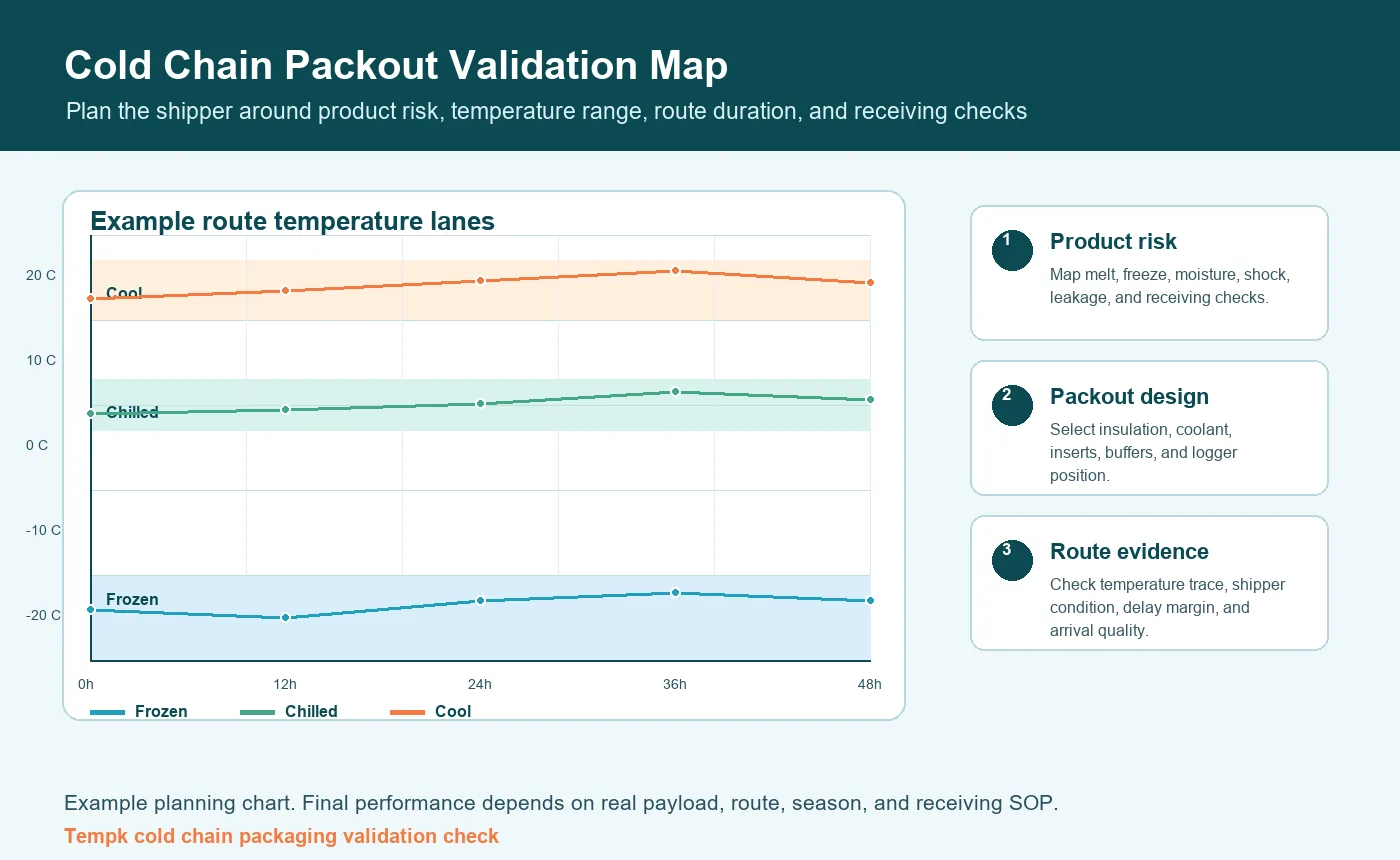
Define the real risk: melting, freezing, bruising, leakage, formula separation, sample rejection, or thaw evidence.
Cold Chain Packaging Solutions
Whether you ship fresh food, frozen desserts, medicines, vaccines, biologics, skincare, pallet goods, blood products, or clinical samples, Tempk helps you build packaging around the product’s real transit risks: temperature drift, moisture, leakage, pressure, route delay, and arrival condition.
How We Match Packaging
The right cold chain package protects more than temperature. It should preserve product condition through loading, storage, parcel sorting, warehouse dwell, delivery, and receiving inspection.
Define the real risk: melting, freezing, bruising, leakage, formula separation, sample rejection, or thaw evidence.
Choose chilled, frozen, cool, ultra-cold, or controlled-room handling according to the product and receiving criteria.
Plan insulation, PCM, gel packs, dry ice, buffers, absorbent layers, dividers, and payload support together.
Check the temperature record, packaging condition, remaining coolant, label readability, and product quality before scaling shipment volume.
Product Categories
Start with the product family closest to your shipment, then open the category plan or one of the product examples. If your exact product is not listed, choose the nearest match and send us the route details.
What to protect: Heat bloom, soft centers, condensation, crushed gift packaging, and direct coolant contact.
Packaging approach: Stable cool or chilled packouts with dry separation, cushioning, and route-tested coolant placement.
What to protect: Moisture loss, bruising, condensation, vent blockage, and ripeness shift.
Packaging approach: Pre-cooled insulated shippers with vent alignment, humidity-aware buffers, and produce protection inserts.
What to protect: Cream softening, cake-board movement, frosting smear, condensation, and shape damage.
Packaging approach: Chilled packouts with rigid cake support, coolant separation, and gentle handling space.
What to protect: Thaw-refreeze texture, carton wetting, lid movement, frost, and shape loss.
Packaging approach: Frozen shippers with dry ice or frozen coolant planning, delay margin, and carton protection.
What to protect: Last-mile dwell, wrong coolant mass, box compression, label damage, and route delay.
Packaging approach: Courier-ready packouts with shipper sizing, logger placement, label protection, and seasonal validation.
What to protect: Odor transfer, drip leakage, texture loss, shell breakage, warm dwell, and thaw evidence.
Packaging approach: Leak-controlled insulated shippers with absorbent layers, chilled or frozen coolant, and product-form protection.
What to protect: Drip, purge, odor, carton wetting, thawing, and rough handling damage.
Packaging approach: Chilled or frozen packouts with leak control, cushioning, dry outer cartons, and route verification.
What to protect: Thawing, frost, package deformation, ice crystal growth, and delivery delay.
Packaging approach: Frozen shippers with dry ice or frozen coolant layouts, delay margin, and box strength matched to payload.
What to protect: Parcel sorting stress, porch dwell, subscription-box delay, and mixed-item temperature needs.
Packaging approach: DTC packouts with route time, shipper size, coolant mass, product separation, and receiving experience planned together.
What to protect: Freeze exposure, warm excursions, logger gaps, shipment delay, and receiving rejection.
Packaging approach: Medical insulated shippers with conditioned PCM, no-freeze buffers, logger placement, and qualified route records.
What to protect: Short shelf life, moisture migration, sauce leakage, warm dwell, and label damage.
Packaging approach: Chilled packouts with portion protection, absorbent layers, coolant separation, and delivery-time validation.
What to protect: Freeze damage, warm excursions, device pressure, missing records, and patient-delivery delay.
Packaging approach: Medical parcel shippers with PCM, no-freeze separation, device support, tamper seals, and logger evidence.
What to protect: Formula separation, oxidation, melted texture, carton damage, and label moisture.
Packaging approach: Cool shipping systems with bottle or jar support, light and heat protection, and dry presentation at arrival.
What to protect: Warm dwell, bottle swelling, carton wetting, texture change, and odor pickup.
Packaging approach: Chilled insulated shippers with absorbent layers, coolant separation, and route time matched to shelf life.
What to protect: Pallet edge warming, mixed SKU exposure, dock dwell, wrap tension, and load shift.
Packaging approach: Pallet covers, thermal liners, coolant planning, data loggers, and route checks for warehouse-to-warehouse lanes.
What to protect: Wrong temperature lane, agitation, thaw evidence, seal damage, and receiving record gaps.
Packaging approach: Blood-product-specific packouts with controlled temperature, cushioning, logger placement, and release checks.
What to protect: Protein aggregation, freeze exposure, dry shipper hold time, thaw risk, and chain-of-identity gaps.
Packaging approach: Validated medical, dry ice, or cryogenic packouts with payload support, monitoring, and route records.
What to protect: Leaking tubes, wet labels, wrong temperature range, broken containers, and chain-of-custody gaps.
Packaging approach: Clinical sample shippers with absorbent secondary packaging, tube support, coolant separation, and receiving checks.
Route Testing
Use route testing to confirm that the selected shipper, coolant mass, buffer layers, logger position, and payload layout can protect the product through the expected route and season.
Tell us the product type, target temperature, payload count, route duration, season, and delivery method.
We match insulation, coolant, buffer layers, inserts, absorbent materials, and logger placement to the product’s transit risk.
Review the temperature trace, product condition, remaining coolant, carton dryness, label readability, and receiving notes.
OEM / Custom Packaging
For private-label packaging, fixed carton dimensions, payload limits, seasonal lanes, or validation targets, start with Tempk custom cold-chain packaging support.
Packout Review
Share the product, target temperature, payload size, route time, season, and receiving requirements. Tempk will help match the shipper, coolant layout, inserts, logger position, and validation plan.