


Blog Detail
Pharma Cold Chain Logistics Shifts Toward Qualified Temperature-Controlled Corridors
Source: Pharmaceutical Commerce
Original Author: Frontier Scientific
Original URL:
https://www.pharmaceuticalcommerce.com/view/qualified-temperature-controlled-corridors-the-future-is-here
Qualified Temperature-Controlled Corridors Are Becoming a New Standard in Pharma Logistics
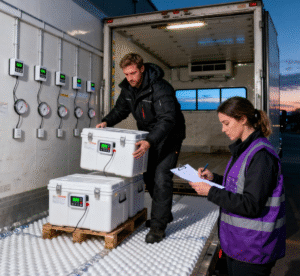
What Happened
A growing number of pharmaceutical logistics providers are moving beyond traditional temperature-controlled transportation and adopting qualified temperature-controlled corridors (QTCCs). According to Frontier Scientific, writing in Pharmaceutical Commerce, the industry is increasingly focusing on lane qualification and corridor validation as a way to improve compliance performance and reduce cold chain risk.
Rather than validating individual shipments only, qualified corridors establish documented and repeatable temperature-control performance across an entire logistics route, including airports, warehouses, ground handlers, transport providers, and transfer points.
How It Works
A qualified corridor combines validated infrastructure, GDP-aligned operating procedures, temperature monitoring, handling controls, and documented performance verification throughout a shipment lane.
The objective is to reduce temperature excursion risk by controlling every major touchpoint rather than relying solely on insulated packaging or active containers.
Under this model, stakeholders assess route performance, seasonal conditions, transfer procedures, dwell times, warehouse environments, airport operations, and transportation assets. The resulting corridor becomes a pre-qualified logistics pathway capable of supporting sensitive pharmaceutical products with greater consistency.
Why It Matters
The pharmaceutical cold chain is becoming increasingly dependent on biologics, specialty medicines, advanced therapies, and other products that have narrow thermal tolerances. Traditional shipment-by-shipment control can become inefficient as product portfolios expand.
Qualified corridors shift the focus from reactive deviation management toward proactive risk reduction. By validating route performance in advance, pharmaceutical companies can gain better predictability, reduce quality incidents, and improve regulatory readiness.
This approach also supports greater confidence in global healthcare supply chains where multiple logistics partners may be involved in a single shipment.
B2B Impact
For pharmaceutical manufacturers, corridor qualification can improve lane reliability and reduce operational uncertainty across international distribution networks.
For cold chain packaging providers, the trend creates opportunities for lane-specific packout validation, thermal risk assessment, and packaging optimization based on validated route performance.
For monitoring technology providers, qualified corridors increase demand for real-time visibility platforms, calibrated sensors, temperature mapping, and deviation analytics.
For logistics providers, the market is moving toward documented cold chain integrity rather than simple temperature-controlled transportation. Companies capable of providing validated corridors, compliance documentation, and performance evidence will be better positioned in future pharmaceutical supply chains.




