


Heat exposure
Warm dwell can undermine customer confidence when the product is sold around live, ferment, or active-ingredient positioning.
Probiotic skincare shipments need packaging that respects the brand storage claim and protects active-ingredient positioning. The packout should reduce heat exposure, control condensation, and keep jars, tubes, labels, and cartons presentable.
For cosmetic cold-chain delivery, the best package is the one that protects both formula condition and customer-facing presentation. The packout below gives a practical starting point before lane testing.
Warm dwell can undermine customer confidence when the product is sold around live, ferment, or active-ingredient positioning.
Cold packs inside small cosmetic parcels can create condensation and wet the retail carton if there is no moisture barrier.
A chilled route may still fail presentation checks if gel packs touch jars, tubes, labels, or cartons directly.
| Route condition | Temperature intent | Packaging setup | Preliminary coolant range | Receiving check |
|---|---|---|---|---|
| Local delivery, 4-8 h | Use the brand storage instruction; many routes need heat protection and some require chilled handling. | Insulated mailer or small carton, moisture sleeve, one or two conditioned gel packs or PCM with spacer. | About 0.4-0.9 kg for a 0.5-2 kg payload. | Product seal, carton dryness, and quick handoff. |
| Warm e-commerce route, 8-24 h | Cool or chilled route based on the label and brand promise; avoid freezing unless explicitly validated. | Insulated carton or compact EPP box, center product cavity, buffered coolant on side/top positions, moisture-control layer. | About 0.9-2.0 kg for a 0.5-3 kg payload. | Logger record if used, condensation, carton crush, and product texture. |
| Hot route or weekend risk, 24-36 h | Validated cool or chilled route with extra dwell allowance. | Higher-performance insulation, conditioned gel packs or PCM, product isolated from coolant, optional logger for premium DTC lanes. | About 2.0-3.2 kg for a compact shipper; confirm by route test. | Minimum and maximum temperature, remaining coolant, label dryness, and cap seal. |
Use these ranges for packaging discussion and sampling. Final coolant mass should be confirmed with the actual formula, unit count, bottle or jar size, carton dimensions, route duration, ambient condition, and any logger requirement.
Confirm whether the product requires refrigerated handling, cool protection, or only heat-spike reduction. This avoids overcooling a formula that only needs summer protection.
Use sleeves, liners, or absorbent separation so condensation from the coolant does not damage cartons and labels.
Place conditioned gel packs or PCM around the payload, not against it. Small skincare parcels often need separation more than extra coolant mass.
Test the actual jar or tube count, inserts, insulation, coolant mass, and route duration before scaling DTC shipment.
These are the issues the packout should reduce before the shipment reaches the customer.
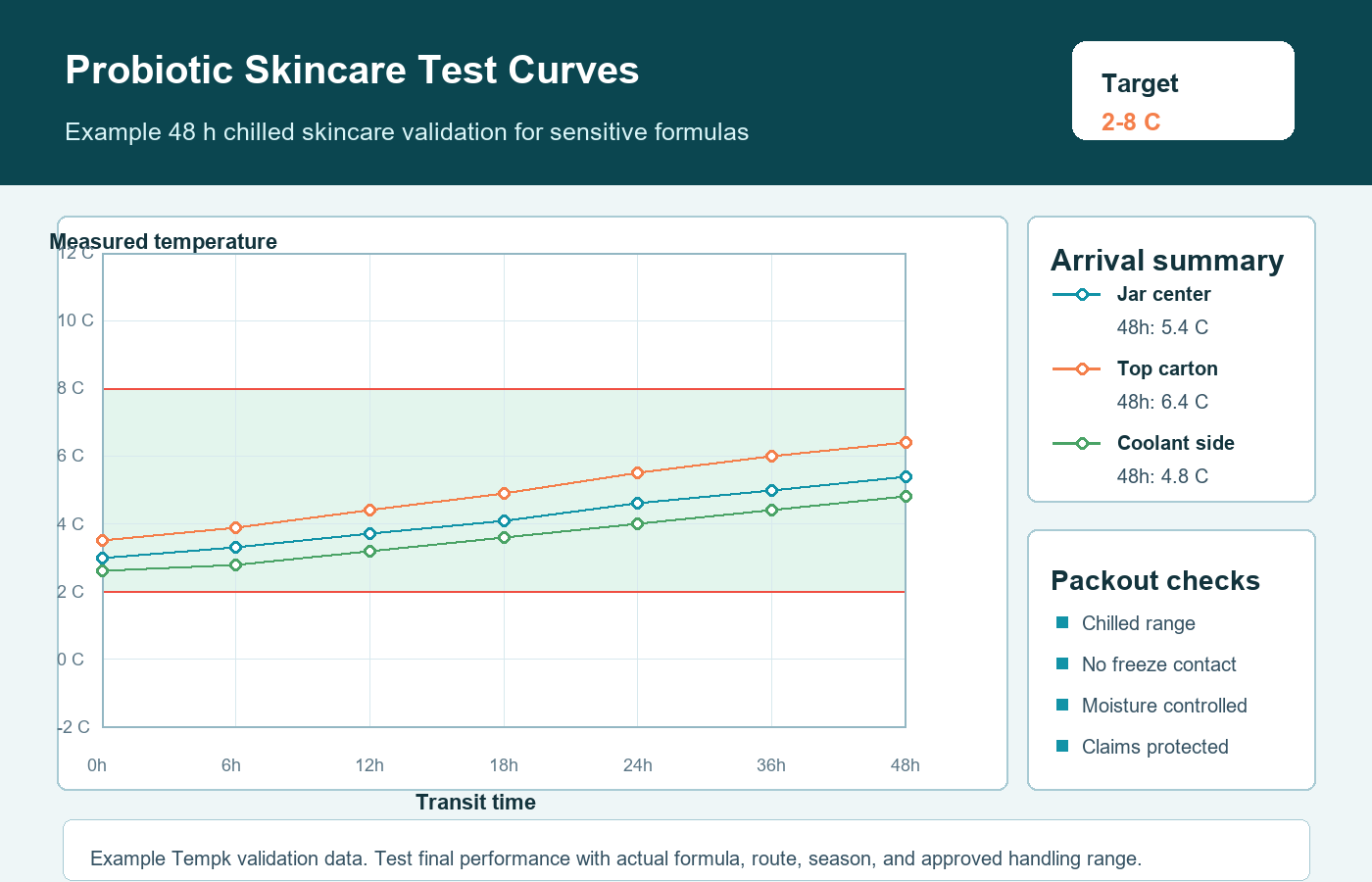
Use the test curve as a working comparison, then validate with the actual product, coolant mass, insulation, route duration, and season. For skincare, also check presentation: label dryness, carton condition, cap seal, and product texture.
Use these pages to compare nearby product routes, select coolant, and check route risk before sampling.
Probiotic skincare may be marketed around live or active ingredients, so temperature confidence and clean presentation are both important at delivery.
Loss can appear as formula separation, odor change, carton moisture, label lift, and customer concern about warm delivery.
Use insulated parcel packaging with a product divider and a moisture-resistant inner wrap. Keep coolant close enough to stabilize the payload but separated from the carton face.
Use chilled gel packs or PCM according to the formula label. For refrigerated products, validate 2 to 8 C and avoid direct frozen-pack contact.
Check visual texture, odor, label condition, and any required stability indicator. Record whether the product still feels premium when opened.
Some probiotic skincare products only need heat moderation, while others require refrigerated handling. The packout should follow the formula label and stability data rather than applying one cosmetic shipping rule to every SKU.
Use a protected product cavity, moisture-resistant inner wrap, and chilled gel or PCM as needed. If the formula requires 2 to 8 C, avoid direct frozen-pack contact and validate both hot and cold lanes.
Tempk route testing should check formula texture, odor, label condition, carton dryness, and whether the product still feels premium when opened. For beauty products, presentation is part of the solution.
For probiotic skincare, start with the stability requirement. If the formula requires 2 to 8 C, use PCM or conditioned gel packs in a separated coolant zone and validate hot and cold lanes. If the product only needs heat protection, a milder chilled-gel layout may protect the formula without making the beauty carton wet. The packaging should hold jars, tubes, or airless pumps upright and clean. Receiving should check odor, texture, carton presentation, label condition, and whether the opening experience still supports a premium skincare brand.
Custom packout support
For fixed carton sizes, payload limits, branding requirements, seasonal lanes, or validation targets, Tempk can adapt this solution into a custom cold-chain packout.
Share the storage instruction, unit count, carton size, payload weight, route duration, ambient condition, delivery handoff, and whether you need a temperature logger. Tempk can help compare gel packs, PCM, EPP, insulated cartons, buffer layers, and receiving checks.
Request a packout review