


Mauvais mode de température
Frais, fixé, et les voies de tissus congelés peuvent nécessiter une manipulation différente; en supposant qu'une route froide peut créer des problèmes de réception.
Biopsie and tissu prélèvement packaging depends on whether the échantillon is fresh, fixé, ou congelé. La même boîte ne peut pas couvrir en toute sécurité les trois itinéraires sans vérifier le protocole de collecte, récipient, risque de fuite, et délai de réception.
Les tissus sont sensibles aux écarts de température et à la manutention. La configuration doit éviter les fuites, l'écrasement, les erreurs gel-dégel et les documents abîmés.
Frais, fixé, et les voies de tissus congelés peuvent nécessiter une manipulation différente; en supposant qu'une route froide peut créer des problèmes de réception.
Les conteneurs de liquides ont besoin d'un support vertical, absorbant emballage secondaire, et documents protégés à l'écart des zones humides.
Les petits conteneurs de mouchoirs peuvent se déplacer à l'intérieur d'un grand expéditeur à moins que le rembourrage et les séparateurs ne soient dimensionnés à la charge utile..
| Condition de route | Objectif de température | Configuration d'emballage | Planification du réfrigérant ou de la glace carbonique | Contrôle à la réception |
|---|---|---|---|---|
| Tissu frais, itinéraire de diagnostic court | Suivez le protocole du laboratoire. De nombreuses voies de tissus frais utilisent 2-8 C et fenêtres de transfert courtes. | Conteneur primaire rigide et résistant aux fuites, absorbant emballage secondaire, amorti, diviseur de liquide de refroidissement, and enregistreur near the charge utile. | Pour un 3-8 L expéditeur, procès 0.8-2 kg conditionné 2-8 C PCM or accumulateurs de gel for local routes. Évitez tout contact direct avec le liquide de refroidissement. | Aucune fuite, tissu container stable, pas de gel, formulaire de demande sèche, et heure de réception. |
| Voie de protocole tissulaire ou ambiant fixe | Utiliser le protocole de collecte. Certains échantillons fixes peuvent ne pas nécessiter de liquide de refroidissement réfrigéré, mais il faut quand même une protection contre les fuites et les documents. | Expéditeur extérieur rigide, support vertical, couche secondaire absorbante, amorti, et pochette pour documents séparée. | L'isolation peut être utilisée pour tamponner la température. Évitez d'ajouter des compresses froides à moins que le protocole du laboratoire ne le demande. | Conteneur intact, bouchon scellé, pas de liquide dans le sac extérieur, étiquettes lisibles, et enregistrement en chaîne. |
| Voie de test de tissus congelés ou de tests moléculaires | Maintenir l'état congelé si nécessaire et éviter le dégel-regel pendant le transfert. | Glace carbonique shipper, frozen échantillon rack, glace carbonique barrier, emballage ventilé, confinement secondaire absorbant, et documents protégés du gel. | De petites lignes de tissus congelés peuvent commencer 2-6 kg glace carbonique for 0-24 main 6-12 kg pour les itinéraires plus longs ou chauds, puis valider. | Remaining glace carbonique, aucune preuve de dégel, échantillon rack stable, paperasse sèche, et transfert au congélateur à la réception. |
Utilisez ces valeurs comme points de départ pour l'échantillonnage et la cotation. Liquide de refroidissement final, PCM, glace carbonique, isolation, emballage secondaire, enregistreur, et les choix de manipulation doivent être validés avec le conteneur d'échantillon réel, itinéraire, processus de transport, saison, classification, et procédure de réception.
Confirmer les conditions de prélèvement avant de choisir un liquide de refroidissement réfrigéré, tampon ambiant, or glace carbonique.
Utilisez un rembourrage et un support vertical pour que les petits conteneurs ne heurtent pas la paroi de l'expéditeur ou le bloc de liquide de refroidissement..
Associez le contenant primaire à l'emballage secondaire absorbant et conservez les bons de commande hors des zones humides ou gelées..
Les tests d'itinéraire doivent inclure le délai de prise en charge, transfert de laboratoire, heure de réception, et inspection des conteneurs.
Ce sont les problèmes visibles et opérationnels que la configuration d'emballage devrait réduire avant que l'envoi n'atteigne le destinataire..
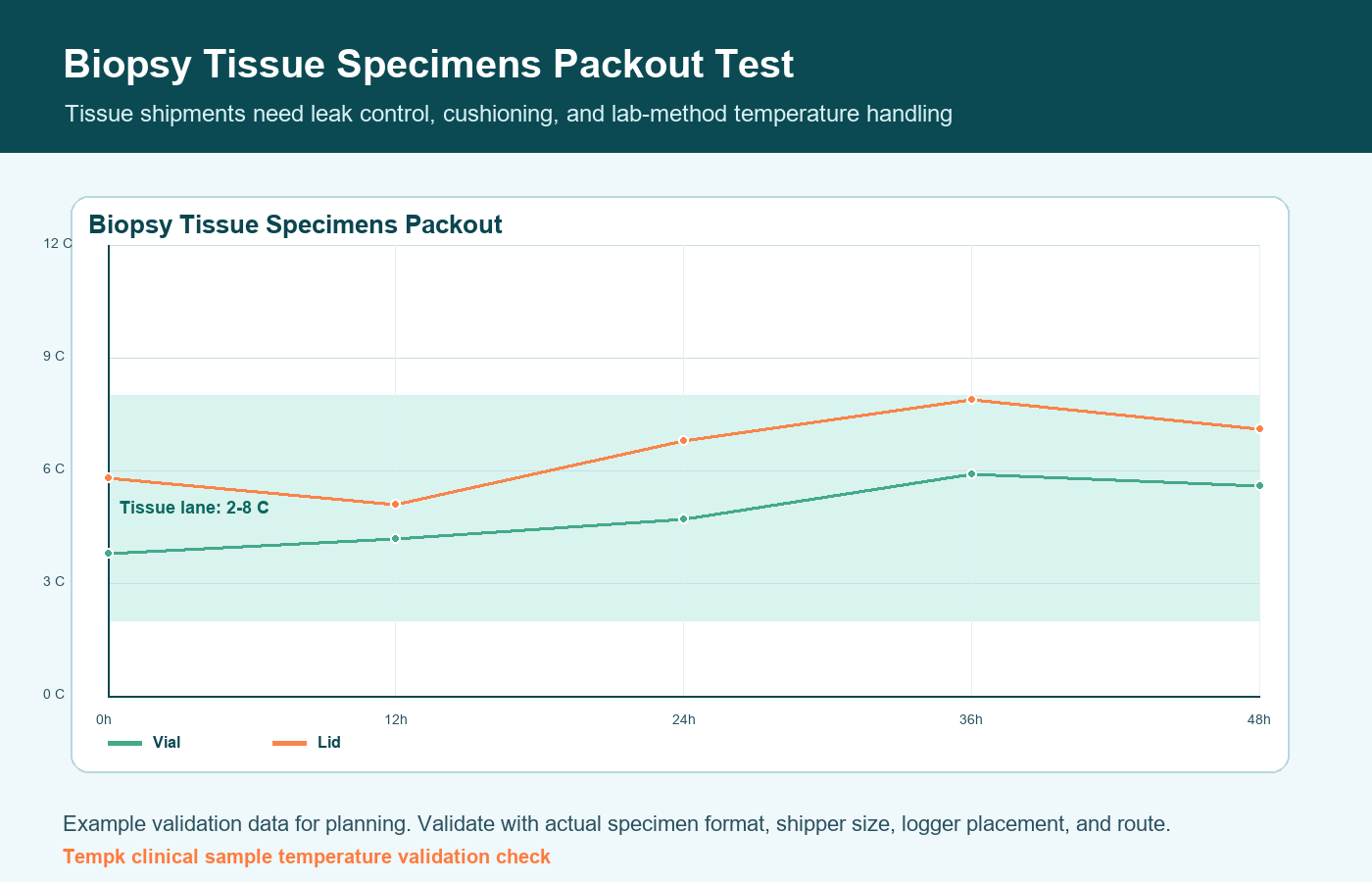
Utilisez la courbe de test comme comparaison de travail, puis validez avec le conteneur d'échantillon réel, expéditeur, coolant or glace carbonique configuration, durée de la voie, profil ambiant, et processus de réception.
Utilisez ces pages pour comparer les itinéraires cliniques et médicaux à proximité, choix de liquide de refroidissement, options d'isolation, et des questions sur les risques d'itinéraire avant l'échantillonnage.
Biopsie and échantillons de tissus are not a single temperature category. Tissu frais, tissu préservé, et les tissus congelés peuvent nécessiter différentes configurations d'emballages pour le même itinéraire.
Les pertes incluent les tissus congelés décongelés, tissu sec, conteneurs qui fuient, dommages causés au récipient de formol, et fenêtres de réception manquées du laboratoire.
Utiliser un confinement secondaire rigide, matériau absorbant, et une pochette pour documents. Protéger les bocaux de prélèvement du liquide de refroidissement dur et des chocs contre la paroi extérieure.
Utilisez du gel réfrigéré, glace carbonique, ou pas de liquide de refroidissement selon la méthode de conservation et les instructions du laboratoire. Les tissus congelés doivent être validés séparément des prélèvements fixes.
Confirmer le conservateur, prélèvement temperature, intégrité du conteneur, paperasserie, et les critères d'acceptation du laboratoire avant de libérer la voie.
Prise en charge de la configuration d'emballage personnalisée
Pour des tailles de carton fixes, limites de charge utile, exigences en matière de marque, voies saisonnières, ou des cibles de validation, Tempk peut adapter cette solution dans une configuration d'emballage de chaîne du froid personnalisée.
Indiquez si le tissu est frais, fixé, ou congelé, plus la taille du conteneur, température cible, durée de l'itinéraire, profil ambiant, glace carbonique allowance, et délai de réception. Tempk peut aider à comparer les expéditeurs, liquide de refroidissement, glace carbonique, amorti, absorbant layer, et mise en page de validation.
Demander une révision de configuration d'emballage