


Fuite du tube ou pression du bouchon
Les tubes lâches et les expéditeurs trop remplis peuvent presser les bouchons contre les séparateurs ou les packs de liquide de refroidissement..
écouvillon PCR prélèvement shipments are usually judged by temperature, intégrité des tubes, échantillon identification, et transfert de diagnostic rapide. La configuration d'emballage doit empêcher les fuites, pression du bouchon, mélange de tubes, et éviter de décongeler-recongeler si une manipulation congelée est nécessaire.
Les itinéraires PCR écouvillon paraissent souvent simples car la charge utile est faible. Le risque est que des petits tubes bougent, les bouchons appuient contre le liquide de refroidissement ou les séparateurs, les disques se mélangent, ou échantillons chauds pendant le délai de réception.
Les tubes lâches et les expéditeurs trop remplis peuvent presser les bouchons contre les séparateurs ou les packs de liquide de refroidissement..
Certains protocoles acceptent le transport réfrigéré à court terme tandis que d'autres exigent une manutention congelée en cas de retard..
Les itinéraires d'écouvillon à grand volume nécessitent un étiquetage propre, prélèvement lists, et les enregistrements de transfert afin que le laboratoire puisse recevoir rapidement.
| Condition de route | Objectif de température | Configuration d'emballage | Planification du réfrigérant ou de la glace carbonique | Contrôle à la réception |
|---|---|---|---|---|
| Parcours diagnostic réfrigéré le jour même, 0-12 h | Suivre le protocole de collecte. Many short écouvillon routes are planned around 2-8 C. | Petit chargeur isotherme, diviseur de tube vertical, sac secondaire scellé, absorbant layer, barrière contre le liquide de refroidissement, and simple échantillon list. | Procès 0.5-1.5 kg de gel conditionné ou 2-8 C PCM pour les petits expéditeurs. Gardez le liquide de refroidissement à l'écart du contact direct avec le tube. | Aucune fuite, bouchons de tube sécurisés, échantillon list matches, pas de gel, et transfert rapide du laboratoire. |
| Itinéraire régional ou à risque le week-end, 12-48 h | Maintenir la portée requise pendant le séjour du véhicule, tri, et délai de réception en laboratoire. | Isolation supérieure, liquide de refroidissement sur le dessus avec séparateurs, plateau à tubes plus solide, two enregistreur positions, et documents protégés. | Commencer 1.5-3 kg de liquide de refroidissement conditionné pour les petits et moyens expéditeurs, puis ajuster par test d'itinéraire et par saison. | Température du bord chaud, marques de pression dans les tubes, lisibilité de l'étiquette, décompte reçu, et heure de transfert. |
| Frozen écouvillon route or delayed testing | Utiliser la manipulation congelée uniquement lorsque le protocole l'exige et éviter la décongélation-recongélation. | Glace carbonique shipper or frozen configuration d'emballage, support de support de tubes, glace carbonique separation, emballage extérieur ventilé, et documents protégés du gel. | If glace carbonique is allowed, de petites voies peuvent commencer aux alentours 2-5 kg pour 0-24 h et plus pour les itinéraires retardés. Valider avec le processus du transporteur réel. | Remaining glace carbonique, aucun signe de dégel, support à tubes stable, paperasse sèche, et transfert immédiat au congélateur. |
Utilisez ces valeurs comme points de départ pour l'échantillonnage et la cotation. Liquide de refroidissement final, PCM, glace carbonique, isolation, emballage secondaire, enregistreur, et les choix de manipulation doivent être validés avec le conteneur d'échantillon réel, itinéraire, processus de transport, saison, classification, et procédure de réception.
VTM, UTM, dry écouvillons, et les kits spécifiques à l'étude peuvent avoir différentes fenêtres de transport.
Utilisez des séparateurs de tubes ou des plateaux pour que les tubes restent séparés, les capuchons ne sont pas compressés, and échantillon IDs remain readable.
Place accumulateurs de gel, PCM, ou glace carbonique derrière des barrières pour que les tubes ne touchent pas une surface froide.
High-volume écouvillon programs should make échantillon count, paperasserie, enregistreur access, et transfert de laboratoire facile.
Ce sont les problèmes visibles et opérationnels que la configuration d'emballage devrait réduire avant que l'envoi n'atteigne le destinataire..
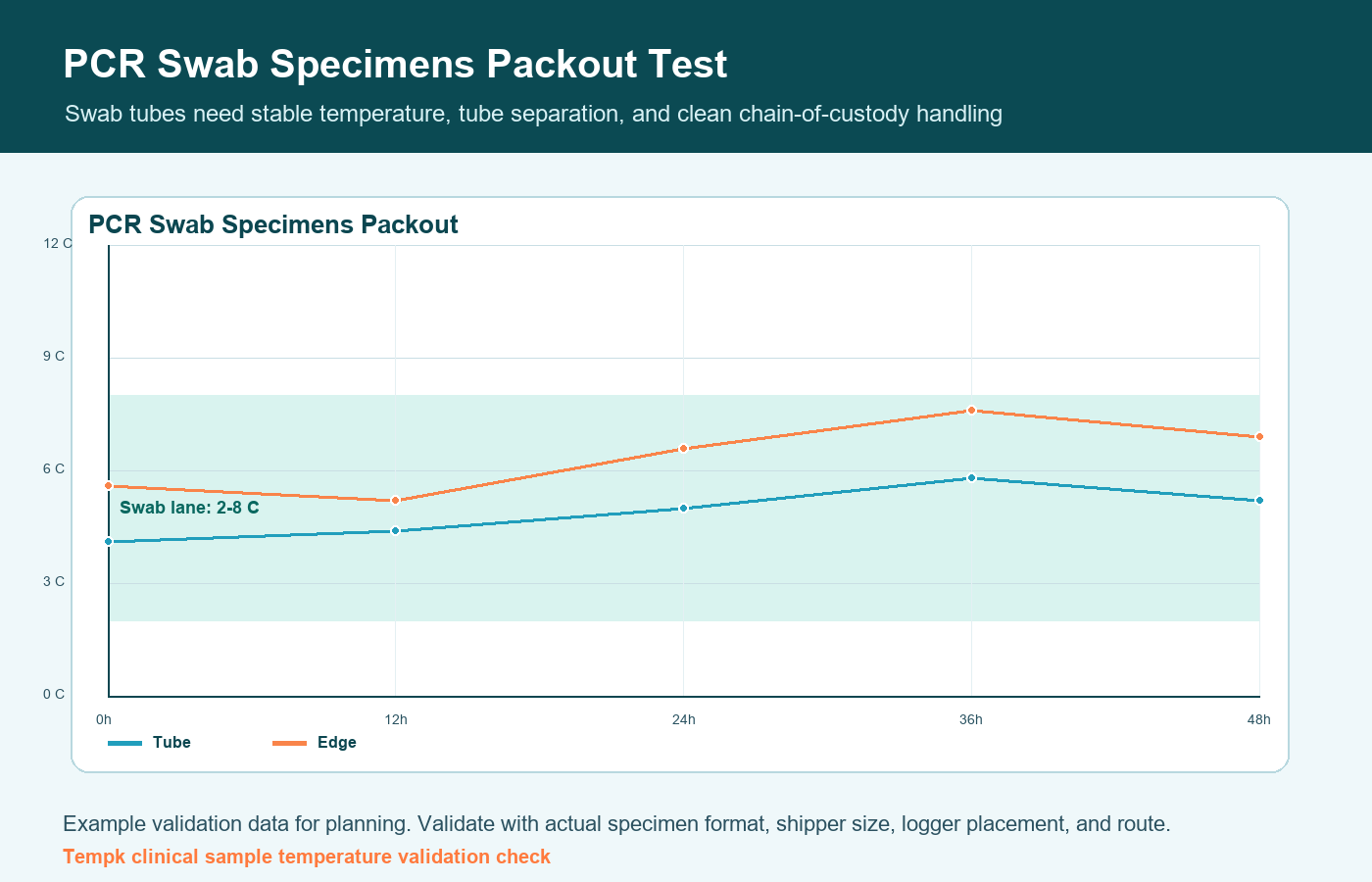
Utilisez la courbe de test comme comparaison de travail, puis validez avec le conteneur d'échantillon réel, expéditeur, coolant or glace carbonique configuration, durée de la voie, profil ambiant, et processus de réception.
Utilisez ces pages pour comparer les itinéraires cliniques et médicaux à proximité, choix de liquide de refroidissement, options d'isolation, et des questions sur les risques d'itinéraire avant l'échantillonnage.
Les écouvillons PCR sont souvent sensibles au facteur temps et à volume élevé. La configuration d'emballage doit empêcher les fuites du tube, garder les étiquettes lisibles, and meet the lab’s température requise.
Les échecs incluent des fuites de supports de transport, étiquettes illisibles, excursions chaleureuses, tubes congelés lorsque cela n'est pas autorisé, et livraison tardive au-delà de la fenêtre de test.
Utiliser des manchons pour tubes, absorbant emballage secondaire, et un expéditeur rigide. Gardez les sacs d'échantillons organisés afin que le laboratoire puisse les traiter sans fouiller dans les emballages humides..
Utilisez des accumulateurs de gel réfrigérés pour faire court 2 à 8 Itinéraires C lorsque nécessaire. Ne pas utiliser de glace carbonique sauf si le laboratoire précise un transport congelé..
Vérifier l'intégrité du joint du tube, lisibilité de l'étiquette, journal de température, et délai de livraison au laboratoire d'essais.
Prise en charge de la configuration d'emballage personnalisée
Pour des tailles de carton fixes, limites de charge utile, exigences en matière de marque, voies saisonnières, ou des cibles de validation, Tempk peut adapter cette solution dans une configuration d'emballage de chaîne du froid personnalisée.
Share the écouvillon medium, nombre de tubes, température cible, fenêtre de transport, profil ambiant, étapes de messagerie, glace carbonique allowance, et processus de réception. Tempk peut aider à comparer l'expéditeur, disposition du liquide de refroidissement, plateau à tubes, absorbant layer, enregistreur position, et plan de validation.
Demander une révision de configuration d'emballage