


Estimer la masse de glace carbonique
Utiliser le poids de la charge utile, taille de boîte, temps de parcours, température ambiante saisonnière, et limites des transporteurs avant le premier essai de voie.
Les plats cuisinés surgelés combinent souvent des plateaux, joints de film, sauces, riz, pâtes, légumes, et manches dans un seul paquet. Le parcours doit conserver les repas surgelés tout en protégeant les joints des barquettes, étiquettes de manche, texture de la sauce, et coins de plateaux empilés.
Les quantités de neige carbonique ci-dessous sont des plages de départ pour la planification. Le package final doit être validé avec la charge utile exacte, taille de boîte, voie porteuse, saison, et limite de glace carbonique.
| État de l'itinéraire | Intention de température | Configuration de l'emballage Tempk | Plage de planification du liquide de refroidissement | Emplacement du liquide de refroidissement |
|---|---|---|---|---|
| Livraison de repas locaux, 8-18 h | Arrivée gelée | PPE ou carton isotherme, support de pile de plateaux, barrière contre l'humidité des manches, liquide de refroidissement congelé séparé ou glace carbonique. | 1.0-2.0 kg de neige carbonique pour 1-5 kg de charge utile, ou PCM congelé/gel congelé validé pour les voies courtes. | Liquide de refroidissement latéral/supérieur avec séparateur; éviter la pression sur les joints du film. |
| Colis congelé pendant la nuit, 18-36 h | -18 Intention d'itinéraire C | Isolation plus épaisse, pochette de glace carbonique, support d'angle de plateau, espace vide réduit. | 2.0-4.5 kg de neige carbonique pour 1-5 kg de charge utile. | Glace carbonique supérieure séparée par une planche; garder l'enregistreur dans l'espace aérien du produit. |
| Voie chaude ou 36-48 h | Voie gelée validée | Isolation supérieure, renfort de plateau plus solide, vérification des risques liés à l'itinéraire, examen des limites du transporteur. | 4.0-7.0 kg de neige carbonique pour 1-5 kg de charge utile. | Si les joints du plateau se soulèvent, réduire la pression et améliorer le renforcement avant de changer la masse de glace carbonique. |
Pour une estimation plus serrée, commencer par le Calculateur de glace carbonique et revoir les choix d'isolation dans le Référence du matériau isolant.
Les retours de produits surgelés proviennent souvent d'un petit échec d'agencement: contact direct avec la glace carbonique, trop d'espace libre, un carton mouillé, ou une pile de produits qui se déplace lors de la manipulation.
Une défaillance du joint crée un retour même si la courbe de température semble acceptable.
Utilisez un séparateur ou une chambre à glace carbonique pour que les manchons ne se froissent pas et que le film du plateau ne soit pas stressé par contact direct..
Repas riches en sauce, bols de riz, et les plateaux de pâtes affichent la décongélation-recongélation différemment; vérifiez le produit réel.
Enregistrer la température, intégrité du joint, fissures du plateau, humidité des manches, séparation des sauces, et glace carbonique restante.
Utilisez ces contrôles de réception lors du réglage de la masse de glace carbonique, épaisseur d'isolation, ou séparation interne.
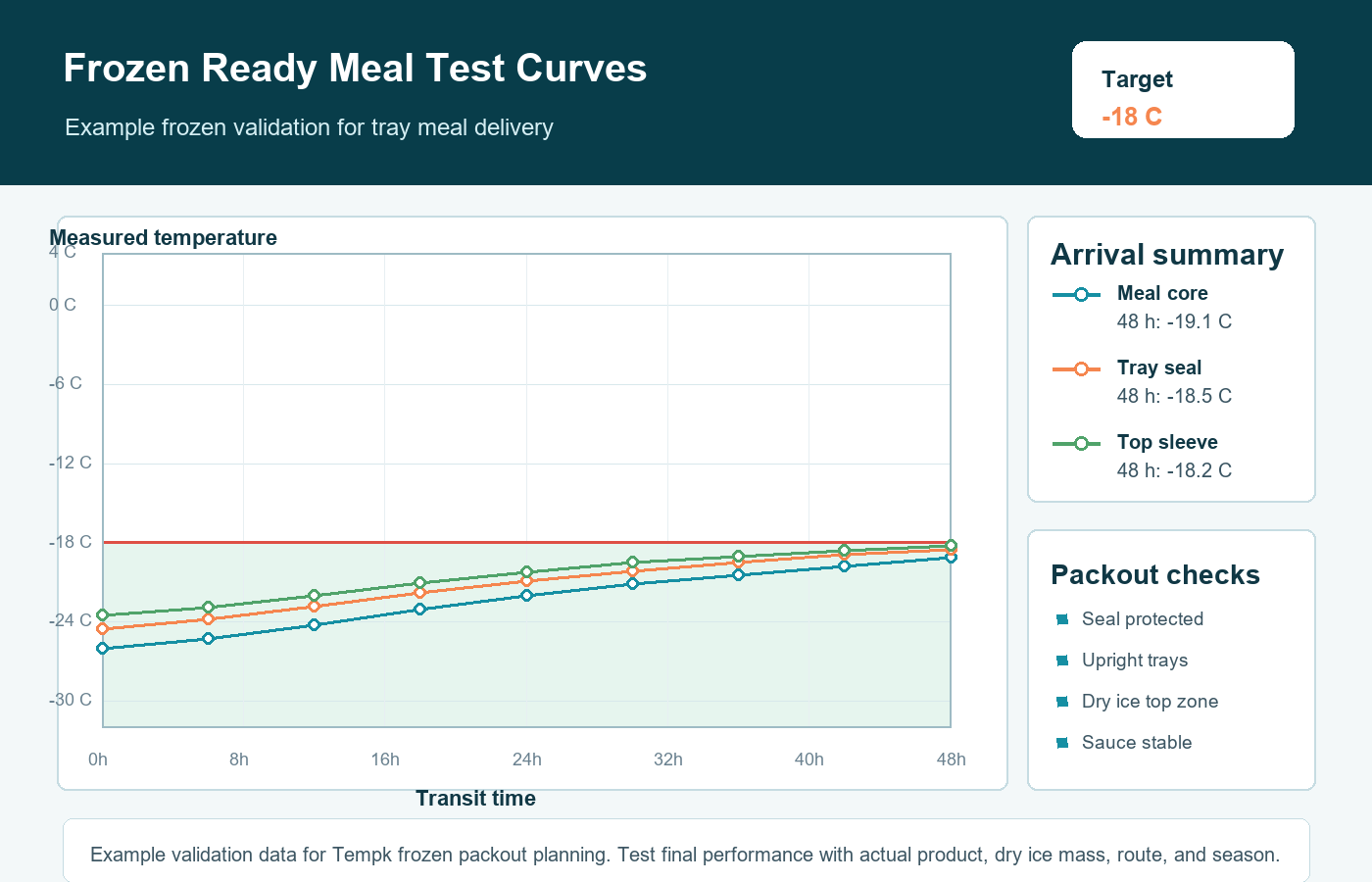
Utiliser la page produit pour la logique de gestion, puis dimensionner le premier essai avec des outils et valider le parcours réel.
Utiliser le poids de la charge utile, taille de boîte, temps de parcours, température ambiante saisonnière, et limites des transporteurs avant le premier essai de voie.
Comparez la glace carbonique, packs de gel congelés, et PCM surgelé lors du choix du premier emballage surgelé.
Revoir le ramassage en direct, retard du dernier kilomètre, fenêtre de réception, et routage d'été avant le lancement.
Partager le type de produit surgelé, poids de charge utile, taille de boîte, durée de l'itinéraire, profil ambiant, limites du transporteur, et recevoir des chèques. Tempk peut vous aider à choisir l'isolation, placement de glace carbonique ou de liquide de refroidissement gelé, et étapes de validation.
Prise en charge des emballages personnalisés
Pour des tailles de carton fixes, limites de charge utile, exigences en matière de marque, voies saisonnières, ou des cibles de validation, Tempk peut adapter cette solution dans un emballage personnalisé pour la chaîne du froid.