


Cold Chain Packout Instructions: A Repeatable Sequence for Every Shipment
Cold Chain Packout Instructions: A Repeatable Sequence for Every Shipment

Cold Chain Packout Instructions: A Repeatable Sequence for Every Shipment
Cold chain packout instructions convert an approved packaging configuration into a sequence that an operator can follow at the packing station. The instructions should identify the correct components, explain how they are prepared and positioned, show where the payload and logger belong, and define the checks required before dispatch.
They are not a substitute for qualification or approval of the packaging system. The configuration defines the tested or approved arrangement; packout instructions preserve that arrangement during routine use. If an operator must guess how much coolant to use, where a barrier belongs, or whether a substitute component is acceptable, the instructions are not sufficiently controlled.
Before packing: confirm the correct configuration
Begin by matching the shipment to the approved configuration. Check the product or order identity, payload size and quantity, destination or route, and current configuration revision. Confirm that the planned payload is within the approved range and that the required monitoring method is available.
Do not begin assembly if the shipment falls outside the documented conditions. Examples include an unusually large payload, a different product arrangement, an unapproved route, or a requested delivery time that exceeds the supported plan. Hold the shipment and contact the designated packaging, logistics, or quality owner.
Prepare the full component kit
Use the current bill of materials or pick list. Depending on the approved system, the kit may include the outer shipper, insulation liner, coolant elements, internal barriers, inserts, void fill, logger, labels, seals, and shipping documents. Each critical component should be identifiable by a part number or controlled label.
Check the quantity and condition before assembling the shipper. Segregate damaged, leaking, contaminated, or unidentified items. A component that looks similar to the approved item should not be treated as interchangeable without authorization.
Confirm coolant conditioning
Coolant preparation is configuration-specific. Different gel packs or phase-change materials may require different conditioning procedures, so there is no universal freezer duration or preparation state that applies to every system. Follow the approved instruction for the exact coolant and configuration.
The instruction should explain how readiness is confirmed and how coolant in different states is identified and stored. Do not mix ready-to-use coolant with packs that are still conditioning or awaiting inspection. If the required state cannot be verified, do not estimate it by touch or appearance; follow the hold and escalation process.
For systems that use different seasonal variants, the approved selection rule must be clear. Staff should not independently add or remove coolant because the day feels warmer or colder than usual.
Assemble the shipper in the approved order
Use a numbered diagram or annotated photograph showing the package orientation and component placement. The exact sequence varies by system, but the instruction should define each critical action:
- Prepare the outer shipper and insulation. Check that the container and liner are the approved types, correctly oriented, and free of damage that could affect fit or closure.
- Install the base components. Place the specified base insulation, insert, or coolant in the exact position shown.
- Add the required barriers. Install separators or contact barriers where specified. Do not cut them smaller, fold them differently, or replace them with generic padding unless the change has been approved.
- Position the coolant. Use the approved component count and location. If the configuration prohibits direct contact between coolant and payload, verify that the barrier fully separates them.
- Load the payload. Check product identity and quantity, use the specified orientation, and keep the load within the approved fill range. Do not force extra units into the shipper or rearrange the layout to make the lid close.
- Add remaining components. Install the specified top layer, void fill, restraints, or additional barriers. Ensure the payload cannot shift into an unintended position during handling.
- Place the logger. Position and activate the approved monitoring device according to the monitoring plan. Record its identifier against the shipment where required.
- Close the shipper. Seat the lid or closure fully and apply the specified tape, seal, or locking method.
- Apply labels and documents. Confirm that the shipment identity and required handling labels are readable and that all required documents are included.
This sequence is an operational framework, not a universal layer pattern. The approved configuration diagram controls the actual order, coolant position, and barrier arrangement for each system.
Place the logger for its intended purpose
A temperature data logger records conditions at its probe location; it does not cool the payload or guarantee that every product in the shipper experiences the same temperature. The sensor position should therefore match the approved monitoring plan. Moving the probe to make it easier to reach can change what the reading represents.
The instruction should identify the device, show the exact probe location, define any activation or start step, and explain how the record is associated with the shipment. If the device is missing, damaged, not activated, or displaying an error, stop and follow the defined exception process rather than dispatching without an approved decision.
Complete the release check
The final check should be based on observable criteria. Depending on the system, verify:
- Correct configuration revision and component identities.
- Required coolant condition and quantity.
- Correct barrier coverage and coolant placement.
- Payload identity, orientation, and permitted fill range.
- Logger location, activation, and shipment association.
- Closure, seal, label, and document completeness.
- Completion of required records and approvals.
A general statement such as “inspect package before shipping” is not enough if the critical details are not specified. Where a second-person verification is required, define exactly which elements the verifier must confirm.
Dispatch and handoff
After release, move the package to the designated dispatch area and protect it from unauthorized opening or exposure outside the approved staging conditions. Record the required dispatch information and complete the carrier handoff. If the carrier is late, the package is opened, the shipper is damaged, or the route changes, do not assume that the original release remains valid. Follow the approved escalation rule.
The receiving process should also be defined. The receiver may need to inspect the outer package, transfer the product promptly to its required storage environment, review monitoring data, and report damage or a suspected temperature excursion. Packout instructions should identify the receiving documents or labels needed to support this handoff.
What to do when the packout cannot be completed as written
Stop and escalate when a required component is missing, the coolant state is uncertain, the payload does not fit, a barrier is damaged, the logger fails, or an unapproved substitution appears necessary. Record the shipment identifier, configuration revision, affected component, time, and reason for the hold. The designated owner should decide whether to replace materials, repack, perform further assessment, or cancel the shipment.
Do not let an operator resolve a design issue by adding more coolant, changing the layer order, or removing a barrier. Such changes may alter thermal performance and can make the actual shipment different from the configuration that was assessed.
How to make instructions usable at scale
A strong instruction sheet combines controlled text with clear visuals. Include the configuration name and revision, a component list, the sequence of actions, coolant conditioning reference, payload limits, logger placement, closure requirements, release checklist, and stop-and-escalate conditions. Use separate diagrams for genuinely different approved variants.
Before release, test the document with an operator who did not write it. Provide the approved materials and ask the operator to complete a representative packout without coaching. Observe where the person hesitates or guesses, compare the finished assembly with the approved diagram, and revise the instruction to remove ambiguity. Withdraw obsolete copies and train affected staff whenever the controlled version changes.
For medicinal products, applicable distribution guidance and the organization’s quality system may impose additional requirements for packaging selection, temperature monitoring, training, and records. Other cold chain applications may follow different rules. In every case, packout instructions should match the approved configuration and should not imply that a particular duration or temperature outcome is guaranteed unless the evidence supports that claim.
The goal is straightforward: every trained operator should be able to assemble the approved package in the same way, verify the critical details, and recognize when a shipment must be held. Clear packout instructions protect both thermal performance and the integrity of the operational record.
Troubleshooting at the packing station
The instruction should give operators a short, unambiguous response for common problems:
- A required component is missing: pause the packout and obtain the approved component; do not replace it with a visually similar item.
- Coolant readiness is uncertain: segregate the pack and confirm its status using the approved method before use.
- The payload does not fit: stop and check the permitted payload range; do not force the lid closed or remove a barrier.
- The logger fails or is unavailable: hold the shipment and follow the monitoring exception process.
- The shipper is damaged or has been opened after release: protect the product and request an authorized assessment before dispatch.
- The pickup is delayed or the route changes: compare the event with the approved shipping plan and escalate when it falls outside the stated conditions.
These responses should point to real roles and records in the company’s process. A generic instruction to “contact a supervisor” is less useful than naming the responsible role and specifying the shipment details needed for a decision. The packout sheet should not attempt to resolve every unusual event; it should help the operator recognize the limit of the approved method and stop before an improvised change becomes an undocumented configuration.
Cold Chain Packaging SOP: Make Every Approved Packout Repeatable
Cold Chain Packaging SOP: Make Every Approved Packout Repeatable
A cold chain packaging SOP defines how an approved temperature-controlled shipping system is prepared, checked, released, and documented. Its purpose is to make the approved method repeatable across operators, shifts, facilities, and shipment dates. It should not ask packers to design a thermal solution on the spot or decide whether an improvised substitution is acceptable.
The SOP connects three different forms of control: the packaging configuration defines what the system contains; qualification or test evidence supports its use under stated conditions; and the SOP controls how people execute the approved process. A complete process needs all three. A test report cannot ensure that the correct materials are used every day, and a detailed SOP cannot prove that an untested package is suitable for a route.
Define the scope and document hierarchy
Begin by stating which products, payload ranges, sites, shipping lanes, and packaging systems the SOP covers. Identify exclusions, such as emergency shipments, oversized payloads, unapproved destinations, or damaged reusable containers. These cases should follow a separate approved procedure or be escalated to the responsible quality or technical role.
Reference controlled documents by title, identifier, and revision. Depending on the operation, the document set may include:
- Product shipping requirements and any approved temperature limits.
- Packaging configuration specification and bill of materials.
- Qualification protocol, test report, or other performance evidence.
- Packout work instruction with diagrams or photographs.
- Temperature-monitoring instructions and data-review process.
- Checklists, shipment records, deviation forms, and change-control records.
Keep critical parameters under document control. If coolant quantity, component position, payload limits, or logger location is copied into several documents, the organization must ensure that every reference stays synchronized when the configuration changes.
Assign responsibilities before work begins
The SOP should identify who owns the procedure, who may pack shipments, who verifies critical steps, who reviews monitoring records, and who can authorize a deviation or configuration change. The same person may hold more than one role in a small operation, but the responsibilities should remain explicit.
A typical division of responsibility is:
- Packaging or engineering owner: maintains the approved configuration and assesses technical changes.
- Packing operator: checks materials, follows the current work instruction, and records required steps.
- Verifier or release role: confirms critical checks are complete when a second-person check is required.
- Quality or designated decision-maker: assesses deviations, excursion reports, and proposed changes.
- Shipping or logistics role: confirms route, carrier handoff, dispatch timing, and receiving arrangements.
Adapt the roles to the organization’s actual workflow. Do not assign approvals to a job title that does not exist at the facility.
Establish prerequisites and material controls
Before opening the shipper, the operator should confirm the order identity, approved configuration, payload range, and current instruction revision. Required components must be available and identifiable. The packing area should be suitable for the work and allow the operator to complete the sequence without avoidable interruption.
The SOP should define how to check each critical item:
- Correct outer shipper, insulation, coolant, barriers, void fill, and closure materials.
- Coolant prepared according to the approved conditioning procedure.
- Payload identity, quantity, packaging condition, and permitted loading arrangement.
- Required temperature logger or monitoring device, including its status and identification.
- Required labels, paperwork, seals, and handling marks.
- Cleanliness and physical condition of reusable components, where applicable.
State what happens when an item fails inspection. Damaged or unapproved components should be segregated so that they cannot be returned to usable stock by mistake. Do not use vague instructions such as “select suitable coolant”; refer to the approved component list and conditioning procedure.
Write the packout steps as observable actions
A practical SOP should point to a controlled packout instruction and define the sequence at a level that allows the operator to verify completion. The exact technical arrangement must come from the approved configuration, but the operational flow commonly includes the following stages:
- Verify the order and configuration. Match the shipment to the approved product, payload, route, and configuration revision.
- Inspect and stage components. Confirm identity, condition, quantity, and any required conditioning status.
- Prepare the shipper. Assemble the specified insulation and internal components in the required orientation.
- Load coolant and barriers. Follow the approved diagram and keep coolant away from the payload where the design requires a separator.
- Load and secure the payload. Use the specified orientation, fill range, spacing, and restraint method.
- Place the monitoring device. Use the defined sensor location and complete the required start or activation steps.
- Close and label. Apply the specified closure, seals, labels, and documents.
- Complete release checks. Verify the final arrangement and record any required identifiers and results.
- Transfer to dispatch. Protect the closed package from unauthorized opening and follow the approved staging and carrier handoff process.
The SOP should not rely on “pack carefully” or “use enough coolant.” Those phrases leave design decisions to the operator. Use controlled component IDs, a diagram, clear sequence words, and objective checks for the steps that affect performance.
Define monitoring and release decisions
A temperature data logger records temperature at the probe location; it does not actively protect the payload. The SOP should state who activates the device, how its identifier is linked to the shipment, where the probe is placed, how the record is retrieved, and who reviews results. Monitoring requirements depend on the product, risk assessment, customer requirements, and applicable quality framework.
Before dispatch, the release gate should confirm that the approved configuration was followed, the payload is within the permitted range, required components and barriers are present, the package is closed correctly, and labels are complete. If the process requires a second-person check, identify exactly which items must be verified. Do not collect signatures without defining what the signer is confirming.
Make deviations and delays actionable
The SOP should tell staff when to stop rather than improvise. Common triggers include missing components, incorrect coolant preparation, a damaged shipper, an out-of-range payload, a failed logger, an unapproved route, a missed pickup, or a package that has been opened after release.
For each deviation, define:
- Immediate containment: stop packing, hold the shipment, or segregate affected materials.
- Notification: name the role that must be contacted.
- Required information: shipment ID, configuration revision, time, affected component, monitoring data, and description of the event.
- Disposition authority: who decides whether to repack, replace, further assess, release, or reject.
- Documentation: how the decision and any corrective action are recorded.
A late dispatch should not be handled by guessing how long the package will remain effective. The responsible role should assess the delay against the approved configuration, route assumptions, and applicable evidence. If the existing evidence does not cover the situation, the shipment should follow the organization’s escalation process.
Control seasonal variants and reusable components
If multiple approved configurations exist, define the rule for selecting each variant, who makes that selection, and how the choice is recorded. Avoid vague seasonal directions such as “add more coolant when it is hot.” A variant must be a controlled configuration with defined components and assembly instructions.
For medicinal products, European Good Distribution Practice guidance addresses training for seasonal insulated-box configurations and control of coolant reuse, including preventing incompletely cooled packs from being used in error. The precise requirements depend on the product and jurisdiction, but the operating principle is broadly useful: distinguish component states clearly and prevent uncontrolled reuse.
For reusable shippers, define return handling, inspection, cleaning where required, damage criteria, and release back into service. A visual inspection can identify some damage, but it does not automatically prove that a reusable container retains its original thermal performance.
Train operators and retain useful records
Training should cover both the sequence and the reasons behind critical controls. Operators should understand why a barrier may be required, why coolant position matters, why the logger has a defined location, and why a substitute component cannot be assumed equivalent. Reassess training when the procedure or configuration changes, and retain evidence according to the applicable quality system.
Shipment records should allow an investigation to reconstruct what happened. Depending on risk, record the shipment identifier, configuration revision, operator and verifier, date and time, component or lot identifiers where required, logger ID, release checks, carrier handoff, and any deviations. Define retention periods in the applicable records procedure rather than assuming one universal duration.
Review the SOP when the process changes
Review the SOP after a change to the payload, route, packaging component, coolant conditioning method, shipper dimensions, supplier, packing area, monitoring method, or receiving process. The packaging owner should assess whether the change affects the approved configuration or the evidence supporting it. Update the controlled documents and train affected staff before the revised method is used.
For pharmaceutical shipments, applicable GDP requirements and the organization’s quality system determine the required controls. Other product categories may follow different rules. Avoid claiming that a single SOP automatically guarantees global compliance.
A strong cold chain packaging SOP is concise at the point of use, technically aligned with the approved configuration, and explicit about release and exception decisions. Review it by observing a real packout, not only by proofreading the document. If a trained operator cannot complete the process correctly using the current instructions alone, improve the procedure before relying on it at scale.
Check whether the SOP is working
Review the procedure using evidence from routine operations, not only the document’s approval status. Useful signals include incomplete checklists, repeated component substitutions, coolant-conditioning errors, logger activation failures, damage found at receiving, and recurring temperature deviations. Look for patterns by shift, site, configuration revision, and shipment type where the records allow that comparison.
A recurring error may indicate that a control is difficult to perform, a component is poorly identified, or the packing station encourages shortcuts. Corrective action should address the cause. When a change affects the approved configuration, route assumptions, or monitoring plan, route it through technical and quality review before updating the SOP. Once the revised procedure is approved, withdraw obsolete copies and confirm that affected operators understand the changed steps.
This feedback loop helps keep the SOP aligned with actual work while preserving the distinction between improving an operational instruction and changing the underlying packaging design.
Cold Chain Packaging Configuration: Design Around the Route and Payload
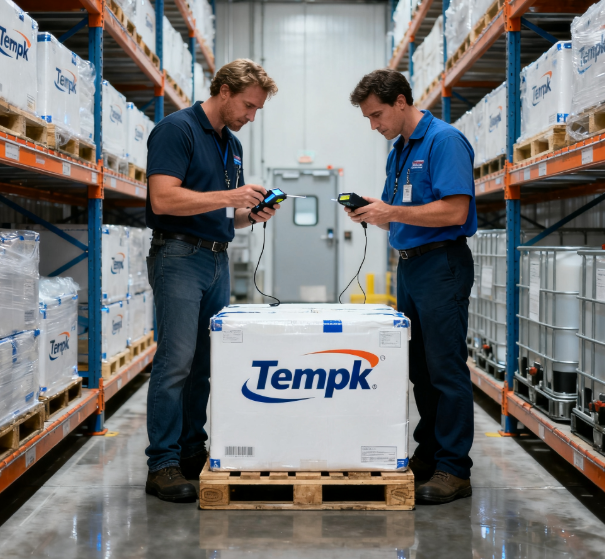
Cold Chain Packaging Configuration: Design Around the Route and Payload
A cold chain packaging configuration is the approved combination of shipper, insulation, coolant, internal arrangement, payload limits, monitoring, closure, and handling instructions used to protect a specific shipment. The configuration should be selected around the product’s temperature requirements and the conditions it may encounter—not around a box size or a supplier’s generic hold-time claim.
The distinction matters because the performance of a temperature-controlled package comes from the assembled system. A gel pack is a coolant component. Insulation slows heat transfer. A temperature data logger records conditions at its sensor location. None of these elements alone demonstrates that the shipment will remain within its required temperature range. That conclusion depends on the complete configuration, test conditions, and intended route.
Define the shipping task before choosing components
Start with a design brief that captures the intended use and the decisions the package must support. Include:
- Product limits: acceptable temperature range, sensitivity to freezing or overheating, and product-owner handling requirements.
- Payload: dimensions, mass, number of units, secondary packaging, loading density, and expected variation between shipments.
- Route: origin, destination, transport modes, planned transit time, likely dwell periods, transfer points, and possible delays.
- Environment: expected seasonal exposure and the conditions at pickup, hubs, customs, and delivery.
- Operation: who packs the shipper, where packing occurs, whether the package is reusable, and what the receiver must do.
- Evidence: required monitoring, acceptance criteria, test documentation, traceability, and deviation handling.
The product owner or quality function should determine the acceptable shipping conditions. A labeled storage range is an important input, but it should not automatically become the packout design target without considering product stability and the risks of distribution.
Build the configuration as a coupled system
A passive temperature-controlled package usually combines an outer container, insulation, coolant, separators or barriers, void fill, payload packaging, a logger, and closure and labeling elements. Each component contributes a different function, and changes to one component can affect the others.
Insulation slows heat transfer but does not compensate for every weak point in the enclosure. A lid that does not seat consistently, a damaged panel, or a poorly controlled opening may undermine the design. Coolant provides thermal capacity, but its effect depends on its mass, preparation, location, and contact with the payload. Internal barriers can reduce direct contact, while also changing the thermal path. Payload arrangement influences both heat transfer and physical stability.
This is why a coolant datasheet, insulation specification, or empty-box test cannot independently establish shipment performance. The relevant evidence must represent the assembled package and its intended load.
Make the trade-offs explicit
There is rarely one configuration that maximizes every desirable attribute. More insulation may reduce heat transfer but increase outer dimensions and reduce usable payload space. More coolant may extend thermal capacity under some conditions but increase shipping weight and create a local freezing risk. A larger shipper may simplify loading but allow a partial payload to move or leave uncontrolled air spaces. A reusable container may reduce recurring packaging consumption but introduce return logistics, inspection, cleaning, and refurbishment requirements.
| Design choice | Potential benefit | Trade-off to evaluate |
|---|---|---|
| Increased insulation | Slower heat transfer through package walls | Larger dimensions, less usable volume, cost |
| Additional coolant | Greater thermal reserve in some configurations | Weight, handling burden, direct-contact risk |
| More internal barriers | Better control of contact and position | Added steps, possible change to heat transfer |
| Larger shipper | Easier loading or more payload capacity | More empty space and possible product movement |
| Reusable system | Repeated use when properly managed | Return flow, inspection, cleaning, component-life control |
The best choice is the configuration that meets the defined requirements and can be assembled consistently. Avoid optimizing a single specification while ignoring the complete shipping task.
Specify the internal arrangement so it can be repeated
A controlled configuration should define the exact components and how they fit together. Include component identifiers, shipper dimensions, coolant type and approved conditioning procedure, coolant quantity and position, barrier materials, payload orientation, allowed fill range, logger location, closure method, and label placement.
Show the sequence in a diagram or annotated photograph when spatial relationships matter. A written instruction such as “place coolant around the product” may be too vague to reproduce. Specify which faces receive coolant, where a barrier is required, whether products may touch one another, and how empty space is managed.
The specification should also identify prohibited substitutions. A different gel pack, insulation liner, separator, or box may look similar while having different thermal behavior. Any substitution should follow a documented assessment and approval process rather than an informal decision at the packing station.
Use route conditions to define the test
The planned carrier transit time is not the entire exposure. A shipment may wait at a collection point, remain on a loading dock, transfer between vehicles, be delayed at a border, or arrive after a receiving site has closed. Seasonal exposure and route variability should be considered when selecting the test conditions.
WHO technical supplements treat transport-route profiling and shipping-container qualification as related but distinct activities. Route information helps characterize the external environment; package qualification evaluates whether a defined system can perform under specified conditions. Neither should be casually substituted for the other.
For medicinal products, European Good Distribution Practice guidance says packaging selection should consider the product’s transport requirements, space needed for the shipment, anticipated external temperature extremes, maximum transport time including transit storage, and the validation status of the packaging. Other product categories may be governed by different requirements, so the applicable quality and regulatory framework should be confirmed.
If a new route is longer, more variable, or exposed to different temperatures than the route represented in the existing evidence, document the gap. Decide whether the current evidence remains applicable, whether additional testing is needed, or whether operational controls must change.
Define monitoring around the risk question
A temperature logger is an evidence tool, not a cooling device. Its reading represents the temperature at the probe location, which may differ from the temperature experienced by products elsewhere in the package. The sensor location should therefore be selected to answer a defined question: represent the payload environment, investigate a potential cold spot, or characterize a known warm area.
The monitoring plan should identify the device, calibration or verification status where required, placement, start and stop steps, sampling settings, data review, and response to missing or abnormal records. For regulated shipments, the user requirement and applicable procedures determine what monitoring is needed. Avoid placing the sensor wherever it is easiest to reach if that location does not represent the risk being assessed.
Build evidence that another team can reproduce
A defensible configuration file should contain:
- The approved bill of materials, drawings, and configuration revision.
- A packout diagram and controlled assembly instructions.
- Payload dimensions, mass, permitted load range, and loading arrangement.
- Coolant conditioning and handling requirements.
- The test protocol, ambient profile, sensor locations, acceptance criteria, and report.
- Any route assumptions or limitations on where the configuration may be used.
- Receiving checks, excursion escalation, and change-control requirements.
A statement that a package “passed testing” is incomplete without the tested configuration, test conditions, and acceptance criteria. ISTA’s thermal packaging resources distinguish development tests used to compare designs from qualification processes intended to support defined claims. The selected method should fit the decision being made.
Keep the approved configuration under control
Performance can change when the payload, route, coolant, insulation, box dimensions, supplier, manufacturing process, or packing method changes. The change may appear minor, but the team should assess whether it affects heat transfer, thermal mass, fit, or handling before use. A documented change-control process should identify who assesses the impact, what evidence is required, and who authorizes release.
For reusable systems, add inspection criteria for damaged insulation, worn closures, missing parts, contamination, and coolant condition. European Good Distribution Practice guidance also highlights the need to control coolant reuse so that incompletely cooled packs are not mistakenly used and different pack states can be distinguished. The exact controls should match the system design and applicable procedures.
Approval checklist for buyers and engineers
Before approving a cold chain packaging configuration, confirm that the team can answer these questions clearly:
- What product and payload range is covered?
- Which routes and environmental conditions are represented by the evidence?
- What exact components, coolant state, barriers, and loading sequence are approved?
- Where is the logger placed, and what does its reading represent?
- What are the acceptance criteria and the response to an excursion?
- Which changes require reassessment or requalification?
- Can trained operators pack the shipment correctly using the controlled instructions alone?
A cold chain packaging configuration is ready for operational use when the design, evidence, and work instructions agree. If the configuration depends on an undocumented packing trick or a component substitution that has never been assessed, it is not yet a controlled system. Define the route and payload requirements first, review the complete configuration with the relevant quality and logistics teams, and request a proposal that makes its assumptions and evidence explicit.
Verify consistency from sample to routine production
The sample used during review should represent the components and assembly method that will be supplied and packed in routine operation. Confirm that the same insulation, coolant model, barriers, shipper dimensions, closure materials, and instructions are used. If the supplier changes a material source or manufacturing process, the change should be assessed for its potential effect rather than accepted because the external appearance is unchanged.
A practical operator trial is valuable before release. Ask trained packers to assemble the configuration using only the controlled instruction, then compare the finished packout with the approved drawing. Record any ambiguity, component-fit issue, or step that requires an undocumented workaround. Correct those issues before scaling up. After release, use incoming inspection and periodic record review to check that routine shipments continue to match the approved configuration.
The configuration is strongest when its technical evidence, physical components, and operating instructions all describe the same system.
Choosing a Cold Chain Packaging Supplier for Shipping

Choosing a Cold Chain Packaging Supplier for Shipping
cold chain packaging supplier should be approached as a shipment-system decision. A cold chain packaging supplier is valuable when its materials, documentation, and production controls fit the way your shipment is actually prepared and handled. The package, refrigerant, product arrangement, outer protection, labels, and handling instructions each have a separate role; the shipment succeeds only when they work together under the assumptions of a real route. That is why the most useful choice is rarely made from a material list or a headline performance claim. It comes from a clear brief, evidence that matches the intended use, and a packout that people can execute repeatedly.
Begin with the product and route
The first design question is not which box or coolant to buy. It is what must be protected, for how long, and through what sequence of conditions. Confirm the product requirement with the people responsible for product quality. Then map the payload, route, transport mode, planned timing, and points where the shipment may wait or change hands. The purpose is not to predict every disruption. It is to make the important assumptions visible, so that the sourcing team can judge whether a proposed configuration is relevant or merely convenient.
Build the package as a system of functions
A robust configuration assigns clear functions. Insulation reduces heat transfer. Refrigerant or phase-change components contribute thermal buffering when prepared and positioned correctly. Dividers and restraints manage contact, movement, and repeatable placement. Outer protection addresses compression and handling exposure. Labels and instructions help the shipper, carrier, and receiver recognize the load. Monitoring can document conditions but does not protect the product by itself. Once these boundaries are clear, a packaging supplier can be discussed as a system rather than as an isolated material claim.
Evidence must match the intended shipment
Evidence is meaningful only when its assumptions are visible. When a supplier refers to a thermal assessment or a tested configuration, ask what payload, coolant arrangement, preparation method, ambient exposure, and acceptance criteria were involved. Ask whether the route and configuration being considered are close enough for the result to be informative. A structured thermal profile can be useful, but it does not eliminate the need for lane-aware judgment. If an important condition has changed, it is better to identify the gap early than to present a historical result as a blanket assurance.
For regulated or highly sensitive products, packaging and distribution requirements may vary by product category, market, carrier service, and internal quality system. The packaging review should therefore support, not replace, the organization’s quality decision. Use cautious language around standards and compliance: a component or test approach may be relevant, but buyers should verify how it applies to their specific product and route.
Supplier review points that change the decision
Procurement should evaluate more than product range and price. Review usable internal dimensions, component compatibility, closure design, protection during handling, sample consistency, and the clarity of assembly instructions. Ask how production changes are controlled and communicated. If a program requires documentation or internal quality approval, ask what information can be reviewed and which statements require route-specific confirmation. These questions help distinguish a quotation that is commercially neat from an option that is operationally suitable.
A focused procurement comparison can be organized around questions that affect execution. Does the internal space fit the actual payload? Are coolant and insulation components compatible with the required configuration? Is the outer package strong enough for normal handling? Can operators assemble it without improvisation? Does the supplier explain the scope of any performance information? These questions are more useful than trying to compare products solely by material name or a generic claim.
Make routine execution part of the design
Routine execution determines whether a carefully selected design delivers its intended value. Define where components are stored and conditioned, who assembles the packout, how the product is positioned, what must be checked before closure, and what the receiver should inspect. The objective is a process that stays understandable when workload rises or personnel change. Simple controls – a clear assembly sequence, component identification, a visual packout reference, and an agreed escalation step – often prevent more problems than adding complexity without improving repeatability.
When a familiar package is not enough
A familiar insulated packout may not be enough when the payload changes shape, the route lengthens, the season changes, or new handoffs are introduced. It may also be insufficient if product sensitivity, documentation expectations, or physical protection needs increase. That does not automatically mean the program requires the most complex solution. It means the original assumptions should be revisited. A thoughtful review can reveal whether a minor configuration change, a different refrigerant strategy, a sturdier outer case, or additional evaluation is the appropriate next step.
Buyer review points
- Product condition and sensitivity: confirm the requirement and product-specific constraints.
- Payload and geometry: check usable internal space, weight distribution, and product restraint.
- Route and handoffs: identify transport mode, waiting periods, handling transfers, and seasonal exposure.
- Packout control: confirm component preparation, placement, closure, labels, and receiving checks.
- Evidence and change control: review relevant documentation and ask how material or route changes are assessed.
FAQ
What is the first step in a cold-chain packaging decision?Confirm the product requirement and map the real shipment. Include payload, route, transport mode, handoffs, likely waiting periods, product placement constraints, and any quality-review needs. This prevents the team from choosing a package before it understands the conditions that package must address.
What should a buyer verify before scaling from samples to production?Verify that the production materials, dimensions, assembly instructions, storage and conditioning steps, and quality controls match the reviewed sample. Ask how changes are managed and how the receiving team will inspect routine shipments. Consistency between sample and production is an operational requirement, not a formality.
Does testing remove the need for route review?No. Testing can provide valuable evidence under defined conditions, but it cannot turn every route into the same environment. Review whether the test assumptions resemble the intended payload, coolant configuration, ambient exposure, and handling sequence. When important conditions differ, additional evaluation may be appropriate.
Additional decision checkpoint
Before a purchase decision is approved, record the assumptions behind the recommendation in one place. This can be a short internal brief rather than a complex report. Its value is that it allows a later reviewer to see why the configuration was selected and which conditions were considered important. It also makes changes easier to recognize. If the destination, product arrangement, or carrier model changes, the team can compare the new situation with the original assumptions instead of relying on memory.
Operational checkpoint
Do not overlook physical protection. A product can remain within its intended temperature condition and still be unacceptable if the load shifts, leaks, is crushed, or arrives with a damaged closure. Outer-case strength, internal restraint, moisture management, label placement, and the ability to identify the intended orientation all deserve a place in the review. The best thermal concept is weakened if the package cannot survive the ordinary mechanical events of distribution.
Operational checkpoint
The receiving process is an informative part of the design. Decide what the receiver should look for: package condition, evidence of leakage or damage, label clarity, product placement, and any monitoring device that must be recovered or read. A receiving observation does not replace a quality decision, but it can help the organization detect recurring weaknesses in handling, packout execution, or the selected packaging format.
Operational checkpoint
Change control deserves plain language. If a supplier changes a material source, dimension, closure detail, coolant fill, carton construction, or assembly instruction, the buyer needs to know whether that change could affect the approved configuration. Likewise, if the shipper changes the product, payload, route, or distribution model, the existing evidence may need to be reconsidered. Treating changes as visible decision points keeps a packaging program credible over time.
Operational checkpoint
Price should be read alongside operational cost and risk. The lowest purchase price can create hidden work if packing takes longer, components are confused, damage rates increase, or quality teams must repeatedly resolve exceptions. Conversely, a more involved configuration may be unnecessary for a stable, low-risk route. The useful question is whether the selected approach has a defensible fit to the shipment rather than whether it uses the most or least material.
Operational checkpoint
Before a purchase decision is approved, record the assumptions behind the recommendation in one place. This can be a short internal brief rather than a complex report. Its value is that it allows a later reviewer to see why the configuration was selected and which conditions were considered important. It also makes changes easier to recognize. If the destination, product arrangement, or carrier model changes, the team can compare the new situation with the original assumptions instead of relying on memory.
Operational checkpoint
Do not overlook physical protection. A product can remain within its intended temperature condition and still be unacceptable if the load shifts, leaks, is crushed, or arrives with a damaged closure. Outer-case strength, internal restraint, moisture management, label placement, and the ability to identify the intended orientation all deserve a place in the review. The best thermal concept is weakened if the package cannot survive the ordinary mechanical events of distribution.
Operational checkpoint
The receiving process is an informative part of the design. Decide what the receiver should look for: package condition, evidence of leakage or damage, label clarity, product placement, and any monitoring device that must be recovered or read. A receiving observation does not replace a quality decision, but it can help the organization detect recurring weaknesses in handling, packout execution, or the selected packaging format.
Operational checkpoint
Change control deserves plain language. If a supplier changes a material source, dimension, closure detail, coolant fill, carton construction, or assembly instruction, the buyer needs to know whether that change could affect the approved configuration. Likewise, if the shipper changes the product, payload, route, or distribution model, the existing evidence may need to be reconsidered. Treating changes as visible decision points keeps a packaging program credible over time.
Operational checkpoint
Price should be read alongside operational cost and risk. The lowest purchase price can create hidden work if packing takes longer, components are confused, damage rates increase, or quality teams must repeatedly resolve exceptions. Conversely, a more involved configuration may be unnecessary for a stable, low-risk route. The useful question is whether the selected approach has a defensible fit to the shipment rather than whether it uses the most or least material.
Operational checkpoint
Before a purchase decision is approved, record the assumptions behind the recommendation in one place. This can be a short internal brief rather than a complex report. Its value is that it allows a later reviewer to see why the configuration was selected and which conditions were considered important. It also makes changes easier to recognize. If the destination, product arrangement, or carrier model changes, the team can compare the new situation with the original assumptions instead of relying on memory.
Operational checkpoint
Do not overlook physical protection. A product can remain within its intended temperature condition and still be unacceptable if the load shifts, leaks, is crushed, or arrives with a damaged closure. Outer-case strength, internal restraint, moisture management, label placement, and the ability to identify the intended orientation all deserve a place in the review. The best thermal concept is weakened if the package cannot survive the ordinary mechanical events of distribution.
Conclusion
A cold chain packaging supplier is valuable when its materials, documentation, and production controls fit the way your shipment is actually prepared and handled. A sound decision starts with the product and the route, assigns a clear role to each packaging element, and treats supplier evidence as useful only within its stated conditions. It also recognizes that routine assembly, handoff management, and receiving inspection are part of the shipment design. When those elements are reviewed together, the team can make a more defensible choice without relying on exaggerated performance claims.
At Tempk, we approach supplier conversations as an opportunity to make the handoff from a sample to a repeatable shipment clearer. The useful inputs are operational: the product, payload, target condition, route, packaging configuration, and the documentation that must be reviewed. This creates a more grounded basis for comparing options and for deciding which questions should be settled before a purchase order becomes a routine program.
Ask Tempk for a discussion centered on your product, packout, route, and procurement review points before committing to a larger cold-chain packaging order.
How to Evaluate a Cold Chain Packaging Company

How to Evaluate a Cold Chain Packaging Company
cold chain packaging company should be approached as a shipment-system decision. A cold chain packaging company should be evaluated as a partner in a shipment system, not as a catalog of boxes and refrigerants. The package, refrigerant, product arrangement, outer protection, labels, and handling instructions each have a separate role; the shipment succeeds only when they work together under the assumptions of a real route. That is why the most useful choice is rarely made from a material list or a headline performance claim. It comes from a clear brief, evidence that matches the intended use, and a packout that people can execute repeatedly.
Begin with the product and route
The first design question is not which box or coolant to buy. It is what must be protected, for how long, and through what sequence of conditions. Confirm the product requirement with the people responsible for product quality. Then map the payload, route, transport mode, planned timing, and points where the shipment may wait or change hands. The purpose is not to predict every disruption. It is to make the important assumptions visible, so that the buyer can judge whether a proposed configuration is relevant or merely convenient.
Build the package as a system of functions
A robust configuration assigns clear functions. Insulation reduces heat transfer. Refrigerant or phase-change components contribute thermal buffering when prepared and positioned correctly. Dividers and restraints manage contact, movement, and repeatable placement. Outer protection addresses compression and handling exposure. Labels and instructions help the shipper, carrier, and receiver recognize the load. Monitoring can document conditions but does not protect the product by itself. Once these boundaries are clear, a packaging partner can be discussed as a system rather than as an isolated material claim.
Evidence must match the intended shipment
Evidence is meaningful only when its assumptions are visible. When a supplier refers to a thermal assessment or a tested configuration, ask what payload, coolant arrangement, preparation method, ambient exposure, and acceptance criteria were involved. Ask whether the route and configuration being considered are close enough for the result to be informative. A structured thermal profile can be useful, but it does not eliminate the need for lane-aware judgment. If an important condition has changed, it is better to identify the gap early than to present a historical result as a blanket assurance.
For regulated or highly sensitive products, packaging and distribution requirements may vary by product category, market, carrier service, and internal quality system. The packaging review should therefore support, not replace, the organization’s quality decision. Use cautious language around standards and compliance: a component or test approach may be relevant, but buyers should verify how it applies to their specific product and route.
Supplier review points that change the decision
Procurement should evaluate more than product range and price. Review usable internal dimensions, component compatibility, closure design, protection during handling, sample consistency, and the clarity of assembly instructions. Ask how production changes are controlled and communicated. If a program requires documentation or internal quality approval, ask what information can be reviewed and which statements require route-specific confirmation. These questions help distinguish a quotation that is commercially neat from an option that is operationally suitable.
A focused procurement comparison can be organized around questions that affect execution. Does the internal space fit the actual payload? Are coolant and insulation components compatible with the required configuration? Is the outer package strong enough for normal handling? Can operators assemble it without improvisation? Does the supplier explain the scope of any performance information? These questions are more useful than trying to compare products solely by material name or a generic claim.
Make routine execution part of the design
Routine execution determines whether a carefully selected design delivers its intended value. Define where components are stored and conditioned, who assembles the packout, how the product is positioned, what must be checked before closure, and what the receiver should inspect. The objective is a process that stays understandable when workload rises or personnel change. Simple controls – a clear assembly sequence, component identification, a visual packout reference, and an agreed escalation step – often prevent more problems than adding complexity without improving repeatability.
When a familiar package is not enough
A familiar insulated packout may not be enough when the payload changes shape, the route lengthens, the season changes, or new handoffs are introduced. It may also be insufficient if product sensitivity, documentation expectations, or physical protection needs increase. That does not automatically mean the program requires the most complex solution. It means the original assumptions should be revisited. A thoughtful review can reveal whether a minor configuration change, a different refrigerant strategy, a sturdier outer case, or additional evaluation is the appropriate next step.
Buyer review points
- Product condition and sensitivity: confirm the requirement and product-specific constraints.
- Payload and geometry: check usable internal space, weight distribution, and product restraint.
- Route and handoffs: identify transport mode, waiting periods, handling transfers, and seasonal exposure.
- Packout control: confirm component preparation, placement, closure, labels, and receiving checks.
- Evidence and change control: review relevant documentation and ask how material or route changes are assessed.
FAQ
What is the first step in a cold-chain packaging decision?Confirm the product requirement and map the real shipment. Include payload, route, transport mode, handoffs, likely waiting periods, product placement constraints, and any quality-review needs. This prevents the team from choosing a package before it understands the conditions that package must address.
What should a buyer verify before scaling from samples to production?Verify that the production materials, dimensions, assembly instructions, storage and conditioning steps, and quality controls match the reviewed sample. Ask how changes are managed and how the receiving team will inspect routine shipments. Consistency between sample and production is an operational requirement, not a formality.
Does testing remove the need for route review?No. Testing can provide valuable evidence under defined conditions, but it cannot turn every route into the same environment. Review whether the test assumptions resemble the intended payload, coolant configuration, ambient exposure, and handling sequence. When important conditions differ, additional evaluation may be appropriate.
Additional decision checkpoint
Before a purchase decision is approved, record the assumptions behind the recommendation in one place. This can be a short internal brief rather than a complex report. Its value is that it allows a later reviewer to see why the configuration was selected and which conditions were considered important. It also makes changes easier to recognize. If the destination, product arrangement, or carrier model changes, the team can compare the new situation with the original assumptions instead of relying on memory.
Operational checkpoint
Do not overlook physical protection. A product can remain within its intended temperature condition and still be unacceptable if the load shifts, leaks, is crushed, or arrives with a damaged closure. Outer-case strength, internal restraint, moisture management, label placement, and the ability to identify the intended orientation all deserve a place in the review. The best thermal concept is weakened if the package cannot survive the ordinary mechanical events of distribution.
Operational checkpoint
The receiving process is an informative part of the design. Decide what the receiver should look for: package condition, evidence of leakage or damage, label clarity, product placement, and any monitoring device that must be recovered or read. A receiving observation does not replace a quality decision, but it can help the organization detect recurring weaknesses in handling, packout execution, or the selected packaging format.
Operational checkpoint
Change control deserves plain language. If a supplier changes a material source, dimension, closure detail, coolant fill, carton construction, or assembly instruction, the buyer needs to know whether that change could affect the approved configuration. Likewise, if the shipper changes the product, payload, route, or distribution model, the existing evidence may need to be reconsidered. Treating changes as visible decision points keeps a packaging program credible over time.
Operational checkpoint
Price should be read alongside operational cost and risk. The lowest purchase price can create hidden work if packing takes longer, components are confused, damage rates increase, or quality teams must repeatedly resolve exceptions. Conversely, a more involved configuration may be unnecessary for a stable, low-risk route. The useful question is whether the selected approach has a defensible fit to the shipment rather than whether it uses the most or least material.
Operational checkpoint
Before a purchase decision is approved, record the assumptions behind the recommendation in one place. This can be a short internal brief rather than a complex report. Its value is that it allows a later reviewer to see why the configuration was selected and which conditions were considered important. It also makes changes easier to recognize. If the destination, product arrangement, or carrier model changes, the team can compare the new situation with the original assumptions instead of relying on memory.
Operational checkpoint
Do not overlook physical protection. A product can remain within its intended temperature condition and still be unacceptable if the load shifts, leaks, is crushed, or arrives with a damaged closure. Outer-case strength, internal restraint, moisture management, label placement, and the ability to identify the intended orientation all deserve a place in the review. The best thermal concept is weakened if the package cannot survive the ordinary mechanical events of distribution.
Operational checkpoint
The receiving process is an informative part of the design. Decide what the receiver should look for: package condition, evidence of leakage or damage, label clarity, product placement, and any monitoring device that must be recovered or read. A receiving observation does not replace a quality decision, but it can help the organization detect recurring weaknesses in handling, packout execution, or the selected packaging format.
Operational checkpoint
Change control deserves plain language. If a supplier changes a material source, dimension, closure detail, coolant fill, carton construction, or assembly instruction, the buyer needs to know whether that change could affect the approved configuration. Likewise, if the shipper changes the product, payload, route, or distribution model, the existing evidence may need to be reconsidered. Treating changes as visible decision points keeps a packaging program credible over time.
Operational checkpoint
Price should be read alongside operational cost and risk. The lowest purchase price can create hidden work if packing takes longer, components are confused, damage rates increase, or quality teams must repeatedly resolve exceptions. Conversely, a more involved configuration may be unnecessary for a stable, low-risk route. The useful question is whether the selected approach has a defensible fit to the shipment rather than whether it uses the most or least material.
Operational checkpoint
Before a purchase decision is approved, record the assumptions behind the recommendation in one place. This can be a short internal brief rather than a complex report. Its value is that it allows a later reviewer to see why the configuration was selected and which conditions were considered important. It also makes changes easier to recognize. If the destination, product arrangement, or carrier model changes, the team can compare the new situation with the original assumptions instead of relying on memory.
Conclusion
A cold chain packaging company should be evaluated as a partner in a shipment system, not as a catalog of boxes and refrigerants. A sound decision starts with the product and the route, assigns a clear role to each packaging element, and treats supplier evidence as useful only within its stated conditions. It also recognizes that routine assembly, handoff management, and receiving inspection are part of the shipment design. When those elements are reviewed together, the team can make a more defensible choice without relying on exaggerated performance claims.
At Tempk, we focus on practical cold-chain packaging discussions that begin with the shipment rather than a generic product claim. A useful conversation can bring together the required condition, payload shape, route, handling sequence, and the evidence a quality or procurement team needs to review. That helps keep the decision tied to the real operating environment and makes it easier to compare packaging approaches on a like-for-like basis.
Share the product type, expected route, handling points, and temperature requirement with Tempk to discuss a packaging approach that can be reviewed before you scale from samples to routine shipments.
Cold Chain Package Design for Shipping That Fits the Route
Cold Chain Package Design for Shipping That Fits the Route
cold chain package design for shipping should be approached as a shipment-system decision. Cold chain package design for shipping is the disciplined arrangement of product, insulation, refrigerant, protection, and handling instructions around a defined route. The package, refrigerant, product arrangement, outer protection, labels, and handling instructions each have a separate role; the shipment succeeds only when they work together under the assumptions of a real route. That is why the most useful choice is rarely made from a material list or a headline performance claim. It comes from a clear brief, evidence that matches the intended use, and a packout that people can execute repeatedly.
Begin with the product and route
The first design question is not which box or coolant to buy. It is what must be protected, for how long, and through what sequence of conditions. Confirm the product requirement with the people responsible for product quality. Then map the payload, route, transport mode, planned timing, and points where the shipment may wait or change hands. The purpose is not to predict every disruption. It is to make the important assumptions visible, so that the design team can judge whether a proposed configuration is relevant or merely convenient.
Build the package as a system of functions
A robust configuration assigns clear functions. Insulation reduces heat transfer. Refrigerant or phase-change components contribute thermal buffering when prepared and positioned correctly. Dividers and restraints manage contact, movement, and repeatable placement. Outer protection addresses compression and handling exposure. Labels and instructions help the shipper, carrier, and receiver recognize the load. Monitoring can document conditions but does not protect the product by itself. Once these boundaries are clear, a shipping packout can be discussed as a system rather than as an isolated material claim.
Evidence must match the intended shipment
Evidence is meaningful only when its assumptions are visible. When a supplier refers to a thermal assessment or a tested configuration, ask what payload, coolant arrangement, preparation method, ambient exposure, and acceptance criteria were involved. Ask whether the route and configuration being considered are close enough for the result to be informative. A structured thermal profile can be useful, but it does not eliminate the need for lane-aware judgment. If an important condition has changed, it is better to identify the gap early than to present a historical result as a blanket assurance.
For regulated or highly sensitive products, packaging and distribution requirements may vary by product category, market, carrier service, and internal quality system. The packaging review should therefore support, not replace, the organization’s quality decision. Use cautious language around standards and compliance: a component or test approach may be relevant, but buyers should verify how it applies to their specific product and route.
Supplier review points that change the decision
Procurement should evaluate more than product range and price. Review usable internal dimensions, component compatibility, closure design, protection during handling, sample consistency, and the clarity of assembly instructions. Ask how production changes are controlled and communicated. If a program requires documentation or internal quality approval, ask what information can be reviewed and which statements require route-specific confirmation. These questions help distinguish a quotation that is commercially neat from an option that is operationally suitable.
A focused procurement comparison can be organized around questions that affect execution. Does the internal space fit the actual payload? Are coolant and insulation components compatible with the required configuration? Is the outer package strong enough for normal handling? Can operators assemble it without improvisation? Does the supplier explain the scope of any performance information? These questions are more useful than trying to compare products solely by material name or a generic claim.
Make routine execution part of the design
Routine execution determines whether a carefully selected design delivers its intended value. Define where components are stored and conditioned, who assembles the packout, how the product is positioned, what must be checked before closure, and what the receiver should inspect. The objective is a process that stays understandable when workload rises or personnel change. Simple controls – a clear assembly sequence, component identification, a visual packout reference, and an agreed escalation step – often prevent more problems than adding complexity without improving repeatability.
When a familiar package is not enough
A familiar insulated packout may not be enough when the payload changes shape, the route lengthens, the season changes, or new handoffs are introduced. It may also be insufficient if product sensitivity, documentation expectations, or physical protection needs increase. That does not automatically mean the program requires the most complex solution. It means the original assumptions should be revisited. A thoughtful review can reveal whether a minor configuration change, a different refrigerant strategy, a sturdier outer case, or additional evaluation is the appropriate next step.
Buyer review points
- Product condition and sensitivity: confirm the requirement and product-specific constraints.
- Payload and geometry: check usable internal space, weight distribution, and product restraint.
- Route and handoffs: identify transport mode, waiting periods, handling transfers, and seasonal exposure.
- Packout control: confirm component preparation, placement, closure, labels, and receiving checks.
- Evidence and change control: review relevant documentation and ask how material or route changes are assessed.
FAQ
What is the first step in a cold-chain packaging decision?Confirm the product requirement and map the real shipment. Include payload, route, transport mode, handoffs, likely waiting periods, product placement constraints, and any quality-review needs. This prevents the team from choosing a package before it understands the conditions that package must address.
What should a buyer verify before scaling from samples to production?Verify that the production materials, dimensions, assembly instructions, storage and conditioning steps, and quality controls match the reviewed sample. Ask how changes are managed and how the receiving team will inspect routine shipments. Consistency between sample and production is an operational requirement, not a formality.
Does testing remove the need for route review?No. Testing can provide valuable evidence under defined conditions, but it cannot turn every route into the same environment. Review whether the test assumptions resemble the intended payload, coolant configuration, ambient exposure, and handling sequence. When important conditions differ, additional evaluation may be appropriate.
Additional decision checkpoint
Before a purchase decision is approved, record the assumptions behind the recommendation in one place. This can be a short internal brief rather than a complex report. Its value is that it allows a later reviewer to see why the configuration was selected and which conditions were considered important. It also makes changes easier to recognize. If the destination, product arrangement, or carrier model changes, the team can compare the new situation with the original assumptions instead of relying on memory.
Operational checkpoint
Do not overlook physical protection. A product can remain within its intended temperature condition and still be unacceptable if the load shifts, leaks, is crushed, or arrives with a damaged closure. Outer-case strength, internal restraint, moisture management, label placement, and the ability to identify the intended orientation all deserve a place in the review. The best thermal concept is weakened if the package cannot survive the ordinary mechanical events of distribution.
Operational checkpoint
The receiving process is an informative part of the design. Decide what the receiver should look for: package condition, evidence of leakage or damage, label clarity, product placement, and any monitoring device that must be recovered or read. A receiving observation does not replace a quality decision, but it can help the organization detect recurring weaknesses in handling, packout execution, or the selected packaging format.
Operational checkpoint
Change control deserves plain language. If a supplier changes a material source, dimension, closure detail, coolant fill, carton construction, or assembly instruction, the buyer needs to know whether that change could affect the approved configuration. Likewise, if the shipper changes the product, payload, route, or distribution model, the existing evidence may need to be reconsidered. Treating changes as visible decision points keeps a packaging program credible over time.
Operational checkpoint
Price should be read alongside operational cost and risk. The lowest purchase price can create hidden work if packing takes longer, components are confused, damage rates increase, or quality teams must repeatedly resolve exceptions. Conversely, a more involved configuration may be unnecessary for a stable, low-risk route. The useful question is whether the selected approach has a defensible fit to the shipment rather than whether it uses the most or least material.
Operational checkpoint
Before a purchase decision is approved, record the assumptions behind the recommendation in one place. This can be a short internal brief rather than a complex report. Its value is that it allows a later reviewer to see why the configuration was selected and which conditions were considered important. It also makes changes easier to recognize. If the destination, product arrangement, or carrier model changes, the team can compare the new situation with the original assumptions instead of relying on memory.
Operational checkpoint
Do not overlook physical protection. A product can remain within its intended temperature condition and still be unacceptable if the load shifts, leaks, is crushed, or arrives with a damaged closure. Outer-case strength, internal restraint, moisture management, label placement, and the ability to identify the intended orientation all deserve a place in the review. The best thermal concept is weakened if the package cannot survive the ordinary mechanical events of distribution.
Operational checkpoint
The receiving process is an informative part of the design. Decide what the receiver should look for: package condition, evidence of leakage or damage, label clarity, product placement, and any monitoring device that must be recovered or read. A receiving observation does not replace a quality decision, but it can help the organization detect recurring weaknesses in handling, packout execution, or the selected packaging format.
Operational checkpoint
Change control deserves plain language. If a supplier changes a material source, dimension, closure detail, coolant fill, carton construction, or assembly instruction, the buyer needs to know whether that change could affect the approved configuration. Likewise, if the shipper changes the product, payload, route, or distribution model, the existing evidence may need to be reconsidered. Treating changes as visible decision points keeps a packaging program credible over time.
Operational checkpoint
Price should be read alongside operational cost and risk. The lowest purchase price can create hidden work if packing takes longer, components are confused, damage rates increase, or quality teams must repeatedly resolve exceptions. Conversely, a more involved configuration may be unnecessary for a stable, low-risk route. The useful question is whether the selected approach has a defensible fit to the shipment rather than whether it uses the most or least material.
Operational checkpoint
Before a purchase decision is approved, record the assumptions behind the recommendation in one place. This can be a short internal brief rather than a complex report. Its value is that it allows a later reviewer to see why the configuration was selected and which conditions were considered important. It also makes changes easier to recognize. If the destination, product arrangement, or carrier model changes, the team can compare the new situation with the original assumptions instead of relying on memory.
Operational checkpoint
Do not overlook physical protection. A product can remain within its intended temperature condition and still be unacceptable if the load shifts, leaks, is crushed, or arrives with a damaged closure. Outer-case strength, internal restraint, moisture management, label placement, and the ability to identify the intended orientation all deserve a place in the review. The best thermal concept is weakened if the package cannot survive the ordinary mechanical events of distribution.
Conclusion
Cold chain package design for shipping is the disciplined arrangement of product, insulation, refrigerant, protection, and handling instructions around a defined route. A sound decision starts with the product and the route, assigns a clear role to each packaging element, and treats supplier evidence as useful only within its stated conditions. It also recognizes that routine assembly, handoff management, and receiving inspection are part of the shipment design. When those elements are reviewed together, the team can make a more defensible choice without relying on exaggerated performance claims.
At Tempk, we see the most useful packaging conversations start with the real shipment conditions. Product geometry, desired temperature condition, duration, handoff points, coolant preparation, and receiving practices all change what a workable design looks like. By framing the task around those inputs, teams can compare insulation and refrigerant options without assuming that a single component alone proves shipping performance.
Bring Tempk the product profile, planned route, packout constraints, and temperature requirement to discuss a cold chain package design for shipping that is suitable for review and testing.
Temperature Controlled Packaging Supplier Selection Guide

Temperature Controlled Packaging Supplier Selection Guide
The right temperature controlled packaging supplier provides more than containers and coolant. The supplier should help convert a defined distribution requirement into a controlled packout, document how that packout was tested, reproduce the approved configuration at scale, and manage changes throughout its life.
Buyers often compare catalog size, unit price, and claimed duration first. Those data are easy to collect but difficult to interpret without context. A more reliable selection process evaluates the chain from shipment requirements to thermal evidence, production controls, warehouse execution, and ongoing support.
Give every supplier the same shipment brief
Comparable proposals begin with comparable inputs. Issue a user requirement specification or a structured RFQ appendix that identifies:
- required product-temperature limits and excursion rules;
- payload dimensions, mass, starting condition, and load range;
- secondary packaging and orientation constraints;
- route, transport modes, custody transfers, and dwell points;
- expected seasonal exposures and credible delays;
- total door-to-door duration rather than scheduled transit alone;
- monitoring, labeling, security, and mechanical-protection needs;
- single-use or reusable workflow;
- qualification and documentation expectations;
- annual volume, order pattern, delivery location, and launch date.
Ask bidders to list assumptions and exclusions. If route data or payload conditions are incomplete, the proposal should identify the information gap rather than hide it behind a standard model number.
The discovery process is itself evidence. A supplier that does not ask about minimum load, conditioning, route, or acceptance criteria may be treating a system claim as universal.
Read thermal claims as conditional statements
A duration claim has meaning only with its conditions. The same insulated shipper can produce different results when the payload, coolant, ambient profile, starting temperature, or sensor placement changes.
Request a full report or controlled technical summary that identifies:
- tested part numbers and configuration version;
- insulation and container construction;
- coolant type, quantity, placement, and conditioning;
- payload or simulant properties and load arrangement;
- programmed and actual chamber profile;
- test duration, repetitions, and acceptance criteria;
- sensor map, logger information, and calibration status;
- individual time-series results, deviations, and conclusions.
The strongest supplier will explain the boundary of the evidence. A test can support the tested configuration under the applied conditions. It does not automatically cover a different lane, a larger payload, another gel pack, or a buyer-defined worst case.
Distinguish standardized profiles from lane evidence
ISTA Standard 7E provides heat and cold profiles for evaluating thermal transport packaging used in parcel delivery. ISTA states that the profiles were developed from characterized real-world transport data and represent annual seasonal extremes. This offers a common benchmark for comparing designs.
ISTA also describes the 7E and Standard 20 approach as not being customized lane data or a customized worst-case qualification. If the intended shipment uses ocean freight, specialized air handling, long customs holds, direct courier service, or unusual climates, ask how the supplier will connect standardized test evidence to those conditions.
Verify the supplier understands qualification boundaries
For pharmaceutical shipping containers, WHO guidance describes design qualification, operational qualification, and performance qualification. It also requires an approved user requirement specification before testing and emphasizes risk assessment of environmental conditions and distribution lanes.
A supplier may provide a prequalified design or an operational qualification package. The buyer still needs to decide whether the supplied documentation meets the end user's requirements and what performance qualification or route verification remains necessary. A component certificate, a chamber test, and a qualified shipping system are not equivalent.
Regulatory and guidance language should be handled carefully. EU GDP guidance for medicinal products calls for a risk-based transportation approach and, where relevant, validated temperature-control systems. It does not make every catalog shipper compliant for every pharmaceutical route. Ask the supplier to state which document, configuration, and use condition supports each compliance-related claim.
Audit the link from tested sample to delivered product
Thermal evidence is only as reliable as configuration control. The supplier should map the tested bill of materials to controlled production part numbers. Review specifications and inspection methods for characteristics that can affect performance, such as dimensions, wall or panel integrity, lid fit, coolant formulation and fill mass, pouch seals, liner construction, spacers, and carton configuration.
Ask how the supplier manages incoming materials, approved vendors, nonconforming output, lot traceability, equipment calibration, complaints, and corrective action. The level of review should reflect product and shipment risk.
Change control deserves specific contract language. Define which material, process, tooling, production-site, and sub-supplier changes require advance notice. Require an impact assessment and agree how the parties decide between documentary review, bridging tests, and requalification.
Without this link, the buyer may be qualifying a prototype while purchasing a moving target.
Test the packout with normal operators
A system that performs in a chamber can fail operationally if it is assembled inconsistently. Conduct a trial with the warehouse team that will condition coolant, stage parts, pack the payload, place the monitor, close the shipper, and apply labels.
Observe whether:
- coolant states are unmistakable;
- components have clear orientation and identifiers;
- seasonal packouts are separated;
- minimum and maximum loads have defined dunnage;
- instructions work without verbal coaching;
- closure and tamper controls are practical;
- the packed unit meets carrier size and weight constraints;
- the facility has adequate conditioning and staging capacity.
EU GDP guidance notes the need to train staff on insulated-box assembly and seasonal configurations and to control cool-pack reuse. These controls are useful beyond pharmaceuticals because they address common execution errors.
Compare proposals with a risk-weighted scorecard
| Category | Strong evidence | Follow-up question |
|---|---|---|
| Requirement fit | Written mapping from shipment brief to configuration | Which requirement is not covered by existing evidence? |
| Thermal performance | Transparent conditions and detailed data | What changes would invalidate this result? |
| Production quality | Controlled specifications and traceability | How is the tested sample linked to each supplied lot? |
| Change management | Advance notice and documented impact review | Which changes can occur without buyer approval? |
| Operational usability | Successful operator trial and clear instructions | What is the most common assembly error? |
| Supply continuity | Capacity and critical-component risk plan | What is the approved response to a shortage? |
| Technical support | Named ownership and escalation path | Who reviews new routes and deviations? |
| Commercial fit | Complete scope and lifecycle cost model | Which costs sit outside the unit price? |
Weight the scorecard. For a high-value pharmaceutical payload, evidence and change control may outweigh small price differences. For a short food-delivery route, simple assembly and local supply may carry more weight. The method should reflect consequence, not habit.
Evaluate total operating cost
Unit price excludes several material costs: freight weight, usable payload volume, coolant-conditioning energy and equipment, warehouse labor, storage space, disposal, returns, damage, and requalification after change. Model cost per successful shipment under realistic load and return assumptions.
For reusable systems, examine the entire loop: asset purchase or rental, tracking, collection, return freight, cleaning, inspection, refurbishment, loss, inventory imbalance, and retirement. Reusability is an operating model, not a material label. A durable shipper that cannot be recovered reliably may deliver little reuse value.
Request price breaks, tooling terms, sample charges, minimum quantities, lead-time assumptions, and delivery terms in writing. Do not treat unverified MOQ or lead-time statements as fixed capabilities.
Plan scale-up, deviations, and route changes
Use a staged approval process: technical proposal, prototype, controlled test evidence, operator trial, pilot shipment, production approval, and routine review. Identify the documents and decision owners for each stage.
Before launch, establish how temperature alarms, damaged components, coolant leaks, incorrect assembly, and late deliveries will be handled. A packaging supplier can investigate the system and provide evidence, but product disposition should remain with the product owner and authorized quality function.
New routes, carriers, origins, payloads, or service levels should trigger documented review. Some changes may remain within the accepted evidence; others may require additional testing. The supplier should be able to explain the assessment path without promising universal coverage.
Select a supplier that can keep the system true
A temperature controlled packaging supplier should make performance claims traceable, limitations visible, and production changes manageable. The selection decision should connect the shipment brief, tested configuration, supplied product, packout instructions, and lifecycle support.
For a useful quotation, provide potential suppliers with payload data, temperature requirements, routes, durations, volume, monitoring needs, and evidence expectations. Then compare the quality of the proposed system and controls before negotiating the final unit price.
ISTA 7E Thermal Testing: Scope, Plan, and Evidence

ISTA 7E Thermal Testing Scope Plan and Evidence
ISTA 7E thermal testing uses standardized heat and cold profiles to evaluate thermal transport packaging used in parcel-delivery shipments. ISTA explains that the profile set was developed from real-world transport data and is designed to represent annual seasonal maxima and minima. This common challenge helps laboratories, packaging developers, and buyers compare thermal designs on a more consistent basis.
The standard does not turn an insulated box into a universally qualified shipper. The result applies to the tested configuration, payload, preparation, profile, duration, sensor plan, and acceptance criteria. Understanding those boundaries is the difference between useful evidence and an unsupported marketing claim.
What ISTA 7E is designed to do
ISTA lists 7E among its development tests and describes it as a testing standard for thermal transport packaging used in parcel delivery system shipment. The profiles evaluate the effects of external temperature exposure on an individual packaged product. ISTA also states that 7E can be used as a standalone profile or in conjunction with a process standard such as ISTA Standard 20.
The standardized profile offers three practical benefits:
- Candidate designs can face the same ambient challenge.
- Test results are easier to compare than results generated with unrelated proprietary profiles.
- The profile can become a defined element in a broader design and qualification process.
ISTA's thermal guidance also states what the approach is not: customized shipping-lane data or a customized worst-case shipping qualification. A 7E result should not be extended automatically to every parcel network, route, climate, delay, or transport mode.
Start with the question the test must answer
Before selecting a profile or booking a chamber, define the intended use. A user requirement specification or equivalent protocol basis should identify:
- product-temperature limits and excursion rules;
- payload dimensions, mass, geometry, and starting condition;
- minimum and maximum load configurations;
- complete packout and coolant-conditioning process;
- expected distribution mode and route characteristics;
- required duration and credible delay;
- seasonal challenges;
- monitoring and mechanical-protection needs;
- acceptance criteria and decision ownership.
For pharmaceutical shipping containers, WHO guidance requires an approved user requirement specification before qualification testing and recommends a risk assessment of environmental conditions and distribution lanes. This prevents the test method from defining the business requirement backward.
A profile is appropriate only when its scope answers the shipment question. If the route uses a specialized courier, long customs storage, ocean freight, active air equipment, or a climate not represented by the selected challenge, the protocol should identify additional evidence.
Freeze the packout before testing
Thermal performance belongs to a system, not to the outer box alone. The test article includes the insulation, coolant, spacers, liners, payload or simulant, secondary packaging, closure, and assembly procedure.
Use controlled identifiers for every component and record the configuration version. The protocol should describe:
- container dimensions and construction;
- insulation type and geometry;
- coolant formulation or identifier, quantity, fill mass, and placement;
- conditioning equipment and method;
- payload or simulant properties;
- load arrangement and dunnage;
- assembly sequence, orientation, and closure;
- allowed staging time before the chamber run.
Photographs are useful for confirming layers and orientation, but they do not replace dimensions, part numbers, and written instructions.
Minimum and maximum payload cases need deliberate treatment. A full conditioned load may add thermal mass, while a minimum load can create more air space and different local gradients. A single test load should not be claimed to cover a broad range without a justified bracketing strategy.
Design the sensor plan around risk
One sensor in the center of a payload cannot characterize every warm and cold location. The sensor map should include positions expected to experience boundary heat gain, coolant proximity, corners, lid effects, and representative payload interiors. Preliminary mapping or engineering analysis can help identify those points.
Each logger should have a unique identifier and current calibration appropriate to the use. Confirm that its range, accuracy, resolution, and sampling interval support the acceptance limits. When the allowable range is narrow, measurement uncertainty may affect conclusions near a limit.
Define how sensors are attached so they measure the intended object or location. A sensor suspended in air and a sensor in contact with a product simulant may report different conditions. The report should state what each sensor represents.
Time synchronization, start and stop rules, missing data, and excluded records should be specified before testing. These controls prevent selective interpretation after results are known.
Control the ambient challenge
The test report should include the selected 7E profile, the programmed chamber cycle, and actual chamber data. Define acceptable chamber variation and how an out-of-tolerance segment will be assessed.
Heat and cold challenges answer different risk questions. If the intended system uses seasonal packouts, each configuration should be clearly linked to its applicable profile. Avoid combining configurations under one generic system name when component placement or conditioning differs.
The test duration must match the selected method and protocol objective. A quoted duration should never be separated from the profile and load. “Maintained temperature for 72 hours” is incomplete unless the reader also knows the ambient challenge, packout, payload, sensor locations, and acceptance criteria.
Establish acceptance criteria before the run
The product owner should define temperature limits from product requirements and applicable stability information. The laboratory applies the protocol; it should not invent the product's allowable excursion after seeing the data.
Acceptance rules should address:
- whether every product sensor must remain within limits;
- treatment of preconditioning or stabilization periods;
- brief excursions and who may assess them;
- measurement uncertainty near a limit;
- missing or malfunctioning sensors;
- chamber deviations;
- failed runs, investigations, and retests;
- required repetitions.
Average temperature is rarely enough. Averages can hide a short excursion or a single vulnerable location. Evaluate each defined sensor trace across time and preserve enough data for independent review.
Read the final report as an evidence package
| Evidence element | What a reviewer should be able to determine |
|---|---|
| Purpose and scope | Which shipment question and configuration were evaluated |
| Protocol | Requirements, profile, load cases, repetitions, and criteria |
| Test articles | Exact parts, materials, dimensions, and assembly version |
| Preparation | Payload and coolant conditioning plus staging controls |
| Measurement | Sensor map, logger details, calibration, and data interval |
| Chamber control | Programmed profile, actual ambient data, and deviations |
| Results | Individual time histories and clear pass or fail assessment |
| Exceptions | Anomalies, investigations, excluded data, and retests |
| Conclusion | What the evidence supports and which boundaries remain |
A certificate or summary can be useful for screening, but the buyer should have access to enough controlled evidence to confirm applicability. The wording should distinguish “tested using an ISTA 7E profile,” an internal pass conclusion, and any formal certification route. Those statements are not automatically interchangeable.
Place ISTA 7E inside the qualification lifecycle
WHO guidance describes three sequential stages for pharmaceutical shipping containers: design qualification, operational qualification, and performance qualification. Design qualification confirms that the proposed solution is suitable for the requirement. Operational qualification challenges the defined system under controlled conditions. Performance qualification evaluates the system in its intended operation.
An ISTA 7E chamber test can support development or operational qualification, depending on the protocol and quality framework. It does not by itself replace route assessment, performance qualification, monitoring strategy, or product-specific quality review.
ISTA Standard 20 provides a broader design and qualification process for insulated shipping containers and includes the 7E thermal profiles. Organizations seeking a standardized certification pathway should verify the current ISTA requirements, laboratory status, and exact wording permitted for claims rather than using “ISTA certified” loosely.
Know when additional evidence is necessary
Route-specific thermal evidence
Add lane data or a risk-based ambient profile when the intended network contains credible conditions outside the standardized parcel challenge. Examples include unusual border dwell, controlled hubs, direct courier routes, extended ground segments, or other transport modes.
Mechanical distribution testing
Thermal exposure does not demonstrate resistance to parcel drops, vibration, compression, moisture, or rough handling. Use appropriate mechanical testing when package integrity or product protection depends on those hazards.
Field performance qualification or verification
Routine use introduces people, equipment, timing, and handovers not present in the chamber. A controlled field protocol can confirm assembly, conditioning, monitoring, and route assumptions under representative operation.
Change assessment
Changes to insulation, coolant, payload, spacers, carton, conditioning, assembly, route, or duration can affect applicability. Use documented change control to decide whether review, bridging work, or retesting is required.
Use the standard for a precise claim
ISTA 7E thermal testing is valuable because it provides a recognized parcel-delivery thermal benchmark. Its credibility depends on disciplined planning and transparent reporting.
Before accepting a result, confirm the test objective, exact packout, load case, preparation, sensor map, chamber performance, acceptance criteria, deviations, and evidence boundaries. When those elements are aligned with the intended shipment, 7E can provide strong comparative and qualification support. When they are not aligned, the correct response is to add relevant evidence, not to broaden the claim.
Custom Cold Chain Packaging: From Requirements to Release

Custom Cold Chain Packaging From Requirements to Release
Custom cold chain packaging is a controlled shipping system built for a defined product, payload, route, duration, and temperature requirement. It is not simply an insulated box with extra coolant. A useful custom design converts distribution risks into a repeatable packout, then supports that packout with evidence, specifications, work instructions, and change control.
For buyers, the central question is not, “How long does this box last?” It is, “Under which tested conditions does this complete configuration protect our payload, and do those conditions match our operation?”
Start with a user requirement specification
The first design document should describe the shipment rather than prescribe a material. In pharmaceutical distribution, WHO guidance uses the user requirement specification as the basis for qualification. The same discipline is valuable for food, diagnostics, laboratory materials, and other temperature-sensitive goods.
A workable specification covers:
- required product-temperature limits and how excursions are evaluated;
- minimum, typical, and maximum payload dimensions and mass;
- payload starting condition and secondary packaging;
- origin, destination, transport modes, handovers, and likely dwell points;
- planned duration plus a justified delay scenario;
- seasonal or climate exposures;
- mechanical, contamination, security, and labeling needs;
- monitoring and receiving procedures;
- single-use or reusable operation;
- documentation and approval requirements.
Avoid defining a hold-time target without its conditions. Time alone says nothing about the ambient profile, payload, coolant arrangement, or acceptance limits. A clear requirement lets suppliers make comparable proposals and exposes missing information before samples are built.
Design the system, not isolated components
Every thermal packout combines heat resistance, thermal capacity, geometry, and operating controls. Insulation slows heat entering or leaving the package. Coolants absorb or release energy. The payload contributes thermal mass. Spacers and dividers manage contact and air paths. The carton and closure keep the geometry intact.
These functions interact. A high-performance panel can be undermined by a damaged edge or a poor lid seal. A deeply frozen gel pack may create a local freezing risk for a refrigerated product. More coolant may extend duration while reducing usable payload volume and increasing freight weight. Customization should make these trade-offs explicit.
The design review should distinguish among common entities:
- A coolant or phase change pack is one thermal component.
- An insulated container reduces heat flow but does not prove temperature control.
- A data logger measures conditions but does not protect the product.
- A qualified shipping system is a defined configuration supported by documented testing and operational controls.
This language prevents a component claim from being mistaken for system performance.
Translate the route into a test challenge
Scheduled transit time is usually shorter than total exposure. The package may wait before pickup, sit at a parcel hub, remain on an airport ramp, clear customs, miss a delivery window, or wait at the receiving dock. Route mapping should identify which events drive heat exposure, cold exposure, or duration.
EU GDP guidance for medicinal products states that container selection should consider the product's storage and transport requirements, space needed for the medicines, anticipated external temperature extremes, estimated maximum transport time including transit storage at customs, and the validation status of the packaging. This is a strong buyer checklist even when the shipment falls outside the direct scope of EU pharmaceutical GDP.
An ambient profile should have a documented rationale. Possible sources include measured lane data, a risk-based profile, or a recognized standard. ISTA Standard 7E supplies heat and cold profiles developed for parcel-delivery thermal testing. ISTA describes those profiles as representing seasonal maxima and minima based on characterized transport data. They provide a common benchmark, but ISTA also states that the approach is not customized lane data or a customized worst-case qualification.
Use a standard profile when it answers the distribution question. Add lane-specific or exceptional-condition work when the actual network creates risks that the standard profile does not represent.
Build evidence around the exact packout
A report should allow another trained team to reconstruct the test. At minimum, it should identify the container and component versions, insulation, coolant type and quantity, conditioning method, payload or simulant, load arrangement, sensor map, ambient profile, duration, acceptance criteria, chamber data, deviations, and results.
Ask what the evidence proves and what it does not prove. A chamber result can show performance of the tested configuration under the applied profile. It does not automatically establish performance for another payload, a different coolant, a changed carton, a longer route, or every geographic lane.
For temperature-sensitive pharmaceutical products, WHO guidance describes design qualification, operational qualification, and performance qualification. Design qualification addresses whether the proposed design meets the requirements. Operational qualification challenges the defined system under controlled conditions. Performance qualification provides evidence under the intended operation. Supplier documentation may reduce duplicated work, but the end user remains responsible for confirming that the evidence fits the intended use and quality system.
Choose sensor locations deliberately
Temperature is rarely uniform throughout a passive container. Sensors should include likely warm and cold locations and representative payload positions. Their calibrated range, accuracy, sampling interval, and measurement uncertainty should be suitable for the acceptance limits.
Do not accept an average temperature as the only conclusion. A short local excursion may be hidden by averaging. Review the time history for each location and ensure that any excluded result or deviation is documented.
Design for correct assembly
A packout that depends on expert judgment at every shipment is difficult to scale. Reduce ambiguity through distinct part labels, controlled coolant states, fixed component positions, clear diagrams, and a verification step before closure. If seasonal packouts are necessary, separate and identify them so components cannot be mixed.
The conditioning process deserves the same precision as the box drawing. Define equipment, set point, duration or readiness criteria, loading pattern, allowable time out of conditioning, and how frozen, chilled, or equilibrated packs are distinguished. EU GDP guidance specifically warns against direct contact between cool packs and products when freezing could result, and it calls for staff training and control of cool-pack reuse.
Trial assemblies should involve the people who will perform the work. Their feedback often reveals orientation errors, difficult closures, unclear labels, or steps that are unrealistic during peak volume.
Compare supplier proposals on controlled evidence
Price comparisons are meaningful only after technical scope is aligned. Use the RFQ to make proposals comparable.
| Evaluation area | What to request | Why it matters |
|---|---|---|
| Configuration | Drawings, bill of materials, internal usable space | Prevents nominal dimensions from hiding payload constraints |
| Thermal evidence | Full conditions, sensor map, repetitions, raw or detailed data | Shows whether the claim matches the intended use |
| Production controls | Critical tolerances, inspection methods, lot traceability | Connects tested samples to bulk production |
| Change control | Notification and assessment process | Protects qualification after material or process changes |
| Packout execution | Conditioning and assembly instructions | Reduces operator-dependent variation |
| Scale-up | Sample plan, pilot quantity, production approval | Detects differences before a full order |
| Reuse, if applicable | Cleaning, inspection, refurbishment, retirement criteria | Prevents damaged assets from remaining in service |
Ask the supplier to mark assumptions and exclusions. Unknown route data, payload variability, test ownership, and qualification responsibilities should not remain hidden in quotation notes.
Control the sample-to-production transition
A successful prototype does not by itself establish production consistency. Define the characteristics that matter to thermal and operational performance: internal and external dimensions, wall or panel integrity, lid fit, coolant pack mass and seal quality, liner construction, spacers, labels, and carton configuration. Agree on tolerances only after their effect is understood.
The approved design should have controlled identifiers for each component and document. Supplier substitutions require review. A risk-based change assessment may conclude that documentary review is sufficient, that partial testing is needed, or that requalification is necessary. The decision should be recorded rather than assumed.
Receiving inspection should confirm identity and critical features, not merely appearance. Keep inspection proportional to risk and supplier performance, and retain traceability to lots or batches when required by the quality system.
Plan monitoring, deviations, and release before launch
Shipment monitoring is most useful when the decision process is defined in advance. Specify logger placement, activation, download responsibility, alarm thresholds, and data retention. Define who can release product after an alarm and what product stability information is needed for an excursion assessment.
A logger is evidence from a measurement location, not proof that every item experienced the same temperature. The monitoring strategy should reflect gradients found during qualification and the value or risk of the payload.
Contingency procedures should cover non-delivery, damaged packaging, missed connections, and delays beyond the qualified duration. A recoverable design may permit controlled replenishment or transfer, but only if the procedure has been assessed and staff have the necessary materials and authority.
Release a configuration that can stay controlled
Before routine use, confirm that the final bill of materials, drawings, packout instructions, conditioning process, test evidence, training, monitoring plan, and receiving procedure all refer to the same version. Conduct a pilot under representative conditions and resolve deviations before scale-up.
Custom cold chain packaging creates value when it removes ambiguity from the shipment. A fit-for-purpose system is one that can be assembled consistently, challenged against relevant conditions, inspected in production, and maintained through change. To request a meaningful proposal, send suppliers the payload, route, temperature limits, duration, monitoring needs, and evidence expectations first; the material selection should follow from those requirements.
Ultra Cold Shipping Packaging Selection and Evidence
Ultra Cold Shipping Packaging Selection and Evidence
Ultra cold shipping packaging is a complete temperature-protection arrangement for a product with defined low-temperature transport requirements. Its suitability depends on the refrigerant, insulation, payload, preparation process and conditions encountered before the product reaches destination storage. The phrase ultra cold alone is not a specification. Buyers need the product's actual limits and evidence showing that the proposed arrangement can meet them.
The most useful selection process works backwards from product acceptance and forwards through the shipment. That approach reveals incompatibilities before a quotation becomes an order: a refrigerant that is too cold for the product container, a nominal payload volume that excludes cooling components, or a long-duration package that cannot be prepared at the dispatch site.
Define the product requirement before choosing the cold source
Ask the product owner to specify approved transport conditions and starting temperature. Record whether the criterion is a bounded range, a maximum temperature or another defined limit. Include any relevant restrictions on warming, excessive cooling, physical handling and time outside controlled storage. A storage freezer setpoint should not silently become a transport acceptance rule.
Frozen, ultra cold and cryogenic are terms used in different contexts. Do not use them as substitutes for the product specification. Two products described as frozen may require different protection, and two nominally similar products may have different primary containers or closures. The shipping system must fit the product being supplied, including the packaging in direct contact with it.
Separate routine transport conditions from any justified excursion allowance. An allowance belongs to the product's approved stability and quality assessment. It is not an extra operating margin that a packaging supplier can invent. Similarly, a supplier's test limit may differ from the product's limit; the quality team must assess the relationship before accepting the test as relevant.
Identify the acceptance owner at the beginning. Procurement can collect documents and compare cost, but the product owner or responsible quality function should decide whether the temperature criteria and evidence support use. This prevents a performance phrase in a quotation from becoming the only basis for a release decision.
Select a cooling mechanism the operating network can support
A passive shipping system combines stored cooling capacity with insulation. Dry ice and suitable phase change materials are possible cold sources, depending on the product requirement and demonstrated system behavior. A powered refrigeration system adds different dependencies, including its specified operating range, power arrangements and service support. Verify those dependencies for the selected equipment rather than assume that any active container can provide ultra cold conditions.
Dry ice is solid carbon dioxide. Some products sold under names such as dry ice pack instead contain a phase change material, or PCM. The sales name does not establish composition, temperature behavior or transport classification. Request the material identity, technical specification and relevant safety information. A PCM product should be evaluated on its own evidence; it should not inherit dry ice performance claims from its name.
A liquid nitrogen dry vapor shipper belongs to a separate cryogenic approach. Cryoport's public description of its standard cryogenic system illustrates this distinction by identifying liquid nitrogen dry vapor as the cooling technology. That is a description of a manufacturer's system, not a universal instruction for cryogenic transport. Preparation, charging verification, payload arrangement and handling must follow the selected system's instructions.
Avoid shortlisting an option solely because its refrigerant can become very cold. Product temperature depends on the complete arrangement. The buyer must also consider whether the dispatch site can prepare the system consistently and whether an intermediate facility can support any proposed intervention. A technically suitable mechanism can still be operationally unsuitable.
| Approach | Decision that must be resolved | Evidence to request |
|---|---|---|
| Dry ice passive system | Can the product and route support solid CO2 handling? | Complete packout report and applicable shipping instructions |
| PCM passive system | Does the selected material deliver the required product conditions? | Material identity, conditioning method and system temperature data |
| Powered refrigeration | Can the selected equipment and network maintain the specified conditions? | Operating range, service controls and intended-use evidence |
| Liquid nitrogen dry vapor system | Does the product require and tolerate this cryogenic approach? | System preparation, payload and handling instructions |
This comparison identifies questions that determine feasibility before price. There is no single preferred mechanism for all products described as ultra cold. The appropriate choice is the one supported by both the product requirement and the available operating controls.
Compare the assembled packout rather than insulation labels
Insulation reduces heat transfer into the container. The refrigerant supplies cooling capacity, while protective components locate and separate the payload. The complete arrangement of those components is the packout. A data logger measures conditions; it does not provide thermal protection.
EPS, polyurethane and vacuum insulation panel designs can be considered where the specific system is suitable. Material names alone do not rank finished shippers. Lid fit, joints, closure, external protection and component arrangement also affect performance. Ask the supplier to identify the exact shipper and the configuration tested rather than provide only a material brochure.
Determine usable payload space with the cooling and protective components installed. A nominal internal volume can include space that the approved packout reserves for refrigerant, separators or clearance. Request a loading drawing using the product's secondary packaging. Confirm orientation, removal access and the space needed for monitoring devices.
Payload mass is another incomplete shortcut. Products with similar weight can respond differently because of material, geometry, starting temperature and packaging. Where a surrogate is used for testing, ask which thermal and geometric features it represents. A container filled with an unrelated material may be useful for development without establishing the behavior of the intended product.
Consider low and high payload configurations through a risk assessment. A lightly loaded shipper may have less thermal mass and a different internal arrangement. A full load may create other challenges, including blocked access or product near a boundary. Evidence for one arrangement should not automatically be extended to every order size.
Read a hold time claim as a conditional test result
A stated duration is useful only with its conditions. Request the ambient time-temperature profile, payload configuration, starting conditions, refrigerant specification, conditioning process, acceptance limits and measurement positions. Confirm when the test clock starts and which event defines the end of protection.
WHO's shipping-container guidance links qualification to the intended product and transport conditions. Apply that fit-for-purpose principle when reviewing evidence. A supplier's report may be valuable, but the buyer still needs to establish that the report's scope matches the proposed use.
Distinguish constant-temperature development tests from tests that use changing exposures. Both can answer useful questions. Neither should be presented as proof of every actual shipment. A profile suitable for parcel benchmarking may omit a particular customs dwell or inspection event; those gaps need assessment.
ISTA identifies Standard 20 as a design and qualification process for insulated shipping containers, and 7E as thermal profiles associated with parcel delivery. Ask which document, revision and process a supplier used. ISTA also distinguishes standardized qualification tools from customized lane data. A mention of ISTA in a brochure therefore needs a precise explanation of what was tested or certified.
Read the individual temperature histories, not just a pass statement or an averaged curve. Look for positions close to a limit, early warming, unexpected shifts and incomplete records. If the intended product has both upper and lower limits, review both. A passing center measurement does not establish that every relevant product position remained acceptable.
Measurement suitability matters especially at low temperatures. Verify sensor range and calibration for the conditions being measured, along with sampling, memory and battery capability. Identify whether the sensor measures air, a surrogate or the product. A display with many decimal places does not demonstrate measurement accuracy.
Account for the time consumed outside the advertised transit leg
Build the protection requirement from the actual operating sequence. The package may be prepared before pickup, wait through a transfer, remain in customs and sit in receiving before being opened. Those periods matter even when the carrier's airport-to-airport or door-to-door target is met.
Define the relevant clock boundaries for the selected system. Refrigerant preparation and staging can affect the state at closure, while the period from closure to destination storage governs another part of the thermal mission. Record enough timestamps to distinguish those intervals. Otherwise, a shipment described as on time may have consumed more package life than the qualification assessment assumed.
Use credible delay scenarios rather than add an arbitrary duration to every lane. Identify likely missed connections, clearance holds, weekend restrictions and appointment delays. Then determine whether the package can cover them or whether a service change is needed. A passive package cannot solve unlimited delay.
For example, a buyer may have a destination broker who can clear the shipment but cannot replenish refrigerant or provide suitable storage. This illustrative constraint changes the recovery plan. The buyer should evaluate a supported intermediate facility, a different carrier service or a route with fewer uncontrolled handoffs before relying on replenishment.
If opening is a foreseeable event, document how it will be handled. Thermal evidence for a sealed package does not prove performance after inspection and informal reassembly. An intervention needs an approved procedure, competent personnel, suitable components and records of what changed.
Make safety and recovery executable
For US air transport of solid carbon dioxide, current 49 CFR 173.217 addresses release of carbon dioxide gas from the packaging. A thermally suitable dry ice shipper must still be prepared for the applicable transport conditions. Confirm current regulatory provisions, carrier requirements and the classification of the contents with trained personnel. Passenger baggage guidance should not be used as the specification for cargo.
Do not modify a venting arrangement to improve insulation without an approved assessment. The safety function and the thermal design have to coexist. Handle the chosen refrigerant using its safety information and the site's procedures, including provisions for contact hazards and accumulation of gas where applicable.
Temperature visibility also needs an operating response. Identify who receives alerts, who has authority to intervene and which facility can actually perform the action. A transmitting logger provides little recovery value if the only contact is unavailable or the shipment is at an inaccessible location. Establish communication across the shipper, carrier, broker and receiving site before dispatch.
Set intervention triggers early enough for the approved response. The trigger might involve elapsed time, a missed milestone or a temperature trend. It should not be confused with the product acceptance limit. Waiting for the acceptance limit to be crossed can leave no time to preserve the shipment.
Receiving instructions should cover identification, safe unpacking, transfer to suitable storage and data review. Define how the recipient segregates a shipment with missing or questionable evidence. Arrival within limits is a useful observation, but it does not replace the full temperature history or an authorized quality disposition.
Purchase a reproducible system with controlled changes
Turn sample approval into a controlled purchasing specification. Identify the shipper, lid, outer carton, refrigerant, separators, loading arrangement and closure instructions. Retain the report and approved version with the order record. Ask how component or material changes are communicated before production substitutions occur.
Qualification support and formal report ownership should be defined commercially. Determine what documentation is included, what additional testing would cost and whether the buyer can access the underlying evidence needed for review. A report summary may support early screening but be insufficient for the quality function's approval.
For reusable systems, establish return responsibility and release criteria for subsequent use. Include cleaning, inspection, preparation, retrieval time and unavailable assets in the cost assessment. Do not equate a durable outer shell with indefinite thermal performance. Reuse claims and environmental benefits need an assessment that reflects the actual program.
Tempk's public packaging resources include a Route Risk Checker and guidance on validation and packout planning. Those resources can help structure an inquiry, while the required testing scope and documentation should be confirmed for the proposed application.
Send the product limits, payload drawing, complete route timeline and recovery constraints when discussing ultra cold shipping packaging. Ask for the configuration-specific evidence needed to decide whether the proposed system can be approved for your shipment.