A Better Buying Guide to Gel Ice Inserts For Blood Transport
gel ice insert blood distributor is best approached as a system decision, not a commodity purchase. A gel ice insert for blood distribution is best understood as a refrigerant component inside a controlled transport system. It can help buffer temperature and limit warm-up, but it does not by itself make a blood shipment compliant or safe.
The most reliable buyers start with the route, product, and risk profile, then choose the refrigerant format that fits those conditions. Blood and blood components have component-specific storage and transport requirements; colder is not always better, and additional qualification may be needed. That approach usually leads to better temperature control, cleaner handling, and fewer surprises when volume scales.
What the product is—and what it is not
Gel ice inserts for blood transport are best thought of as controlled cold sources inside a passive shipper. They are not active refrigeration, they are not universal compliance certificates, and they do not compensate for a poor carton layout. Their value lies in giving you a predictable thermal buffer that can be conditioned, counted, placed, and evaluated as part of a wider packaging system.
That distinction matters because buyers often over-focus on the refrigerant and under-focus on the route. Temperature control is created by the interaction between the cold source, the insulation, the payload, and the handling conditions. Once you view the product that way, supplier questions become clearer and format trade-offs become easier to judge.
How to match the cold source to the route
Start with the payload requirement and the real lane duration, including packing time, carrier dwell, last-mile exposure, and receiving delay. Then look at the insulated system, not just the refrigerant. A thinner pack in a well-fitted insulated carton can outperform a heavier pack in a poor layout. The objective is to hold the right band for long enough with the least unnecessary complexity.
Next, decide how much standardization the operation needs. If the same carton runs repeatedly with a stable product mix, rigid formats become easier to justify because they simplify count and placement. If box sizes or product loads change often, flexible inserts or linked packs may give better overall packaging efficiency. Finally, account for seasonality. Summer heat and winter cold can point to different conditioning states or even different approved pack-outs.
Materials, construction, and thermal behavior
Public product pages in the cold-chain market show that not all gel packs behave the same way. Refrigerated packs are commonly offered with formulations designed around a 0°C melt point, while frozen-distribution products may use suppressed-temperature formulas around -23°C or other lower set points. Some no-sweat formats add a woven or absorbent outer layer to control condensation. Rigid bricks may use a durable plastic shell around a gel or PCM core. Those differences affect freeze time, surface hardness, puncture resistance, moisture behavior, and the rate of heat transfer into the payload.
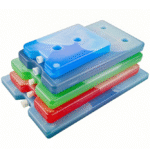
Geometry matters just as much as chemistry. Flat inserts maximize wall coverage, linked sheets wrap well around irregular contents, and rigid bricks deliver concentrated thermal mass with easier counting on the packing line. None of those formats is universally better. The right choice depends on available box space, the product layout, whether the route is chilled or frozen, and whether your operators need speed, flexibility, or strict pack-count discipline.
Conditioning is another major variable. A pack can be technically correct on paper and still fail in practice if it is under-frozen, over-frozen for the application, or staged too long at ambient before boxing. In many failed pack-outs, the problem is not the gel formula itself but inconsistent freezer conditions, unclear work instructions, or a mismatch between the pack state and the product requirement.
Quality and compliance boundaries
Blood distribution is a cold-chain discipline, not a packaging shortcut. WHO describes the blood cold chain as the system that stores and transports blood and blood products within the correct temperature range and conditions from collection to transfusion. That means a gel insert must be considered alongside the transport box, conditioning method, route profile, receiving checks, and product-specific handling instructions.
If the shipment includes samples or other biological materials, packaging rules may add leakproof primary and secondary layers, absorbents, and the required outer markings. A refrigerant insert can support the thermal objective, but it does not replace the broader packaging requirements for biological transport. Buyers should therefore ask suppliers for technical fit and quality consistency rather than assuming any medical-looking cold pack is appropriate.
Why total cost of use is a better metric than piece price
A wholesaler quote usually makes the unit pack price visible and leaves the rest hidden. But operators still pay for freezer capacity, line labor, product-space displacement, extra corrugated volume, damaged labels, returns, and customer-service issues caused by poor presentation or temperature drift. That is why a slightly more expensive cold pack can still lower overall cost if it fits the carton better or reduces handling problems.
For the same reason, buyers should compare pack families with the insulated system they intend to use. The best-performing or most sustainable cold source on paper may not be the most economical once carton size, freight cost, and receiving conditions are added to the equation. Good distributors help teams see that broader picture.
Which format usually makes the most sense?
Buyers usually get farther by comparing formats in operational terms instead of asking which refrigerant is 'best' in the abstract. The right choice depends on how the box is packed, how sensitive the product is to direct cold contact, and how standardized the route and carton design really are.
| Format | Best when | Main strength | Main caution |
|---|---|---|---|
| Flat insert | Compact medical cartons and side-wall buffering | Efficient use of space and controlled separation from the payload | Can create uneven contact if the layout is not carefully designed |
| Rigid plate or brick | Reusable transport boxes and stable layouts | Predictable placement and strong handling durability | May be too aggressive unless insulated or separated from the product |
| Conditioned PCM element | Narrower temperature-band control | Better fit when freeze protection matters as much as cooling | Usually costs more and requires tighter conditioning discipline |
A useful rule is simple: if the pack-out is highly standardized and the product can tolerate a more rigid layout, bricks and blocks become more attractive. If the product mix changes often or the carton has many irregular gaps, flatter or more flexible formats usually give you better packaging efficiency.
A practical supplier checklist
Because the query behind gel ice insert blood distributor clearly carries bulk-buying intent, supplier selection should go beyond basic price and case quantity. A practical shortlist usually comes down to the questions below.
1. The exact target temperature band for the product type you move, along with conditioning instructions that support that band rather than just 'freeze and ship'.
2. How the insert should be separated from the blood unit, pouch, or sample to avoid direct cold shock.
3. Lot traceability and labeling, because medical logistics often require tighter documentation and inventory control than food lanes.
4. Leak resistance, seal quality, and puncture behavior under repeated transport handling.
Helpful decision tools
Check the details before you choose packaging
These quick tools can help you compare route risk, sizing needs, coolant choices, and packaging details before you request a quote.
Insulation Material Drop Resistance
Review drop resistance and handling factors before choosing insulation materials.
Check resistanceDry Ice Calculator
Estimate dry ice needs for frozen or ultra-cold shipments before packing.
Estimate dry iceCompliance Checklist Generator
Build a practical checklist for packaging review, shipping, and documentation.
Build checklist5. Compatibility with the transport box, dividers, absorbents, and any monitoring devices you already use.
6. Whether the supplier can hold dimensions and fill weight tightly enough for validated pack-outs across many facilities.
7. Change-control practices. Medical routes are sensitive to silent substitutions in film, gel formula, or shell geometry.
8. Support for qualification work, including repeat samples, preconditioning guidance, and clear technical documentation.
Notice how many of those questions are really about consistency rather than headline performance. At wholesale scale, stable dimensions, repeatable fill, clear conditioning instructions, and responsive technical support often matter more than impressive but isolated cold-retention claims.
Failure points buyers should not ignore
The most common weak points are silent and procedural: inconsistent freezer temperature, under-conditioned packs, changed film or fill without notice, poor product-to-pack separation, and pack-outs that were never revised for seasonal extremes. Those issues are often misdiagnosed as a general cold-pack failure when the real problem is process control.
Another failure point is documentation mismatch. Procurement may approve a pack based on weight and rough dimensions, while operations really need detailed conditioning instructions, tolerance control, receiving checks, and clarity on where the pack should sit in the carton. A supplier that cannot support those details is harder to scale, even if the sample looked acceptable.
A practical way to review the pack-out before scaling
Imagine a normal shipment in blood transport: the product is packed at its intended starting temperature, the refrigerant is conditioned according to instructions, the insulated components are assembled on the line, and the box then sits through real carrier handoffs before final receipt. That simple scenario is more useful than an abstract cold-retention claim because it reveals whether the pack fits the carton cleanly, whether operators can place it consistently, and whether the payload is protected where it is most vulnerable.
Before full rollout, buyers should test more than one realistic condition. Look at a warm-day lane, a routine lane, and any route with an unusual handoff or receiving delay. A wholesaler that supports this kind of practical review usually adds far more value than one that only quotes the next lower case price.
FAQ
Can a gel insert be used without a qualified transport box?
It should not be treated that way. The insert only works as intended when paired with an appropriate container, conditioning method, and route-specific pack-out.
How do teams avoid freezing blood products?
By controlling pack temperature, using separation layers where needed, and validating the pack-out against the actual route rather than guessing from pack weight alone.
Do diagnostic blood samples need different packaging rules?
Often yes. Depending on classification, sample shipments may need leakproof primary and secondary packaging, absorbents, and the required outer markings.
Final takeaway
For most buyers, the winning choice is not the coldest pack or the thickest brick. It is the refrigerant format that gives the right temperature behavior, the cleanest handling, and the most dependable supply for the lanes you actually run. That is what turns a cold pack purchase into a stable operating standard.
About Tempk
At Tempk, we have focused on temperature-control products since 2011. Our range includes gel ice packs, insulated bags, insulation boxes, and other temperature-controlled packaging for food, pharmaceutical, and other sensitive shipments. We also support custom packaging solutions and publish quality-oriented information around insulation performance, phase-change behavior, and product testing. For teams evaluating temperature-controlled packaging for medical and pharmaceutical transport, we can help connect the cold source choice with the shipper design, route profile, and handling model.
Next step
If you are reviewing a current lane or planning a new one, ask for guidance based on the required temperature band, transit time, and pack format. For bulk or custom projects, it helps to compare the refrigerant and the insulated shipper together.
What a strong wholesaler or distributor should add
The best suppliers do more than deliver cases of cold packs. They help clarify which format fits which lane, provide documentation that operations can actually use, and keep sample-to-production consistency under control. That matters because temperature problems are often caused by ambiguous instructions and silent product variation rather than by the concept of the refrigerant itself.
At scale, procurement also depends on service basics: inventory reliability, replacement speed, technical response time, and the ability to support seasonal revisions. Those are not glamorous purchase criteria, but they often determine whether a packaging program stays stable over time.