How to Choose Insulated Grocery Bag Logo for Real Routes, Payloads, and Brand Use
The best way to choose insulated grocery bag logo is to define the real route before you define the bag. The product must fit branded grocery shopping, frozen aisle support, pickup counters, and retail campaigns, but it also has to match the payload, user behavior, cleaning method, climate, branding, and production scale. A passive insulated bag can reduce temperature change; it does not automatically refrigerate goods or prove compliance. This final guide brings the key buyer, material, operational, and sustainability questions into one practical workflow for grocery chains, private-label retail teams, food brands, and promotional buyers.
Define the promise before choosing the construction
For logo insulated grocery bags, the first question is what the bag is supposed to promise. Is it a branded customer carrier? A short-distance delivery tool? A promotional pouch? A parcel mailer? A distributor item? A support component in a cold-chain process? Each answer creates a different risk level. The bag may only need to protect perceived freshness and brand image, or it may need to support a documented temperature process. Mixing these promises creates confusion.
Use plain language in the specification. Write that the bag is passive, insulated, reusable or single-use as applicable, and designed for a defined handling condition. If coolants are required, specify them as part of the packout. If the product is food, pharmacy, laboratory, or healthcare related, ask quality and logistics teams to confirm requirements. Clear wording prevents the bag from being sold internally as more capable than the evidence supports.
Build the specification around the route
A route-first specification starts with the product and the journey. For insulated grocery bag logo, note the starting temperature of the goods, estimated handling time, number of openings, staging location, vehicle type, handover point, and receiver behavior. For global, include realistic exposure such as heavy groceries, chilled items next to dry goods, customer reuse, car trunk exposure, and folded storage. If the bag will be reused, include the cleaning and drying process. If it will be exported, include carton storage and inspection requirements.
This route description should be short enough to use in supplier communication. A good supplier can use it to suggest bag shape, liner type, closure, insulation layer, and carton packing. A vague request invites generic samples. A route-based request helps the buyer see why one sample costs more, why another packs smaller, and why a third may be inappropriate even if it looks attractive.
| Specification point | Good buyer wording | Avoid assuming |
|---|---|---|
| Function | Passive insulated bag for a defined route or carrying task | That the bag actively cools or qualifies every shipment. |
| Payload | Actual product dimensions, weight, and packing shape | That outside bag size equals usable internal space. |
| Temperature concern | Target handling condition and whether coolant is used | That insulation alone creates a required temperature range. |
| Branding | Artwork method, color tolerance, logo position, and sample approval | That any logo method works on any fabric or shape. |
| Production | Approved sample, material lock, inspection checklist, and substitution control | That mass production will match a prototype automatically. |
This table is designed for procurement meetings. It turns common assumptions into checkable language. When teams use this wording, the supplier quote becomes easier to compare and the final product is less likely to disappoint operations.
Match materials to daily handling, not catalog appeal
The right material set for insulated grocery bag logo depends on the users and the environment. A premium canvas outer shell may support a retail or outdoor brand, but it still needs a cleanable liner and a strong base. A foil liner can look technical, but if the seam is weak it may stain or leak. A thin mailer may be efficient for parcel shipping, but it may not suit heavy grocery loads. A backpack may solve rider ergonomics, but it adds strap, sweat, cleaning, and storage questions.
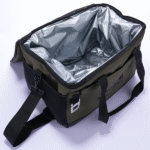
Look for balance. The outer shell should handle abrasion and branding. The insulation should be consistent and not overly compressed at corners. The liner should suit moisture, odor, and cleaning requirements. The closure should match opening frequency. The handle or strap system should carry the real load. A good sample review touches, loads, opens, cleans, folds, and packs the bag rather than judging it on a desk.
Supplier evidence that actually helps
Helpful evidence does not always need to be complicated, but it should match the claim. For a simple branded shopping or promotional bag, an approved sample, material description, artwork proof, and inspection checklist may be enough. For a delivery or grocery operation, cleaning guidance, liner checks, and packout instructions may be needed. For temperature-sensitive healthcare or pharmaceutical use, quality teams may expect documented testing, logger data, and route-specific review.
For a logo bag that earns attention but cannot carry real groceries without sagging or leaking, ask for proof in the right form. If the supplier mentions a hold time, ask what payload, starting temperature, ambient profile, coolant, and acceptance criteria were used. If the supplier mentions compliance, ask which product, market, standard, and document support the statement. If the supplier mentions sustainability, ask whether the claim refers to material, reuse, recyclability, reduced waste, or a complete product life cycle. Precise questions protect both buyer and supplier.
From sample to bulk order
Bulk procurement for insulated grocery bag logo should not move directly from a promising sample to a purchase order. Approve a functional sample first. Then approve a decorated sample if branding matters. Confirm whether the sample was made using production materials and production methods. Ask what tolerances apply to size, color, stitching, liner appearance, and logo position. Confirm carton quantity and carton weight because packing affects freight, storage, and damage risk.
Before production, create a short inspection list. It can include dimensions, liner finish, odor, stains, zipper movement, handle reinforcement, seam quality, logo accuracy, carton count, and packaging condition. Keep this list practical. A buyer does not need an elaborate laboratory process for every order, but repeatable checks are essential when the product will be used by many stores, riders, distributors, or customers.
Helpful decision tools
Check the details before you choose packaging
These quick tools can help you compare route risk, sizing needs, coolant choices, and packaging details before you request a quote.
Packaging Selector
Compare insulated packaging options by product, route, and temperature need.
Find packagingInsulation Material Reference
Compare insulation material choices for different cold chain packaging needs.
Compare materialsDry Ice Calculator
Estimate dry ice needs for frozen or ultra-cold shipments before packing.
Estimate dry icePractical example: choosing the better sample
A team sourcing insulated grocery bag logo receives three samples. The first is the lowest price and packs tightly, but the liner smells strong and the handle stitching looks uneven. The second has a premium outer material and a large logo, but the closure is slow for staff to use. The third is not the thickest, but it fits the payload, closes cleanly, wipes down easily, and its logo remains clear after filling. If the route is branded grocery shopping, frozen aisle support, pickup counters, and retail campaigns, the third sample may be the best operational choice even if it is not the most dramatic product in the meeting.
Sustainability and cost should be reviewed together
A lower unit price is not always the lower operating cost. If handles fail, liners stain, cartons collapse, or the product is too large for the payload, the program pays in replacements, complaints, freight, and waste. Sustainability has the same logic. A reusable product only helps if it is easy to reuse. A recyclable claim only helps if the material system and local recovery path support it. A right-sized, durable, cleanable bag with realistic use instructions may create better value than a more impressive but poorly matched design.
For grocery chains, private-label retail teams, food brands, and promotional buyers, cost review should include sample rounds, artwork setup, carton efficiency, warehouse storage, inspection time, expected reuse, replacement policy, and whether a different packaging format would reduce risk. Sometimes a simple insulated bag is enough. Sometimes a rigid box, insulated liner, pallet cover, or qualified shipper is the better choice. The goal is not to buy the most advanced product. The goal is to buy the most appropriate system.
FAQ
What is the first step when sourcing insulated grocery bag logo?
Write a route and use-case brief before requesting prices. Include the product type, payload, handling time, number of openings, cleaning method, logo needs, carton requirements, and any temperature or documentation concern. This helps suppliers quote the right design and prevents the buying team from comparing samples that solve different problems.
How do I know whether a soft bag is enough?
A soft insulated bag may be enough for short, lower-risk carrying when the product starts at the right temperature and users follow the process. It may not be enough for long, regulated, high-value, or uncertain routes. When risk is higher, review coolant, packout, monitoring, and qualification needs with your quality or logistics team.
What makes a logo program fail?
Logo programs fail when artwork is approved without testing the product as used. Curved surfaces, textured fabric, folding lines, dark colors, heat, cleaning, and carton compression can affect appearance. Request a decorated sample and check the logo after filling, folding, wiping, and packing. Brand quality depends on the whole product, not only the artwork file.
Should a buyer ask for standards or certificates?
Ask for documents that match the claim. Material documents, inspection records, sample approvals, and test reports can all be useful. For food, healthcare, or pharmaceutical use, requirements vary by product, market, and route. Standards should not be used as decoration in a proposal. They should support a specific packaging function and be reviewed by the appropriate team.
Conclusion
Choosing insulated grocery bag logo is a practical route-design exercise. Define what the bag must promise, match materials to real handling, ask for evidence that supports the claim, approve samples carefully, and control the move from prototype to bulk production. If the contents are temperature-sensitive, do not treat insulation as a substitute for a complete cold-chain process. With clear specifications, grocery chains, private-label retail teams, food brands, and promotional buyers can order a product that supports the brand and the operation at the same time.
About Tempk
Tempk helps buyers evaluate insulated bags, thermal bags, gel packs, ice bricks, EPP boxes, box liners, and other cold-chain packaging components. For insulated grocery bag logo, we can help translate a route, payload, and branding plan into a clearer sample request and production discussion. We focus on fit, limits, and repeatability so buyers can avoid overpromising and reduce avoidable sample revisions.
CTA
Share your route, payload, order scale, and logo requirements with Tempk. We can help you compare insulated grocery bag logo options and decide what should be tested before production.
Operational note before approval
Before approving insulated grocery bag logo, write down how the bag will actually move through the operation. A design used by a supermarket shopper has different stress points from a bag used by a courier, a pharmacy counter, or a distributor rep. The route may include staging, loading, waiting, handover, and return storage. Each step changes what the bag must tolerate. This is why a useful specification should cover payload, closure behavior, cleaning method, branding method, carton packing, and the evidence you expect from the supplier. Without that written baseline, teams often compare samples by touch and appearance rather than by how they will perform in daily work.
Receiving and inspection details
A receiving inspection for insulated grocery bag logo should be simple enough for warehouse staff to repeat, but specific enough to catch costly variation. Check dimensions, odor, liner finish, zipper movement, handle stitching, logo alignment, carton quantity, stains, and obvious seam damage. For a thermal project, keep the approved sample and approved artwork together so buyers, quality staff, and suppliers are comparing against the same reference. If the product will be reused, ask how the liner should be cleaned and dried. If it will ship in bulk, check whether cartons protect the shape and logo during export storage.