


VIP thermal shipper for pharma shipping: the complete 2026 guide
VIP thermal shipper for pharma shipping: the complete 2026 guide

VIP thermal shipping container for pharmaceutical shipping is most useful when you treat it as a complete control system rather than a premium carton. In April 2026, the best-performing cold-chain teams use VIP insulation because it can create meaningful thermal margin in a compact format, but they only approve a design after it proves itself against product stability, route variability, operator behavior, and receiving reality. That is the standard you should use as well.
This guide fuses buyer logic, engineering detail, and current market direction so you can decide when this packaging approach is worth it, how to qualify it, what evidence to request, and where reuse, returnability, recyclability, and digital visibility change the economics. The goal is simple: help you reduce product risk without paying for complexity that your lane does not need.
What this guide will help you answer
- How to decide whether VIP thermal shipping container for pharmaceutical shipping is the right packaging strategy for your lane
- How to engineer a qualified packout using real stability limits and route data
- Which records, standards, and logger evidence you should require before approval
- How to lower total landed cost while preserving product protection
- What current trends in traceability, reuse, and recyclability mean for your next packaging decision
What makes VIP thermal shipper for pharma shipping the right fit for your lane?
The right reason to choose VIP thermal shipping container for pharmaceutical shipping is not that it sounds advanced. The right reason is that your shipment needs more controllable thermal margin than ordinary insulation can provide, and you want that margin in a format your operators can actually pack, ship, receive, and review consistently. When those conditions are true, a VIP-based design can protect commercial pharmaceuticals, clinical supplies, vaccines, biologics, and specialty drugs with better resilience and less wasted space than many generic alternatives.
The wrong reason is simple branding logic. Premium insulation does not rescue a weak route map, vague work instructions, or poor receiving discipline. The shipper has to fit the product, the lane, the packaging form factor, and the quality process at the same time. This format is a passive thermal shipper engineered to buffer external heat or cold for longer, more variable lanes. It usually wins when you need useful autonomy, broad route flexibility, and room for reusable or modular components. The main trade-off is that benefits disappear if lane data, coolant design, and reset procedures are weak. In practice, it fits best for premium lanes where passive performance must survive real-world variability. Your first task is therefore to judge fit, not to assume superiority.
Product category changes the decision logic. Fresh produce cares about appearance and shelf life. Regulated healthcare cares about labeled temperature control and documented review. Reagents and biotech materials care about activity retention, chain of custody, and rapid receiving decisions. Reusable and returnable programs care about inspection, recovery, and total trips per asset. The best packaging choice reflects those priorities clearly.
Quick fit scorecard
Use the scorecard below to decide whether you truly need premium passive protection, what level of evidence you should require, and whether lifecycle features such as reuse or recyclability are likely to help your operation.
Scorecard for deciding whether the packaging strategy fits
| <strong>Decision lens</strong> | <strong>What strong fit looks like</strong> | <strong>What good teams do next</strong> | <strong>Why it matters to you</strong> |
| Product risk | The shipment contains high-value or quality-sensitive product | Use premium passive protection only where failure consequences justify it | You spend more where it matters and less where it does not |
| Lane severity | The route includes hand-offs, delay risk, or seasonal extremes | Qualify by real route family, not by average transit time | You buy performance that matches reality |
| Operational fit | Operators can assemble and receivers can interpret the shipment consistently | Simplify packout, labels, and logger review rules | You reduce avoidable human error |
| Evidence quality | The supplier can show thermal, process, and change-control records | Approve the system, not just the materials | You protect audits, deviations, and scaling |
| Lifecycle logic | Reuse, return, or recycling can be executed in normal operations | Model cost per trip and end-of-use before launch | You improve economics and sustainability together |
Practical actions before you request a quote
- Approve the packout against the product label, stability data, and a realistic lane profile rather than against a brochure claim.
- Treat logger placement as part of qualification. A poorly placed logger can hide freezing or exaggerate warm exposure.
- Train operators on conditioning, assembly order, and release rules, then lock the configuration under change control.
A pharmaceutical exporter moved from ad hoc packouts to one controlled family of VIP thermal shipping containers for defined lane tiers. Training became easier, release decisions were faster, and seasonal changes no longer forced last-minute packaging improvisation.
How do you engineer temperature protection that survives the real lane?
Engineering a shipment that survives the lane starts with a disciplined thermal model. Define the allowed product range, the realistic delay profile, the payload mass, the weak points inside the pack, and the exact condition of the coolant at assembly. Then design the cavity so the product sits in a controlled thermal zone rather than in direct contact with the hottest or coldest surfaces. That is where real performance comes from.
The insulation layer is only one part of the answer. Recent literature still places healthy VIP conductivity in the super-insulation range, roughly around 0.003 to 0.006 W/m·K, but panel performance can drift if barrier films are damaged or if edges are not protected. In field conditions, your result is governed by the combination of panel health, coolant layout, void space, operator consistency, and receiving speed.
For most non-food cold chains, the design objective is repeatable control. That means the packout should work in ordinary hands under ordinary time pressure. A slightly less aggressive design that is easier to execute can outperform a laboratory-optimized design that operators assemble inconsistently.
How should coolant, payload spacing, and hold time be sized?
Size them against the true worst-case route, not a convenient average. Keep the payload in the most stable internal zone, control direct contact with cold sources, and use seasonal logic when the route changes materially across the year. If your lane is highly variable, add margin through design rather than through last-minute improvisation.
What compliance evidence should you require before approving VIP thermal shipper for pharma shipping?
Before approving VIP thermal shipping container for pharmaceutical shipping, require evidence in three layers. First, require thermal evidence: test results or qualification summaries that resemble your lane and payload. Second, require process evidence: packout drawings, work instructions, coolant conditioning rules, and logger placement logic. Third, require governance evidence: change control, component traceability, and a clear rule for how live results are reviewed and dispositioned.
For regulated pharmaceutical work, those layers should align with storage and distribution expectations under 21 CFR Part 211, the route discipline expected under GDP, and air-freight temperature-control rules under IATA TCR where relevant. DSCSA’s push toward electronic tracing has also raised the value of packaging systems that create cleaner package-level evidence. Compliance is no longer just about a stable temperature. It is also about traceable execution.
Standards help give that evidence structure. ISTA now points buyers toward Standard 7E as the newer thermal transport framework for insulated shippers. WHO continues to emphasize temperature monitoring devices for international health-product shipping. GS1 sensor-event standards now make it easier to connect package condition with shipment history. None of these references replaces your product-specific logic, but together they raise the quality of the conversation.
Which records separate qualified suppliers from hopeful ones?
Qualified suppliers can show what was tested, how it was packed, which components were used, what happens when those components change, and how receiving teams should review results. Hopeful suppliers usually return to generic hold-time language and vague marketing claims once you ask about change control or live-lane assumptions.
How do you reduce total cost without increasing deviation risk?
The fastest way to lower cost without raising risk is to remove wasteful mismatch. Oversized packs waste freight cube. Excess coolant adds weight and can increase freezing risk. Too many custom variants create training burden. Too few variants can push weak packouts onto difficult lanes. The commercial sweet spot is a small family of qualified solutions sized to real route families.
Use total landed cost rather than purchase price. Count product loss, deviation labor, customer complaints, reverse logistics, and operator time. When you do that, a better shipper often pays for itself not by being cheaper to buy, but by being cheaper to operate and easier to defend. That logic matters especially when shipment failures trigger regulatory review or service breakdown.
For most other cold-chain categories, the right balance is to right-size first, then decide whether reuse or improved recyclability adds value on top. EU policy pressure toward more recyclable and reusable packaging is real, but the best business result still comes from choosing a model that operations can execute without confusion.
When do reusable, returnable, or recyclable models win?
They win when the operating model supports them. Reuse needs predictable turns and inspections. Returnable assets need visibility and strong recovery. Recyclable designs need easy separation and clear instructions. Pick the lifecycle strategy that reduces waste without creating new quality or logistics problems.
What 2026 trends should shape your next VIP thermal shipper for pharma shipping decision?
Several 2026 trends should shape your next decision. Digital traceability is expanding, which means packaging needs to work with event data and not just with temperature chambers. Sensor support in GS1 EPCIS makes it easier to align location, delay, and temperature information. FDA’s recent DSCSA guidance reinforces the value of package-level electronic information in eligible drug distribution. At the same time, WHO and IATA continue to keep temperature monitoring and disciplined air-cargo handling in focus.
Standards and policy are also pulling cold-chain packaging toward more transparent lifecycle choices. The EU Packaging and Packaging Waste Regulation entered into force in 2025 and generally applies from August 2026, which raises the pressure for transport packaging that is more recyclable, more reusable, or at least easier to explain. Buyers increasingly ask not only whether the shipper works, but also how it will be returned, repaired, or separated at end of use.
The main market insight is that packaging is becoming more accountable. Buyers want fewer claims and more evidence, fewer variants and better training, stronger protection and less waste. The cold-chain solutions that will stand out are the ones that make those trade-offs easier, not harder.
Latest developments at a glance
- Route-specific qualification is replacing generic performance claims.
- Digital visibility is moving from simple logging toward connected event interpretation.
- Policy pressure is raising the value of recyclable, reusable, and easier-to-explain packaging systems.
- Training simplicity is becoming a major competitive advantage in cold-chain execution.
- Package-level traceability expectations are making clean documentation more valuable at the packaging level.
Frequently asked questions
How do I know whether VIP thermal shipping container for pharmaceutical shipping is the right fit for my shipment?
Check product consequence, route severity, operator capability, and the evidence your quality team will require. If failure is expensive and the route is variable, premium passive protection often makes sense. If the route is easy, simpler packaging may be sufficient.
What should I ask a supplier before approving a packout?
Ask for the qualification summary, packout drawing, coolant conditioning instructions, logger plan, component specification, and change-control policy. If the design is reusable, also ask for inspection and retirement criteria.
How many packaging variants should a network usually keep?
As few as practical, but enough to match clearly different lane families. Too many variants create training problems. Too few force poor route fit. A small controlled family of approved packouts is usually the strongest model.
Is the newest standard or sensor technology enough to guarantee performance?
No. Standards and sensors improve structure and visibility, but they do not replace route-specific design, disciplined assembly, or clear receiving rules. Strong execution still decides field success.
What is the biggest hidden reason cold-chain packages fail?
In many programs, the hidden reason is operator variation rather than raw insulation weakness. The packout may look strong in the lab but fail in the field because assembly, staging, or receipt behavior changes the thermal reality.
How should I think about reuse or recyclability for this packaging approach?
Treat lifecycle choice as an operating-model decision. Reuse needs recovery and inspection discipline. Recyclability needs simple material separation and clear instructions. Choose the model your network can actually support.
Summary and recommendations
The best way to evaluate VIP thermal shipping container for pharmaceutical shipping is to ask one question: does it make your real shipment easier to protect, easier to operate, and easier to defend? When the answer is yes, VIP packaging can deliver strong value by adding thermal margin, improving evidence, and supporting smarter lifecycle choices. When the answer is no, premium insulation may only add cost.
Start with a lane-specific qualification plan, request evidence that matches your product and route, and build a small family of controlled packouts that your operators can execute consistently. Then choose reuse, returnability, or recyclability based on what your network can genuinely support. That is how you get the strongest result from cold-chain packaging in 2026.
About Tempk
At Tempk, we build cold-chain packaging around real operating conditions rather than generic catalog claims. Our focus is to combine strong thermal engineering with clear packout discipline, practical qualification support, and packaging options that are easier to deploy in daily operations. We work with teams that need dependable control for regulated, fragile, or high-value shipments without unnecessary complexity.
Talk with our team if you want help comparing routes, packout concepts, or reusable versus single-use options for your next cold-chain program.
VIP Thermal Shipping Box for Ultra-Cold Chain: The 2026 Practical Guide

VIP thermal shipping box for ultra-cold chain is the right choice when you need a passive shipper that combines high insulation, practical packout control, and documentation-friendly performance. In 2026, that combination matters more than ever. Cold-chain networks are moving more biologics, diagnostics, and specialty products through smaller parcels, more outsourced routes, and more final-mile handoffs. Buyers therefore need packaging that protects the product and simplifies decision making at the same time.
A strong VIP-based design can do exactly that. Fresh vacuum insulated panels can deliver thermal conductivity in the low 0.002 to 0.004 W/m-K range, while many common foams are roughly an order of magnitude higher. That insulation density can translate into smaller outer dimensions, better payload space, and more controlled thermal performance when the route is demanding. But the best result comes only when insulation, coolant, payload configuration, monitoring, and route qualification are treated as one system. That is the mindset behind this optimized guide.
This guide will help you answer
- Why VIP Thermal Box for Ultra-Cold Chain matters in ultra-cold chain and when it clearly outperforms simpler formats
- How VIP insulation, refrigerant choice, and payload mass work together
- How to choose the right hold time, load range, and logger strategy
- Which standards and quality rules matter most for qualification and scale-up
- What 2026 trends in market growth, sustainability, and digital monitoring mean for your purchase
Why does VIP Thermal Shipping Box for Ultra-Cold Chain matter to your shipment?
The purpose of the package is not to look advanced. It is to protect the product zone through the real shipment journey. In ultra-cold chain, the shipment may encounter ambient swings, handling abuse, waiting time, or receiving delays. ultra-cold lanes are unforgiving when customs delays, re-icing gaps, or poor ventilation plans occur; dry ice management, worker safety, and dangerous-goods labeling add operational complexity; and a package that performs in lab testing still needs practical re-icing and receiving-site discipline. A package that manages those stresses well protects product quality, reduces waste, and shortens the time quality teams spend explaining avoidable deviations.
This is why buyers increasingly choose VIP Thermal Box for Ultra-Cold Chain when the route becomes more critical. They are often looking for VIP insulation can reduce heat gain and help extend ULT passive hold time, better cube efficiency than bulky conventional foam in many designs, and stronger protection for high-value frozen biologics and vaccines when combined with the right coolant. Those gains can improve both technical performance and business performance. Less outer cube can help freight efficiency. More payload room can help shipping economics. Better thermal control can reduce the chance that one delayed shipment becomes a product complaint or a write-off.
How does VIP Thermal Shipping Box for Ultra-Cold Chain work, and when does it beat conventional foam?
The core advantage is thermal efficiency per unit of wall thickness. Fresh vacuum insulated panels can deliver thermal conductivity in the low 0.002 to 0.004 W/m-K range, while many common foams are roughly an order of magnitude higher. That means a VIP-based shipper can often deliver the same or better protection in a smaller geometry than a basic foam design. The practical outcome is not just better insulation on paper. It is more freedom to design a package that fits real parcel, courier, or depot workflows without becoming oversized and awkward to use.
Even so, VIP does not eliminate the need for good design. Performance still depends on panel protection, seam management, lid closure, coolant placement, and the thermal mass of the payload. Buyers should therefore compare complete systems, not only insulation materials. Ask how the package behaves when partly full, when the route is delayed, when ambient conditions change, and when the box is opened at the receiving site. Those are the moments that separate a credible packaging system from a simple specification sheet.
A practical comparison table for VIP Thermal Box for Ultra-Cold Chain
| <strong>Decision point</strong> | <strong>What to check</strong> | <strong>Good answer</strong> | <strong>Why it matters</strong> |
| Temperature target | label range and stability limit | qualified around the real product zone | wrong target means the best insulation still fails |
| Route profile | ambient exposure, delay risk, and handoffs | summer and winter logic defined | route reality drives hold-time need |
| Payload size | minimum and maximum thermal mass | qualified for both small and full loads | payload changes package behavior |
| Monitoring plan | logger type and location | calibrated device in the product zone | data becomes useful during release and CAPA |
How should you select hold time, payload size, and coolant for VIP Thermal Shipping Box for Ultra-Cold Chain?
Begin with the labeled product range. Then define the real shipment profile: normal transit time, likely delay time, minimum payload, maximum payload, and destination readiness. A package should be qualified for the conditions you will actually face, not just for an ideal shipping window. WHO guidance is explicit on this point: WHO Annex 9 says insulated passive containers should be qualified with full assembly details, thermal conditioning rules, and minimum and maximum shipping volume, weight, and thermal mass. That is a reminder that route profile and payload range belong inside the package decision from the beginning.
Coolant selection comes next. Dry ice can be good for simpler chilled lanes, special ULT PCM are usually stronger when you need a defined temperature plateau, and powered ULT systems only makes sense when the product truly needs that deeper level of cold. Good engineering avoids overcooling just as carefully as overheating. The best packout maintains the product zone predictably instead of simply creating the coldest internal environment possible.
| <strong>Coolant</strong> | <strong>Where it fits</strong> | <strong>Main watch-out</strong> | <strong>What it means for you</strong> |
| dry ice | most common ULT passive shipments | strong cooling and wide availability, but requires venting and replenishment planning | Choose only when product really needs deeper freezing |
| special ULT PCM | niche validated systems | cleaner handling and reusable options, but needs ULT pre-freezing | Choose tighter control |
| powered ULT systems | critical high-value lanes | less dependence on coolant, but much higher cost and complexity | Choose only when product really needs deeper freezing |
How do you qualify VIP Thermal Shipping Box for Ultra-Cold Chain for compliant, repeatable shipping?
Qualification should be treated as a system exercise. EU GDP says temperature conditions must be maintained within acceptable limits during transport, the route should be risk assessed, and transport monitoring equipment should be maintained and calibrated at regular intervals at least once a year. EU GDP also expects initial temperature mapping before use and placement of monitors where the greatest fluctuations occur. WHO also says transport routes should be profiled and qualified against the anticipated ambient conditions over the journey. Together, those expectations tell you what regulators and quality teams care about: correct temperature, documented route thinking, monitored evidence, and clear response if an excursion occurs. A good package helps because it supports all those needs with a repeatable assembly process and a defensible monitoring plan.
In practical terms, the qualification package should define preload conditions, assembly sequence, coolant conditioning, payload range, logger location, route assumptions, acceptance criteria, and seasonal variants if they exist. It should also be easy for operators to follow. Many packaging failures are not caused by bad materials. They are caused by small but repeatable errors in assembly, such as wrong coolant conditioning, the wrong payload fill, or a logger pushed into the wrong position. A controlled SOP is therefore part of package performance.
A repeatable qualification workflow
- Lock the product-zone target and the acceptable excursion logic.
- Profile or simulate the route, including delays and seasonal exposure.
- Test minimum and maximum loads with the real payload packaging format.
- Fix coolant conditioning, assembly order, and logger placement in writing.
- Review results against the product zone and investigate any edge-zone anomalies.
- Requalify after major changes in route, payload, component, or supplier.
What does the ideal packout look like for ultra-cold chain?
The ideal packout is not the most elaborate one. It is the one that operators can build correctly every time and that recipients can understand immediately. In ultra-cold chain, that usually means the package clearly separates the product zone from the coolant, protects the most temperature-sensitive items from direct contact with extreme cold, reserves a defined space for the logger, and includes simple handling instructions for the receiving side. If a package is hard to build, hard to inspect, or hard to receive, it becomes harder to trust at scale.
A good packout also reflects the specific application. In ultra-cold chain work, insulation quality and coolant strategy are inseparable. A VIP thermal shipping box is valuable because it slows heat gain, but your real success depends on dry ice management, receiving speed, and whether the shipper was qualified for your exact volume, opening pattern, and route profile. That application lens matters because the same package architecture is not ideal for every lane. A direct-to-patient box, a GDP wholesale shipper, a diagnostic kit shipper, and a cryogenic transport system all need different trade-offs. The best suppliers will talk through those trade-offs openly and show why a certain configuration fits your use case instead of pushing one generic design for everything.
| <em>Applied example: A frozen-biologics team replaced an oversized foam design with a qualified VIP thermal shipper that used a repeatable dry-ice loading pattern and logger placement rule. The new process improved packout consistency, reduced shipping cube, and gave the receiving site a clearer re-icing routine.</em> |
What do 2026 market, sustainability, and monitoring trends mean for VIP Thermal Shipping Box for Ultra-Cold Chain?
The broader market continues to support higher-performance cold-chain packaging. Public market research in 2025 and 2026 continues to show strong growth in pharmaceutical cold chain packaging as biologics, vaccines, and specialty medicines expand. The broader temperature-controlled packaging sector is also expanding, helped by direct-to-patient delivery, healthcare e-commerce, and sustainability pressure. That growth is being shaped by more complex therapies, greater reliance on small shipments, and stronger expectations for documented performance. Buyers increasingly want packaging that can stand up to both operational stress and quality review. In this environment, higher insulation is valuable because it creates flexibility without immediately forcing a move to active systems.
Sustainability is adding another layer to the decision. The EU Packaging and Packaging Waste Regulation entered into force on 11 February 2025, generally applies from 12 August 2026, and pushes the market toward recyclability and circular design. A strong VIP package can contribute because it often reduces freight cube and can support durable reuse models. But the 2026 standard is higher than a recycled-content claim. Buyers now ask how the packaging will be recovered, cleaned, inspected, and eventually recycled or refurbished. Digital monitoring is also becoming more central. A package that makes logger use easy and consistent can reduce investigation time and improve release confidence.
2026 trend snapshot
- Wider use of special ULT PCM and dry-ice thermal shippers.
- Greater demand for receiving-site re-icing capability.
- Continued investment in compact passive ULT devices for field use.
Frequently asked questions
How long can a VIP thermal shipping box hold temperature in ultra-cold chain?
It depends on the qualified design, the coolant, the payload thermal mass, and the actual route profile. Treat hold time as a validated system result, not a catalog headline. For regulated lanes, qualify summer and winter packouts separately and define minimum and maximum payload sizes before commercial use.
Is VIP Thermal Box for Ultra-Cold Chain better than a conventional foam shipper?
For many lanes, yes-especially when you need strong thermal performance in a smaller footprint. Fresh vacuum insulated panels can deliver thermal conductivity in the low 0.002 to 0.004 W/m-K range, while many common foams are roughly an order of magnitude higher. The practical benefit is that you can often gain payload room, reduce refrigerant, or extend hold time. But the advantage only counts if the complete packout is qualified for your shipment.
When should you use PCM instead of dry ice with VIP Thermal Box for Ultra-Cold Chain?
Use PCM when you need a defined target range such as 2 to 8°C or controlled room temperature and want steadier product-zone conditions. Use dry ice only when the product stability profile truly calls for deep-frozen or ultra-cold transport. For freeze-sensitive payloads, PCM is usually the safer and more precise choice.
Do you need a data logger in every ultra-cold chain shipment?
Not every lane has the same risk, but monitored shipments are strongly recommended whenever the payload is high value, the route is new, or compliance evidence matters. CDC recommends digital data loggers for vaccine storage and handling, set to record at least every 30 minutes. For GDP and validation work, a calibrated logger turns a package from a promise into documented proof.
Can VIP Thermal Box for Ultra-Cold Chain be reused?
Often yes, if the design is built for repeat trips and you can control inspection, cleaning, refurbishment, and return logistics. WHO guidance also expects reusable shipping containers to be cleaned and records maintained. Reuse is only a real advantage when the operating process is as disciplined as the packaging design.
How do you qualify VIP Thermal Box for Ultra-Cold Chain before launch?
Start with the product’s allowed temperature range and stability limits. Then qualify the packout against the real route, ambient profile, minimum and maximum payload, and likely handling pattern. WHO Annex 9 says insulated passive containers should be qualified with full assembly details, thermal conditioning rules, and minimum and maximum shipping volume, weight, and thermal mass. Finally, lock the winning configuration into a written SOP so operators build it the same way every time.
Summary and recommendation
The strongest reason to choose VIP Thermal Box for Ultra-Cold Chain is that it can deliver concentrated thermal performance in a package format that still supports operational simplicity. That matters because modern cold-chain shipping is no longer defined by temperature alone. You also need lane realism, repeatable packout logic, usable monitoring data, and a package that fits your receiving workflow. When those factors align, a VIP-based system can protect product value while improving the overall shipping process.
The best next step is to compare candidate systems using your real route, your actual payload range, and your chosen logger method. Look at temperature results, operator usability, receiving-site ease, dimensional weight, and documentation quality together. The winner should not only keep the shipment safe. It should also make your cold chain easier to run, easier to scale, and easier to defend.
About Tempk
Tempk develops passive cold-chain packaging with a focus on high-efficiency insulation, practical packout design, and real-world qualification logic. We aim to connect materials, monitoring, and route reality in one clear system so customers can choose packaging with confidence instead of guesswork. That approach is especially useful when shipment value, quality requirements, and service complexity are all high.
If you want a package decision that holds up in operations and in quality review, start with the route, the product zone, and the packout discipline. Once those are clear, the right thermal packaging format becomes much easier to identify and much easier to justify.
VIP Thermal Container for Express Cold Shipping: The 2026 Practical Guide
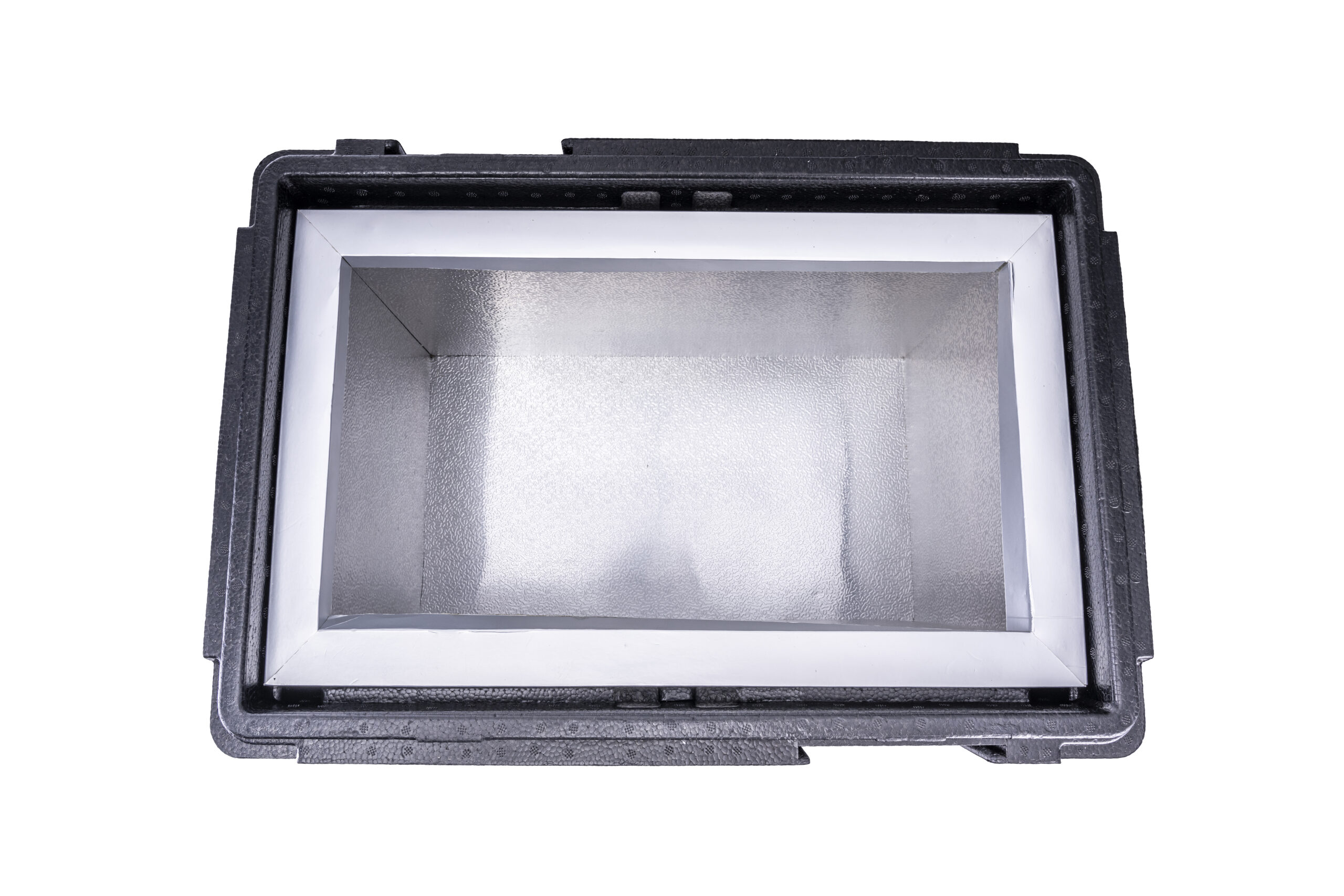
VIP thermal container for express cold shipping is the right choice when you need a passive shipper that combines high insulation, practical packout control, and documentation-friendly performance. In 2026, that combination matters more than ever. Cold-chain networks are moving more biologics, diagnostics, and specialty products through smaller parcels, more outsourced routes, and more final-mile handoffs. Buyers therefore need packaging that protects the product and simplifies decision making at the same time.
A strong VIP-based design can do exactly that. Fresh vacuum insulated panels can deliver thermal conductivity in the low 0.002 to 0.004 W/m-K range, while many common foams are roughly an order of magnitude higher. That insulation density can translate into smaller outer dimensions, better payload space, and more controlled thermal performance when the route is demanding. But the best result comes only when insulation, coolant, payload configuration, monitoring, and route qualification are treated as one system. That is the mindset behind this optimized guide.
This guide will help you answer
- Why VIP Thermal Container for Express Cold Shipping matters in express cold shipping and when it clearly outperforms simpler formats
- How VIP insulation, refrigerant choice, and payload mass work together
- How to choose the right hold time, load range, and logger strategy
- Which standards and quality rules matter most for qualification and scale-up
- What 2026 trends in market growth, sustainability, and digital monitoring mean for your purchase
Why does VIP Thermal Container for Express Cold Shipping matter to your shipment?
The purpose of the package is not to look advanced. It is to protect the product zone through the real shipment journey. In express cold shipping, the shipment may encounter ambient swings, handling abuse, waiting time, or receiving delays. sorting hubs, airport ramps, and delivery vans create sharp ambient swings in a short time; express promises can hide real-world delays such as late pickups, weather holds, and second delivery attempts; and high-value payloads often need strong protection without oversized outer cartons or heavy refrigerant loads. A package that manages those stresses well protects product quality, reduces waste, and shortens the time quality teams spend explaining avoidable deviations.
This is why buyers increasingly choose VIP Thermal Container for Express Cold Shipping when the route becomes more critical. They are often looking for a smaller shipper for the same protection target, more payload space inside a parcel-sized footprint, and better control when you need overnight or 48-hour performance with simple packout steps. Those gains can improve both technical performance and business performance. Less outer cube can help freight efficiency. More payload room can help shipping economics. Better thermal control can reduce the chance that one delayed shipment becomes a product complaint or a write-off.
How does VIP Thermal Container for Express Cold Shipping work, and when does it beat conventional foam?
The core advantage is thermal efficiency per unit of wall thickness. Fresh vacuum insulated panels can deliver thermal conductivity in the low 0.002 to 0.004 W/m-K range, while many common foams are roughly an order of magnitude higher. That means a VIP-based shipper can often deliver the same or better protection in a smaller geometry than a basic foam design. The practical outcome is not just better insulation on paper. It is more freedom to design a package that fits real parcel, courier, or depot workflows without becoming oversized and awkward to use.
Even so, VIP does not eliminate the need for good design. Performance still depends on panel protection, seam management, lid closure, coolant placement, and the thermal mass of the payload. Buyers should therefore compare complete systems, not only insulation materials. Ask how the package behaves when partly full, when the route is delayed, when ambient conditions change, and when the box is opened at the receiving site. Those are the moments that separate a credible packaging system from a simple specification sheet.
A practical comparison table for VIP Thermal Container for Express Cold Shipping
| <strong>Decision point</strong> | <strong>What to check</strong> | <strong>Good answer</strong> | <strong>Why it matters</strong> |
| Temperature target | label range and stability limit | qualified around the real product zone | wrong target means the best insulation still fails |
| Route profile | ambient exposure, delay risk, and handoffs | summer and winter logic defined | route reality drives hold-time need |
| Payload size | minimum and maximum thermal mass | qualified for both small and full loads | payload changes package behavior |
| Monitoring plan | logger type and location | calibrated device in the product zone | data becomes useful during release and CAPA |
How should you select hold time, payload size, and coolant for VIP Thermal Container for Express Cold Shipping?
Begin with the labeled product range. Then define the real shipment profile: normal transit time, likely delay time, minimum payload, maximum payload, and destination readiness. A package should be qualified for the conditions you will actually face, not just for an ideal shipping window. WHO guidance is explicit on this point: WHO Annex 9 says insulated passive containers should be qualified with full assembly details, thermal conditioning rules, and minimum and maximum shipping volume, weight, and thermal mass. That is a reminder that route profile and payload range belong inside the package decision from the beginning.
Coolant selection comes next. Gel packs can be good for simpler chilled lanes, PCM packs are usually stronger when you need a defined temperature plateau, and dry ice only makes sense when the product truly needs that deeper level of cold. Good engineering avoids overcooling just as carefully as overheating. The best packout maintains the product zone predictably instead of simply creating the coldest internal environment possible.
| <strong>Coolant</strong> | <strong>Where it fits</strong> | <strong>Main watch-out</strong> | <strong>What it means for you</strong> |
| gel packs | 2 to 8°C and short lanes | simple and low-cost, but can be bulky | Choose simplicity |
| PCM packs | tighter target ranges | better temperature plateau, but need controlled conditioning | Choose tighter control |
| dry ice | frozen or ultra-cold loads | powerful cooling, but regulated and venting-sensitive | Choose only when product really needs deeper freezing |
How do you qualify VIP Thermal Container for Express Cold Shipping for compliant, repeatable shipping?
Qualification should be treated as a system exercise. EU GDP says temperature conditions must be maintained within acceptable limits during transport, the route should be risk assessed, and transport monitoring equipment should be maintained and calibrated at regular intervals at least once a year. EU GDP also expects initial temperature mapping before use and placement of monitors where the greatest fluctuations occur. WHO also says transport routes should be profiled and qualified against the anticipated ambient conditions over the journey. Together, those expectations tell you what regulators and quality teams care about: correct temperature, documented route thinking, monitored evidence, and clear response if an excursion occurs. A good package helps because it supports all those needs with a repeatable assembly process and a defensible monitoring plan.
In practical terms, the qualification package should define preload conditions, assembly sequence, coolant conditioning, payload range, logger location, route assumptions, acceptance criteria, and seasonal variants if they exist. It should also be easy for operators to follow. Many packaging failures are not caused by bad materials. They are caused by small but repeatable errors in assembly, such as wrong coolant conditioning, the wrong payload fill, or a logger pushed into the wrong position. A controlled SOP is therefore part of package performance.
A repeatable qualification workflow
- Lock the product-zone target and the acceptable excursion logic.
- Profile or simulate the route, including delays and seasonal exposure.
- Test minimum and maximum loads with the real payload packaging format.
- Fix coolant conditioning, assembly order, and logger placement in writing.
- Review results against the product zone and investigate any edge-zone anomalies.
- Requalify after major changes in route, payload, component, or supplier.
What does the ideal packout look like for express cold shipping?
The ideal packout is not the most elaborate one. It is the one that operators can build correctly every time and that recipients can understand immediately. In express cold shipping, that usually means the package clearly separates the product zone from the coolant, protects the most temperature-sensitive items from direct contact with extreme cold, reserves a defined space for the logger, and includes simple handling instructions for the receiving side. If a package is hard to build, hard to inspect, or hard to receive, it becomes harder to trust at scale.
A good packout also reflects the specific application. In express service, the strongest design is not always the one with the thickest walls. It is the design that keeps the product safe across pickup, hub dwell, air or road transfer, and final-mile handoff without adding avoidable cube or labor. That application lens matters because the same package architecture is not ideal for every lane. A direct-to-patient box, a GDP wholesale shipper, a diagnostic kit shipper, and a cryogenic transport system all need different trade-offs. The best suppliers will talk through those trade-offs openly and show why a certain configuration fits your use case instead of pushing one generic design for everything.
| <em>Applied example: A regional biotech shifted an overnight refrigerated control-kit lane from conventional foam to a qualified VIP parcel shipper. The outer carton became easier to handle, the payload ratio improved, and summer excursion investigations dropped because the packout was standardized for the actual lane rather than the brochure hold time.</em> |
What do 2026 market, sustainability, and monitoring trends mean for VIP Thermal Container for Express Cold Shipping?
The broader market continues to support higher-performance cold-chain packaging. Public market research in 2025 and 2026 continues to show strong growth in pharmaceutical cold chain packaging as biologics, vaccines, and specialty medicines expand. The broader temperature-controlled packaging sector is also expanding, helped by direct-to-patient delivery, healthcare e-commerce, and sustainability pressure. That growth is being shaped by more complex therapies, greater reliance on small shipments, and stronger expectations for documented performance. Buyers increasingly want packaging that can stand up to both operational stress and quality review. In this environment, higher insulation is valuable because it creates flexibility without immediately forcing a move to active systems.
Sustainability is adding another layer to the decision. The EU Packaging and Packaging Waste Regulation entered into force on 11 February 2025, generally applies from 12 August 2026, and pushes the market toward recyclability and circular design. A strong VIP package can contribute because it often reduces freight cube and can support durable reuse models. But the 2026 standard is higher than a recycled-content claim. Buyers now ask how the packaging will be recovered, cleaned, inspected, and eventually recycled or refurbished. Digital monitoring is also becoming more central. A package that makes logger use easy and consistent can reduce investigation time and improve release confidence.
2026 trend snapshot
- More direct-to-patient and smaller parcel flows.
- Heavier use of ISTA 7E parcel-style thermal testing.
- Greater focus on dimensional-weight efficiency and reusable parcel shippers.
Frequently asked questions
How long can a VIP thermal container hold temperature in express cold shipping?
It depends on the qualified design, the coolant, the payload thermal mass, and the actual route profile. Treat hold time as a validated system result, not a catalog headline. For regulated lanes, qualify summer and winter packouts separately and define minimum and maximum payload sizes before commercial use.
Is VIP Thermal Container for Express Cold Shipping better than a conventional foam shipper?
For many lanes, yes-especially when you need strong thermal performance in a smaller footprint. Fresh vacuum insulated panels can deliver thermal conductivity in the low 0.002 to 0.004 W/m-K range, while many common foams are roughly an order of magnitude higher. The practical benefit is that you can often gain payload room, reduce refrigerant, or extend hold time. But the advantage only counts if the complete packout is qualified for your shipment.
When should you use PCM instead of dry ice with VIP Thermal Container for Express Cold Shipping?
Use PCM when you need a defined target range such as 2 to 8°C or controlled room temperature and want steadier product-zone conditions. Use dry ice only when the product stability profile truly calls for deep-frozen or ultra-cold transport. For freeze-sensitive payloads, PCM is usually the safer and more precise choice.
Do you need a data logger in every express cold shipping shipment?
Not every lane has the same risk, but monitored shipments are strongly recommended whenever the payload is high value, the route is new, or compliance evidence matters. CDC recommends digital data loggers for vaccine storage and handling, set to record at least every 30 minutes. For GDP and validation work, a calibrated logger turns a package from a promise into documented proof.
Can VIP Thermal Container for Express Cold Shipping be reused?
Often yes, if the design is built for repeat trips and you can control inspection, cleaning, refurbishment, and return logistics. WHO guidance also expects reusable shipping containers to be cleaned and records maintained. Reuse is only a real advantage when the operating process is as disciplined as the packaging design.
How do you qualify VIP Thermal Container for Express Cold Shipping before launch?
Start with the product’s allowed temperature range and stability limits. Then qualify the packout against the real route, ambient profile, minimum and maximum payload, and likely handling pattern. WHO Annex 9 says insulated passive containers should be qualified with full assembly details, thermal conditioning rules, and minimum and maximum shipping volume, weight, and thermal mass. Finally, lock the winning configuration into a written SOP so operators build it the same way every time.
Summary and recommendation
The strongest reason to choose VIP Thermal Container for Express Cold Shipping is that it can deliver concentrated thermal performance in a package format that still supports operational simplicity. That matters because modern cold-chain shipping is no longer defined by temperature alone. You also need lane realism, repeatable packout logic, usable monitoring data, and a package that fits your receiving workflow. When those factors align, a VIP-based system can protect product value while improving the overall shipping process.
The best next step is to compare candidate systems using your real route, your actual payload range, and your chosen logger method. Look at temperature results, operator usability, receiving-site ease, dimensional weight, and documentation quality together. The winner should not only keep the shipment safe. It should also make your cold chain easier to run, easier to scale, and easier to defend.
About Tempk
Tempk develops passive cold-chain packaging with a focus on high-efficiency insulation, practical packout design, and real-world qualification logic. We aim to connect materials, monitoring, and route reality in one clear system so customers can choose packaging with confidence instead of guesswork. That approach is especially useful when shipment value, quality requirements, and service complexity are all high.
If you want a package decision that holds up in operations and in quality review, start with the route, the product zone, and the packout discipline. Once those are clear, the right thermal packaging format becomes much easier to identify and much easier to justify.
VIP Thermal Box for Biological Samples Shipping: The 2026 Practical Guide
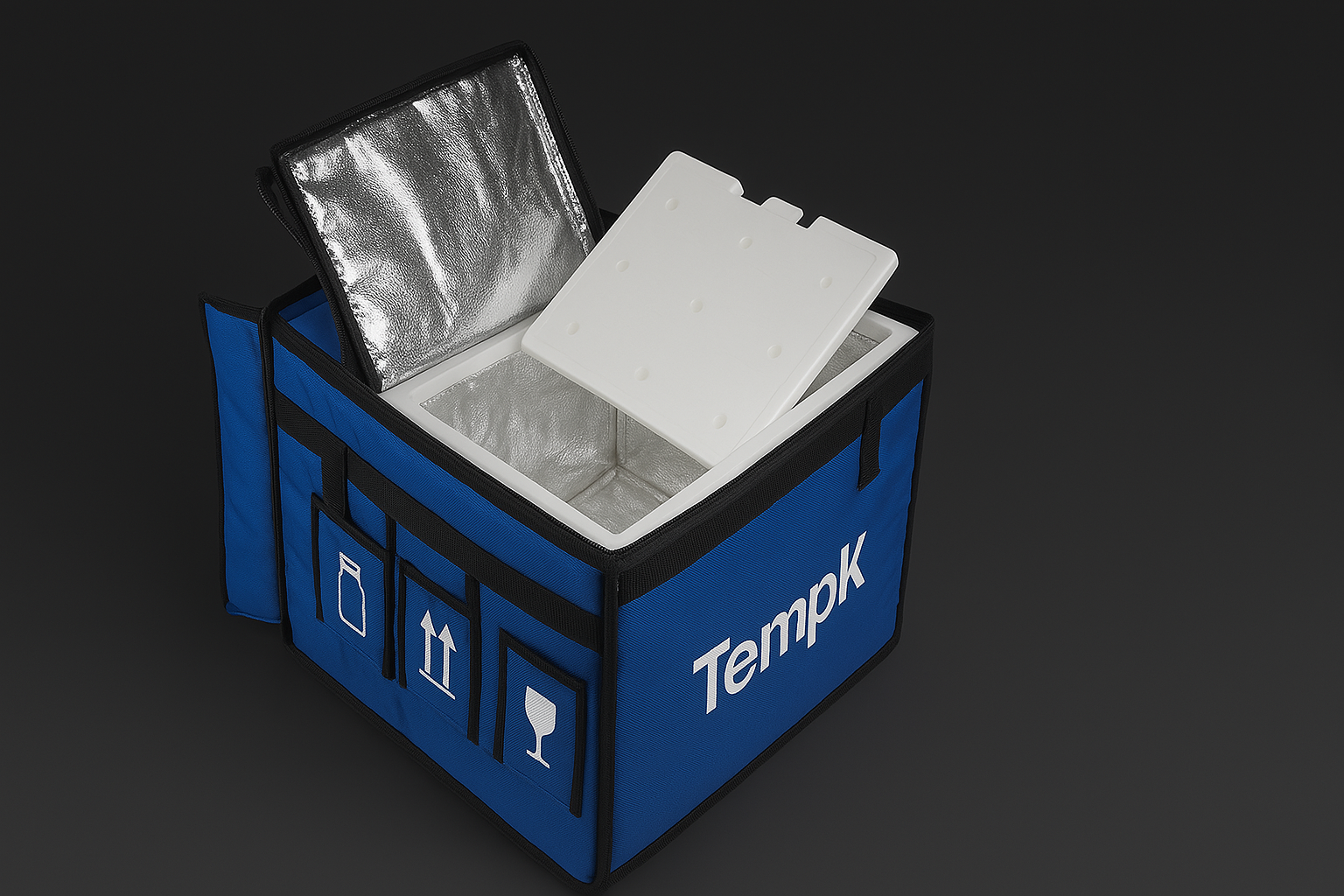
VIP thermal box for biological samples shipping is the right choice when you need a passive shipper that combines high insulation, practical packout control, and documentation-friendly performance. In 2026, that combination matters more than ever. Cold-chain networks are moving more biologics, diagnostics, and specialty products through smaller parcels, more outsourced routes, and more final-mile handoffs. Buyers therefore need packaging that protects the product and simplifies decision making at the same time.
A strong VIP-based design can do exactly that. Fresh vacuum insulated panels can deliver thermal conductivity in the low 0.002 to 0.004 W/m-K range, while many common foams are roughly an order of magnitude higher. That insulation density can translate into smaller outer dimensions, better payload space, and more controlled thermal performance when the route is demanding. But the best result comes only when insulation, coolant, payload configuration, monitoring, and route qualification are treated as one system. That is the mindset behind this optimized guide.
This guide will help you answer
- Why VIP Thermal Box for Biological Samples Shipping matters in biological samples shipping and when it clearly outperforms simpler formats
- How VIP insulation, refrigerant choice, and payload mass work together
- How to choose the right hold time, load range, and logger strategy
- Which standards and quality rules matter most for qualification and scale-up
- What 2026 trends in market growth, sustainability, and digital monitoring mean for your purchase
Why does VIP Thermal Box for Biological Samples Shipping matter to your shipment?
The purpose of the package is not to look advanced. It is to protect the product zone through the real shipment journey. In biological samples shipping, the shipment may encounter ambient swings, handling abuse, waiting time, or receiving delays. sample integrity can be lost by leakage, thawing, freeze damage, or identity mix-ups during a routine courier move; biosafety rules require the packaging system to do more than keep temperature; and return logistics, documentation, and person-responsible labeling matter for regulated specimen flows. A package that manages those stresses well protects product quality, reduces waste, and shortens the time quality teams spend explaining avoidable deviations.
This is why buyers increasingly choose VIP Thermal Box for Biological Samples Shipping when the route becomes more critical. They are often looking for high insulation around a compliant multi-layer packaging system, better support for dry ice or PCM-based sample protection, and safer handling when the outer package is compact, rigid, and clearly marked. Those gains can improve both technical performance and business performance. Less outer cube can help freight efficiency. More payload room can help shipping economics. Better thermal control can reduce the chance that one delayed shipment becomes a product complaint or a write-off.
How does VIP Thermal Box for Biological Samples Shipping work, and when does it beat conventional foam?
The core advantage is thermal efficiency per unit of wall thickness. Fresh vacuum insulated panels can deliver thermal conductivity in the low 0.002 to 0.004 W/m-K range, while many common foams are roughly an order of magnitude higher. That means a VIP-based shipper can often deliver the same or better protection in a smaller geometry than a basic foam design. The practical outcome is not just better insulation on paper. It is more freedom to design a package that fits real parcel, courier, or depot workflows without becoming oversized and awkward to use.
Even so, VIP does not eliminate the need for good design. Performance still depends on panel protection, seam management, lid closure, coolant placement, and the thermal mass of the payload. Buyers should therefore compare complete systems, not only insulation materials. Ask how the package behaves when partly full, when the route is delayed, when ambient conditions change, and when the box is opened at the receiving site. Those are the moments that separate a credible packaging system from a simple specification sheet.
A practical comparison table for VIP Thermal Box for Biological Samples Shipping
| <strong>Decision point</strong> | <strong>What to check</strong> | <strong>Good answer</strong> | <strong>Why it matters</strong> |
| Temperature target | label range and stability limit | qualified around the real product zone | wrong target means the best insulation still fails |
| Route profile | ambient exposure, delay risk, and handoffs | summer and winter logic defined | route reality drives hold-time need |
| Payload size | minimum and maximum thermal mass | qualified for both small and full loads | payload changes package behavior |
| Monitoring plan | logger type and location | calibrated device in the product zone | data becomes useful during release and CAPA |
How should you select hold time, payload size, and coolant for VIP Thermal Box for Biological Samples Shipping?
Begin with the labeled product range. Then define the real shipment profile: normal transit time, likely delay time, minimum payload, maximum payload, and destination readiness. A package should be qualified for the conditions you will actually face, not just for an ideal shipping window. WHO guidance is explicit on this point: WHO Annex 9 says insulated passive containers should be qualified with full assembly details, thermal conditioning rules, and minimum and maximum shipping volume, weight, and thermal mass. That is a reminder that route profile and payload range belong inside the package decision from the beginning.
Coolant selection comes next. Room-temperature stabilizers can be good for simpler chilled lanes, PCM or cold packs are usually stronger when you need a defined temperature plateau, and dry ice only makes sense when the product truly needs that deeper level of cold. Good engineering avoids overcooling just as carefully as overheating. The best packout maintains the product zone predictably instead of simply creating the coldest internal environment possible.
| <strong>Coolant</strong> | <strong>Where it fits</strong> | <strong>Main watch-out</strong> | <strong>What it means for you</strong> |
| room-temperature stabilizers | ambient or CRT specimens | useful when cold is unnecessary or harmful | Choose only when product really needs deeper freezing |
| PCM or cold packs | 2 to 8°C specimens | good for refrigerated lanes when freeze risk is managed | Choose tighter control |
| dry ice | frozen or deep-frozen samples | necessary for some lanes, but requires specific labeling and cushioning | Choose only when product really needs deeper freezing |
How do you qualify VIP Thermal Box for Biological Samples Shipping for compliant, repeatable shipping?
Qualification should be treated as a system exercise. EU GDP says temperature conditions must be maintained within acceptable limits during transport, the route should be risk assessed, and transport monitoring equipment should be maintained and calibrated at regular intervals at least once a year. EU GDP also expects initial temperature mapping before use and placement of monitors where the greatest fluctuations occur. WHO also says transport routes should be profiled and qualified against the anticipated ambient conditions over the journey. Together, those expectations tell you what regulators and quality teams care about: correct temperature, documented route thinking, monitored evidence, and clear response if an excursion occurs. A good package helps because it supports all those needs with a repeatable assembly process and a defensible monitoring plan.
In practical terms, the qualification package should define preload conditions, assembly sequence, coolant conditioning, payload range, logger location, route assumptions, acceptance criteria, and seasonal variants if they exist. It should also be easy for operators to follow. Many packaging failures are not caused by bad materials. They are caused by small but repeatable errors in assembly, such as wrong coolant conditioning, the wrong payload fill, or a logger pushed into the wrong position. A controlled SOP is therefore part of package performance.
A repeatable qualification workflow
- Lock the product-zone target and the acceptable excursion logic.
- Profile or simulate the route, including delays and seasonal exposure.
- Test minimum and maximum loads with the real payload packaging format.
- Fix coolant conditioning, assembly order, and logger placement in writing.
- Review results against the product zone and investigate any edge-zone anomalies.
- Requalify after major changes in route, payload, component, or supplier.
What does the ideal packout look like for biological samples shipping?
The ideal packout is not the most elaborate one. It is the one that operators can build correctly every time and that recipients can understand immediately. In biological samples shipping, that usually means the package clearly separates the product zone from the coolant, protects the most temperature-sensitive items from direct contact with extreme cold, reserves a defined space for the logger, and includes simple handling instructions for the receiving side. If a package is hard to build, hard to inspect, or hard to receive, it becomes harder to trust at scale.
A good packout also reflects the specific application. For biological samples, the insulated box is only one layer of the system. The full design must include the primary receptacle, absorbent material when needed, leakproof secondary packaging, and a rigid outer package with the correct markings. The thermal plan should protect the sample without creating new hazards such as direct dry-ice contact or pressure problems. That application lens matters because the same package architecture is not ideal for every lane. A direct-to-patient box, a GDP wholesale shipper, a diagnostic kit shipper, and a cryogenic transport system all need different trade-offs. The best suppliers will talk through those trade-offs openly and show why a certain configuration fits your use case instead of pushing one generic design for everything.
| <em>Applied example: A multi-site clinical study standardized its specimen returns around one VIP thermal box with fixed secondary packaging, absorbent materials, and sample-specific coolant rules. Training became easier, and the central lab saw fewer ambiguous arrivals because every site used the same packout map and marking set.</em> |
What do 2026 market, sustainability, and monitoring trends mean for VIP Thermal Box for Biological Samples Shipping?
The broader market continues to support higher-performance cold-chain packaging. Public market research in 2025 and 2026 continues to show strong growth in pharmaceutical cold chain packaging as biologics, vaccines, and specialty medicines expand. The broader temperature-controlled packaging sector is also expanding, helped by direct-to-patient delivery, healthcare e-commerce, and sustainability pressure. That growth is being shaped by more complex therapies, greater reliance on small shipments, and stronger expectations for documented performance. Buyers increasingly want packaging that can stand up to both operational stress and quality review. In this environment, higher insulation is valuable because it creates flexibility without immediately forcing a move to active systems.
Sustainability is adding another layer to the decision. The EU Packaging and Packaging Waste Regulation entered into force on 11 February 2025, generally applies from 12 August 2026, and pushes the market toward recyclability and circular design. A strong VIP package can contribute because it often reduces freight cube and can support durable reuse models. But the 2026 standard is higher than a recycled-content claim. Buyers now ask how the packaging will be recovered, cleaned, inspected, and eventually recycled or refurbished. Digital monitoring is also becoming more central. A package that makes logger use easy and consistent can reduce investigation time and improve release confidence.
2026 trend snapshot
- More decentralized clinical trials and home collection workflows.
- Greater use of monitored specimen shipments.
- Higher emphasis on training and packaging consistency for multi-site studies.
Frequently asked questions
How long can a VIP thermal box hold temperature in biological samples shipping?
It depends on the qualified design, the coolant, the payload thermal mass, and the actual route profile. Treat hold time as a validated system result, not a catalog headline. For regulated lanes, qualify summer and winter packouts separately and define minimum and maximum payload sizes before commercial use.
Is VIP Thermal Box for Biological Samples Shipping better than a conventional foam shipper?
For many lanes, yes-especially when you need strong thermal performance in a smaller footprint. Fresh vacuum insulated panels can deliver thermal conductivity in the low 0.002 to 0.004 W/m-K range, while many common foams are roughly an order of magnitude higher. The practical benefit is that you can often gain payload room, reduce refrigerant, or extend hold time. But the advantage only counts if the complete packout is qualified for your shipment.
When should you use PCM instead of dry ice with VIP Thermal Box for Biological Samples Shipping?
Use PCM when you need a defined target range such as 2 to 8°C or controlled room temperature and want steadier product-zone conditions. Use dry ice only when the product stability profile truly calls for deep-frozen or ultra-cold transport. For freeze-sensitive payloads, PCM is usually the safer and more precise choice.
Do you need a data logger in every biological samples shipping shipment?
Not every lane has the same risk, but monitored shipments are strongly recommended whenever the payload is high value, the route is new, or compliance evidence matters. CDC recommends digital data loggers for vaccine storage and handling, set to record at least every 30 minutes. For GDP and validation work, a calibrated logger turns a package from a promise into documented proof.
Can VIP Thermal Box for Biological Samples Shipping be reused?
Often yes, if the design is built for repeat trips and you can control inspection, cleaning, refurbishment, and return logistics. WHO guidance also expects reusable shipping containers to be cleaned and records maintained. Reuse is only a real advantage when the operating process is as disciplined as the packaging design.
How do you qualify VIP Thermal Box for Biological Samples Shipping for biological sample transport?
Qualify both the biosafety layers and the thermal layers. The system should protect the primary receptacle, absorbent material, leakproof secondary packaging, and rigid outer package while also proving temperature control for the sample type. Use the actual specimen matrix, route duration, and marking requirements during qualification.
Summary and recommendation
The strongest reason to choose VIP Thermal Box for Biological Samples Shipping is that it can deliver concentrated thermal performance in a package format that still supports operational simplicity. That matters because modern cold-chain shipping is no longer defined by temperature alone. You also need lane realism, repeatable packout logic, usable monitoring data, and a package that fits your receiving workflow. When those factors align, a VIP-based system can protect product value while improving the overall shipping process.
The best next step is to compare candidate systems using your real route, your actual payload range, and your chosen logger method. Look at temperature results, operator usability, receiving-site ease, dimensional weight, and documentation quality together. The winner should not only keep the shipment safe. It should also make your cold chain easier to run, easier to scale, and easier to defend.
About Tempk
Tempk develops passive cold-chain packaging with a focus on high-efficiency insulation, practical packout design, and real-world qualification logic. We aim to connect materials, monitoring, and route reality in one clear system so customers can choose packaging with confidence instead of guesswork. That approach is especially useful when shipment value, quality requirements, and service complexity are all high.
If you want a package decision that holds up in operations and in quality review, start with the route, the product zone, and the packout discipline. Once those are clear, the right thermal packaging format becomes much easier to identify and much easier to justify.
VIP shipper for reagent shipping: the complete 2026 guide
VIP shipping container for research reagent shipping is most useful when you treat it as a complete control system rather than a premium carton. In April 2026, the best-performing cold-chain teams use VIP insulation because it can create meaningful thermal margin in a compact format, but they only approve a design after it proves itself against product stability, route variability, operator behavior, and receiving reality. That is the standard you should use as well.
This guide fuses buyer logic, engineering detail, and current market direction so you can decide when this packaging approach is worth it, how to qualify it, what evidence to request, and where reuse, returnability, recyclability, and digital visibility change the economics. The goal is simple: help you reduce product risk without paying for complexity that your lane does not need.
What this guide will help you answer
- How to decide whether VIP shipping container for research reagent shipping is the right packaging strategy for your lane
- How to engineer a qualified packout using real stability limits and route data
- Which records, standards, and logger evidence you should require before approval
- How to lower total landed cost while preserving product protection
- What current trends in traceability, reuse, and recyclability mean for your next packaging decision
What makes VIP shipper for reagent shipping the right fit for your lane?
The right reason to choose VIP shipping container for research reagent shipping is not that it sounds advanced. The right reason is that your shipment needs more controllable thermal margin than ordinary insulation can provide, and you want that margin in a format your operators can actually pack, ship, receive, and review consistently. When those conditions are true, a VIP-based design can protect reference standards, antibodies, assay reagents, enzymes, controls, and sensitive laboratory kits with better resilience and less wasted space than many generic alternatives.
The wrong reason is simple branding logic. Premium insulation does not rescue a weak route map, vague work instructions, or poor receiving discipline. The shipper has to fit the product, the lane, the packaging form factor, and the quality process at the same time. This format is a line-haul oriented passive shipper built for more hand-offs, more route uncertainty, and larger payload value. It usually wins when you need stronger hold-time potential, better route resilience, and more room for qualified packout geometry. The main trade-off is that heavier than a simple box and usually harder to justify if the lane is short and predictable. In practice, it fits best for regulated or high-value shipments moving through airports, cross-docks, or regional hubs. Your first task is therefore to judge fit, not to assume superiority.
Product category changes the decision logic. Fresh produce cares about appearance and shelf life. Regulated healthcare cares about labeled temperature control and documented review. Reagents and biotech materials care about activity retention, chain of custody, and rapid receiving decisions. Reusable and returnable programs care about inspection, recovery, and total trips per asset. The best packaging choice reflects those priorities clearly.
Quick fit scorecard
Use the scorecard below to decide whether you truly need premium passive protection, what level of evidence you should require, and whether lifecycle features such as reuse or recyclability are likely to help your operation.
Scorecard for deciding whether the packaging strategy fits
| <strong>Decision lens</strong> | <strong>What strong fit looks like</strong> | <strong>What good teams do next</strong> | <strong>Why it matters to you</strong> |
| Product risk | The shipment contains high-value or quality-sensitive product | Use premium passive protection only where failure consequences justify it | You spend more where it matters and less where it does not |
| Lane severity | The route includes hand-offs, delay risk, or seasonal extremes | Qualify by real route family, not by average transit time | You buy performance that matches reality |
| Operational fit | Operators can assemble and receivers can interpret the shipment consistently | Simplify packout, labels, and logger review rules | You reduce avoidable human error |
| Evidence quality | The supplier can show thermal, process, and change-control records | Approve the system, not just the materials | You protect audits, deviations, and scaling |
| Lifecycle logic | Reuse, return, or recycling can be executed in normal operations | Model cost per trip and end-of-use before launch | You improve economics and sustainability together |
Practical actions before you request a quote
- Start with the true stability window. Some biologics fear freezing as much as they fear warming.
- Keep the payload cavity tight. Small, high-value lab products are easy to overbox and hard to protect if they rattle inside a large void.
- Define what the receiver should do with the logger report before the first live shipment leaves the site.
A trial support team replaced a heavy generic cooler with a VIP shipping container sized around the actual reagent load and real lane data. The revised design reduced dry ice use, kept temperature records cleaner, and improved receiving consistency across satellite labs.
How do you engineer temperature protection that survives the real lane?
Engineering a shipment that survives the lane starts with a disciplined thermal model. Define the allowed product range, the realistic delay profile, the payload mass, the weak points inside the pack, and the exact condition of the coolant at assembly. Then design the cavity so the product sits in a controlled thermal zone rather than in direct contact with the hottest or coldest surfaces. That is where real performance comes from.
The insulation layer is only one part of the answer. Recent literature still places healthy VIP conductivity in the super-insulation range, roughly around 0.003 to 0.006 W/m·K, but panel performance can drift if barrier films are damaged or if edges are not protected. In field conditions, your result is governed by the combination of panel health, coolant layout, void space, operator consistency, and receiving speed.
For most non-food cold chains, the design objective is repeatable control. That means the packout should work in ordinary hands under ordinary time pressure. A slightly less aggressive design that is easier to execute can outperform a laboratory-optimized design that operators assemble inconsistently.
How should coolant, payload spacing, and hold time be sized?
Size them against the true worst-case route, not a convenient average. Keep the payload in the most stable internal zone, control direct contact with cold sources, and use seasonal logic when the route changes materially across the year. If your lane is highly variable, add margin through design rather than through last-minute improvisation.
What compliance evidence should you require before approving VIP shipper for reagent shipping?
Before approving VIP shipping container for research reagent shipping, require evidence in three layers. First, require thermal evidence: test results or qualification summaries that resemble your lane and payload. Second, require process evidence: packout drawings, work instructions, coolant conditioning rules, and logger placement logic. Third, require governance evidence: change control, component traceability, and a clear rule for how live results are reviewed and dispositioned.
For broader cold-chain categories, the same principle holds. Evidence must link product needs, route assumptions, and operator steps into one defensible file. If the supplier cannot explain how the design was challenged, assembled, monitored, and revised when components change, the package is not ready for serious deployment.
Standards help give that evidence structure. ISTA now points buyers toward Standard 7E as the newer thermal transport framework for insulated shippers. WHO continues to emphasize temperature monitoring devices for international health-product shipping. GS1 sensor-event standards now make it easier to connect package condition with shipment history. None of these references replaces your product-specific logic, but together they raise the quality of the conversation.
Which records separate qualified suppliers from hopeful ones?
Qualified suppliers can show what was tested, how it was packed, which components were used, what happens when those components change, and how receiving teams should review results. Hopeful suppliers usually return to generic hold-time language and vague marketing claims once you ask about change control or live-lane assumptions.
How do you reduce total cost without increasing deviation risk?
The fastest way to lower cost without raising risk is to remove wasteful mismatch. Oversized packs waste freight cube. Excess coolant adds weight and can increase freezing risk. Too many custom variants create training burden. Too few variants can push weak packouts onto difficult lanes. The commercial sweet spot is a small family of qualified solutions sized to real route families.
Use total landed cost rather than purchase price. Count product loss, deviation labor, customer complaints, reverse logistics, and operator time. When you do that, a better shipper often pays for itself not by being cheaper to buy, but by being cheaper to operate and easier to defend. That logic matters especially when shipment failures trigger regulatory review or service breakdown.
For most other cold-chain categories, the right balance is to right-size first, then decide whether reuse or improved recyclability adds value on top. EU policy pressure toward more recyclable and reusable packaging is real, but the best business result still comes from choosing a model that operations can execute without confusion.
When do reusable, returnable, or recyclable models win?
They win when the operating model supports them. Reuse needs predictable turns and inspections. Returnable assets need visibility and strong recovery. Recyclable designs need easy separation and clear instructions. Pick the lifecycle strategy that reduces waste without creating new quality or logistics problems.
What 2026 trends should shape your next VIP shipper for reagent shipping decision?
Several 2026 trends should shape your next decision. Digital traceability is expanding, which means packaging needs to work with event data and not just with temperature chambers. Sensor support in GS1 EPCIS makes it easier to align location, delay, and temperature information. FDA’s recent DSCSA guidance reinforces the value of package-level electronic information in eligible drug distribution. At the same time, WHO and IATA continue to keep temperature monitoring and disciplined air-cargo handling in focus.
Standards and policy are also pulling cold-chain packaging toward more transparent lifecycle choices. The EU Packaging and Packaging Waste Regulation entered into force in 2025 and generally applies from August 2026, which raises the pressure for transport packaging that is more recyclable, more reusable, or at least easier to explain. Buyers increasingly ask not only whether the shipper works, but also how it will be returned, repaired, or separated at end of use.
The main market insight is that packaging is becoming more accountable. Buyers want fewer claims and more evidence, fewer variants and better training, stronger protection and less waste. The cold-chain solutions that will stand out are the ones that make those trade-offs easier, not harder.
Latest developments at a glance
- Route-specific qualification is replacing generic performance claims.
- Digital visibility is moving from simple logging toward connected event interpretation.
- Policy pressure is raising the value of recyclable, reusable, and easier-to-explain packaging systems.
- Training simplicity is becoming a major competitive advantage in cold-chain execution.
Frequently asked questions
How do I know whether VIP shipping container for research reagent shipping is the right fit for my shipment?
Check product consequence, route severity, operator capability, and the evidence your quality team will require. If failure is expensive and the route is variable, premium passive protection often makes sense. If the route is easy, simpler packaging may be sufficient.
What should I ask a supplier before approving a packout?
Ask for the qualification summary, packout drawing, coolant conditioning instructions, logger plan, component specification, and change-control policy. If the design is reusable, also ask for inspection and retirement criteria.
How many packaging variants should a network usually keep?
As few as practical, but enough to match clearly different lane families. Too many variants create training problems. Too few force poor route fit. A small controlled family of approved packouts is usually the strongest model.
Is the newest standard or sensor technology enough to guarantee performance?
No. Standards and sensors improve structure and visibility, but they do not replace route-specific design, disciplined assembly, or clear receiving rules. Strong execution still decides field success.
What is the biggest hidden reason cold-chain packages fail?
In many programs, the hidden reason is operator variation rather than raw insulation weakness. The packout may look strong in the lab but fail in the field because assembly, staging, or receipt behavior changes the thermal reality.
How should I think about reuse or recyclability for this packaging approach?
Treat lifecycle choice as an operating-model decision. Reuse needs recovery and inspection discipline. Recyclability needs simple material separation and clear instructions. Choose the model your network can actually support.
Summary and recommendations
The best way to evaluate VIP shipping container for research reagent shipping is to ask one question: does it make your real shipment easier to protect, easier to operate, and easier to defend? When the answer is yes, VIP packaging can deliver strong value by adding thermal margin, improving evidence, and supporting smarter lifecycle choices. When the answer is no, premium insulation may only add cost.
Start with a lane-specific qualification plan, request evidence that matches your product and route, and build a small family of controlled packouts that your operators can execute consistently. Then choose reuse, returnability, or recyclability based on what your network can genuinely support. That is how you get the strongest result from cold-chain packaging in 2026.
About Tempk
At Tempk, we build cold-chain packaging around real operating conditions rather than generic catalog claims. Our focus is to combine strong thermal engineering with clear packout discipline, practical qualification support, and packaging options that are easier to deploy in daily operations. We work with teams that need dependable control for regulated, fragile, or high-value shipments without unnecessary complexity.
Talk with our team if you want help comparing routes, packout concepts, or reusable versus single-use options for your next cold-chain program.
VIP shipping case for returnable packaging: the complete 2026 guide
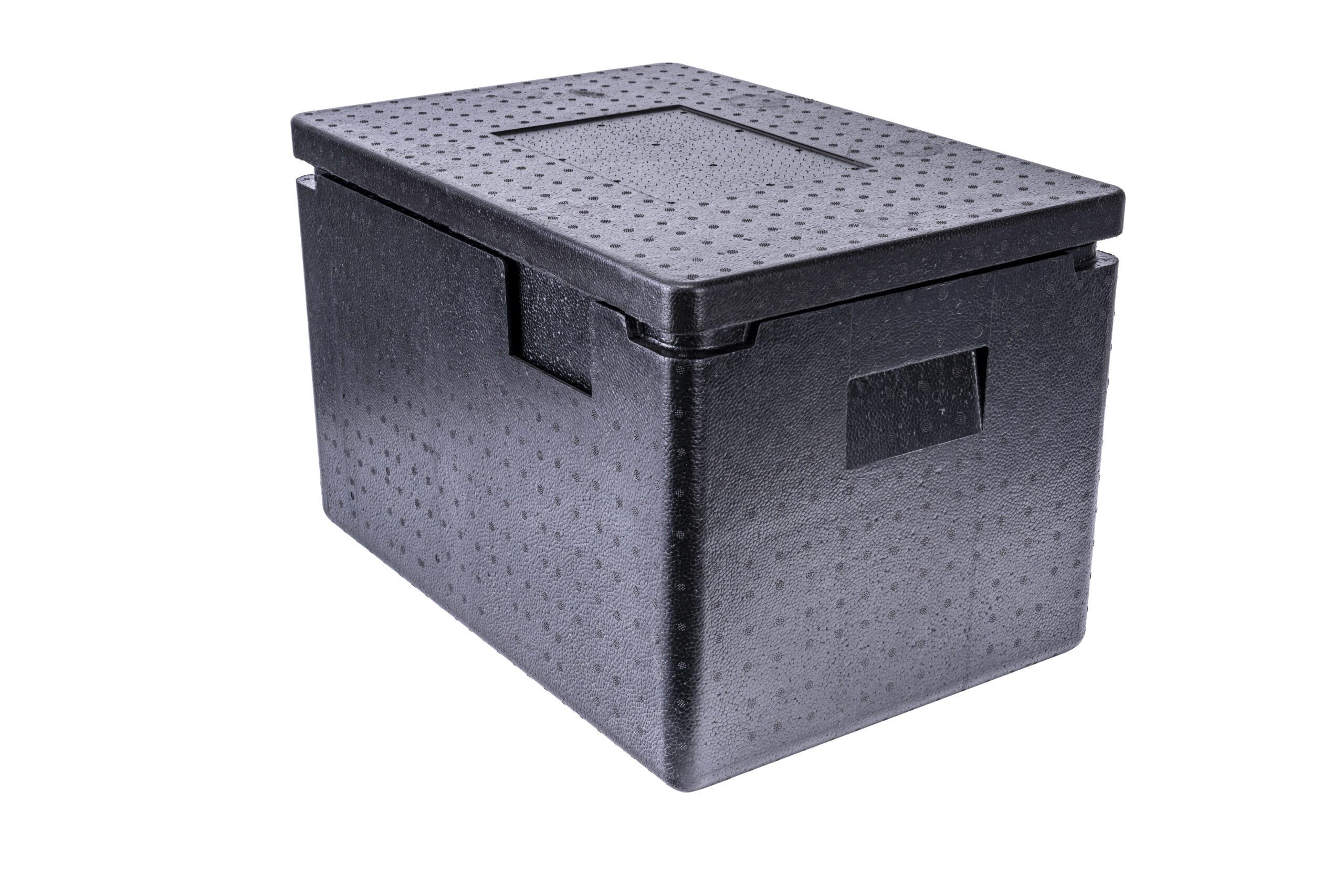
VIP shipping case for returnable packaging is most useful when you treat it as a complete control system rather than a premium carton. In April 2026, the best-performing cold-chain teams use VIP insulation because it can create meaningful thermal margin in a compact format, but they only approve a design after it proves itself against product stability, route variability, operator behavior, and receiving reality. That is the standard you should use as well.
This guide fuses buyer logic, engineering detail, and current market direction so you can decide when this packaging approach is worth it, how to qualify it, what evidence to request, and where reuse, returnability, recyclability, and digital visibility change the economics. The goal is simple: help you reduce product risk without paying for complexity that your lane does not need.
What this guide will help you answer
- How to decide whether VIP shipping case for returnable packaging is the right packaging strategy for your lane
- How to engineer a qualified packout using real stability limits and route data
- Which records, standards, and logger evidence you should require before approval
- How to lower total landed cost while preserving product protection
- What current trends in traceability, reuse, and recyclability mean for your next packaging decision
What makes VIP shipping case for returnable packaging the right fit for your lane?
The right reason to choose VIP shipping case for returnable packaging is not that it sounds advanced. The right reason is that your shipment needs more controllable thermal margin than ordinary insulation can provide, and you want that margin in a format your operators can actually pack, ship, receive, and review consistently. When those conditions are true, a VIP-based design can protect recurring pharma, life-science, and premium food shipments moving between known nodes with better resilience and less wasted space than many generic alternatives.
The wrong reason is simple branding logic. Premium insulation does not rescue a weak route map, vague work instructions, or poor receiving discipline. The shipper has to fit the product, the lane, the packaging form factor, and the quality process at the same time. This format is a durable hard-sided case suited to repeated trips, asset tracking, and tighter operational control. It usually wins when you need excellent reusability potential, better cosmetic durability, and clear fit for return loops. The main trade-off is that asset loss and slow returns can erase the economic benefit quickly. In practice, it fits best for returnable programs with known senders and receivers. Your first task is therefore to judge fit, not to assume superiority.
Product category changes the decision logic. Fresh produce cares about appearance and shelf life. Regulated healthcare cares about labeled temperature control and documented review. Reagents and biotech materials care about activity retention, chain of custody, and rapid receiving decisions. Reusable and returnable programs care about inspection, recovery, and total trips per asset. The best packaging choice reflects those priorities clearly.
Quick fit scorecard
Use the scorecard below to decide whether you truly need premium passive protection, what level of evidence you should require, and whether lifecycle features such as reuse or recyclability are likely to help your operation.
Scorecard for deciding whether the packaging strategy fits
| <strong>Decision lens</strong> | <strong>What strong fit looks like</strong> | <strong>What good teams do next</strong> | <strong>Why it matters to you</strong> |
| Product risk | The shipment contains high-value or quality-sensitive product | Use premium passive protection only where failure consequences justify it | You spend more where it matters and less where it does not |
| Lane severity | The route includes hand-offs, delay risk, or seasonal extremes | Qualify by real route family, not by average transit time | You buy performance that matches reality |
| Operational fit | Operators can assemble and receivers can interpret the shipment consistently | Simplify packout, labels, and logger review rules | You reduce avoidable human error |
| Evidence quality | The supplier can show thermal, process, and change-control records | Approve the system, not just the materials | You protect audits, deviations, and scaling |
| Lifecycle logic | Reuse, return, or recycling can be executed in normal operations | Model cost per trip and end-of-use before launch | You improve economics and sustainability together |
Practical actions before you request a quote
- Measure cost per completed trip, not cost per shipped unit. Recovery and refurbishment decide the real economics.
- Write inspection rules for shell damage, latch condition, panel edge protection, and coolant reset before you scale.
- Make return or disposal instructions obvious. Sustainability fails quickly when the receiver does not know the next step.
A medical supply network adopted a VIP shipping case with asset IDs and a return dashboard. Once loss visibility improved, the case delivered lower cost per completed lane and a clearer carbon story than the old disposable setup.
How do you engineer temperature protection that survives the real lane?
Engineering a shipment that survives the lane starts with a disciplined thermal model. Define the allowed product range, the realistic delay profile, the payload mass, the weak points inside the pack, and the exact condition of the coolant at assembly. Then design the cavity so the product sits in a controlled thermal zone rather than in direct contact with the hottest or coldest surfaces. That is where real performance comes from.
The insulation layer is only one part of the answer. Recent literature still places healthy VIP conductivity in the super-insulation range, roughly around 0.003 to 0.006 W/m·K, but panel performance can drift if barrier films are damaged or if edges are not protected. In field conditions, your result is governed by the combination of panel health, coolant layout, void space, operator consistency, and receiving speed.
For most non-food cold chains, the design objective is repeatable control. That means the packout should work in ordinary hands under ordinary time pressure. A slightly less aggressive design that is easier to execute can outperform a laboratory-optimized design that operators assemble inconsistently.
How should coolant, payload spacing, and hold time be sized?
Size them against the true worst-case route, not a convenient average. Keep the payload in the most stable internal zone, control direct contact with cold sources, and use seasonal logic when the route changes materially across the year. If your lane is highly variable, add margin through design rather than through last-minute improvisation.
What compliance evidence should you require before approving VIP shipping case for returnable packaging?
Before approving VIP shipping case for returnable packaging, require evidence in three layers. First, require thermal evidence: test results or qualification summaries that resemble your lane and payload. Second, require process evidence: packout drawings, work instructions, coolant conditioning rules, and logger placement logic. Third, require governance evidence: change control, component traceability, and a clear rule for how live results are reviewed and dispositioned.
For broader cold-chain categories, the same principle holds. Evidence must link product needs, route assumptions, and operator steps into one defensible file. If the supplier cannot explain how the design was challenged, assembled, monitored, and revised when components change, the package is not ready for serious deployment.
Standards help give that evidence structure. ISTA now points buyers toward Standard 7E as the newer thermal transport framework for insulated shippers. WHO continues to emphasize temperature monitoring devices for international health-product shipping. GS1 sensor-event standards now make it easier to connect package condition with shipment history. None of these references replaces your product-specific logic, but together they raise the quality of the conversation.
Which records separate qualified suppliers from hopeful ones?
Qualified suppliers can show what was tested, how it was packed, which components were used, what happens when those components change, and how receiving teams should review results. Hopeful suppliers usually return to generic hold-time language and vague marketing claims once you ask about change control or live-lane assumptions.
How do you reduce total cost without increasing deviation risk?
The fastest way to lower cost without raising risk is to remove wasteful mismatch. Oversized packs waste freight cube. Excess coolant adds weight and can increase freezing risk. Too many custom variants create training burden. Too few variants can push weak packouts onto difficult lanes. The commercial sweet spot is a small family of qualified solutions sized to real route families.
Use total landed cost rather than purchase price. Count product loss, deviation labor, customer complaints, reverse logistics, and operator time. When you do that, a better shipper often pays for itself not by being cheaper to buy, but by being cheaper to operate and easier to defend. That logic matters especially when shipment failures trigger regulatory review or service breakdown.
For reusable, returnable, or recyclable programs, choose the lifecycle model your network can actually run. Reuse wins when inspection and recovery are disciplined. Returnable assets win when cycle count and return speed are visible. Recyclable designs win when recipients are diverse and unlikely to send assets back. Sustainability becomes credible only when the operating model is credible.
When do reusable, returnable, or recyclable models win?
They win when the operating model supports them. Reuse needs predictable turns and inspections. Returnable assets need visibility and strong recovery. Recyclable designs need easy separation and clear instructions. Pick the lifecycle strategy that reduces waste without creating new quality or logistics problems.
What 2026 trends should shape your next VIP shipping case for returnable packaging decision?
Several 2026 trends should shape your next decision. Digital traceability is expanding, which means packaging needs to work with event data and not just with temperature chambers. Sensor support in GS1 EPCIS makes it easier to align location, delay, and temperature information. FDA’s recent DSCSA guidance reinforces the value of package-level electronic information in eligible drug distribution. At the same time, WHO and IATA continue to keep temperature monitoring and disciplined air-cargo handling in focus.
Standards and policy are also pulling cold-chain packaging toward more transparent lifecycle choices. The EU Packaging and Packaging Waste Regulation entered into force in 2025 and generally applies from August 2026, which raises the pressure for transport packaging that is more recyclable, more reusable, or at least easier to explain. Buyers increasingly ask not only whether the shipper works, but also how it will be returned, repaired, or separated at end of use.
The main market insight is that packaging is becoming more accountable. Buyers want fewer claims and more evidence, fewer variants and better training, stronger protection and less waste. The cold-chain solutions that will stand out are the ones that make those trade-offs easier, not harder.
Latest developments at a glance
- Route-specific qualification is replacing generic performance claims.
- Digital visibility is moving from simple logging toward connected event interpretation.
- Policy pressure is raising the value of recyclable, reusable, and easier-to-explain packaging systems.
- Training simplicity is becoming a major competitive advantage in cold-chain execution.
Frequently asked questions
How do I know whether VIP shipping case for returnable packaging is the right fit for my shipment?
Check product consequence, route severity, operator capability, and the evidence your quality team will require. If failure is expensive and the route is variable, premium passive protection often makes sense. If the route is easy, simpler packaging may be sufficient.
What should I ask a supplier before approving a packout?
Ask for the qualification summary, packout drawing, coolant conditioning instructions, logger plan, component specification, and change-control policy. If the design is reusable, also ask for inspection and retirement criteria.
How many packaging variants should a network usually keep?
As few as practical, but enough to match clearly different lane families. Too many variants create training problems. Too few force poor route fit. A small controlled family of approved packouts is usually the strongest model.
Is the newest standard or sensor technology enough to guarantee performance?
No. Standards and sensors improve structure and visibility, but they do not replace route-specific design, disciplined assembly, or clear receiving rules. Strong execution still decides field success.
What is the biggest hidden reason cold-chain packages fail?
In many programs, the hidden reason is operator variation rather than raw insulation weakness. The packout may look strong in the lab but fail in the field because assembly, staging, or receipt behavior changes the thermal reality.
How should I think about reuse or recyclability for this packaging approach?
Treat lifecycle choice as an operating-model decision. Reuse needs recovery and inspection discipline. Recyclability needs simple material separation and clear instructions. Choose the model your network can actually support.
Summary and recommendations
The best way to evaluate VIP shipping case for returnable packaging is to ask one question: does it make your real shipment easier to protect, easier to operate, and easier to defend? When the answer is yes, VIP packaging can deliver strong value by adding thermal margin, improving evidence, and supporting smarter lifecycle choices. When the answer is no, premium insulation may only add cost.
Start with a lane-specific qualification plan, request evidence that matches your product and route, and build a small family of controlled packouts that your operators can execute consistently. Then choose reuse, returnability, or recyclability based on what your network can genuinely support. That is how you get the strongest result from cold-chain packaging in 2026.
About Tempk
At Tempk, we build cold-chain packaging around real operating conditions rather than generic catalog claims. Our focus is to combine strong thermal engineering with clear packout discipline, practical qualification support, and packaging options that are easier to deploy in daily operations. We work with teams that need dependable control for regulated, fragile, or high-value shipments without unnecessary complexity.
Talk with our team if you want help comparing routes, packout concepts, or reusable versus single-use options for your next cold-chain program.
VIP shipping box for biotech shipments: the complete 2026 guide

VIP shipping box for biotech shipments is most useful when you treat it as a complete control system rather than a premium carton. In April 2026, the best-performing cold-chain teams use VIP insulation because it can create meaningful thermal margin in a compact format, but they only approve a design after it proves itself against product stability, route variability, operator behavior, and receiving reality. That is the standard you should use as well.
This guide fuses buyer logic, engineering detail, and current market direction so you can decide when this packaging approach is worth it, how to qualify it, what evidence to request, and where reuse, returnability, recyclability, and digital visibility change the economics. The goal is simple: help you reduce product risk without paying for complexity that your lane does not need.
What this guide will help you answer
- How to decide whether VIP shipping box for biotech shipments is the right packaging strategy for your lane
- How to engineer a qualified packout using real stability limits and route data
- Which records, standards, and logger evidence you should require before approval
- How to lower total landed cost while preserving product protection
- What current trends in traceability, reuse, and recyclability mean for your next packaging decision
What makes VIP shipping box for biotech shipments the right fit for your lane?
The right reason to choose VIP shipping box for biotech shipments is not that it sounds advanced. The right reason is that your shipment needs more controllable thermal margin than ordinary insulation can provide, and you want that margin in a format your operators can actually pack, ship, receive, and review consistently. When those conditions are true, a VIP-based design can protect biologics, clinical samples, advanced therapies, investigational materials, and high-value biotech payloads with better resilience and less wasted space than many generic alternatives.
The wrong reason is simple branding logic. Premium insulation does not rescue a weak route map, vague work instructions, or poor receiving discipline. The shipper has to fit the product, the lane, the packaging form factor, and the quality process at the same time. This format is a shipping box designed for parcel and courier networks but optimized around higher-value cold-chain use. It usually wins when you need flexible, familiar to operators, and well suited to decentralized receiving sites. The main trade-off is that can be overexposed to rough parcel handling if durability features are not specified. In practice, it fits best for biotech and specialty cold-chain shipments with distributed destination sites. Your first task is therefore to judge fit, not to assume superiority.
Product category changes the decision logic. Fresh produce cares about appearance and shelf life. Regulated healthcare cares about labeled temperature control and documented review. Reagents and biotech materials care about activity retention, chain of custody, and rapid receiving decisions. Reusable and returnable programs care about inspection, recovery, and total trips per asset. The best packaging choice reflects those priorities clearly.
Quick fit scorecard
Use the scorecard below to decide whether you truly need premium passive protection, what level of evidence you should require, and whether lifecycle features such as reuse or recyclability are likely to help your operation.
Scorecard for deciding whether the packaging strategy fits
| <strong>Decision lens</strong> | <strong>What strong fit looks like</strong> | <strong>What good teams do next</strong> | <strong>Why it matters to you</strong> |
| Product risk | The shipment contains high-value or quality-sensitive product | Use premium passive protection only where failure consequences justify it | You spend more where it matters and less where it does not |
| Lane severity | The route includes hand-offs, delay risk, or seasonal extremes | Qualify by real route family, not by average transit time | You buy performance that matches reality |
| Operational fit | Operators can assemble and receivers can interpret the shipment consistently | Simplify packout, labels, and logger review rules | You reduce avoidable human error |
| Evidence quality | The supplier can show thermal, process, and change-control records | Approve the system, not just the materials | You protect audits, deviations, and scaling |
| Lifecycle logic | Reuse, return, or recycling can be executed in normal operations | Model cost per trip and end-of-use before launch | You improve economics and sustainability together |
Practical actions before you request a quote
- Start with the true stability window. Some biologics fear freezing as much as they fear warming.
- Keep the payload cavity tight. Small, high-value lab products are easy to overbox and hard to protect if they rattle inside a large void.
- Define what the receiver should do with the logger report before the first live shipment leaves the site.
A biotech sponsor deployed one VIP shipping box family across pilot, engineering, and clinical lanes. Standardized labels, logger review, and exception workflows reduced confusion between sites and made escalation faster when temperature data showed a real risk.
How do you engineer temperature protection that survives the real lane?
Engineering a shipment that survives the lane starts with a disciplined thermal model. Define the allowed product range, the realistic delay profile, the payload mass, the weak points inside the pack, and the exact condition of the coolant at assembly. Then design the cavity so the product sits in a controlled thermal zone rather than in direct contact with the hottest or coldest surfaces. That is where real performance comes from.
The insulation layer is only one part of the answer. Recent literature still places healthy VIP conductivity in the super-insulation range, roughly around 0.003 to 0.006 W/m·K, but panel performance can drift if barrier films are damaged or if edges are not protected. In field conditions, your result is governed by the combination of panel health, coolant layout, void space, operator consistency, and receiving speed.
For most non-food cold chains, the design objective is repeatable control. That means the packout should work in ordinary hands under ordinary time pressure. A slightly less aggressive design that is easier to execute can outperform a laboratory-optimized design that operators assemble inconsistently.
How should coolant, payload spacing, and hold time be sized?
Size them against the true worst-case route, not a convenient average. Keep the payload in the most stable internal zone, control direct contact with cold sources, and use seasonal logic when the route changes materially across the year. If your lane is highly variable, add margin through design rather than through last-minute improvisation.
What compliance evidence should you require before approving VIP shipping box for biotech shipments?
Before approving VIP shipping box for biotech shipments, require evidence in three layers. First, require thermal evidence: test results or qualification summaries that resemble your lane and payload. Second, require process evidence: packout drawings, work instructions, coolant conditioning rules, and logger placement logic. Third, require governance evidence: change control, component traceability, and a clear rule for how live results are reviewed and dispositioned.
For broader cold-chain categories, the same principle holds. Evidence must link product needs, route assumptions, and operator steps into one defensible file. If the supplier cannot explain how the design was challenged, assembled, monitored, and revised when components change, the package is not ready for serious deployment.
Standards help give that evidence structure. ISTA now points buyers toward Standard 7E as the newer thermal transport framework for insulated shippers. WHO continues to emphasize temperature monitoring devices for international health-product shipping. GS1 sensor-event standards now make it easier to connect package condition with shipment history. None of these references replaces your product-specific logic, but together they raise the quality of the conversation.
Which records separate qualified suppliers from hopeful ones?
Qualified suppliers can show what was tested, how it was packed, which components were used, what happens when those components change, and how receiving teams should review results. Hopeful suppliers usually return to generic hold-time language and vague marketing claims once you ask about change control or live-lane assumptions.
How do you reduce total cost without increasing deviation risk?
The fastest way to lower cost without raising risk is to remove wasteful mismatch. Oversized packs waste freight cube. Excess coolant adds weight and can increase freezing risk. Too many custom variants create training burden. Too few variants can push weak packouts onto difficult lanes. The commercial sweet spot is a small family of qualified solutions sized to real route families.
Use total landed cost rather than purchase price. Count product loss, deviation labor, customer complaints, reverse logistics, and operator time. When you do that, a better shipper often pays for itself not by being cheaper to buy, but by being cheaper to operate and easier to defend. That logic matters especially when shipment failures trigger regulatory review or service breakdown.
For most other cold-chain categories, the right balance is to right-size first, then decide whether reuse or improved recyclability adds value on top. EU policy pressure toward more recyclable and reusable packaging is real, but the best business result still comes from choosing a model that operations can execute without confusion.
When do reusable, returnable, or recyclable models win?
They win when the operating model supports them. Reuse needs predictable turns and inspections. Returnable assets need visibility and strong recovery. Recyclable designs need easy separation and clear instructions. Pick the lifecycle strategy that reduces waste without creating new quality or logistics problems.
What 2026 trends should shape your next VIP shipping box for biotech shipments decision?
Several 2026 trends should shape your next decision. Digital traceability is expanding, which means packaging needs to work with event data and not just with temperature chambers. Sensor support in GS1 EPCIS makes it easier to align location, delay, and temperature information. FDA’s recent DSCSA guidance reinforces the value of package-level electronic information in eligible drug distribution. At the same time, WHO and IATA continue to keep temperature monitoring and disciplined air-cargo handling in focus.
Standards and policy are also pulling cold-chain packaging toward more transparent lifecycle choices. The EU Packaging and Packaging Waste Regulation entered into force in 2025 and generally applies from August 2026, which raises the pressure for transport packaging that is more recyclable, more reusable, or at least easier to explain. Buyers increasingly ask not only whether the shipper works, but also how it will be returned, repaired, or separated at end of use.
The main market insight is that packaging is becoming more accountable. Buyers want fewer claims and more evidence, fewer variants and better training, stronger protection and less waste. The cold-chain solutions that will stand out are the ones that make those trade-offs easier, not harder.
Latest developments at a glance
- Route-specific qualification is replacing generic performance claims.
- Digital visibility is moving from simple logging toward connected event interpretation.
- Policy pressure is raising the value of recyclable, reusable, and easier-to-explain packaging systems.
- Training simplicity is becoming a major competitive advantage in cold-chain execution.
Frequently asked questions
How do I know whether VIP shipping box for biotech shipments is the right fit for my shipment?
Check product consequence, route severity, operator capability, and the evidence your quality team will require. If failure is expensive and the route is variable, premium passive protection often makes sense. If the route is easy, simpler packaging may be sufficient.
What should I ask a supplier before approving a packout?
Ask for the qualification summary, packout drawing, coolant conditioning instructions, logger plan, component specification, and change-control policy. If the design is reusable, also ask for inspection and retirement criteria.
How many packaging variants should a network usually keep?
As few as practical, but enough to match clearly different lane families. Too many variants create training problems. Too few force poor route fit. A small controlled family of approved packouts is usually the strongest model.
Is the newest standard or sensor technology enough to guarantee performance?
No. Standards and sensors improve structure and visibility, but they do not replace route-specific design, disciplined assembly, or clear receiving rules. Strong execution still decides field success.
What is the biggest hidden reason cold-chain packages fail?
In many programs, the hidden reason is operator variation rather than raw insulation weakness. The packout may look strong in the lab but fail in the field because assembly, staging, or receipt behavior changes the thermal reality.
How should I think about reuse or recyclability for this packaging approach?
Treat lifecycle choice as an operating-model decision. Reuse needs recovery and inspection discipline. Recyclability needs simple material separation and clear instructions. Choose the model your network can actually support.
Summary and recommendations
The best way to evaluate VIP shipping box for biotech shipments is to ask one question: does it make your real shipment easier to protect, easier to operate, and easier to defend? When the answer is yes, VIP packaging can deliver strong value by adding thermal margin, improving evidence, and supporting smarter lifecycle choices. When the answer is no, premium insulation may only add cost.
Start with a lane-specific qualification plan, request evidence that matches your product and route, and build a small family of controlled packouts that your operators can execute consistently. Then choose reuse, returnability, or recyclability based on what your network can genuinely support. That is how you get the strongest result from cold-chain packaging in 2026.
About Tempk
At Tempk, we build cold-chain packaging around real operating conditions rather than generic catalog claims. Our focus is to combine strong thermal engineering with clear packout discipline, practical qualification support, and packaging options that are easier to deploy in daily operations. We work with teams that need dependable control for regulated, fragile, or high-value shipments without unnecessary complexity.
Talk with our team if you want help comparing routes, packout concepts, or reusable versus single-use options for your next cold-chain program.
VIP refrigerated shipper for IoT cold chain: the complete 2026 guide

VIP refrigerated shipping container for IoT enabled cold chain is most useful when you treat it as a complete control system rather than a premium carton. In April 2026, the best-performing cold-chain teams use VIP insulation because it can create meaningful thermal margin in a compact format, but they only approve a design after it proves itself against product stability, route variability, operator behavior, and receiving reality. That is the standard you should use as well.
This guide fuses buyer logic, engineering detail, and current market direction so you can decide when this packaging approach is worth it, how to qualify it, what evidence to request, and where reuse, returnability, recyclability, and digital visibility change the economics. The goal is simple: help you reduce product risk without paying for complexity that your lane does not need.
What this guide will help you answer
- How to decide whether VIP refrigerated shipping container for IoT enabled cold chain is the right packaging strategy for your lane
- How to engineer a qualified packout using real stability limits and route data
- Which records, standards, and logger evidence you should require before approval
- How to lower total landed cost while preserving product protection
- What current trends in traceability, reuse, and recyclability mean for your next packaging decision
What makes VIP shipper for IoT cold chain the right fit for your lane?
The right reason to choose VIP refrigerated shipping container for IoT enabled cold chain is not that it sounds advanced. The right reason is that your shipment needs more controllable thermal margin than ordinary insulation can provide, and you want that margin in a format your operators can actually pack, ship, receive, and review consistently. When those conditions are true, a VIP-based design can protect high-value pharmaceuticals, connected devices, research samples, and products needing live exception handling with better resilience and less wasted space than many generic alternatives.
The wrong reason is simple branding logic. Premium insulation does not rescue a weak route map, vague work instructions, or poor receiving discipline. The shipper has to fit the product, the lane, the packaging form factor, and the quality process at the same time. This format is a shipping container configured for chilled lanes and paired with coolant, spacing, and monitoring controls. It usually wins when you need high resilience for difficult chilled routes and good capacity for logger placement and zone control. The main trade-off is that greater process complexity, especially if coolant conditioning or multiple payload temperatures are involved. In practice, it fits best for critical refrigerated lanes with air freight, customs, or long transit uncertainty. Your first task is therefore to judge fit, not to assume superiority.
Product category changes the decision logic. Fresh produce cares about appearance and shelf life. Regulated healthcare cares about labeled temperature control and documented review. Reagents and biotech materials care about activity retention, chain of custody, and rapid receiving decisions. Reusable and returnable programs care about inspection, recovery, and total trips per asset. The best packaging choice reflects those priorities clearly.
Quick fit scorecard
Use the scorecard below to decide whether you truly need premium passive protection, what level of evidence you should require, and whether lifecycle features such as reuse or recyclability are likely to help your operation.
Scorecard for deciding whether the packaging strategy fits
| <strong>Decision lens</strong> | <strong>What strong fit looks like</strong> | <strong>What good teams do next</strong> | <strong>Why it matters to you</strong> |
| Product risk | The shipment contains high-value or quality-sensitive product | Use premium passive protection only where failure consequences justify it | You spend more where it matters and less where it does not |
| Lane severity | The route includes hand-offs, delay risk, or seasonal extremes | Qualify by real route family, not by average transit time | You buy performance that matches reality |
| Operational fit | Operators can assemble and receivers can interpret the shipment consistently | Simplify packout, labels, and logger review rules | You reduce avoidable human error |
| Evidence quality | The supplier can show thermal, process, and change-control records | Approve the system, not just the materials | You protect audits, deviations, and scaling |
| Lifecycle logic | Reuse, return, or recycling can be executed in normal operations | Model cost per trip and end-of-use before launch | You improve economics and sustainability together |
Practical actions before you request a quote
- Decide in advance which alarms require intervention and which are only for later review.
- Keep real-time sensing separate from qualification logic. Telemetry adds visibility, but it does not replace validated packaging.
- Connect package IDs, event data, and temperature data so that investigations are faster after exceptions.
A connected thermal shipper program used real-time alerts to escalate only true at-risk delays rather than every late scan. That reduced unnecessary reshipments and helped the quality team focus on the few events that genuinely threatened product stability.
How do you engineer temperature protection that survives the real lane?
Engineering a shipment that survives the lane starts with a disciplined thermal model. Define the allowed product range, the realistic delay profile, the payload mass, the weak points inside the pack, and the exact condition of the coolant at assembly. Then design the cavity so the product sits in a controlled thermal zone rather than in direct contact with the hottest or coldest surfaces. That is where real performance comes from.
The insulation layer is only one part of the answer. Recent literature still places healthy VIP conductivity in the super-insulation range, roughly around 0.003 to 0.006 W/m·K, but panel performance can drift if barrier films are damaged or if edges are not protected. In field conditions, your result is governed by the combination of panel health, coolant layout, void space, operator consistency, and receiving speed.
For most non-food cold chains, the design objective is repeatable control. That means the packout should work in ordinary hands under ordinary time pressure. A slightly less aggressive design that is easier to execute can outperform a laboratory-optimized design that operators assemble inconsistently.
How should coolant, payload spacing, and hold time be sized?
Size them against the true worst-case route, not a convenient average. Keep the payload in the most stable internal zone, control direct contact with cold sources, and use seasonal logic when the route changes materially across the year. If your lane is highly variable, add margin through design rather than through last-minute improvisation.
What compliance evidence should you require before approving VIP shipper for IoT cold chain?
Before approving VIP refrigerated shipping container for IoT enabled cold chain, require evidence in three layers. First, require thermal evidence: test results or qualification summaries that resemble your lane and payload. Second, require process evidence: packout drawings, work instructions, coolant conditioning rules, and logger placement logic. Third, require governance evidence: change control, component traceability, and a clear rule for how live results are reviewed and dispositioned.
For broader cold-chain categories, the same principle holds. Evidence must link product needs, route assumptions, and operator steps into one defensible file. If the supplier cannot explain how the design was challenged, assembled, monitored, and revised when components change, the package is not ready for serious deployment.
Standards help give that evidence structure. ISTA now points buyers toward Standard 7E as the newer thermal transport framework for insulated shippers. WHO continues to emphasize temperature monitoring devices for international health-product shipping. GS1 sensor-event standards now make it easier to connect package condition with shipment history. None of these references replaces your product-specific logic, but together they raise the quality of the conversation.
Which records separate qualified suppliers from hopeful ones?
Qualified suppliers can show what was tested, how it was packed, which components were used, what happens when those components change, and how receiving teams should review results. Hopeful suppliers usually return to generic hold-time language and vague marketing claims once you ask about change control or live-lane assumptions.
How do you reduce total cost without increasing deviation risk?
The fastest way to lower cost without raising risk is to remove wasteful mismatch. Oversized packs waste freight cube. Excess coolant adds weight and can increase freezing risk. Too many custom variants create training burden. Too few variants can push weak packouts onto difficult lanes. The commercial sweet spot is a small family of qualified solutions sized to real route families.
Use total landed cost rather than purchase price. Count product loss, deviation labor, customer complaints, reverse logistics, and operator time. When you do that, a better shipper often pays for itself not by being cheaper to buy, but by being cheaper to operate and easier to defend. That logic matters especially when shipment failures trigger regulatory review or service breakdown.
For most other cold-chain categories, the right balance is to right-size first, then decide whether reuse or improved recyclability adds value on top. EU policy pressure toward more recyclable and reusable packaging is real, but the best business result still comes from choosing a model that operations can execute without confusion.
When do reusable, returnable, or recyclable models win?
They win when the operating model supports them. Reuse needs predictable turns and inspections. Returnable assets need visibility and strong recovery. Recyclable designs need easy separation and clear instructions. Pick the lifecycle strategy that reduces waste without creating new quality or logistics problems.
What 2026 trends should shape your next VIP shipper for IoT cold chain decision?
Several 2026 trends should shape your next decision. Digital traceability is expanding, which means packaging needs to work with event data and not just with temperature chambers. Sensor support in GS1 EPCIS makes it easier to align location, delay, and temperature information. FDA’s recent DSCSA guidance reinforces the value of package-level electronic information in eligible drug distribution. At the same time, WHO and IATA continue to keep temperature monitoring and disciplined air-cargo handling in focus.
Standards and policy are also pulling cold-chain packaging toward more transparent lifecycle choices. The EU Packaging and Packaging Waste Regulation entered into force in 2025 and generally applies from August 2026, which raises the pressure for transport packaging that is more recyclable, more reusable, or at least easier to explain. Buyers increasingly ask not only whether the shipper works, but also how it will be returned, repaired, or separated at end of use.
For connected cold chains, the next advantage will come from response design. Real-time visibility is already useful, but the competitive edge now comes from deciding which exceptions matter, how fast teams intervene, and how those events feed future packaging choices. Data should improve the package, not merely accompany it.
Latest developments at a glance
- Route-specific qualification is replacing generic performance claims.
- Digital visibility is moving from simple logging toward connected event interpretation.
- Policy pressure is raising the value of recyclable, reusable, and easier-to-explain packaging systems.
- Training simplicity is becoming a major competitive advantage in cold-chain execution.
Frequently asked questions
How do I know whether VIP refrigerated shipping container for IoT enabled cold chain is the right fit for my shipment?
Check product consequence, route severity, operator capability, and the evidence your quality team will require. If failure is expensive and the route is variable, premium passive protection often makes sense. If the route is easy, simpler packaging may be sufficient.
What should I ask a supplier before approving a packout?
Ask for the qualification summary, packout drawing, coolant conditioning instructions, logger plan, component specification, and change-control policy. If the design is reusable, also ask for inspection and retirement criteria.
How many packaging variants should a network usually keep?
As few as practical, but enough to match clearly different lane families. Too many variants create training problems. Too few force poor route fit. A small controlled family of approved packouts is usually the strongest model.
Is the newest standard or sensor technology enough to guarantee performance?
No. Standards and sensors improve structure and visibility, but they do not replace route-specific design, disciplined assembly, or clear receiving rules. Strong execution still decides field success.
What is the biggest hidden reason cold-chain packages fail?
In many programs, the hidden reason is operator variation rather than raw insulation weakness. The packout may look strong in the lab but fail in the field because assembly, staging, or receipt behavior changes the thermal reality.
How should I think about reuse or recyclability for this packaging approach?
Treat lifecycle choice as an operating-model decision. Reuse needs recovery and inspection discipline. Recyclability needs simple material separation and clear instructions. Choose the model your network can actually support.
Summary and recommendations
The best way to evaluate VIP refrigerated shipping container for IoT enabled cold chain is to ask one question: does it make your real shipment easier to protect, easier to operate, and easier to defend? When the answer is yes, VIP packaging can deliver strong value by adding thermal margin, improving evidence, and supporting smarter lifecycle choices. When the answer is no, premium insulation may only add cost.
Start with a lane-specific qualification plan, request evidence that matches your product and route, and build a small family of controlled packouts that your operators can execute consistently. Then choose reuse, returnability, or recyclability based on what your network can genuinely support. That is how you get the strongest result from cold-chain packaging in 2026.
About Tempk
At Tempk, we build cold-chain packaging around real operating conditions rather than generic catalog claims. Our focus is to combine strong thermal engineering with clear packout discipline, practical qualification support, and packaging options that are easier to deploy in daily operations. We work with teams that need dependable control for regulated, fragile, or high-value shipments without unnecessary complexity.
Talk with our team if you want help comparing routes, packout concepts, or reusable versus single-use options for your next cold-chain program.
VIP Refrigerated Shipping Box for Diagnostic Kit Shipping: The 2026 Practical Guide
VIP refrigerated shipping box for diagnostic kit shipping is the right choice when you need a passive shipper that combines high insulation, practical packout control, and documentation-friendly performance. In 2026, that combination matters more than ever. Cold-chain networks are moving more biologics, diagnostics, and specialty products through smaller parcels, more outsourced routes, and more final-mile handoffs. Buyers therefore need packaging that protects the product and simplifies decision making at the same time.
A strong VIP-based design can do exactly that. Fresh vacuum insulated panels can deliver thermal conductivity in the low 0.002 to 0.004 W/m-K range, while many common foams are roughly an order of magnitude higher. That insulation density can translate into smaller outer dimensions, better payload space, and more controlled thermal performance when the route is demanding. But the best result comes only when insulation, coolant, payload configuration, monitoring, and route qualification are treated as one system. That is the mindset behind this optimized guide.
This guide will help you answer
- Why VIP Shipping Box for Diagnostic Kit Shipping matters in diagnostic kit shipping and when it clearly outperforms simpler formats
- How VIP insulation, refrigerant choice, and payload mass work together
- How to choose the right hold time, load range, and logger strategy
- Which standards and quality rules matter most for qualification and scale-up
- What 2026 trends in market growth, sustainability, and digital monitoring mean for your purchase
Why does VIP Refrigerated Shipping Box for Diagnostic Kit Shipping matter to your shipment?
The purpose of the package is not to look advanced. It is to protect the product zone through the real shipment journey. In diagnostic kit shipping, the shipment may encounter ambient swings, handling abuse, waiting time, or receiving delays. many diagnostic reagents are temperature sensitive and can lose performance long before the outer package looks damaged; freeze-sensitive enzymes, calibrators, and controls require tighter protection than a generic cold pack box can give; and weekend holds and mixed-temperature components complicate the packaging plan. A package that manages those stresses well protects product quality, reduces waste, and shortens the time quality teams spend explaining avoidable deviations.
This is why buyers increasingly choose VIP Shipping Box for Diagnostic Kit Shipping when the route becomes more critical. They are often looking for compact insulation for smaller, higher-value kit payloads, better control for freeze-sensitive refrigerated products, and easy integration with indicators or digital loggers for complaint review. Those gains can improve both technical performance and business performance. Less outer cube can help freight efficiency. More payload room can help shipping economics. Better thermal control can reduce the chance that one delayed shipment becomes a product complaint or a write-off.
How does VIP Refrigerated Shipping Box for Diagnostic Kit Shipping work, and when does it beat conventional foam?
The core advantage is thermal efficiency per unit of wall thickness. Fresh vacuum insulated panels can deliver thermal conductivity in the low 0.002 to 0.004 W/m-K range, while many common foams are roughly an order of magnitude higher. That means a VIP-based shipper can often deliver the same or better protection in a smaller geometry than a basic foam design. The practical outcome is not just better insulation on paper. It is more freedom to design a package that fits real parcel, courier, or depot workflows without becoming oversized and awkward to use.
Even so, VIP does not eliminate the need for good design. Performance still depends on panel protection, seam management, lid closure, coolant placement, and the thermal mass of the payload. Buyers should therefore compare complete systems, not only insulation materials. Ask how the package behaves when partly full, when the route is delayed, when ambient conditions change, and when the box is opened at the receiving site. Those are the moments that separate a credible packaging system from a simple specification sheet.
A practical comparison table for VIP Shipping Box for Diagnostic Kit Shipping
| <strong>Decision point</strong> | <strong>What to check</strong> | <strong>Good answer</strong> | <strong>Why it matters</strong> |
| Temperature target | label range and stability limit | qualified around the real product zone | wrong target means the best insulation still fails |
| Route profile | ambient exposure, delay risk, and handoffs | summer and winter logic defined | route reality drives hold-time need |
| Payload size | minimum and maximum thermal mass | qualified for both small and full loads | payload changes package behavior |
| Monitoring plan | logger type and location | calibrated device in the product zone | data becomes useful during release and CAPA |
How should you select hold time, payload size, and coolant for VIP Refrigerated Shipping Box for Diagnostic Kit Shipping?
Begin with the labeled product range. Then define the real shipment profile: normal transit time, likely delay time, minimum payload, maximum payload, and destination readiness. A package should be qualified for the conditions you will actually face, not just for an ideal shipping window. WHO guidance is explicit on this point: WHO Annex 9 says insulated passive containers should be qualified with full assembly details, thermal conditioning rules, and minimum and maximum shipping volume, weight, and thermal mass. That is a reminder that route profile and payload range belong inside the package decision from the beginning.
Coolant selection comes next. Gel packs can be good for simpler chilled lanes, PCM packs are usually stronger when you need a defined temperature plateau, and dry ice only makes sense when the product truly needs that deeper level of cold. Good engineering avoids overcooling just as carefully as overheating. The best packout maintains the product zone predictably instead of simply creating the coldest internal environment possible.
| <strong>Coolant</strong> | <strong>Where it fits</strong> | <strong>Main watch-out</strong> | <strong>What it means for you</strong> |
| gel packs | basic chilled diagnostic kits | common and simple, but can freeze edge-near product | Choose simplicity |
| PCM packs | freeze-sensitive refrigerated kits | better for precise 2 to 8°C protection | Choose tighter control |
| dry ice | selected frozen components | only when product labeling truly requires deep freezing | Choose only when product really needs deeper freezing |
How do you qualify VIP Refrigerated Shipping Box for Diagnostic Kit Shipping for compliant, repeatable shipping?
Qualification should be treated as a system exercise. EU GDP says temperature conditions must be maintained within acceptable limits during transport, the route should be risk assessed, and transport monitoring equipment should be maintained and calibrated at regular intervals at least once a year. EU GDP also expects initial temperature mapping before use and placement of monitors where the greatest fluctuations occur. WHO also says transport routes should be profiled and qualified against the anticipated ambient conditions over the journey. Together, those expectations tell you what regulators and quality teams care about: correct temperature, documented route thinking, monitored evidence, and clear response if an excursion occurs. A good package helps because it supports all those needs with a repeatable assembly process and a defensible monitoring plan.
In practical terms, the qualification package should define preload conditions, assembly sequence, coolant conditioning, payload range, logger location, route assumptions, acceptance criteria, and seasonal variants if they exist. It should also be easy for operators to follow. Many packaging failures are not caused by bad materials. They are caused by small but repeatable errors in assembly, such as wrong coolant conditioning, the wrong payload fill, or a logger pushed into the wrong position. A controlled SOP is therefore part of package performance.
A repeatable qualification workflow
- Lock the product-zone target and the acceptable excursion logic.
- Profile or simulate the route, including delays and seasonal exposure.
- Test minimum and maximum loads with the real payload packaging format.
- Fix coolant conditioning, assembly order, and logger placement in writing.
- Review results against the product zone and investigate any edge-zone anomalies.
- Requalify after major changes in route, payload, component, or supplier.
What does the ideal packout look like for diagnostic kit shipping?
The ideal packout is not the most elaborate one. It is the one that operators can build correctly every time and that recipients can understand immediately. In diagnostic kit shipping, that usually means the package clearly separates the product zone from the coolant, protects the most temperature-sensitive items from direct contact with extreme cold, reserves a defined space for the logger, and includes simple handling instructions for the receiving side. If a package is hard to build, hard to inspect, or hard to receive, it becomes harder to trust at scale.
A good packout also reflects the specific application. Diagnostic kit shipping is not just about arriving cold. It is about arriving usable. If a reagent loses sensitivity, if a control drifts, or if a freeze-sensitive component gets damaged by direct contact with frozen coolant, the shipment has failed even when it reaches the lab on time. That application lens matters because the same package architecture is not ideal for every lane. A direct-to-patient box, a GDP wholesale shipper, a diagnostic kit shipper, and a cryogenic transport system all need different trade-offs. The best suppliers will talk through those trade-offs openly and show why a certain configuration fits your use case instead of pushing one generic design for everything.
| <em>Applied example: A diagnostics company shipping refrigerated assay kits replaced a one-packout-fits-all foam box with a VIP refrigerated shipping box qualified around the kit's real thermal mass. Freeze damage complaints fell because the PCM layout protected the product zone instead of overcooling the edges.</em> |
What do 2026 market, sustainability, and monitoring trends mean for VIP Refrigerated Shipping Box for Diagnostic Kit Shipping?
The broader market continues to support higher-performance cold-chain packaging. Public market research in 2025 and 2026 continues to show strong growth in pharmaceutical cold chain packaging as biologics, vaccines, and specialty medicines expand. The broader temperature-controlled packaging sector is also expanding, helped by direct-to-patient delivery, healthcare e-commerce, and sustainability pressure. That growth is being shaped by more complex therapies, greater reliance on small shipments, and stronger expectations for documented performance. Buyers increasingly want packaging that can stand up to both operational stress and quality review. In this environment, higher insulation is valuable because it creates flexibility without immediately forcing a move to active systems.
Sustainability is adding another layer to the decision. The EU Packaging and Packaging Waste Regulation entered into force on 11 February 2025, generally applies from 12 August 2026, and pushes the market toward recyclability and circular design. A strong VIP package can contribute because it often reduces freight cube and can support durable reuse models. But the 2026 standard is higher than a recycled-content claim. Buyers now ask how the packaging will be recovered, cleaned, inspected, and eventually recycled or refurbished. Digital monitoring is also becoming more central. A package that makes logger use easy and consistent can reduce investigation time and improve release confidence.
2026 trend snapshot
- More decentralized testing and distributed lab networks.
- Stronger need for mixed-channel delivery to hospitals, clinics, and reference labs.
- Higher interest in compact monitored packaging for premium reagents.
Frequently asked questions
How long can a VIP refrigerated shipping box hold temperature in diagnostic kit shipping?
It depends on the qualified design, the coolant, the payload thermal mass, and the actual route profile. Treat hold time as a validated system result, not a catalog headline. For regulated lanes, qualify summer and winter packouts separately and define minimum and maximum payload sizes before commercial use.
Is VIP Shipping Box for Diagnostic Kit Shipping better than a conventional foam shipper?
For many lanes, yes-especially when you need strong thermal performance in a smaller footprint. Fresh vacuum insulated panels can deliver thermal conductivity in the low 0.002 to 0.004 W/m-K range, while many common foams are roughly an order of magnitude higher. The practical benefit is that you can often gain payload room, reduce refrigerant, or extend hold time. But the advantage only counts if the complete packout is qualified for your shipment.
When should you use PCM instead of dry ice with VIP Shipping Box for Diagnostic Kit Shipping?
Use PCM when you need a defined target range such as 2 to 8°C or controlled room temperature and want steadier product-zone conditions. Use dry ice only when the product stability profile truly calls for deep-frozen or ultra-cold transport. For freeze-sensitive payloads, PCM is usually the safer and more precise choice.
Do you need a data logger in every diagnostic kit shipping shipment?
Not every lane has the same risk, but monitored shipments are strongly recommended whenever the payload is high value, the route is new, or compliance evidence matters. CDC recommends digital data loggers for vaccine storage and handling, set to record at least every 30 minutes. For GDP and validation work, a calibrated logger turns a package from a promise into documented proof.
Can VIP Shipping Box for Diagnostic Kit Shipping be reused?
Often yes, if the design is built for repeat trips and you can control inspection, cleaning, refurbishment, and return logistics. WHO guidance also expects reusable shipping containers to be cleaned and records maintained. Reuse is only a real advantage when the operating process is as disciplined as the packaging design.
How do you qualify VIP Shipping Box for Diagnostic Kit Shipping before launch?
Start with the product’s allowed temperature range and stability limits. Then qualify the packout against the real route, ambient profile, minimum and maximum payload, and likely handling pattern. WHO Annex 9 says insulated passive containers should be qualified with full assembly details, thermal conditioning rules, and minimum and maximum shipping volume, weight, and thermal mass. Finally, lock the winning configuration into a written SOP so operators build it the same way every time.
Summary and recommendation
The strongest reason to choose VIP Shipping Box for Diagnostic Kit Shipping is that it can deliver concentrated thermal performance in a package format that still supports operational simplicity. That matters because modern cold-chain shipping is no longer defined by temperature alone. You also need lane realism, repeatable packout logic, usable monitoring data, and a package that fits your receiving workflow. When those factors align, a VIP-based system can protect product value while improving the overall shipping process.
The best next step is to compare candidate systems using your real route, your actual payload range, and your chosen logger method. Look at temperature results, operator usability, receiving-site ease, dimensional weight, and documentation quality together. The winner should not only keep the shipment safe. It should also make your cold chain easier to run, easier to scale, and easier to defend.
About Tempk
Tempk develops passive cold-chain packaging with a focus on high-efficiency insulation, practical packout design, and real-world qualification logic. We aim to connect materials, monitoring, and route reality in one clear system so customers can choose packaging with confidence instead of guesswork. That approach is especially useful when shipment value, quality requirements, and service complexity are all high.
If you want a package decision that holds up in operations and in quality review, start with the route, the product zone, and the packout discipline. Once those are clear, the right thermal packaging format becomes much easier to identify and much easier to justify.
VIP refrigerated box for FDA compliant packaging: the complete 2026 guide
VIP refrigerated box for FDA compliant packaging is most useful when you treat it as a complete control system rather than a premium carton. In April 2026, the best-performing cold-chain teams use VIP insulation because it can create meaningful thermal margin in a compact format, but they only approve a design after it proves itself against product stability, route variability, operator behavior, and receiving reality. That is the standard you should use as well.
This guide fuses buyer logic, engineering detail, and current market direction so you can decide when this packaging approach is worth it, how to qualify it, what evidence to request, and where reuse, returnability, recyclability, and digital visibility change the economics. The goal is simple: help you reduce product risk without paying for complexity that your lane does not need.
What this guide will help you answer
- How to decide whether VIP refrigerated box for FDA compliant packaging is the right packaging strategy for your lane
- How to engineer a qualified packout using real stability limits and route data
- Which records, standards, and logger evidence you should require before approval
- How to lower total landed cost while preserving product protection
- What current trends in traceability, reuse, and recyclability mean for your next packaging decision
What makes VIP box for FDA compliant packaging the right fit for your lane?
The right reason to choose VIP refrigerated box for FDA compliant packaging is not that it sounds advanced. The right reason is that your shipment needs more controllable thermal margin than ordinary insulation can provide, and you want that margin in a format your operators can actually pack, ship, receive, and review consistently. When those conditions are true, a VIP-based design can protect prescription drugs, diagnostics, clinical samples, combination products, and temperature-sensitive healthcare products with better resilience and less wasted space than many generic alternatives.
The wrong reason is simple branding logic. Premium insulation does not rescue a weak route map, vague work instructions, or poor receiving discipline. The shipper has to fit the product, the lane, the packaging form factor, and the quality process at the same time. This format is a chilled parcel box that prioritizes simple refrigerated transport without moving straight to an active system. It usually wins when you need operator-friendly packout, good parcel compatibility, and practical economics for smaller chilled loads. The main trade-off is that less forgiving than larger containers when dwell time grows or payload thermal mass is very low. In practice, it fits best for smaller refrigerated shipments in controlled parcel or courier networks. Your first task is therefore to judge fit, not to assume superiority.
Product category changes the decision logic. Fresh produce cares about appearance and shelf life. Regulated healthcare cares about labeled temperature control and documented review. Reagents and biotech materials care about activity retention, chain of custody, and rapid receiving decisions. Reusable and returnable programs care about inspection, recovery, and total trips per asset. The best packaging choice reflects those priorities clearly.
Quick fit scorecard
Use the scorecard below to decide whether you truly need premium passive protection, what level of evidence you should require, and whether lifecycle features such as reuse or recyclability are likely to help your operation.
Scorecard for deciding whether the packaging strategy fits
| <strong>Decision lens</strong> | <strong>What strong fit looks like</strong> | <strong>What good teams do next</strong> | <strong>Why it matters to you</strong> |
| Product risk | The shipment contains high-value or quality-sensitive product | Use premium passive protection only where failure consequences justify it | You spend more where it matters and less where it does not |
| Lane severity | The route includes hand-offs, delay risk, or seasonal extremes | Qualify by real route family, not by average transit time | You buy performance that matches reality |
| Operational fit | Operators can assemble and receivers can interpret the shipment consistently | Simplify packout, labels, and logger review rules | You reduce avoidable human error |
| Evidence quality | The supplier can show thermal, process, and change-control records | Approve the system, not just the materials | You protect audits, deviations, and scaling |
| Lifecycle logic | Reuse, return, or recycling can be executed in normal operations | Model cost per trip and end-of-use before launch | You improve economics and sustainability together |
Practical actions before you request a quote
- Approve the packout against the product label, stability data, and a realistic lane profile rather than against a brochure claim.
- Treat logger placement as part of qualification. A poorly placed logger can hide freezing or exaggerate warm exposure.
- Train operators on conditioning, assembly order, and release rules, then lock the configuration under change control.
One healthcare shipper stopped describing every insulated carton as ‘FDA compliant’ and instead created route-specific qualification summaries, work instructions, and component change controls. Audit conversations became faster because claims were tied to records rather than marketing language.
How do you engineer temperature protection that survives the real lane?
Engineering a shipment that survives the lane starts with a disciplined thermal model. Define the allowed product range, the realistic delay profile, the payload mass, the weak points inside the pack, and the exact condition of the coolant at assembly. Then design the cavity so the product sits in a controlled thermal zone rather than in direct contact with the hottest or coldest surfaces. That is where real performance comes from.
The insulation layer is only one part of the answer. Recent literature still places healthy VIP conductivity in the super-insulation range, roughly around 0.003 to 0.006 W/m·K, but panel performance can drift if barrier films are damaged or if edges are not protected. In field conditions, your result is governed by the combination of panel health, coolant layout, void space, operator consistency, and receiving speed.
For most non-food cold chains, the design objective is repeatable control. That means the packout should work in ordinary hands under ordinary time pressure. A slightly less aggressive design that is easier to execute can outperform a laboratory-optimized design that operators assemble inconsistently.
How should coolant, payload spacing, and hold time be sized?
Size them against the true worst-case route, not a convenient average. Keep the payload in the most stable internal zone, control direct contact with cold sources, and use seasonal logic when the route changes materially across the year. If your lane is highly variable, add margin through design rather than through last-minute improvisation.
What compliance evidence should you require before approving VIP box for FDA compliant packaging?
Before approving VIP refrigerated box for FDA compliant packaging, require evidence in three layers. First, require thermal evidence: test results or qualification summaries that resemble your lane and payload. Second, require process evidence: packout drawings, work instructions, coolant conditioning rules, and logger placement logic. Third, require governance evidence: change control, component traceability, and a clear rule for how live results are reviewed and dispositioned.
For regulated pharmaceutical work, those layers should align with storage and distribution expectations under 21 CFR Part 211, the route discipline expected under GDP, and air-freight temperature-control rules under IATA TCR where relevant. DSCSA’s push toward electronic tracing has also raised the value of packaging systems that create cleaner package-level evidence. Compliance is no longer just about a stable temperature. It is also about traceable execution.
Standards help give that evidence structure. ISTA now points buyers toward Standard 7E as the newer thermal transport framework for insulated shippers. WHO continues to emphasize temperature monitoring devices for international health-product shipping. GS1 sensor-event standards now make it easier to connect package condition with shipment history. None of these references replaces your product-specific logic, but together they raise the quality of the conversation.
Which records separate qualified suppliers from hopeful ones?
Qualified suppliers can show what was tested, how it was packed, which components were used, what happens when those components change, and how receiving teams should review results. Hopeful suppliers usually return to generic hold-time language and vague marketing claims once you ask about change control or live-lane assumptions.
How do you reduce total cost without increasing deviation risk?
The fastest way to lower cost without raising risk is to remove wasteful mismatch. Oversized packs waste freight cube. Excess coolant adds weight and can increase freezing risk. Too many custom variants create training burden. Too few variants can push weak packouts onto difficult lanes. The commercial sweet spot is a small family of qualified solutions sized to real route families.
Use total landed cost rather than purchase price. Count product loss, deviation labor, customer complaints, reverse logistics, and operator time. When you do that, a better shipper often pays for itself not by being cheaper to buy, but by being cheaper to operate and easier to defend. That logic matters especially when shipment failures trigger regulatory review or service breakdown.
For most other cold-chain categories, the right balance is to right-size first, then decide whether reuse or improved recyclability adds value on top. EU policy pressure toward more recyclable and reusable packaging is real, but the best business result still comes from choosing a model that operations can execute without confusion.
When do reusable, returnable, or recyclable models win?
They win when the operating model supports them. Reuse needs predictable turns and inspections. Returnable assets need visibility and strong recovery. Recyclable designs need easy separation and clear instructions. Pick the lifecycle strategy that reduces waste without creating new quality or logistics problems.
What 2026 trends should shape your next VIP box for FDA compliant packaging decision?
Several 2026 trends should shape your next decision. Digital traceability is expanding, which means packaging needs to work with event data and not just with temperature chambers. Sensor support in GS1 EPCIS makes it easier to align location, delay, and temperature information. FDA’s recent DSCSA guidance reinforces the value of package-level electronic information in eligible drug distribution. At the same time, WHO and IATA continue to keep temperature monitoring and disciplined air-cargo handling in focus.
Standards and policy are also pulling cold-chain packaging toward more transparent lifecycle choices. The EU Packaging and Packaging Waste Regulation entered into force in 2025 and generally applies from August 2026, which raises the pressure for transport packaging that is more recyclable, more reusable, or at least easier to explain. Buyers increasingly ask not only whether the shipper works, but also how it will be returned, repaired, or separated at end of use.
The main market insight is that packaging is becoming more accountable. Buyers want fewer claims and more evidence, fewer variants and better training, stronger protection and less waste. The cold-chain solutions that will stand out are the ones that make those trade-offs easier, not harder.
Latest developments at a glance
- Route-specific qualification is replacing generic performance claims.
- Digital visibility is moving from simple logging toward connected event interpretation.
- Policy pressure is raising the value of recyclable, reusable, and easier-to-explain packaging systems.
- Training simplicity is becoming a major competitive advantage in cold-chain execution.
- Package-level traceability expectations are making clean documentation more valuable at the packaging level.
Frequently asked questions
How do I know whether VIP refrigerated box for FDA compliant packaging is the right fit for my shipment?
Check product consequence, route severity, operator capability, and the evidence your quality team will require. If failure is expensive and the route is variable, premium passive protection often makes sense. If the route is easy, simpler packaging may be sufficient.
What should I ask a supplier before approving a packout?
Ask for the qualification summary, packout drawing, coolant conditioning instructions, logger plan, component specification, and change-control policy. If the design is reusable, also ask for inspection and retirement criteria.
How many packaging variants should a network usually keep?
As few as practical, but enough to match clearly different lane families. Too many variants create training problems. Too few force poor route fit. A small controlled family of approved packouts is usually the strongest model.
Is the newest standard or sensor technology enough to guarantee performance?
No. Standards and sensors improve structure and visibility, but they do not replace route-specific design, disciplined assembly, or clear receiving rules. Strong execution still decides field success.
What is the biggest hidden reason cold-chain packages fail?
In many programs, the hidden reason is operator variation rather than raw insulation weakness. The packout may look strong in the lab but fail in the field because assembly, staging, or receipt behavior changes the thermal reality.
How should I think about reuse or recyclability for this packaging approach?
Treat lifecycle choice as an operating-model decision. Reuse needs recovery and inspection discipline. Recyclability needs simple material separation and clear instructions. Choose the model your network can actually support.
Summary and recommendations
The best way to evaluate VIP refrigerated box for FDA compliant packaging is to ask one question: does it make your real shipment easier to protect, easier to operate, and easier to defend? When the answer is yes, VIP packaging can deliver strong value by adding thermal margin, improving evidence, and supporting smarter lifecycle choices. When the answer is no, premium insulation may only add cost.
Start with a lane-specific qualification plan, request evidence that matches your product and route, and build a small family of controlled packouts that your operators can execute consistently. Then choose reuse, returnability, or recyclability based on what your network can genuinely support. That is how you get the strongest result from cold-chain packaging in 2026.
About Tempk
At Tempk, we build cold-chain packaging around real operating conditions rather than generic catalog claims. Our focus is to combine strong thermal engineering with clear packout discipline, practical qualification support, and packaging options that are easier to deploy in daily operations. We work with teams that need dependable control for regulated, fragile, or high-value shipments without unnecessary complexity.
Talk with our team if you want help comparing routes, packout concepts, or reusable versus single-use options for your next cold-chain program.