


Dry Ice Pack for Shipping Food (2025 Guide)
Dry Ice Pack for Shipping Food (2025 Guide)
What a “Dry Ice Pack” Is—and When Food Shippers Should Use It
Dry ice is solid CO₂ that sublimates (skips the liquid phase), staying near −78.5 °C at atmospheric pressure. That deep‑freeze profile makes it ideal for ice cream, frozen meats/seafood, bakery desserts, and any SKU that must remain ≤ −18 °C end‑to‑end. Because it turns into gas, there’s no meltwater to soak cartons—just be sure the box vents.
From a planning standpoint, dry ice absorbs roughly 25–27 kJ/mol when it sublimes—about ~571 kJ/kg, a handy number for estimating hold time and mass.
Quick Decision Matrix: Dry Ice vs. Gel vs. PCM (Food)
| Scenario | Target Temp | Best Choice | Why it wins |
|---|---|---|---|
| Ice cream to homes, 24–72 h | ≤ −18 °C | Dry ice packs | Deep‑freeze, long hold; label + vent required. |
| Meal kits / produce, 1–2 days | 0–8 °C | Gel packs | Holds “refrigerated” range without freezing. |
| Frozen but not ultra‑cold (many foods) | −20 °C band | −20 °C PCM or dry ice | PCMs avoid CO₂ hazards + hazmat paperwork; test your lane. |
Tip: For mixed‑temp boxes, isolate zones—dry ice above the frozen portion, gel packs around the chill portion.
The 10‑Minute Pack‑and‑Label SOP (2025)
Pre‑condition
Pre‑freeze product; pre‑chill the shipper to cut initial heat load.Choose a vent‑capable shipper
EPS/EPP/VIP or validated corrugated‑foam sets. Never make it airtight; pressure from CO₂ gas must escape. (Required by 49 CFR §173.217.)Load & isolate
Line the box; keep food bagged and separated from dry ice surfaces. Top‑load blocks for stability; use pellets to fill side voids.Close, but keep venting
Secure flaps/tape seams without sealing every possible leak path; confirm a gas‑escape path. (49 CFR + IATA.)Apply marks & labels (air/ground couriers)
On the outer package, add:
UN 1845
Proper shipping name: Dry Ice or Carbon dioxide, solid
Net mass of dry ice (kg)
Class 9 hazard label
Follow IATA PI 954 + operator acceptance checklist (2025).
Air waybill (when no Shipper’s Declaration is required)
If dry ice only cools non‑dangerous goods, enter this in AWB “Nature and Quantity of Goods”:
(Format per IATA + carrier job aids; FedEx example below.)
Tender & track
Ship early in the week; add a data logger on new lanes.
USPS (U.S. mail) is different: domestic air mail ≤ 5 lb (2.27 kg) per mailpiece and requires a Shipper’s Declaration affixed to the outside; international mail with dry ice is prohibited.
The Sizing Math (Fast)
Energy method (good starting point):
Sublimation energy: ~571 kJ/kg
Dry ice needed (kg) ≈ Total heat load (kJ) ÷ 571
Total heat load = Heat gain (kJ/h) × transit hours
Add 20–30% buffer for delays/heat waves.
Rule‑of‑thumb for food shippers (first trial):
| Hold Time | Small shipper (8–12 qt) | Medium shipper (20–30 qt) |
|---|---|---|
| 24 h | 2.3–3.6 kg (5–8 lb) | 3.6–5.4 kg (8–12 lb) |
| 48 h | 4.5–6.8 kg (10–15 lb) | 6.8–9.1 kg (15–20 lb) |
| 72 h | 6.8–11.3 kg (15–25 lb) | 9.1–13.6 kg (20–30 lb) |
These bands reflect common CDC/EHS guidance to budget ~5–10 lb per 24 h and should be tuned by your insulation, box size, and route temps.
Copy‑paste calculator (any notebook):
Safety You Can Audit
PPE: Insulated gloves + eye protection; dry ice is ~−78.5 °C.
CO₂ exposure: OSHA PEL 5,000 ppm (8 h TWA); STEL 30,000 ppm—ventilate pack‑out rooms, vehicles, and receiving areas.
Gas volume: 1 lb dry ice → ~250 L CO₂; small rooms can reach hazardous levels quickly.
Never airtight: Vent required by 49 CFR; IATA PI 954 addresses mark/label/documentation for air.
Receiving routine (food ops): Crack the box in a ventilated area, remove product, and allow remaining dry ice to dissipate—do not put in sinks/bins with sealing lids.
Carrier & Rule Highlights (2025)
| Rule set / Operator | Core requirement you’ll actually use | Why it matters |
|---|---|---|
| IATA PI 954 + 2025 Acceptance Checklist | UN 1845 + proper shipping name + net kg + Class 9; AWB text when no Declaration is required; operators use checklists. | Universal air‑cargo baseline; reduces acceptance failures. |
| 49 CFR §173.217 (U.S.) | Packages must vent; specific markings; vehicle/containers marked appropriately. | Legal in the U.S.; prevents pressure incidents. |
| USPS 9A (U.S. mail) | Air mail ≤ 5 lb dry ice; address‑side text + Class 9; Shipper’s Declaration required (air). | USPS is stricter than couriers; avoid rejections. |
| FedEx | AWB line: UN 1845, Dry Ice, _ x _ kg; no DG Declaration if cooling non‑DG only. | Copy‑ready wording; smooths intake. |
| UPS | “How to ship dry ice” mirrors PI 954; plan 5–10 lb per 24 h as a rule‑of‑thumb. | Practical mass planning + compliance pointers. |
Passenger baggage context (not cargo): many airlines allow ≤ 2.5 kg per person in carry‑on/checked bag for perishables if vented and marked—don’t confuse with cargo limits.
2025 Changes & What’s New
IATA DGR 66th Ed.: Acceptance checklist for dry ice is live; check operator variations and provide net weight during booking when requested (aircraft limits).
WHO (Edition 7, 2025): Updated Guidelines for the international packaging and shipping of vaccines—good patterns for venting, documentation, and handling if you ship food + health products together.
Copy‑Ready Labels & AWB Text
On the box (near the Class 9 label):
(IATA PI 954 + 49 CFR basics.)
On the air waybill (couriers; when Declaration not required):
(FedEx job aid format.)
USPS air mail (domestic): add required Shipper’s Declaration, ≤ 5 lb per mailpiece, and mandated address‑side markings.
FAQ (Food Shippers)
How much dry ice for 48 h?
Typically 10–20 lb depending on insulation, shipper volume, and summer heat. Start with the table above and tune from logger results.
Is dry ice safe for food shipments?
Yes—if food is wrapped and not in direct contact; ventilate and handle with PPE. (CO₂ PEL 5,000 ppm; STEL 30,000 ppm.)
Will my package explode if sealed?
Airtight packages can rupture as CO₂ builds. Regulations require venting for exactly this reason.
What’s the max dry ice per package by air?
IATA practice allows up to 200 kg per package under PI 954 (far above typical parcel weights); always check operator variations.
If I only need 0–8 °C?
Use gel packs—they hold refrigerator temps without freezing chocolate/produce.
Dry Ice Packing Sign: 2025 Rules, Sizes & Checklist
Dry Ice Packing Sign: 2025 Compliance Guide (UN1845)
What is a dry‑ice packing sign?
Mandatory elements (air shipments)
Sign placement & sizing rules
Mode-by-mode differences: air, ground, USPS
Safety icons & warnings to add
2‑minute sign template (copy–paste)
10‑point acceptance checklist (2025)
FAQs
What is a dry‑ice packing sign?
A dry‑ice packing sign (a.k.a. shipping label set for UN1845) is the visible set of marks and labels that tells carriers and inspectors exactly what’s inside, how much dry ice (CO₂, solid) is present, and how to handle it safely. It also proves your package vents CO₂ gas (never airtight), which is both a safety and legal requirement.
Mandatory elements (air)
Your sign and marks must include:
UN number & Proper Shipping Name: Mark “UN1845” and “Carbon dioxide, solid” (or “Dry ice”) on the package.
Net weight of dry ice in kilograms (per package): Write the actual kg of dry ice; if using an overpack, also show the total kg on the overpack.
Quantity limit: ≤ 200 kg dry ice per package by air under IATA PI 954 (applies to passenger & cargo aircraft). Operators may impose stricter limits.
Class 9 hazard label (100×100 mm): Affix the Class 9 diamond (7 stripes), minimum 100 mm, and do not write inside the diamond.
Label & mark on the same surface: Place the Class 9 label on the same face as the Proper Shipping Name/UN mark, close together.
Shipper/Consignee names & addresses: Durable, legible, unobscured.
On the air waybill (when a Shipper’s Declaration isn’t required): include UN1845, the words “Carbon dioxide, solid” or “Dry ice”, number of packages, and net weight in kg in the Nature & Quantity box.
Sign placement & sizing rules
Class 9 diamond size: minimum 100×100 mm; attach securely (strong tag acceptable).
Same‑surface rule: Keep the Class 9 label near the Proper Shipping Name/UN mark on the same package face (don’t split across sides).
UN number character height (non‑bulk, U.S. ground): at least 12 mm high (6 mm allowed on very small packages per HMR exceptions).
No labels on the bottom; make packages large enough for all marks/labels without overlaps.
Mode‑by‑mode differences (what your sign needs) <a id=”modes”></a>
Air (IATA DGR 66th, 2025)
Vent the package to release gas; mark UN1845, Proper Shipping Name, net kg, Class 9, addresses; ≤200 kg dry ice per package; overpack totals shown.
Ground (U.S. HMR, domestic)
If dry ice is used only as a refrigerant for non‑dangerous goods, HMR Column 6 = “None” for UN1845, so no Class 9 label is required; you still need proper marks and durable, contrasting UN/Name.
USPS (U.S. mail)
Air mail: ≤ 5 lb (≈2.27 kg) dry ice per mailpiece; mark UN1845 and contents; Class 9 label required.
Surface mail: may exceed 5 lb; no Class 9 label; mark “Surface Only” plus UN1845 and contents.
Passengers vs. cargo (don’t confuse them!)
Passengers may carry up to 2.5 kg (5.5 lb) of dry ice in checked/carry‑on baggage with venting and marks—this is not the limit for cargo shipments.
Carrier policies (UPS/FedEx)
UPS international dry‑ice shipments often require a signed International Special Commodities (ISC) agreement; always check operator variations.
FedEx acceptance follows PI 954 and IATA marking/label placement rules; use their 2025 DG checklist.
Safety icons & warnings to add
Enhance your sign set with small, universally understood icons (not a substitute for required hazard labels):
Frostbite risk (−78.5 °C): glove/eye protection icons.
CO₂ asphyxiation risk: note that sublimation can rapidly release large volumes of CO₂ (approx. 1 lb → 250 L), so ventilation is critical; include a “Do not seal airtight” warning.
Reference workplace exposure limits (OSHA/NIOSH: TWA 5,000 ppm, STEL 30,000 ppm) in your SOPs (not on the label).
2‑minute sign template
Place this block on one face of the package; affix the Class 9 diamond (100 mm) adjacent on the same surface. Replace brackets with your data.
Then add the Class 9 hazard label (100×100 mm), ensuring you do not write inside the diamond.
Make sure the package is vented to release CO₂ gas (no airtight containers).
10‑point acceptance checklist (2025)
Package is sound, vented; no leaks/odor/damage.
UN1845 and Proper Shipping Name are marked.
Net weight (kg) marked on each package; overpack total (kg) shown if applicable.
Class 9 label (100 mm) affixed and on the same surface as the Proper Shipping Name.
Shipper & Consignee names/addresses are present and unobscured.
≤ 200 kg of dry ice per package (air).
Air waybill shows UN1845, name, number of packages, and net kg.
USPS: follow ≤5 lb rule by air; surface mail rules differ.
U.S. ground: labels not required under HMR for UN1845 used as refrigerant; marks must meet HMR size/contrast.
Operator/state variations checked (e.g., UPS ISC, FedEx policies).
FAQs
Q1. What must be on a dry‑ice packing sign?
A: UN1845, “Carbon dioxide, solid”/“Dry ice”, net kg of dry ice, Class 9 (100 mm) on the same surface, shipper/consignee, and overpack totals if used. IATA
Q2. What’s the max dry ice per package by air?
A: 200 kg per package under IATA PI 954; carriers may set lower limits. IATA
Q3. Do I need the Class 9 label for U.S. ground shipments?
A: When dry ice is used solely as a refrigerant for non‑hazardous contents, HMR shows no label required (Column 6 = “None”). Markings still apply.
Q4. How do USPS rules differ?
A: Air: ≤ 5 lb per piece, Class 9 label required; Surface: may exceed 5 lb, no Class 9 label, mark “Surface Only.”
Q5. Is the 2.5 kg limit real?
A: Yes—but for passengers’ baggage (not cargo). Passenger baggage limit is 2.5 kg with venting and marks.
Q6. Any wording I should avoid on the diamond?
A: Never write inside the Class 9 diamond; place all text outside the border.
Q7. What about safety icons?
A: Add frostbite/ventilation icons as supplemental info; they don’t replace required IATA/HMR marks.
Dry Ice Packing Label (2025): UN1845, Class 9 & AWB
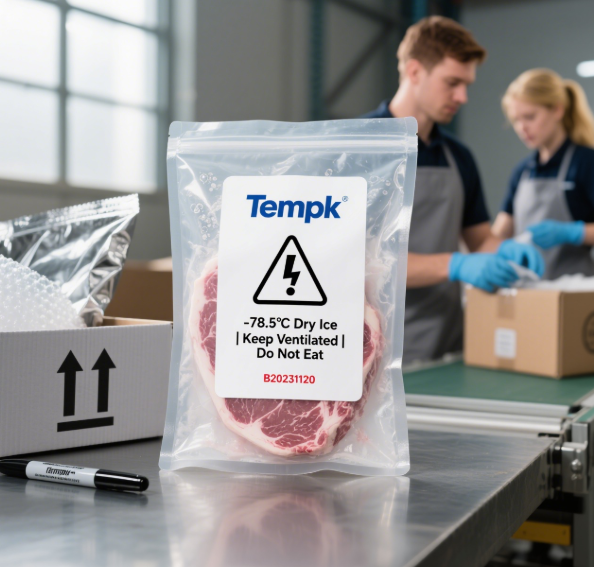
Dry Ice Packing Label: 2025 Compliance Guide (UN 1845, PI 954)
Tempk Compliance Team • Updated: August 8, 2025 • Read time: 9–12 minutes
TL;DR — Print on the outer package: “Dry ice/Carbon dioxide, solid” + “UN 1845” + net dry ice weight in kilograms + Class 9 hazard label; keep packaging vented; put the dry‑ice line on the air waybill (AWB). Class 9 label must be ≥100 × 100 mm; don’t write inside the diamond. Overpacks must show OVERPACK and the total dry ice net kg when inner marks aren’t visible.
What must appear on a dry ice packing label in 2025
Size, placement & text height (with quick table)
Exactly what to write on the Air Waybill (copy‑paste)
Mode & operator specifics: Air, USPS, passenger, UPS/FedEx
Overpacks, UN3373 & mixed contents
Step‑by‑step label builder (HowTo)
Materials that stick: facestock, adhesives & print
Common mistakes to avoid
FAQ
1) What must appear on a dry ice packing label in 2025
On the outside of each package:
Proper shipping name: “Dry ice” or “Carbon dioxide, solid.”
UN 1845.
Net weight of dry ice in kilograms (kg) on the package.
Class 9 hazard label (black‑and‑white stripes) affixed square‑on‑point.
Shipper & consignee names and addresses (package marking).
Packaging must allow CO₂ to vent (never airtight).
These are the core acceptance checks under IATA PI 954 and DOT; addresses/marking requirements are explicitly referenced in IATA 7.1.4.1 and DOT §172.301.
2) Size, placement & text height
| Element | Minimum spec | Placement / notes | Source |
|---|---|---|---|
| Class 9 label | ≥100 × 100 mm (square‑on‑point) | On a vertical side, unobstructed; do not write inside the diamond. | eCFRFedEx |
| UN/ID text height | 12 mm if >30 kg/L; 6 mm if >5 and ≤30 kg/L; appropriate size if ≤5 | Keep near the proper name; not inside the diamond. | FedEx |
| OVERPACK letters | ≥12 mm | Required if inner marks/labels aren’t visible. | Lion |
Why it matters: Label size and text height are frequent fail points. Carriers’ 2025 job aids emphasize keeping the Class 9 diamond full‑size where any face allows and never writing the net kg inside the symbol.
3) Exactly what to write on the Air Waybill (AWB)
In the AWB “Nature and Quantity of Goods”:
No Shipper’s Declaration is required when dry ice is used only as a refrigerant for non‑dangerous goods; operators accept electronic entries (eAWB) where agreed.
4) Mode & operator specifics <a id=”modes”></a>
Air (IATA/ICAO)
Max net dry ice per package: 200 kg (operator/state variations may set lower caps).
Vent the package for CO₂ release; follow PI 954.
Expect digital acceptance checks aligned to IATA DGR 66th (effective Jan 1, 2025).
Operator variation example: Some carriers impose lower per‑package limits (e.g., 68 kg in certain UPS tables). Always confirm your operator’s limit at booking.
USPS (domestic)
Air: ≤ 5 lb (2.27 kg) dry ice per mailpiece; mark UN1845 and ensure venting.
Surface: may exceed 5 lb; international mail prohibited.
Passenger baggage (FAA)
Passengers may carry up to 2.5 kg (5.5 lb) of dry ice per person with operator approval; package must vent and be marked with the net quantity or “2.5 kg or less.”
DOT/49 CFR small‑quantity exception (U.S.)
When ≤2.5 kg per package and used as a refrigerant, the package is excepted from all other requirements if it’s vented and marked with the proper name, UN1845, and the net weight (or the statement “2.5 kg or less”).
FedEx & UPS notes
FedEx job aids stress 100 mm hazard diamond and no writing in the diamond; they also mirror the IATA text‑height rules.
UPS follows IATA and publishes acceptance tables; caps may differ (see above).
5) Overpacks, UN3373 & mixed contents
If packages with dry ice go into an overpack and inner marks/labels aren’t visible, mark the overpack with “OVERPACK” (≥12 mm) and show the total net dry ice (kg) on the overpack. This clarification was reinforced for 2024/2025 and appears in the 66th‑edition checklist.
UN3373 (Biological Substance, Category B) + dry ice: Keep both marks: the UN3373 diamond (per PI 650) and the Class 9 + UN1845 + net kg for dry ice. A Shipper’s Declaration is not required for UN3373 or for dry ice used only as a refrigerant; note both on the AWB where applicable.
6) Step‑by‑step label builder (HowTo)
Weigh the dry ice you’ll load; record net kg.
Print core text: “Dry ice” (or “Carbon dioxide, solid”) and UN 1845.
Add the net kg prominently outside the hazard diamond.
Affix the Class 9 label (≥100 × 100 mm) on a vertical side.
Add shipper & consignee addresses on the outer carton.
Enter the AWB line: e.g.,
UN1845, Dry ice, 1 package x 6 kg.Overpack? Add OVERPACK (≥12 mm) and the total dry ice kg.
7) Materials that stick (and stay legible)
Use freezer‑/cryo‑rated adhesives validated for dry ice/−78.5 °C and below (e.g., cryogenic adhesives rated down to −196 °C).
Print with resin or wax‑resin thermal transfer ribbons for abrasion/moisture resistance; they outlast plain wax in wet docks and thaw cycles.
Apply to dry, unfrosted carton surfaces when possible; use a label backer (flat panel) on textured corrugate to prevent edge lift. (Vendor guidance; good practice for acceptance durability.)
8) Common mistakes to avoid
Writing net kg inside the Class 9 diamond. Don’t—keep the symbol clean.
Printing pounds only—kilograms are mandatory for acceptance (lbs may appear in parentheses).
Forgetting OVERPACK or the overpack total net kg when inner marks aren’t visible.
Using the lithium battery Class 9 variant by mistake—dry ice uses the generic Class 9 label.
Sealing packages airtight (no vent)—required to vent CO₂.
9) FAQ
Q1: What are the absolute must‑haves on the label?
A: Proper name (Dry ice/Carbon dioxide, solid), UN 1845, net kg, Class 9, shipper/consignee addresses; packaging must vent.
Q2: How big is the Class 9 diamond?
A: ≥100 × 100 mm; square‑on‑point; don’t write inside.
Q3: What AWB wording should I use?
A: UN1845, Dry ice, [X] package(s) x [Y] kg (no DGD when cooling non‑DG).
Q4: What’s the air limit per package?
A: 200 kg by IATA PI 954 (but operator variations may set lower caps—check your carrier).
Q5: USPS limits?
A: Domestic air ≤ 5 lb, surface may exceed, international not allowed.
Q6: Passenger travel with dry ice?
A: Up to 2.5 kg (5.5 lb) per passenger, with airline approval; vented, marked with net kg or “2.5 kg or less.” FAA
Copy‑ready label text (paste & fill)
Proper Shipping Name: Dry ice (Carbon dioxide, solid)
UN Number: UN 1845
Net Dry Ice: ____ kg
Class 9 hazard label: affix ≥100 × 100 mm on a vertical side; no writing inside
Shipper: [Full name & address]
Consignee: [Full name & address]
Overpack (if used): OVERPACK (≥12 mm) + Total dry ice: ____ kg
(Tip: kg = lb ÷ 2.2046. Show kg on the package; you may add lb in parentheses.)
Dry Ice Packing Peanuts (2025): Safe Shipping Guide
What “dry ice packing peanuts” really means
The 2025 rules you must meet (IATA, DOT, USPS)
Step‑by‑step packout (audit‑ready)
How much dry ice? Quick estimator
Which peanuts: EPS vs. biodegradable vs. paper
CO₂ safety: ventilation, exposure limits, signage
QA: labels, documents, acceptance checks
FAQs
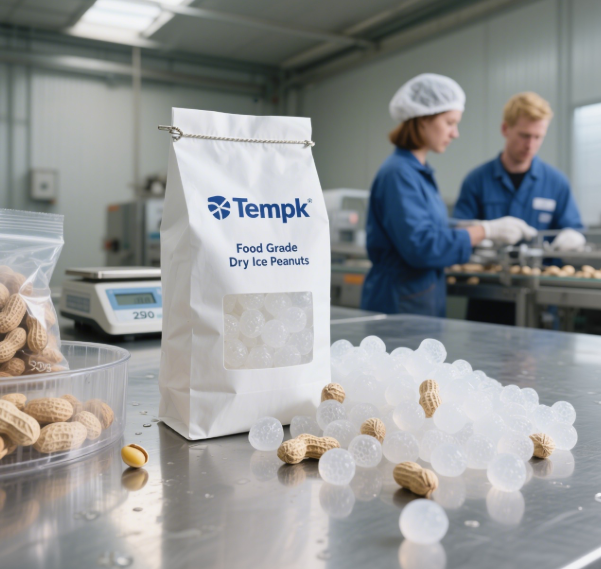
1) What “dry ice packing peanuts” really means
Direct answer: It’s the combination of dry ice (to hold temperature) and packing peanuts (to remove dead air and prevent product movement) inside an insulated, vented shipper. Regulations require CO₂ to vent; packages must be marked UN 1845 and show the net mass of dry ice (kg).
Air waybill text: Many university and carrier job‑aids require wording similar to: “Dry ice, 9, UN1845, number of packages X, net weight in kilograms.” Check your operator’s variation.
2) The 2025 rules you must meet (IATA, DOT, USPS)
IATA DGR 66th ed. (2025) + Addendum 1 (Apr 30, 2025): Dry ice shipped without other DG uses the Acceptance Checklist for Dry Ice (when a Shipper’s Declaration isn’t required). Keep state/operator variations in mind.
DOT (US) 49 CFR §173.217: Packaging must permit CO₂ release; mark UN 1845 and the net mass of dry ice on the package.
USPS Publication 52, Instr. 9A (domestic mail): Specific limits/packaging for dry ice; follow §349 plus 9A details for air pieces. International mail with dry ice is prohibited.
Note: Some acceptance job‑aids and EHS guides cite 200 kg max net dry ice per package under PI 954; operators may set stricter limits—always check carrier variations.
3) Step‑by‑step packout (audit‑ready)
Pick the shipper: EPS/EPP cooler (VIP for long lanes) nested in a corrugated outer.
Prep the payload: Bag/seal anything that may leak or thaw.
Load dry ice: Place around and above the product (do not wrap or seal dry ice); the package must vent.
Fill voids: After loading dry ice, eliminate remaining air space with packing peanuts or crumpled paper to immobilize contents and slow sublimation.
Close & mark: Apply Class 9 label, UN 1845, net dry‑ice kg, and shipper/consignee addresses to a vertical side panel; complete air waybill text.
Pro tip (acceptance speed): FedEx job‑aids highlight UN‑number mark size guidance (≥12 mm when package capacity >30 kg). Check the current job‑aid for your region.
4) How much dry ice? Quick estimator
Planning rule of thumb: 5–10 lb (2.3–4.5 kg) per 24 h for small insulated shippers (validate on your lane; add a delay buffer).
Estimator (include a buffer):
Choose days = ceil(hours/24)
Start at 3.6 kg/day (midpoint) × cooler factor (0.6 good / 1.0 average / 1.4 poor)
Add 20% delay buffer.
Example: 48 h, average cooler → 3.6×2×1.0 = 7.2 kg → +20% ≈ 8.6 kg dry ice.
5) Which peanuts: EPS vs. biodegradable vs. paper
| Material | Best use with dry ice | Moisture behavior | Weight impact | Notes |
|---|---|---|---|---|
| EPS (polystyrene) peanuts | Robust lanes; humid routes | Low moisture sensitivity | Lightest | Check local bans on EPS loose‑fill (e.g., NY statewide since 2022; WA since 2023; OR law effective 2025 prohibits sale of foam peanuts). |
| Biodegradable starch peanuts | Eco‑messaging; dry lanes | Water‑soluble; can slump with condensation | Heavier per volume (typ. 0.4–0.8 lb/ft³) | Starch films/coatings are hydrophilic; moisture resistance is weaker unless modified. |
| Paper/honeycomb | Bracing corners; humid routes | Low moisture risk | Moderate | Recyclable; good mixed with EPS or starch depending on route. |
Why fill voids at all? Dead‑air space speeds sublimation; removing it helps retain refrigerant and stabilizes temperature.
6) CO₂ safety: ventilation, exposure limits, signage
Gas volume: 1 lb dry ice → ~8.3–8.7 ft³ CO₂ at ambient conditions—plan room ventilation and vehicle airflow accordingly.
Exposure limits: OSHA PEL 5,000 ppm (8‑h TWA); NIOSH STEL 30,000 ppm, IDLH 40,000 ppm. Use monitors in small staging rooms.
Do not airtight‑seal inner liners or coolers; packaging must allow CO₂ to vent.
7) QA: labels, documents, acceptance checks
Air waybill (when no DG declaration): Include “Dry ice, 9, UN1845, number of packages X, net weight in kilograms.”
Acceptance checklist: Use IATA’s Dry Ice Acceptance Checklist and your carrier’s job‑aid at tender.
Common errors: Missing net kg, labels on top/bottom panels, or covering marks with tape. Follow carrier job‑aids for placement/size.
8) FAQs
Q1. Is there really a product called “dry ice packing peanuts”?
No. It’s a packout method: dry ice for cooling + peanuts for void fill inside a vented insulated shipper marked UN 1845 with net kg.
Q2. How much dry ice for 48 hours?
Most small/medium insulated parcels plan ~5–10 lb per day; for 48 h you’ll typically load 5–9 kg, plus a delay buffer. Validate on your lane.
Q3. Can I use biodegradable peanuts with dry ice?
Yes—just keep them dry. Starch‑based loose‑fill is water‑soluble and can slump under condensation; choose EPS or paper for humid routes.
Q4. What must be on the box?
Class 9 label, UN 1845, and net dry‑ice weight (kg), plus shipper/consignee addresses; follow IATA/49 CFR and carrier job‑aids.
Q5. Are there state bans impacting EPS peanuts procurement?
Yes. Examples: NY (2022), WA (2023), OR (2025) restrict sale/distribution of EPS loose‑fill. Source EPS alternatives when shipping into those markets.
Dry Ice Packing Instruction 2025: PI 954 & 49 CFR
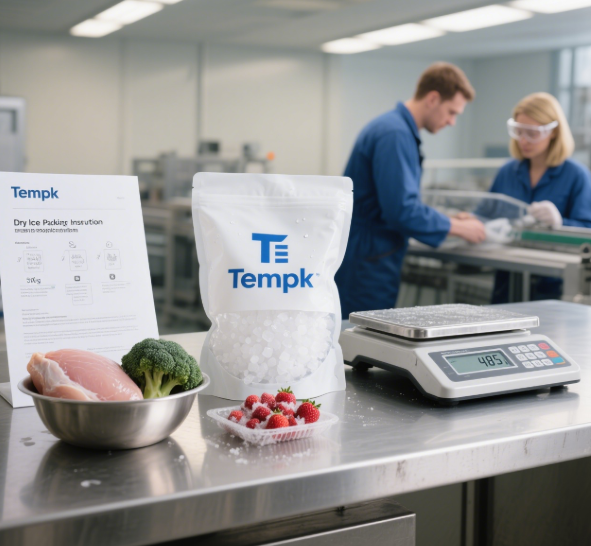
Dry Ice Packing Instruction (2025): A Practical, Compliant How‑To
Use vented packaging, mark “Dry Ice”/“Carbon dioxide, solid” + UN 1845, add net dry ice mass in kg on the outer package, and apply a Class 9 hazard label (min 100×100 mm). For air, follow IATA PI 954, respect the ≤ 200 kg per package cap, and include the dry‑ice line on the Air Waybill (AWB):UN 1845, Dry Ice, x packages × y kg (net per package) (no Shipper’s Declaration when cooling non‑DG; carrier/state variations may apply).
USPS is different: domestic air mail ≤ 5 lb of dry ice per piece and requires a Shipper’s Declaration affixed; international mail with dry ice is prohibited.

1) What rules actually apply in 2025
2) Marks, labels, sizes—exactly what goes where
3) How much dry ice to use (calculator & rules of thumb)
4) Step‑by‑step packout (PI 954‑aligned)
5) Carrier specifics: FedEx, UPS, USPS
6) Dry ice pack for shipping food (practical recipe)
7) Safety (CO₂ exposure, venting, disposal)
8) 2025 updates to watch
9) FAQ
1) What rules actually apply in 2025
Air (global): IATA DGR PI 954 governs dry ice (UN 1845). It requires vented packaging, proper marking & labeling, the net dry‑ice mass in kg on the package, and AWB information when a Shipper’s Declaration isn’t required (i.e., dry ice used only as a refrigerant for non‑dangerous goods). Operators may impose variations and ask you to declare dry‑ice weight at booking.
U.S. (all modes / aircraft specifics): 49 CFR § 173.217 requires vented packaging and net mass (kg) on the outside for air. Documentation for air transport of dry ice used only as refrigerant is generally handled on the AWB when no DGD is required.
USPS mail (postal network): USPS Packaging Instruction 9A caps air mailpieces at ≤ 5 lb dry ice per piece, requires Class 9 labeling and markings, and requires a Shipper’s Declaration for air mail; international mail with dry ice is prohibited. (USPS surface mail rules differ.)
EU road (ADR): Dry ice used as a coolant is not subject to ADR beyond section 5.5.3 (asphyxiant‑gas provisions)—focus on vehicle ventilation and the package/vehicle markings that may apply in ventilation‑risk scenarios.
2) Marks, labels, sizes—exactly what goes where
On the outer package (air):
Proper shipping name: “Dry Ice” or “Carbon dioxide, solid”
UN 1845
Net mass of dry ice in kilograms (kg only)
Class 9 hazard label, minimum 100 mm × 100 mm
Shipper & consignee addresses (same panel when feasible)
Practical rules that stop rejections: Keep the Class 9 label clear (don’t write inside the diamond). Put UN 1845 and net kg adjacent to the Class 9 when space allows. Use the AWB line for non‑DG cargo chilled by dry ice.
Why venting matters: Packaging must permit CO₂ release; sealed containers can rupture. That’s a requirement in 49 CFR § 173.217 and mirrored in carrier job aids.
Package quantity limits: Under PI 954, the typical maximum net dry ice per package is 200 kg (operators may set lower limits).
3) How much dry ice to use (calculator & rules of thumb)
Engineering method (most accurate):
Dry ice absorbs ~571 kJ/kg on sublimation. Estimate your shipper’s heat gain (kJ/h), multiply by transit hours, then ÷ 571 to get kg of dry ice; add +20–30% buffer for handoffs or hot routes.
Formula:
Dry‑ice kg ≈ (Heat gain kJ/h × Hours) / 571, then × 1.2–1.3 (buffer)Source for enthalpy: NIST Chemistry WebBook.
Field rule of thumb (fast planning):
Plan on ~5–10 lb (2.3–4.5 kg) per 24 h in a well‑insulated shipper; blocks last longer than pellets. Start at the low end in VIP/thick EPS; add +25–50% for hot lanes (> 90 °F) or thin insulation.
Placement: Top‑load blocks and surround with pellets; cold gas sinks, so top‑down cooling is efficient. (University and carrier guidance recommend top placement.)
4) Step‑by‑step packout (PI 954‑aligned)
Pre‑condition: Freeze product; pre‑chill the shipper interior.
Choose vent‑capable insulation: EPS/EPP/VIP or validated systems; no airtight liners/lids.
Line & segregate: Poly liner/absorbent as needed; prevent direct dry ice contact with unpackaged food.
Load & position dry ice: Blocks on top, pellets around sides; stabilize voids to prevent shifting.
Close—but do not seal airtight: Tape outer carton but maintain vent paths.
Apply marks & labels: “Dry Ice/Carbon dioxide, solid,” UN 1845, net kg, Class 9 (100×100 mm).
Complete documents: For non‑DG cooled by dry ice, put the dry‑ice line on the AWB; check operator/state variations.
Tender & track: Ship early in the week; use data loggers for high‑value lanes.
5) Carrier specifics: FedEx, UPS, USPS
FedEx (air): On paper airbills, check “Shipper’s Declaration NOT Required” (when dry ice only cools non‑DG). Use this AWB syntax:
UN 1845, Dry Ice, __ x __ kg(packages × net kg per package). Also, Class 9 label must be ≥ 100×100 mm; don’t write inside the diamond.UPS: Expect an acceptance audit. Mark “Dry Ice/Carbon Dioxide, Solid” + UN 1845; keep packages vented; UPS healthcare guidance echoes the 5–10 lb/24 h planning rule.
USPS mail: Domestic air: ≤ 5 lb per mailpiece + Class 9 + required markings and a Shipper’s Declaration affixed. International: prohibited.
6) Dry ice pack for shipping food (practical recipe)
Target: Keep frozen foods below 0 °C for 48 h on 2‑day service.
Start with: 10–20 lb dry ice for a medium EPS (20–30 qt) shipper (increase in summer or thin walls).
Method: Pre‑freeze goods, line with poly, top‑load dry ice blocks, fill side voids with pellets/foam, keep vent paths.
Labeling: “Dry Ice/Carbon dioxide, solid,” UN 1845, net kg, Class 9.
Want to target the keyword “dry ice pack for shipping food” more directly? Link this section to a deeper recipe page (internal hub) with packout photos and calculators.
7) Safety (CO₂ exposure, venting, disposal)
Exposure limits: OSHA PEL 5,000 ppm (8‑h TWA); STEL 30,000 ppm. NIOSH IDLH 40,000 ppm. Use ventilation and avoid confined spaces and vehicles without airflow.
Gas volume: ~250 L CO₂ per lb of dry ice—one reason airtight is a hard no.
PPE: Insulated gloves and eye protection; avoid direct skin contact (frostbite risk).
Disposal: Let remaining dry ice sublime in ventilated areas; never in sinks/closed rooms (risk of pressure/CO₂ buildup).
8) 2025 updates to watch
IATA 2025 acceptance checklists: IATA published a 2025 Dry Ice Acceptance Checklist template; operators can request declared net dry ice at booking to manage aircraft CO₂ limits. Continue to check operator/state variations.
Core DGR edition: The 66th Edition (effective Jan 1, 2025) is in force; addenda may update checklist wording—stay current on the IATA site and your carrier job aids.
9) FAQ
Q1: Is there a hard maximum per package by air?
A: Commonly ≤ 200 kg net dry ice per package under PI 954; carriers can impose lower limits or aircraft‑type caps. Always verify operator variations.
Q2: Do I need a Shipper’s Declaration (DGD) for dry ice?
A: Not when dry ice is only cooling non‑dangerous goods in air cargo—use the AWB entry. If cooling dangerous goods, a DGD is required. Note: USPS air mail requires a DGD even for dry‑ice‑cooled non‑DG.
Q3: Pounds or kilograms on the box?
A: Kilograms are required on the outer package for air shipments (net dry ice mass).
Q4: What’s the most common labeling mistake?
A: Missing net kg and undersized Class 9 labels. Use 100 × 100 mm minimum; don’t write inside the diamond.
Q5: Can I send dry‑ice‑cooled parcels by USPS internationally?
A: No. International mail containing dry ice is prohibited by USPS
Dry Ice Packing Group (2025): Build, Validate & Scale
Dry Ice Packing Group (2025): How to Build, Validate & Scale Frozen Shipping
Last updated: August 8, 2025 • Reading time: 9–12 min

1) What a “Dry Ice Packing Group” Is—and Why It Matters
A Dry Ice Packing Group is a cross‑functional capability that designs, qualifies, and runs compliant frozen shipments at scale. It combines: (1) Regulatory ownership, (2) Thermal design & validation, (3) SOPs & training, (4) Supplier & carrier management, and (5) Operational analytics for melt‑rate and OTD.
This article synthesizes best practices and field patterns highlighted across your three drafts (team roles, SOP templates, procurement and local intent coverage).
2) Regulatory Ground Truth (2025)
Classification & Limits
UN number & hazard class: UN1845 – Carbon dioxide, solid (Dry ice), Class 9; no packing group assigned in the HMR entry.
Air shipments (IATA): Governed by Packing Instruction 954. The IATA 2025 Dry Ice Acceptance Checklist (66th DGR) requires UN number, proper shipping name, and net dry ice weight in kg on the air waybill. Typical quantity limit is 200 kg per package; always check State/Operator variations.
U.S. HMR ventilation & markings: Packages must be designed to vent CO₂; vessel/vehicle markings are specified in 49 CFR §173.217.
Domestic postal reference: USPS PI 9A caps dry ice in domestic air mail at 5 lb (≈2.27 kg) per mailpiece (for context; carriers differ).
Note: Some secondary sources misstate “PG III” for dry ice; this is incorrect for UN1845. Your new SOPs should reflect “Class 9, no PG,” and PI 954 (not “PI9700”).
Passenger baggage exception (for awareness)
Passengers may carry up to 2.5 kg of dry ice in checked/hand baggage under IATA personal baggage provisions, provided venting and marking. This does not apply to cargo operations but helps explain airline‑level constraints.
3) People, Roles & SOP (Your Operating Model)
Core roles
DG Compliance Lead: Owns IATA/IMDG/49 CFR interpretations, change‑log, and acceptance checklists.
Thermal Packaging Engineer: Calculates heat load, selects insulation and dry ice mass, and drives ISTA 7E qualification.
Operations Supervisor: Trains packers, enforces labeling, runs re‑icing cadence, monitors exceptions.
Procurement & Quality: Approves suppliers (dry ice pellets/blocks, VIP sets), keeps SDS and COAs current.
Data & CX: Tracks INP/LCP/CLS on key pages, local SEO footprint, and customer feedback loops.
SOP (excerpt)
Verify contents (non‑DG vs DG) and lane → select PI 954 flow.
Choose box & insulation; add vented primary and overpack.
Compute dry ice mass (see §4).
Pack, mark & label (Class 9 for air) and AWB entries (UN1845 + proper name + net kg).
Acceptance self‑check using IATA 2025 Dry Ice Checklist.
Handover; record net dry ice and time‑to‑melt assumptions.
4) Pack‑Out Design & Validation
4.1 Materials & Configuration
Insulation:
EPS/EPP/PUR: economical, moderate R‑value; larger ice loads.
VIP shippers: center‑of‑panel conductivity around 0.004–0.008 W/m·K vs PUR ~0.02–0.03 W/m·K (≈4–6× better), enabling longer holds or smaller cube.
Containment: Use durable corrugated or molded outer, do not seal airtight; the system must vent CO₂.
4.2 How to Size Dry Ice (engineering shorthand)
Heat load ≈ U·A·ΔT·t + infiltration + door/opening losses.
Rule of thumb for sublimation energy: ~571 kJ/kg (derived from NIST ΔH_sub ≈ 25–27 kJ/mol). Use your chamber profile to back‑solve required kg.
4.3 Qualification
Execute lab & field cycles against ISTA 7E (72/144 h heat/cold profiles). For certification or audited documentation, apply Standard 20 with 7E.
5) Acceptance, Marking & Labeling (Air)
Before tender:
Confirm max net dry ice per package against PI 954 (typically 200 kg), check State/Operator variations and aircraft constraints.
On the Air Waybill, include: UN1845, “Carbon dioxide, solid” or “Dry ice,” number of packages, and net weight of dry ice in kilograms.
On package: Class 9 label (air), proper shipping name, UN1845, net kg; ensure venting. (FedEx 2025 job aid reflects the same 200 kg/package ceiling and marking details.)
6) Safety & Training
CO₂ exposure: Follow OSHA exposure guidance—typical PEL 5,000 ppm TWA; STEL ≈ 30,000 ppm (per NIOSH/agency guidance). Ventilate and monitor confined spaces.
Handling: Frostbite risk; use cryo‑gloves and tongs. Never place dry ice in sealed containers.
Air ops: Operators may limit total aircraft dry ice loading; disclose net weights during booking per operator variations.
Dry Ice Pack for Shipping Food: The 2025 Expert Guide
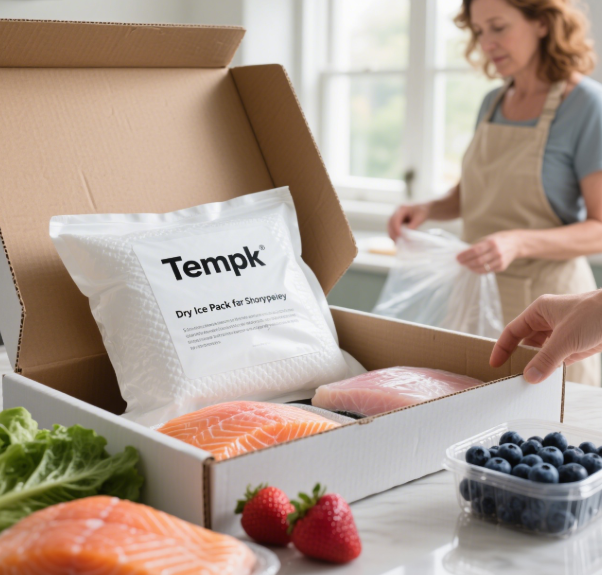
Dry Ice Pack for Shipping Food (2025): Safe, Compliant & Cost‑Smart

What dry ice packing is—and why it works
How much dry ice you really need (calculator + examples)
Step‑by‑step pack‑out that passes audits
2025 regulations cheat sheet (IATA/DOT/USPS)
Safety: PPE, ventilation & CO₂ exposure
Dry ice vs. gel packs vs. PCMs/VIPs
Food‑specific tips: meat, ice cream, seafood
FAQs
What dry ice packing is—and why it works
Dry ice is solid CO₂ that sublimates at –78.5 °C (–109.3 °F), so it keeps loads frozen without meltwater. As it sublimates, it displaces air with dense CO₂ gas; packaging must be able to vent.
Key physics for planners
Gas volume: ~8.8 ft³ CO₂ per lb of dry ice; sublimation rate depends on format (pellet vs. block), insulation, and ambient profile.
Top‑loading helps: CO₂ sinks, so placing dry ice above the payload improves envelope temperature uniformity.
How much dry ice you really need
Rule‑of‑thumb starting point: 5–10 lb per 24 h in a typical insulated shipper, plus one extra day as a delay buffer; then validate with a data logger on your lane.
Lane‑aware calculator (pragmatic, not regulatory)
Start load = (5–10 lb × hours/24) × Insulation factor × Ambient factor + one 24 h base load as buffer.
Insulation factor: VIP × 0.7 · EPS (1–1.5″) × 1.0 · Minimal insulation × 1.3
Ambient factor: Mild (<25 °C) × 1.0 · Hot (25–35 °C) × 1.2 · Very hot (>35 °C) × 1.4
Example (48 h, EPS, ~30 °C): (5–10 lb × 2)×1.0×1.2 + (5–10 lb) ≈ 17–34 lb. Validate before scale‑up.
Why this range works: It reflects widely cited operational guidance and real‑world thermal behavior; still, validate on your specific shipper and lane.
Step‑by‑step pack‑out that passes audits
Choose the right shipper. EPS for cost; VIP for long lanes/weight savings—ideally validated to ISTA 7E (72/144 h) with Standard 20 documentation.
Pre‑chill payload. Freeze to ≤0 °F (–18 °C) before packing for frozen shipments.
Line & segregate. Keep sensitive items off direct contact with dry ice.
Add dry ice (top‑load preferred) and fill voids to reduce air exchange (slower sublimation).
Ensure venting. Never seal airtight; permit CO₂ release. (Required by DOT for air/water; also in IATA PI 954.)
Close, then mark & label:
Proper shipping name: “Carbon dioxide, solid” or “Dry ice”, UN 1845
Net weight of dry ice in kilograms on each package
Class 9 hazard label (diamond ≥100 mm)
Docs: For air consignments with only dry ice + non‑dangerous goods, a Shipper’s Declaration is not required; include the required text on the Air Waybill. Always honor state/operator variations.
2025 regulations cheat sheet (quick‑ref)
IATA DGR 66th (effective Jan 1, 2025):
≤200 kg dry ice per package by air; PI 954 requires vented packaging; AWB must list UN1845, proper name, number of packages, and net kg. Operator variations apply.
U.S. DOT (49 CFR 173.217):
Packaging must permit CO₂ release to avoid rupture; mark net mass externally for aircraft; shipper must arrange with operator.
2.5 kg (5.5 lb) per package exception for certain air shipments if marked as specified (still vent!).
USPS (Postal Explorer):
International mail: prohibited.
Domestic air: ≤5 lb of dry ice per mailpiece; follow Packaging Instruction 9A.
Carrier guides (example FedEx):
Class 9 label ≥100×100 mm; UN 1845 text and net kg required; many carriers echo ≤200 kg per package consistent with IATA.
Practical takeaway: Bookings sometimes require declaring net kg at time of tender to ensure aircraft CO₂ limits aren’t exceeded (operator variations).
Safety: PPE, ventilation & CO₂ exposure
People: Use insulated gloves and eye protection; handle in well‑ventilated spaces.
Exposure limits: OSHA PEL = 5,000 ppm (8‑h TWA); NIOSH STEL = 30,000 ppm (15 min). Consider CO₂ monitors in pack rooms, coolers, and vehicles.
Vent awareness: 1 lb → ~8.8 ft³ CO₂; staging many boxes in a small room can spike CO₂—use exhaust, open doors, and limit batch size.
Dry ice vs. gel packs vs. PCMs/VIPs (which to choose?)
Dry ice: Deep‑frozen/ultracold; strict marks/labels; heavier than some VIP+PCM combos.
Gel packs (water‑based): Best for 2–8 °C; simpler compliance; possible condensate/leaks.
PCMs + VIP shippers: Tune setpoints (e.g., –21 °C or +5 °C); validated VIP systems cut refrigerant mass and total freight on 72–144 h lanes.
<Food‑specific tips (meat, ice cream, seafood)
Ice cream: Aim to keep < –20 °C end‑to‑end; prefer VIP on 72 h lanes; top‑load dry ice; minimize headspace.
Meat/seafood: Pre‑freeze hard; use liners to avoid direct contact; consider pellets + blocks for faster start and longer tail.
Ops: Weekends add risk—ship early week and add a full‑day buffer.
FAQs
How much dry ice for 48 h?
Start with 10–20 lb depending on shipper and lane, plus a 24‑h buffer; verify with pilots and a data logger.
Do I need a Shipper’s Declaration for dry ice?
If dry ice is the only dangerous good and it’s cooling non‑dangerous goods by air, no Shipper’s Declaration is required; include the proper AWB text and labels. Carrier variations may add requirements.
Is dry ice allowed in international mail?
No. USPS prohibits dry ice in international mail; domestic air is ≤5 lb with Packaging Instruction 9A.
Can I seal dry ice inside a bag?
No—packaging must vent; never airtight.
What are the safe exposure limits?
OSHA 5,000 ppm (TWA); NIOSH 30,000 ppm (STEL). Use monitors in small rooms
Dry Ice Packet Price 2025: Cost Ranges, Key Factors & Savings Strategies
Quick Takeaways
Retail: $2–$4/lb; Bulk/Contract: $0.60–$1.20/lb (location & season dependent)
Primary cost drivers: order volume, geography, dry ice form, compliance, packaging, and storage losses
Alternatives: PCM phase-change packs or gel packs can reduce dry ice usage for certain routes and temperature profiles
1. Pricing Fundamentals: How Dry Ice Is Sold
Dry ice is priced by weight (per pound or kilogram). The unit price decreases with larger volumes due to economies of scale. While form (pellets, blocks, pre-packed units) influences price slightly, the dominant factor is weight and total order size.
Example:
1–5 lbs retail: $2–$4/lb
50 lbs: ~$1.50/lb
500 lbs: ~$0.80/lb under wholesale terms
2. Six Key Factors Influencing Price
Order Volume – Bulk contracts with tiered pricing deliver the lowest unit costs.
Geography & Transport Distance – Sourcing near production reduces freight and sublimation losses.
Form & Packaging – Pellets may cost slightly more than blocks; pre-filled insulated packs command a premium but extend holding time.
Compliance & Handling Fees – Air freight hazardous materials surcharges (IATA PI 954) increase total cost.
Temperature Monitoring – Built-in data loggers improve shipment reliability but add to per-unit cost.
Loss Rate (Sublimation) – Daily losses of 5–10% are common; better insulation or just-in-time delivery lowers effective cost.
3. Typical Price Tiers (2025)
| Order Volume | Approx. Price (USD/lb) | Total Cost Example | Use Case | Notes |
|---|---|---|---|---|
| 10 lbs | ~$2.00 | ~$20 | Urgent/small shipments | Baseline retail rate |
| 50 lbs | ~$1.50 | ~$75 | Scheduled distribution | ~25% per-lb savings |
| 500 lbs | ~$0.80 | ~$400 | High-frequency shippers | Near wholesale pricing |
4. Dry Ice vs. PCM vs. Gel Packs
| Cooling Medium | Typical Price Range* | Optimal Temp/Duration | Applications | Cost Advantage |
|---|---|---|---|---|
| Dry Ice | $1.50–$3.00 retail; $0.60–$1.20 bulk | −78 °C, short-to-mid haul | Pharma, biotech, frozen food | Best for ultra-low temps |
| PCM Packs | $0.80–$2.50 | −25 °C to −18 °C, mid-to-long haul | Frozen/chilled goods | Extended duration, reusable |
| Gel Packs | $0.30–$1.00 | 0–8 °C or −5–0 °C | Light cold chain | Lowest cost per unit |
*Based on aggregated 2025 supplier data; actual rates vary by region and vendor.
5. Market Trends & Outlook (2025)
Demand Growth – Driven by e-commerce fresh food, global pharma, and biotech logistics
Supply Stabilization – Post-2022 CO₂ shortages addressed via diversified feedstock and new production capacity
Sustainability Innovations – CO₂ capture/recycling reduces production cost up to 40%, supporting stable prices
Hybrid Cooling Solutions – Strategic use of PCM/gel packs to offset dry ice consumption
6. Procurement Channels
Local Retail (e.g., supermarkets) – Immediate access, highest per-lb cost
Specialized Industrial Suppliers – Scheduled delivery, bulk discounts, custom packaging
Contract Procurement – Ideal for high-frequency lanes; stable pricing & guaranteed capacity
7. Twelve Proven Cost-Reduction Tactics
Consolidate orders to access tiered pricing
Source locally to cut freight and loss
Match form to route length (pellets for short, blocks for long)
Upgrade insulation to extend hold time
Optimize pack-out to reduce air gaps
Minimize transit time and re-openings
Integrate temperature data logging to avoid over-packing
Avoid over-buying; plan just-in-time
Combine dry ice with PCM or gel packs
Maintain dual suppliers for price resilience
Train handlers to minimize waste and safety incidents
Track total landed cost (unit price + freight + loss + re-icing) regularly
8. FAQs
Q1: What is the typical per-pound price in 2025?
A: $2–$4/lb retail; $0.60–$1.20/lb for bulk/contract buyers.
Q2: Is bulk purchase more economical?
A: Yes. Volume discounts can reduce unit cost by over 60% versus retail.
Q3: Can I ship dry ice internationally?
A: Yes, but comply with IATA PI 954 and hazardous goods handling rules; expect additional charges.
Q4: How to reduce dry ice without risking product integrity?
A: Improve insulation, shorten transit, and combine with PCM or gel packs.
9. About Tempk
Tempk delivers dry ice packs, PCM solutions, and insulated packaging to food, pharma, and biotech shippers. We offer bulk pricing, tailored insulation systems, and temperature-monitoring integration to optimize cold chain performance and cost efficiency.
Dry Ice Pack for Shipping Food (2025 Guide): Safety, PI 954 Rules, Sizing & Greener Options
Dry Ice Pack for Shipping Food (2025 Guide)
What a dry ice pack is—and when food shippers should use it
Dry ice vs. gel vs. PCM (for food lanes)
Sizing the charge (with a fast formula & examples)
How to pack frozen food with dry ice (step‑by‑step)
2025 regulations you must meet (air & baggage)
Food‑specific best practices (quality & safety)
Handling, disposal & worker safety
Sustainability: lower‑carbon options for your program
FAQs
References & next steps
1) What a dry ice pack is—and when food shippers should use it
A dry ice pack/packet is sealed solid CO₂ that cools by sublimation (~−78.5 °C / −109 °F). It keeps cartons dry (no meltwater) and enables deep‑freeze lanes for ice cream, seafood, meat, and ready‑to‑eat frozen meals during transit windows of 24–72 h depending on insulation and charge. Use it when your target hold ≤−20 °C or you need “frozen hard” delivery without powered refrigeration.
2) Dry ice vs. gel vs. PCM (for food lanes)
| Cooling option | Typical hold temp | Pros | Cons | Best for |
|---|---|---|---|---|
| Dry ice pack | Source ~−78.5 °C; supports ≤−20 °C | Deep‑freeze headroom; no water | Class 9 DG; needs venting & labels | Frozen foods (ice cream, seafood), long lanes |
| Gel pack | ~0 to −10/−20 °C | Simple, reusable, non‑DG | Limited cold depth | Chilled perishables, short lanes |
| PCM pack | Tuned setpoints (e.g., 2–8 °C, −20 °C) | Tight control; reusable | Upfront cost; weight | Pharma foods or lanes not needing −78.5 °C |
This comparison consolidates your draft’s structure and aligns with common cold‑chain practice.
3) Sizing the charge (fast)
Rule of thumb: Expect 5–10 lb of dry ice to sublimate per 24 h in a properly insulated shipper. Add +25% buffer for hot weather, weekend dwell, or multi‑stop routes.
Formula:Dry ice (lb) = (Transit hours ÷ 24) × (5 to 10)
Worked examples (food focus):
Ice cream, 36 h, medium EPS shipper: 10–15 lb; place packs above payload; add +3 lb buffer for summer Friday dispatch. UPS
Seafood, 48 h, premium vacuum‑panel shipper: 12–20 lb; add data logger; instruct consignee on safe venting on receipt. UPS
Why above the load? CO₂ gas is heavier than air; top‑loading helps cold gas flow across the food evenly.
4) How to pack frozen food with dry ice (step‑by‑step)
Pre‑chill the insulated container.
Bag & seal food (vacuum/pouches) to prevent freezer burn and odor transfer.
Add a separator (tray/pad) so food doesn’t touch dry ice directly.
Place dry ice packs on top of the food space.
Vent the shipper—never airtight.
Mark & label:
Proper shipping name + UN #: “Carbon dioxide, solid (Dry ice), UN 1845”
Net weight (kg) of dry ice on each package
Class 9 hazard label
Add temperature logger and SOP insert for the receiver.
5) 2025 regulations you must meet (air & baggage)
Air cargo (non‑DG contents cooled by dry ice): Follow IATA Packing Instruction 954. Key checks include vented packaging, correct marks/labels, net weight in kg, and a per‑package max of 200 kg dry ice. Acceptance checklists were updated for 2025 (66th ed.).
Passenger & crew baggage: A different rule (Table 2.3.A) permits ≤2.5 kg of dry ice per person if the baggage can vent; baggage must be marked “dry ice” and show net mass or “2.5 kg or less.”
Carrier/operator variations: Carriers (e.g., FedEx) publish 2025 DG dry‑ice checklists—verify before tender.
Always reconcile state/operator variations and declare properly on the Air Waybill; incorrect marking is a common delay cause.
6) Food‑specific best practices (quality & safety)
For mail‑order food: Use a sturdy box, choose dry ice for frozen goods, and warn the recipient on the outer carton; avoid direct food contact.
Avoid under‑insulation: If the payload is not meant to freeze (e.g., chilled bakery), use gel/PCM instead of dry ice.
Follow PHMSA/US DOT guidance for any perishable package likely to move by air legs.
7) Handling, disposal & worker safety
PPE: Use insulated/cryogenic gloves and eye protection; never bare‑hand dry ice.
Ventilation: 1 lb of dry ice releases ~250 L CO₂—risk of oxygen displacement in confined spaces; open and stage in ventilated areas.
Disposal: Let dry ice sublimate in a ventilated area; never in sinks or sealed bins.
Training: Ensure anyone preparing paperwork or packouts for air transport is trained on IATA/DOT rules.
8) Sustainability: lower‑carbon options for your program
CO₂ recovery at pelletizers: Modern recovery systems capture vented CO₂ during production and recycle it back to liquid—cutting liquid CO₂ use by ~50% in many installs and reducing scope‑related impacts.
Biogenic CO₂ sourcing: Where available, biogenic/captured CO₂ streams (e.g., from fermentation/biogas) can lower lifecycle impact relative to fossil sources.
Right‑sizing & hybrids: Replace some lanes with PCM panels where frozen‑hard isn’t required; keep dry ice for truly ultracold/frozen lanes.
Good practice: Understand environmental aspects around dry‑ice/CO₂ facilities and implement operational controls.
9) FAQs
Q1. How much dry ice do I need to ship frozen food for 48 h?
Plan 10–20 lb total (5–10 lb per 24 h) depending on insulation; add +25% buffer for heat or delays. Place packs on top.
Q2. What labels are mandatory on the box?
Mark “Carbon dioxide, solid (Dry ice), UN 1845”, add net weight (kg) on each package, and apply the Class 9 label; packaging must vent.
Q3. Can I fly with dry ice in checked baggage?
Yes—if the bag can vent and you carry ≤2.5 kg per person with required marking (see IATA Table 2.3.A).
Q4. Is dry ice safe for food shipments?
Yes, when isolated from direct contact, vented, and handled with PPE; it keeps foods deeply frozen without water mess.
Q5. How do I dispose of leftover dry ice on delivery?
Let it fully sublimate in a well‑ventilated area away from people and pets; never put it in sinks or sealed containers.
10) References & next steps
IATA 2025 Acceptance Checklist (PI 954, marks & 200 kg limit)—use it to pass acceptance first time.
UPS dry‑ice guidance (5–10 lb/24 h rule)—baseline sizing for food shippers.
Baggage rule (2.5 kg/pax)—IATA Table 2.3.A excerpt.
Safety (PPE/venting; 250 L CO₂ per lb)—OSHA & university EHS summaries.
USDA/FSIS mail‑order food tips—consumer‑safe delivery practices.
Dry Ice Packaging Near Me (2025): Best Local & Online Cold‑Chain Solutions
Dry Ice Packaging Near Me: The 2025 Buyer’s Guide for Food & Pharma Shipping
What Is Dry Ice Packaging—and Why It Works
How to Find Dry Ice Packaging Near You (Fast)
Choosing the Right Shipper: Food vs. Pharma
How Much Dry Ice Do You Need? (Quick Table)
Safe & Compliant Shipping (2025 Rules)
Pro Packing Checklist
FAQ
About Tempk
1) What Is Dry Ice Packaging—and Why It Works
Dry ice is solid CO₂ that sublimates (solid → gas) around –78.5 °C. Because it doesn’t melt into liquid, it keeps payloads dry while holding deep‑freeze temperatures for long routes. That’s why it’s the go‑to for ice cream, seafood, meats and temperature‑sensitive pharma where staying frozen really matters. (Concepts consolidated from your drafts.)
2) How to Find Dry Ice Packaging Near You (Fast)
Use a two‑track approach:
A. Local same‑day pickup
Search “dry ice + your city” and call welding supply stores, grocery chains, ice distributors for block/pellet availability.
Ask if they also sell EPS/PU foam coolers or liners. (Local‑sourcing idea adapted from your drafts.)
B. Online specialty suppliers
Order ready‑to‑ship kits (insulated shipper + dry ice packs/liners) delivered 1–2 days before your ship date—ideal if local supply is thin or you ship often.
SEO tip for “near me” queries: Ensure your Google Business Profile is complete (address/phone/hours/categories), keep reviews active, and embed consistent NAP data on the page. Local ranking is driven by relevance, distance, and prominence—not repeating “near me.”
3) Choosing the Right Shipper: Food vs. Pharma
For frozen food (–18 °C or below):
Insulation: EPS (polystyrene) is cost‑effective; PU/vacuum‑panel shippers last longer for 48–72 h legs.
Placement: Keep product bagged, separate from dry ice with cardboard/paper layers to prevent freezer burn. (Materials & practices summarized from your drafts.)
For pharma/biologics (some require ≤ –60 °C):
Prefer tested dry‑ice shippers, and add data loggers for traceability.
Confirm carrier acceptance and destination rules before booking (airlines/operators may have specific variations). IATA
Hybrid loads (frozen + chilled parts):
Combine dry ice (frozen items) with PCM/gel packs (2–8 °C components) to avoid over‑freezing sensitive items. (Technique consolidated from your drafts.)
4) How Much Dry Ice Do You Need? (Quick Table)
Rule of thumb: plan 5–10 lb (2.3–4.5 kg) per 24 h in a quality insulated shipper; add +24 h buffer for delays. Exact need varies by shipper size, ambient temps, and how full you pack the box.
| Transit time | Recommended dry ice (range) | Notes |
|---|---|---|
| ≤12 h | 3–6 lb (1.4–2.7 kg) | Short hauls / well‑insulated, payload pre‑frozen |
| ~24 h | 5–10 lb (2.3–4.5 kg) | Baseline per UPS/FedEx guidance UPSFedEx |
| ~36 h | 8–15 lb (3.6–6.8 kg) | Consider thicker insulation |
| ~48 h | 10–20 lb (4.5–9.1 kg) | Prefer PU/VIP shippers |
| 72 h+ | 20–35 lb (9–16 kg)+ | Use high‑performance systems / split replenishment |
Always pre‑chill contents and fill voids to reduce sublimation.
5) Safe & Compliant Shipping (2025 Rules)
UN Number & Proper Shipping Name:
UN1845 / Carbon Dioxide, Solid (Dry Ice) — (kg)Air Transport (IATA):
Comply with IATA Packing Instruction (PI) 954. Packaging must be capable of venting to prevent pressure build-up. The air waybill must declare UN1845, the proper shipping name, the number of packages, and the net weight of dry ice. Follow any additional requirements specified by the operator or airline. (Reference: IATA Dangerous Goods Regulations – PI 954)U.S. Ground Transport (49 CFR):
For quantities ≤ 2.5 kg per package used as a refrigerant, most requirements may be waived if specific marking conditions are met. Quantities exceeding this threshold must comply with the applicable provisions of 49 CFR.Operational Safety Guidelines:
Wear insulated protective gloves when handling.
Maintain adequate ventilation.
Do not seal packages completely—ensure CO₂ gas can be safely vented.
Prevent direct contact between dry ice and food or specimen surfaces.
6) Pro Packing Checklist
Pre-Shipment Preparation & Packaging Instructions
Pre-freeze all contents before packing.
Select an appropriate insulated shipping container: EPS (Expanded Polystyrene), PU (Polyurethane), or VIP (Vacuum Insulated Panel).
Place a protective separation layer (cardboard or heavy kraft paper) between product and refrigerant. Position dry ice on the top and/or sides and fill all void spaces to minimize air gaps.
Clearly label with UN1845 and net weight of dry ice (kg). For air shipments, declare in accordance with IATA PI 954 requirements.
Choose the correct service level: prioritize next-day delivery or within 48 hours; for high-risk transit lanes, add +24 hours buffer and include a temperature data logger.
Pre-notify the consignee to confirm availability (consider public holiday closures) and ensure customs clearance timelines are met.
7) FAQ
Q1. Can I ship dry ice internationally?
Yes. Most carriers accept dry ice as a refrigerant when packaged/declared correctly (UN1845, PI 954). Always check operator variations and destination rules in advance.
Q2. Is it safe to ship food with dry ice?
Yes—common for frozen food. Keep dry ice separated from the product, use a vented container, and label properly. (Best practices summarized from your drafts + carrier guidance.)
Q3. How much dry ice should I buy for two days?
Start with 10–20 lb total for ~48 h, depending on insulation and payload; add extra in hot climates or for potential delays. FedEx
Q4. Gel packs vs. dry ice—when to use which?
Use dry ice for frozen requirements (deep‑freeze). Use PCM/gel packs for refrigerated ranges (e.g., 2–8 °C) or when hazardous‑materials handling is undesirable. (Concepts consolidated from your drafts.)
8) About Tempk
Tempk provides advanced cold‑chain packaging—from durable dry‑ice shippers to reusable coolant solutions—backed by testing and sustainability practices. Talk to our team for a right‑sized kit (food or pharma) and compliance guidance for your lanes.