


Heat bloom
Warm exposure and temperature cycling can dull surfaces or soften pieces.
Boxed Chocolates
Boxed chocolates need a cool route that protects the chocolate and the gift box. A shipment can fail even when the pieces survive, if corners are crushed, labels are wet, inserts shift, or the box no longer looks premium.
Product Risk
Boxed chocolates carry a retail promise. The packout must reduce warm-route softening while keeping the paperboard, insert, and chocolate layout clean, dry, and aligned.
Warm exposure and temperature cycling can dull surfaces or soften pieces.
Gift boxes lose value when corners dent, sleeves scuff, or labels become wet.
Assorted chocolates can move inside trays if the box slides or takes top pressure.
Corporate gifts and premium assortments are judged by appearance before the first bite.
Route-Based Recommendation
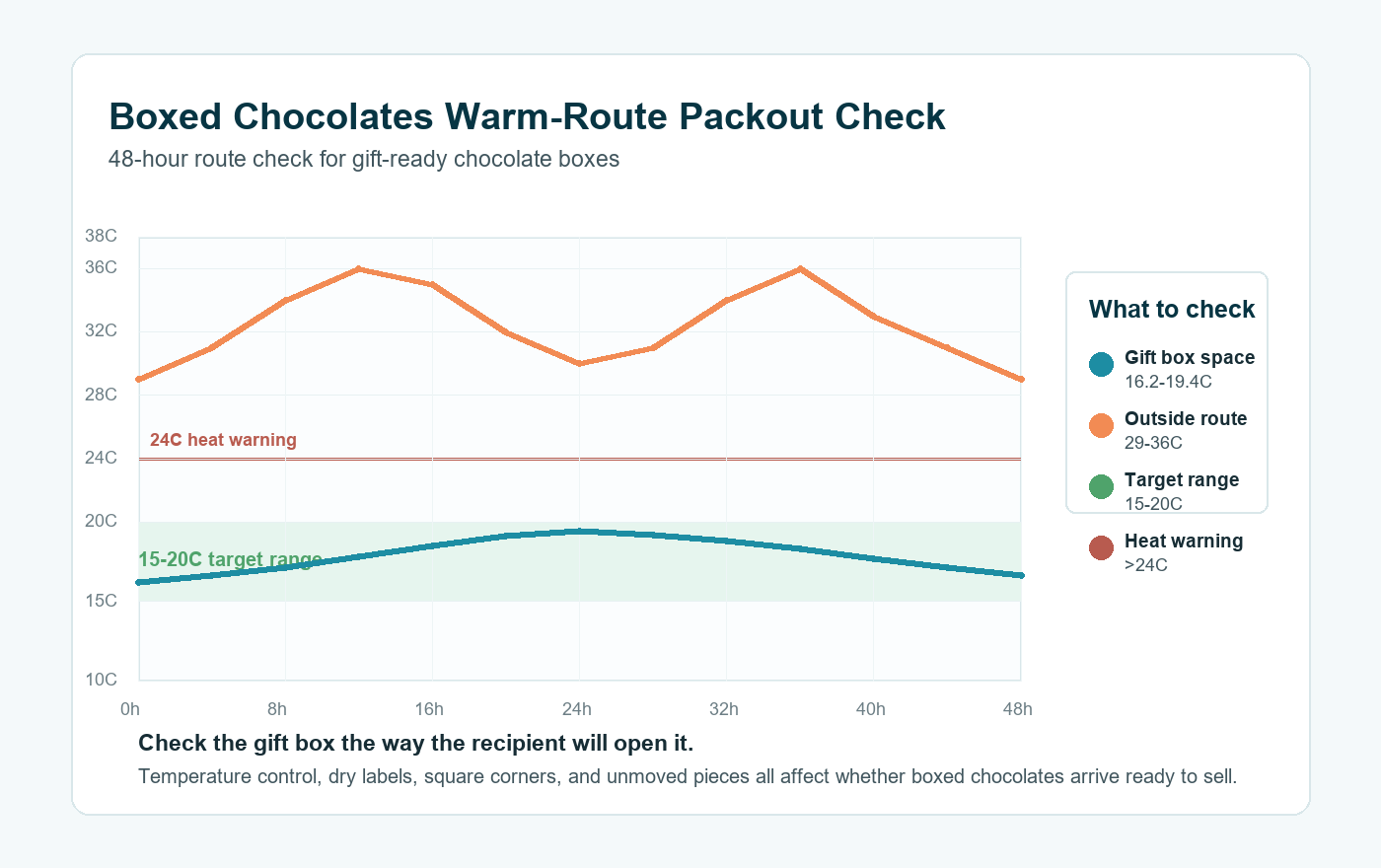
Use these ranges as starting points for sample planning. The final coolant mass should be confirmed with the real box, payload, route duration, season, and receiving standard.
| Shipment condition | Recommended Tempk package | Starting coolant direction | Coolant position | What to validate |
|---|---|---|---|---|
| Same-day retail or corporate delivery 8-18h route, ambient below 24 C, short handoff time |
Insulated carton liner or light EPS shipper, retail box cradle, corner protection | About 0.3-0.7 kg total cool-conditioned gel packs or 15-18 C PCM for a small gift parcel | Side or base-side pocket with dry divider; avoid top pressure on the gift box | Box corners, sleeve dryness, insert position, chocolate gloss, and remaining coolant state |
| Overnight ecommerce parcel 18-36h route, ambient 24-30 C, depot dwell and van delivery |
EPP/EPS insulated box, dry liner, rigid gift-box support, spacer layer, outer carton | About 0.8-1.5 kg total gel packs or PCM system selected around the holding range | Two side positions or perimeter pockets; logger near product zone, not against coolant | Temperature trace, wet carton risk, tray shift, label readability, and chocolate softening |
| Hot-weather or delay-prone route 30-35 C ambient, 36-48h risk, route delay or weekend hold |
Thicker EPP/EPS shipper, stronger outer carton, moisture barrier, higher insulation margin | About 1.5-2.5 kg total coolant or PCM system after route testing; avoid dry ice for ordinary boxed chocolate | Perimeter layout with full divider and no coolant weight on retail face | Warmest product point, cold spot risk, carton dryness, corner damage, and delay margin |
Coolant mass is a sample planning range, not a guarantee. For boxed chocolates, package appearance is part of the product value. Do not solve every warm route by adding more ice if the retail box becomes wet, crushed, or cold-spotted.
Packout Structure
The retail box should sit protected in the center of the shipper. Coolant should work around the gift box with a dry divider and enough spacing to prevent pressure marks.
Packing Process
Boxed chocolates need a presentation-first workflow. The product should be stable before packing, and the shipper should protect the gift box from moisture and parcel pressure.
Avoid loading warm boxes into the shipper, especially during summer fulfillment.
Use gel packs or PCM selected for the route; do not press hard-frozen packs onto the retail box.
Use cradles, spacers, or void fill so the box remains level and does not slide.
Check temperature, box corners, sleeve dryness, insert alignment, labels, and chocolate surface appearance.
When to Change the Design
Upgrade outer carton strength, add corner support, or reduce movement around the retail box.
Increase dry barrier, change coolant conditioning, use side pockets, or switch to a better PCM point.
Increase insulation margin, adjust coolant mass, shorten route time, or validate a higher-performance shipper.
Related Resources
Share the assortment type, retail box size, carton count, payload weight, target handling range, route duration, and summer ambient profile. Tempk can help choose the shipper, coolant layout, buffer layers, and validation plan.
Request a packout reviewCustom packout support
For fixed carton sizes, payload limits, branding requirements, seasonal lanes, or validation targets, Tempk can adapt this solution into a custom cold-chain packout.