Dry Ice Pack for Meat: Ship Frozen for 72 Hours?
Updated: September 22, 2025. If you need a dry ice pack for meat, this guide shows you how to size the ice, choose the box, apply 2025 labels, and validate performance. You’ll see the 5–10 lb per 24 h planner, UN 1845 marking rules, and a simple estimator to cut guesswork and reduce spoilage claims. All recommendations are field-tested against current carrier and postal guidance.
How much dry ice pack for meat do you need for 24–72 hours?
Which shipper (EPS, PUR, VIP) keeps meat frozen longest in hot lanes?
What 2025 labels and documents do UN 1845 shipments require?
When should you use gel/PCM instead of a dry ice pack for meat?
How do you validate results (ISTA 7E) and prove food safety to customers?
How much dry ice pack for meat do you need for 24–72 hours?
Short answer: Use 5–10 lb of dry ice per 24 hours in a quality insulated shipper, then add a 15–25% safety buffer for heat or weekend risk. Plan 15–30 lb for 72 hours and record net dry-ice mass in kilograms on the outer label.
Why it works (plain English): Insulation slows heat sneaking into the box; dry ice absorbs that heat as it turns to gas. Each kilogram soaks up a large amount of energy, so you can predict hold time with a simple rate × days × buffer plan.
Dry ice pack for meat estimator for 48–72 hours
| Sizing Variable | Typical Range | Effect on Dry Ice | What it means for you |
|---|---|---|---|
| Transit duration | 24–72 h | Linear increase | Multiply daily rate by days |
| Insulation class | EPS → PUR → VIP | Better class = less ice | Upgrade for summer lanes |
| Ambient severity | Mild → Hot | Faster sublimation | Add 15–25% buffer |
| Payload mass | 5–25 lb | More “cold battery” | Larger payload needs proportionally less ice |
Which insulated shipper keeps a dry ice pack for meat frozen longer?
Short answer: EPS is cheapest but consumes the most ice; PUR improves hold time; VIP cuts ice mass dramatically and shrinks the box. For 72-hour lanes, step up insulation or increase ice—then verify with ISTA 7E parcel profiles.
| Shipper Type | What changes | Hold-time impact | For you |
|---|---|---|---|
| EPS (1–1.5″) | Lowest cost | Uses the most ice | Budget routes, mild weather |
| PUR (1–1.5″) | Better R-per-inch | Medium ice | Tougher builds, reuse |
| VIP (0.5–1″) | Highest R-value | Least ice | Hot lanes, smallest cube |
What 2025 rules apply to a dry ice pack for meat?
You must mark and vent correctly. On the outer box show “Dry Ice” or “Carbon dioxide, solid,” UN 1845, and the net dry-ice mass in kilograms, add the Class 9 label, keep packaging vented, and follow IATA PI 954 for air. USPS air is capped at 5 lb per mailpiece; surface allows more but must be marked “Surface Only.”
Counter checklist (what agents verify): package condition; UN 1845 name/number; net kg stated; Class 9 label; addresses; and ventilation—not airtight.
When should you choose gel/PCM over a dry ice pack for meat?
Use gel or 2–8 °C PCM when you want refrigerated arrival. For meat that must stay frozen, a dry ice pack for meat is still the simplest, most powerful option for 48–72 h lanes.
How do you validate results and prove food safety?
Run a small ISTA 7E bench qualification with data loggers on your toughest lane. Tune dry-ice mass by ±10–20% based on warmest point and leftover ice at opening. Keep the report to satisfy marketplaces, carriers, and QA audits.
2025 developments and trends for frozen meat shipping
What’s new: The 2025 IATA dry-ice acceptance checklist standardizes counter checks; USPS Publication 52 keeps the 5 lb air cap; carriers emphasize UN 1845 + net kg and venting on labels. Ecommerce butchers are adopting VIP liners in hot lanes to cut ice mass while holding 72 hours.
Helpful decision tools
Check the details before you choose packaging
These quick tools can help you compare route risk, sizing needs, coolant choices, and packaging details before you request a quote.
Insulation Material Drop Resistance
Review drop resistance and handling factors before choosing insulation materials.
Check resistanceInsulation Material Reference
Compare insulation material choices for different cold chain packaging needs.
Compare materialsBox Liner & Pallet Cover Sizing
Check box liner and pallet cover sizing logic for insulated packaging projects.
Estimate sizingSnapshot of the latest
Cleaner acceptance: Checklist-driven audits reduce relabels and delays.
VIP adoption: Less ice, smaller cube, better summer performance.
USPS clarity: Use private carriers for >5 lb by air; use USPS surface with “Surface Only.”
Frequently Asked Questions
How much dry ice for a 2–3 day box (10–15 lb payload)?
Plan 10–20 lb total (5–10 lb/day) in PUR; add 20–30% in summer. Record net kg on the box.
Can dry ice touch the meat?
No. Keep dry ice off food with inner cartons or spacers to prevent texture damage.
Do I need a Shipper’s Declaration?
Not when dry ice cools non-dangerous goods under PI 954; you still add UN 1845 and net kg to the air waybill.
What arrival temperature is safe?
Frozen or ≤ 40 °F at opening meets mail-order food safety guidance.
Is there a USPS limit for air?
Yes—5 lb per mailpiece. Use surface for larger charges or switch to UPS/FedEx air.
Summary & recommendations
A reliable dry ice pack for meat uses the 5–10 lb/day rule with a buffer, puts most ice on top, fills voids tight, and marks UN 1845 + net kg on vented packaging. Validate once with ISTA 7E and hold every delivery to frozen or ≤ 40 °F on arrival.
Next steps (do this now):
Map your hottest lane and choose EPS/PUR/VIP.
Use the estimator to set 24/48/72 h ice with a 20% buffer.
Update labels to UN 1845 + net kg; add Class 9; confirm venting.
Pilot two boxes with loggers; adjust ice by ±10–20%.
About Tempk
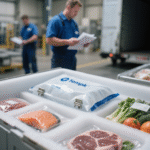
We design and qualify insulated shippers for frozen foods and life sciences. Our dry ice pack for meat kits pair right-sized EPS/PUR/VIP with clear packout photos, label templates, and validation support. Two advantages: fewer counter rejections and consistent 72-hour holds in hot lanes verified against ISTA 7E. Talk to a cold-chain specialist to right-size your next shipment.