


Fresh berries warm quickly
Warm fruit adds heat load and shortens shelf life. Finished product should enter the shipper already chilled.
Chocolate-Covered Strawberries
Chocolate-covered strawberries need a chilled route, but the packout cannot treat them like normal chocolate or normal fruit. The goal is to hold the berries cold, keep the shell dry, protect the clamshell, and avoid direct coolant pressure.
Product Risk
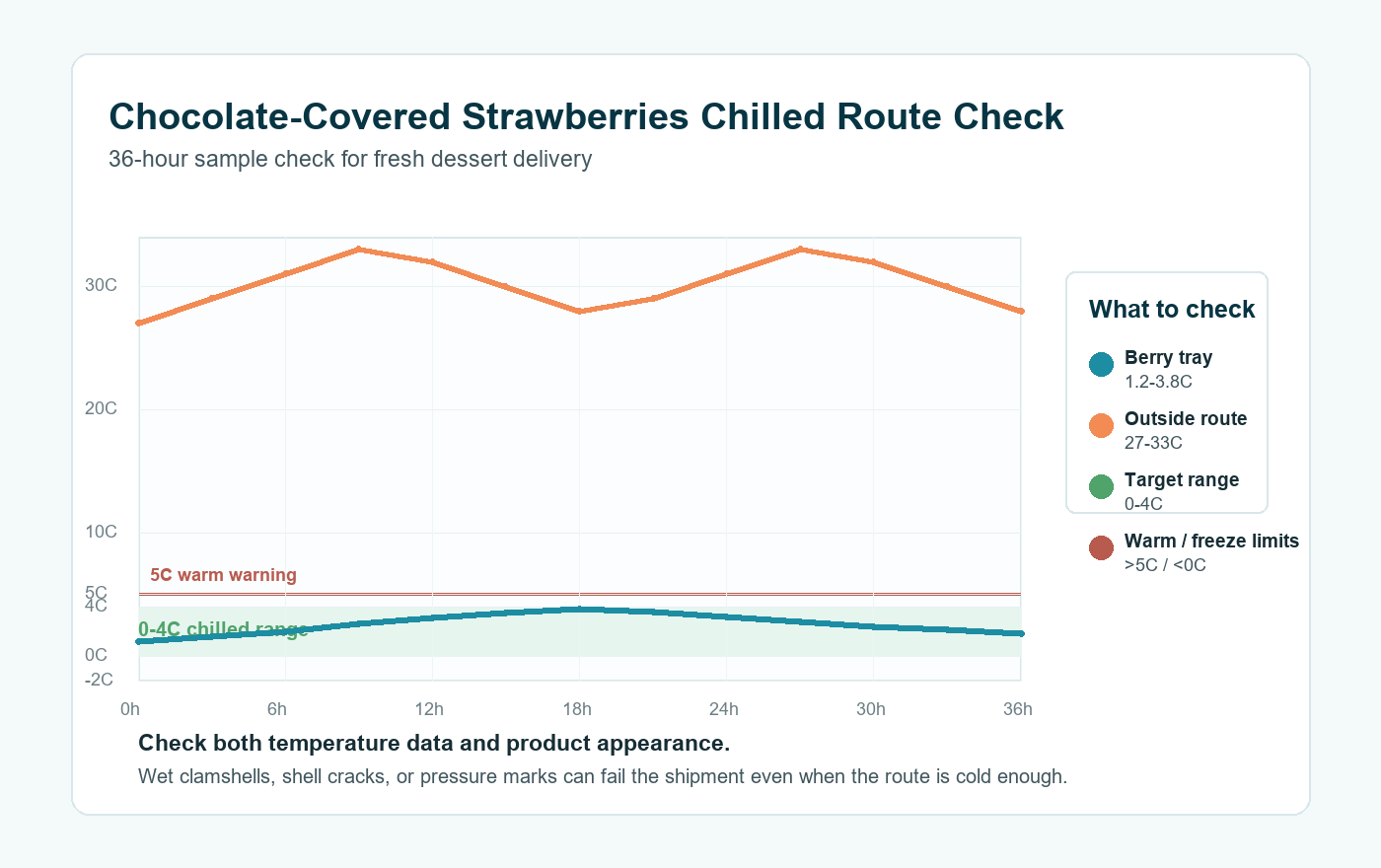
A standard ice pack box can keep the shipment cold, but it can still fail if the clamshell gets wet, berries soften, chocolate cracks, or the tray is pressed by frozen gel packs. The package has to control temperature and presentation at the same time.
Warm fruit adds heat load and shortens shelf life. Finished product should enter the shipper already chilled.
Wet clamshells, labels, and chocolate surfaces create the look of poor handling even when the product is still cold.
Hard gel packs placed directly on top can crack coating, flatten toppings, or deform the clamshell lid.
The receiver checks shine, dryness, tray position, fruit firmness, and package cleanliness before temperature data.
Route-Based Recommendation
These are practical starting points for sample design. The final gel pack weight, insulation thickness, and placement should be verified with a route test.
| Shipment condition | Recommended Tempk package | Starting coolant direction | Coolant position | What to validate |
|---|---|---|---|---|
| Same-day local delivery 8-18h route, ambient below 22 C, short handoff time |
Insulated carton liner or compact EPS shipper, rigid clamshell tray, absorbent pad, dry liner bag | Small parcel starting point: about 0.4-0.8 kg total conditioned gel ice packs for a 1-3 kg chilled payload. Use the calculator for the actual box size and route time. | Side wall or top corner with corrugated divider; no direct contact with clamshell lid | Arrival temperature, clamshell dryness, chocolate shine, tray movement, and remaining coolant state |
| Overnight parcel route 18-36h route, ambient 22-30 C, depot and van exposure |
EPP or EPS insulated box, liner bag, absorbent layer, rigid product spacer, outer carton protection | Sample design range: about 0.8-1.5 kg total gel ice packs or chilled PCM for a small parcel. Select coolant by target range, payload mass, and insulation level. | Two side positions or side-plus-top with buffer layer; logger near product, not against coolant | Temperature trace, condensation points, top pressure, fruit firmness, shell cracks, and label condition |
| Hot-weather or delay-prone route 30-35 C ambient, 36-48h risk, weekend hold possible |
Thicker EPP/EPS shipper, higher insulation margin, moisture barrier, stronger outer carton, route logger | Test-first range: about 1.5-2.5 kg total coolant or a PCM system for a small parcel. Ice bricks can be considered only with full buffering and cold-spot testing. | Perimeter coolant layout with divider on all product-facing sides; keep weight off the clamshell top | Warmest internal point, cold spot risk, condensation recovery, receiving appearance, and route delay margin |
Coolant mass is a starting point, not a guarantee. Adjust by payload weight, clamshell count, shipper size, insulation material, coolant conditioning, route duration, ambient profile, and receiving criteria. More ice does not solve cracked shells, wet labels, or crushed trays if the product support and moisture barrier are wrong.
Packout Structure
For chocolate-covered strawberries, the inner product support is as important as the insulation. A good packout protects the berries from cold shock, tray movement, and moisture before it tries to extend route duration.
Packing Process
This product should not be packed warm and rescued with extra ice. The best result comes from controlling product temperature before packing and using a buffered coolant layout.
Move finished trays into a controlled chilled room before packing so the strawberries and chocolate shell start cold and stable.
Use the selected gel pack or PCM condition based on the tested route. Do not place hard-frozen packs directly against fruit or clamshells.
Keep clamshells level, reduce empty space, and prevent top-load pressure from coolant or mixed items.
Record temperature, but also inspect shell shine, cracks, clamshell dryness, fruit firmness, label condition, and tray movement.
When to Change the Design
Keep the same thermal target, then improve barrier layers, absorbent material, ventilation gap, or coolant conditioning.
Reduce top pressure, move coolant to side pockets, add a product spacer, and check clamshell headspace.
Increase insulation margin, adjust coolant mass, shorten route time, or move to an EPP/EPS shipper for the season.
Related Resources
Share the strawberry count, clamshell size, product weight, desired temperature range, route duration, summer ambient range, and receiving checks. Tempk can help choose the shipper, gel pack layout, buffer layers, and validation plan.
Request a packout reviewCustom packout support
For fixed carton sizes, payload limits, branding requirements, seasonal lanes, or validation targets, Tempk can adapt this solution into a custom cold-chain packout.