


Heat and light exposure
Warm parcels and bright storage can create avoidable customer complaints for active-positioning skincare.
Retinol skincare is usually handled as a heat and light sensitive premium product. The packout should protect the formula story, cream texture, tube or jar shape, and printed carton while avoiding frozen-pack pressure marks.
For cosmetic cold-chain delivery, the best package is the one that protects both formula condition and customer-facing presentation. The packout below gives a practical starting point before lane testing.
Warm parcels and bright storage can create avoidable customer complaints for active-positioning skincare.
Jars and tubes can show separation, softening, denting, or seal pressure if coolant and inserts are poorly positioned.
Premium skincare depends on clean presentation; wet labels, crushed cartons, and cold-pack marks hurt the unboxing experience.
| Route condition | Temperature intent | Packaging setup | Preliminary coolant range | Receiving check |
|---|---|---|---|---|
| Same-city or store route, 4-8 h | Cool protection against vehicle heat, usually without freezing the product. | Insulated mailer or carton, light-protective inner carton, small conditioned gel pack or PCM separated by board. | About 0.3-0.8 kg for a 0.5-2 kg payload. | Jar seal, tube shape, carton dryness, and handoff time. |
| Warm e-commerce route, 8-24 h | Cool route around the brand requirement; avoid direct frozen contact with tubes, jars, or printed cartons. | Insulated carton or EPP box, upright or divider insert, side/top coolant with foam or corrugated buffer. | About 0.8-1.8 kg for a 0.5-3 kg payload. | Texture, carton crush, label wetting, and minimum temperature. |
| Hot-season delay route, 24-36 h | Validated cool-chain route based on product storage instruction and delivery promise. | Thicker insulation, more PCM or conditioned gel packs, product in center cavity, optional logger for premium shipments. | About 1.8-3.0 kg for a compact shipper; validate with the actual carton. | Logger curve, jar or tube pressure marks, seal condition, and remaining coolant state. |
Use these ranges for packaging discussion and sampling. Final coolant mass should be confirmed with the actual formula, unit count, bottle or jar size, carton dimensions, route duration, ambient condition, and any logger requirement.
Retinol jars and tubes should not be pressed against frozen gel packs. Use a spacer so the coolant controls air temperature instead of touching the package.
Use retail cartons, sleeves, or opaque inner protection when the product positioning depends on light-sensitive active ingredients.
A divider or tray keeps packages upright and reduces rubbing, dents, and cap movement during parcel handling.
Temperature is only one check. Also look for cream separation, tube deformation, wet labels, and crushed cartons.
These are the issues the packout should reduce before the shipment reaches the customer.
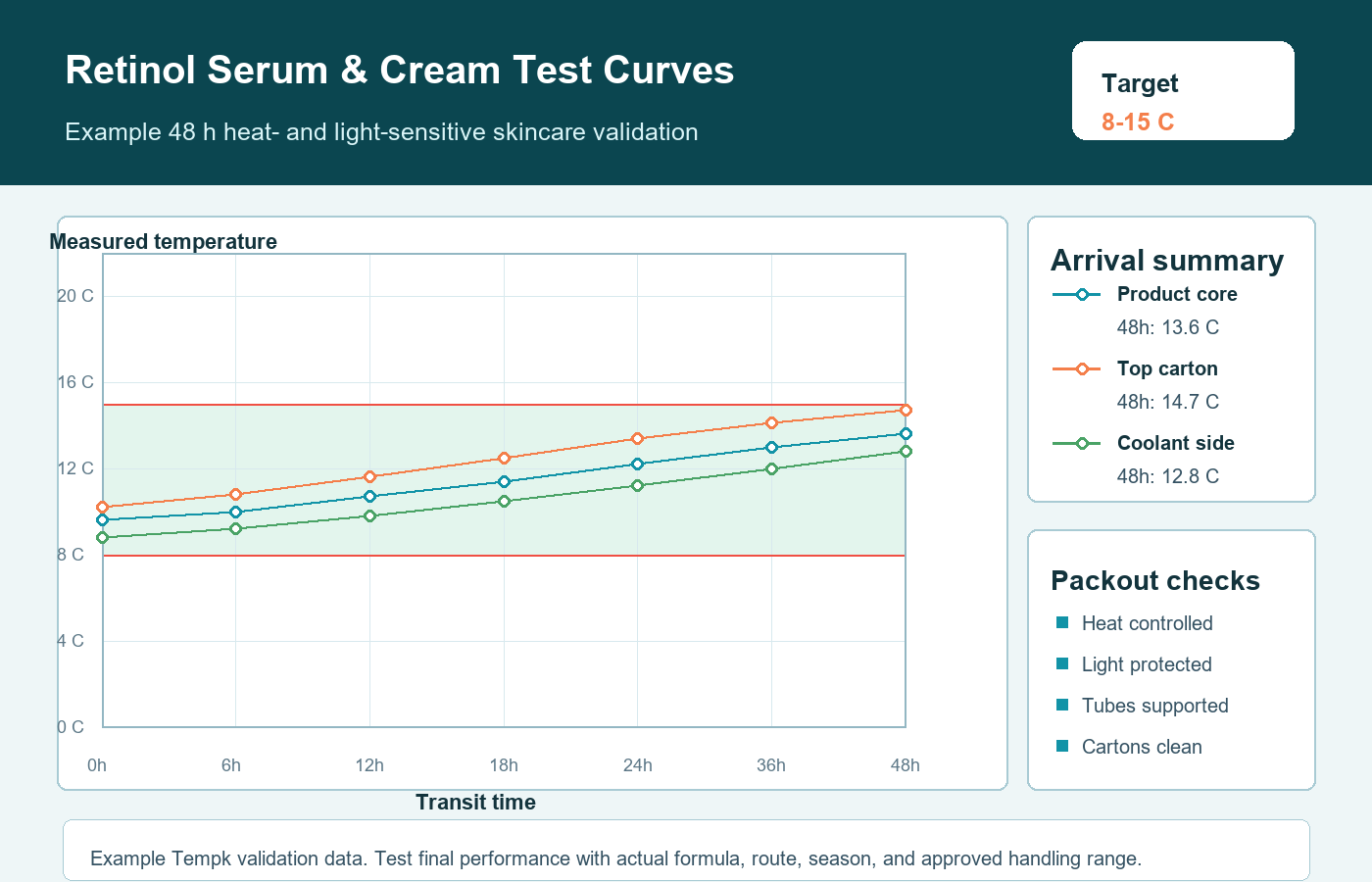
Use the test curve as a working comparison, then validate with the actual product, coolant mass, insulation, route duration, and season. For skincare, also check presentation: label dryness, carton condition, cap seal, and product texture.
Use these pages to compare nearby product routes, select coolant, and check route risk before sampling.
Retinol creams and serums need stable handling because heat can affect texture and customer trust. Packaging should also protect tubes, jars, and airless pumps from pressure.
The visible failures are separated cream, softened tubes, carton staining, pump leakage, and label damage from condensation.
Keep retail units upright in a divider and use a moisture buffer between coolant and cartons. Do not let a heavy gel pack press on pump heads.
Use chilled gel or PCM for hot lanes. If the formula is not refrigerated, design the packout to moderate heat rather than create a very cold payload.
Check viscosity, pump operation, carton condition, and label adhesion after a summer-route simulation.
Retinol creams and serums often need protection from heat and light rather than a strict refrigerated lane. A practical packout uses insulation and chilled gel or PCM to reduce summer peaks while keeping retail cartons dry.
Protect tubes, jars, and pumps from pressure. A heavy gel pack directly over a pump head can create leakage or carton deformation even if temperature looks acceptable.
Tempk can compare a mild chilled layout against a stronger refrigerated layout. Review viscosity, pump operation, carton staining, label adhesion, and customer opening presentation after the route.
Custom packout support
For fixed carton sizes, payload limits, branding requirements, seasonal lanes, or validation targets, Tempk can adapt this solution into a custom cold-chain packout.
Share the storage instruction, unit count, carton size, payload weight, route duration, ambient condition, delivery handoff, and whether you need a temperature logger. Tempk can help compare gel packs, PCM, EPP, insulated cartons, buffer layers, and receiving checks.
Request a packout review