Gel Brick Bag Design Starts With the Delivery Shift
A gel brick bag is a good fit when portability, frequent handling, and organized access matter as much as insulation. It is not simply a soft cooler box. The walls flex, the closure opens, the payload changes, and coolant can move each time the bag is lifted. Reliable performance therefore comes from a defined operating loop: condition the bricks, load an approved arrangement, control openings, protect the product from direct cold, monitor when required, and return the bag for inspection. Buyers should evaluate that whole loop before comparing colors, nominal capacity, or an unsupported hold-time claim.
Define the Job Before Selecting the Bag
Start with one product and follow it from controlled storage to the point where the receiver places it in the correct destination condition. Include time spent waiting at dispatch, walking to a vehicle, traveling, searching for an address, completing a handover, and returning undelivered goods. The route clock is usually broader than driving time.
Next, identify the operating pattern. A sealed point-to-point transfer is thermally different from a grocery route that opens at every stop. A specimen-collection bag has the opposite payload pattern: relatively warm items may be added during the route instead of cold items being removed. These uses should not share a generic duration or packing instruction.
Decide which product category you actually need:
A general insulated carrier can support lower-risk, controlled local work.
A reusable delivery bag can be managed as a depot-owned asset with defined loading, cleaning, and return.
A passive temperature-controlled package is a documented combination of insulation, coolant, payload, conditioning, and assembly.
A qualified transport system has evidence for specified conditions, loads, and procedures.
An ordinary food or beverage bag should not be treated as a qualified healthcare container because it accepts frozen bricks. Vaccine and pharmaceutical programs may require approved packouts, monitoring, and quality review. The product's labeled conditions and current program guidance take priority over the bag's marketing description.
Engineer the Bag in Its Loaded Shape
Soft construction is useful for storage and carrying, but it makes the thermal boundary variable. A side panel can compress against a product corner. A full bag can pull the zipper apart at a curve. A low-fill bag can collapse, creating an air channel and letting bricks fall to the base. Evaluate prototypes with minimum, typical, and maximum approved payloads.
| Design area | Failure to look for | Practical buyer check |
|---|---|---|
| Insulated panels | Compression, thin spots, or exposed seam paths | Load and carry the bag, then inspect wall separation around the payload |
| Closure | Zipper gap, worn flap, or excessive tension | Confirm one person can close it fully with the maximum packout |
| Brick pocket | Abrasion, stretching, trapped moisture, or coolant movement | Test filled bricks after conditioning and tilt the loaded bag |
| Product bay | Crushing, mixed orders, or direct cold contact | Model every approved payload and remove items in route order |
| Base | Sagging, tipping, or heat transfer from a vehicle floor | Set down the fully loaded bag on representative surfaces |
| Handle and straps | Poor balance or overloaded attachment points | Assess complete packed mass and the actual carry distance |
| Inner lining | Inaccessible soil, torn coating, or liquid retention | Inspect seams and corners after the approved cleaning method |
| Identification | Lost route, status, or asset information | Check label readability after condensation, cleaning, and abrasion |
This table connects thermal design with daily handling. A high-specification insulation layer provides little value if the bag cannot close or the brick pocket fails after routine carrying. Review the system after movement and cleaning, not only when a new sample is flat on a table.
Usable volume is the volume left after coolant
Headline bag capacity can be misleading. Bricks, pockets, dividers, a logger, secondary containment, and closing clearance all reduce payload space. Request internal dimensions, then build the intended configuration. A smaller bag with controlled placement may work better than a large bag filled unpredictably with dunnage.
Conditioned dimensions matter too. Rigid bricks may bow or expand, while flexible packs can freeze into uneven forms. Check the actual product state used on the route. If staff must force a brick into a sleeve, the tolerance or pocket design needs correction.
Make Access Part of the Thermal Plan
Every opening exchanges internal air with the surrounding environment and disturbs the packout. As orders leave, thermal mass falls and headspace changes. The last delivery may face the longest exposure with the smallest remaining payload.
For a multi-drop route, arrange orders so a driver can remove the next item without unloading the bag. Numbered compartments, inner modules, or one-bag-per-order methods can reduce search time. The right choice depends on vehicle space, asset availability, return efficiency, and product risk. One bag per customer reduces openings but increases fleet size and cleaning work.
Write the opening pattern into development tests. Define how often the lid opens, how far it opens, how long it remains open, what payload is removed or added, and where the bag sits during the stop. A closed-chamber duration should not be applied to that route without evidence.
Design around the final stop
Low payload is not automatically easy. With less product mass, the bag may respond faster to exterior conditions. Loose bricks can migrate into the empty space and contact the remaining order. Test the final-stop configuration and the failed-delivery return, not just the full bag leaving the depot.
Staging also consumes protection. Coordinate packing with dispatch and define where loaded bags wait. Adding coolant is a poor substitute for correcting a routine delay at the loading door.
Restrain Coolant and Manage Cold Contact
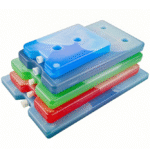
Rigid bricks are useful in bags because they are countable and can fit fixed pockets. Side positions keep the center accessible; a lid pocket can address a vulnerable closure; a base position may support some layouts. None is universally correct. Heat paths, bag orientation, product sensitivity, and access pattern determine placement.
Secure each brick so carrying does not move it to the lowest point. The restraint must accommodate conditioned dimensions and remain inspectable. Pocket corners and seams need enough durability to tolerate repeated insertion, walking, and vibration. A removable cassette can simplify counting and exchange, but it becomes another component to clean, identify, and control.
Frozen coolant may create a local condition below the lower limit of a chilled product. Use an approved separator or controlled spacing when direct contact is unsuitable. Specify the separator material and position; “wrap the product” leaves too much room for interpretation. The goal is not to make the bag as cold as possible. It is to keep the product within its approved condition through the defined journey.
Hot and chilled items generally need separate thermal zones. A flexible divider does not prevent all heat transfer, especially when staff repeatedly open the same cavity. Laboratory samples may also require primary and secondary containment, absorbent material, orientation, and labeling independent of the temperature-control layer. The bag cannot replace those requirements.
Condition Bricks as a Controlled Production Step
The coolant state at packing affects both cooling capacity and freeze risk. “Put it in the freezer overnight” is not a complete instruction. Define the exact brick, conditioning equipment, loading arrangement, readiness method, released status, and maximum interval between removal and bag closure.
Verify the process at peak load. A crowded freezer with frequent door openings may prepare bricks unevenly. Warm returns should not be mixed with released stock. A simple flow can use separate locations for returned, conditioning, ready, and rejected units, with labels that remain readable in cold and wet conditions.
Inspect bricks before conditioning. Quarantine leaking, cracked, swollen, punctured, contaminated, or badly distorted units. A compromised shell reduces coolant mass and can soil the bag or payload.
Product should enter the bag in the condition required by the approved process. Passive packaging is normally designed to maintain a starting condition for a limited journey, not to cool a warm load quickly. Control time out of storage during packing and verify that the line can meet its procedure during busy periods.
Prove Performance With a Route Simulation
The most informative trial combines thermal mapping, handling, and worker behavior. Begin with production-intent bags and bricks. Pack low, normal, and high payloads; carry the bag by every intended handle; place it in the actual rack or vehicle position; and confirm that the closure, pockets, dividers, and sensors stay where intended.
Helpful decision tools
Check the details before you choose packaging
These quick tools can help you compare route risk, sizing needs, coolant choices, and packaging details before you request a quote.
Ice Pack Calculator
Estimate gel ice pack quantity for chilled shipments and practical route planning.
Estimate ice packsBox Liner & Pallet Cover Sizing
Check box liner and pallet cover sizing logic for insulated packaging projects.
Estimate sizingDry Ice Calculator
Estimate dry ice needs for frozen or ultra-cold shipments before packing.
Estimate dry iceUse a justified hot and cold challenge and measure likely warm and cold locations. Sensor placement may include areas near the zipper, base, brick interface, and representative product. A logger floating loose in the cavity can migrate and produce data that describe the wrong location.
Then reproduce the opening schedule. Remove orders in the planned sequence or add representative collection loads. Include a credible delay and the return of an undelivered item. Mechanical checks should cover carrying, setting down, tipping where foreseeable, base abrasion, strap loading, and pocket wear. If cleaning is part of reuse, expose trial units to the approved method and reassess them.
Imagine a pharmacy courier uses one large bag for several stops. During observation, staff leave the lid open while checking paperwork and move a side brick to reach the next order. A better design may use external manifests, numbered inner sections, and captive brick pockets. The revised system should still be evaluated against product requirements, but the improvement addresses the actual failure path rather than merely adding coolant.
Monitoring supports a decision; it does not protect temperature. Define the required device range and accuracy, calibration status, recording interval, location, activation, data review, and excursion process according to product risk. Multi-drop data are easier to interpret when delivery or opening times are recorded. For healthcare use, the authorized quality function should decide product disposition.
Run Reusable Bags as a Controlled Fleet
Closed local routes can make bag and brick reuse practical because vehicles return to a depot. Physical reusability alone is not enough. The program needs asset ownership, return checks, dirty-to-clean separation, compatible washing, complete drying, inspection, and retirement.
Soft bags can trap residue in seams, pockets, zipper tracks, hook-and-loop closures, and removable boards. Follow a material-compatible method and avoid immersion unless the construction permits it. Moisture left inside insulation can affect odor, hygiene, weight, and performance.
Inspect bags for torn lining, delamination, compressed panels, broken zipper teeth, failed stitching, damaged handles, deformed bases, persistent contamination, and unreadable identifiers. Define which repairs are allowed and whether a repair can affect thermal evidence. Track bags and bricks separately because they may fail or disappear at different rates.
A credible sustainability assessment includes return rate, completed uses, loss, washing and drying, freezer energy, reverse transport, repair, end of life, and product waste. A bag labeled reusable but lost after one route has not delivered a reuse benefit. Right-sizing and reliable product protection often provide more defensible gains than a broad environmental claim.
What Buyers Should Confirm Before Scaling
Move from sample to production with a controlled checklist:
internal and external dimensions in a loaded condition;
insulation construction, seams, closure, and base details;
filled and conditioned brick dimensions with tolerances;
pocket strength, retention, cleaning access, and replacement method;
complete loaded mass and handle or strap evidence relevant to use;
approved cleaning, drying, inspection, and retirement guidance;
thermal-report scope, including payload, coolant layout, profile, openings, sensors, and acceptance criteria;
product and material information required for the intended market;
production sample consistency, lot identification, and change notification;
custom artwork, pocket tooling, order quantities, lead time, and replacement availability.
Ask the supplier to separate component facts from system results. A material declaration does not establish thermal duration, and a closed-bag test does not establish multi-stop performance. Final approval should use the exact commercial configuration and a route method accepted by the responsible quality or food-safety team.
Frequently Asked Questions
How long can a gel brick bag maintain temperature?
There is no transferable duration for every bag. Performance depends on insulation and closure, brick type and condition, payload mass and starting state, headspace, external exposure, surface contact, and openings. Review the test configuration behind any claim, then evaluate your complete commercial packout over the full operating cycle, including staging and delay.
Is a rigid gel brick better than a flexible gel pack?
Rigid bricks offer predictable shape, counting, and pocket fit. Flexible packs conform around irregular payloads but may freeze in variable shapes or move more easily. Either can be suitable when the bag, product, conditioning, and restraint are designed around it. Treat a change in coolant format as a packout change that may need reassessment.
Can the same bag carry food, medicine, and specimens?
Shared use may create hygiene, documentation, and process conflicts. Each product group can have different containment, cleaning, labeling, temperature, and quality requirements. Use separate fleets unless a documented risk assessment and validated cleaning and segregation process support sharing. Color coding can help identification, but it is not sufficient control by itself.
When should a bag be replaced?
Retire or quarantine it when damage, contamination, closure failure, compressed insulation, or loss of identification means it no longer meets the approved criteria. Do not use a universal trip count without evidence. Base retirement on inspection, use history, material compatibility, and periodic performance review appropriate to the application.
A Dependable Bag Is Easy to Use Correctly
The best gel brick bag is not the thickest or the one carrying the most coolant. It is the one that keeps its loaded shape, restrains every brick, protects the product from hot and cold extremes, closes without struggle, and supports the real opening pattern. Qualification establishes the operating boundary; training, cleaning, inspection, and monitoring keep routine work inside it.
Before volume purchase, simulate a complete shift with the people who pack, carry, receive, and clean the system. Their actions will reveal risks that a stationary sample cannot.
About Tempk
We supply rigid ice bricks, reusable gel packs, insulated bags, box liners, EPP and cold shipping boxes, water-injection packs, and pallet covers for temperature-controlled packaging applications. For a mobile bag project, Tempk can discuss coolant geometry, pocket fit, payload organization, and standard or custom packaging options using the buyer's route and handling requirements. The final configuration should be evaluated with the intended product, load, opening pattern, conditioning process, and cleaning routine.
Share your bag dimensions, payload, required condition, route time, opening schedule, carrying method, cleaning process, and freezer capability with Tempk. Ask for production-representative options that can be assessed in a monitored route simulation before scaling.