Temperature Control Pallet Covers for Bulk Chemical Shipping: A Decision System That Holds Up
Temperature control pallet covers for bulk chemical shipping should be approved through a decision system, not purchased as a stand-alone promise. The system connects a documented chemical requirement with a mapped exposure, a fitted passive cover, representative evidence, safe operating steps, and a clear exit to stronger control. This approach avoids two common errors: expecting reflective insulation to regulate a set point, and letting a cover interfere with dangerous-goods packaging or hazard communication. The result is a defined use that procurement can specify, operators can repeat, and quality and safety teams can review.
Prepare Two Files Before Requesting Samples
The first file is the product-and-package brief. It identifies the chemical or approved family, current safety data sheet, product condition criteria, known temperature-response mechanisms, dangerous-goods determination, authorized containers, pallet build, restraint, and required access. It should distinguish quality requirements from safe storage conditions and from regulatory transport controls.
OSHA's safety data sheet framework includes precautions for safe handling and conditions for safe storage, including incompatibilities. That information must remain central to the workplace process. A transport specialist still needs to determine the requirements for the actual shipment. PHMSA rules govern relevant U.S. hazardous-material movements; ADR, IATA dangerous-goods processes, and the IMO's IMDG Code apply in their respective road, air, and sea contexts.
The brief should also resolve the word "bulk." If it means a bulk commercial order of smaller containers, state that. If the shipment uses an intermediate bulk container or another form considered bulk packaging by applicable rules, record the actual category. The cover does not change packaging status, quantity limits, or communication duties.
The second file is the route-and-operations brief. It maps the shipment from conditioning through receipt, including all dwell points, conveyances, seasonal conditions, direct sun or cold airflow, floor contact, openings, custody changes, and delays. It names what can be controlled at each point and the protected options available when the schedule fails.
Together, the files give suppliers a solvable problem. Without them, suppliers are pushed toward generic descriptions because no one has defined the load or the exposure. They also give internal reviewers a stable baseline: when the product, package, or route changes, the company can see which approval assumptions need review.
Draw the Boundary Around What the Cover Owns
The cover should own a particular exposure, not the entire cold or temperature chain. A boundary statement might assign it to outbound staging and an ambient regional trailer, while protected holding owns extended delay and the warehouse owns product conditioning. Every risk should have a control with enough authority.
| Boundary question | Answer that supports passive use | Answer that signals escalation | Owner to involve |
|---|---|---|---|
| Does the product start in the approved condition? | Measured or controlled starting process | Unknown core condition or release at a limit | Product and quality teams |
| Is exposure bounded and represented by evidence? | Defined stages with credible delay and backup | Uncontrolled hold or unobserved route variability | Logistics and carrier |
| Is the pallet configuration stable? | Approved packages, load pattern, restraint, and fit | Mixed or changing builds without review | Packaging and operations |
| Can the cover remain correctly closed? | Openings are limited, simulated, and rechecked | Frequent inspection or scanning defeats closure | Operations and handlers |
| Are hazard communication and inspection preserved? | Exact arrangement has competent approval | Marks, labels, closures, or damage are hidden | Dangerous-goods and safety teams |
| Is passive buffering enough for the consequence? | Verified margin and workable contingency | High consequence, narrow margin, or required active control | Technical and compliance owners |
This table is a governance screen. It prevents a favorable material feature from overruling an unsuitable route. A single escalation answer does not always end the project, but it must be resolved through route control, design change, stronger packaging, or active equipment.
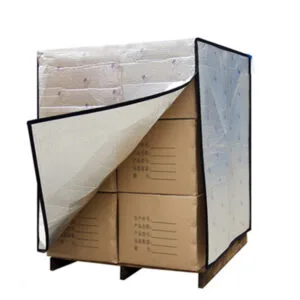
The boundary should include the bottom. A cover that wraps only sides and top can leave conductive and convective paths at the pallet base. If a bottom panel, skirt, or floor interface is used, it must remain compatible with forklifts, pallet jacks, restraint, drainage, and safe handling. The tested and shipped arrangements should match.
The boundary should also include time outside normal movement. Weekend closures, missed transfers, security inspection, customs holds, vehicle breakdowns, delivery refusal, and power or equipment failure at protected sites can shift responsibility. Give each credible event an owner and response.
Select an Architecture, Not Just an Insulating Layer
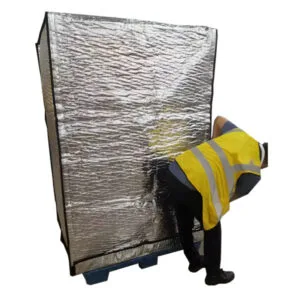
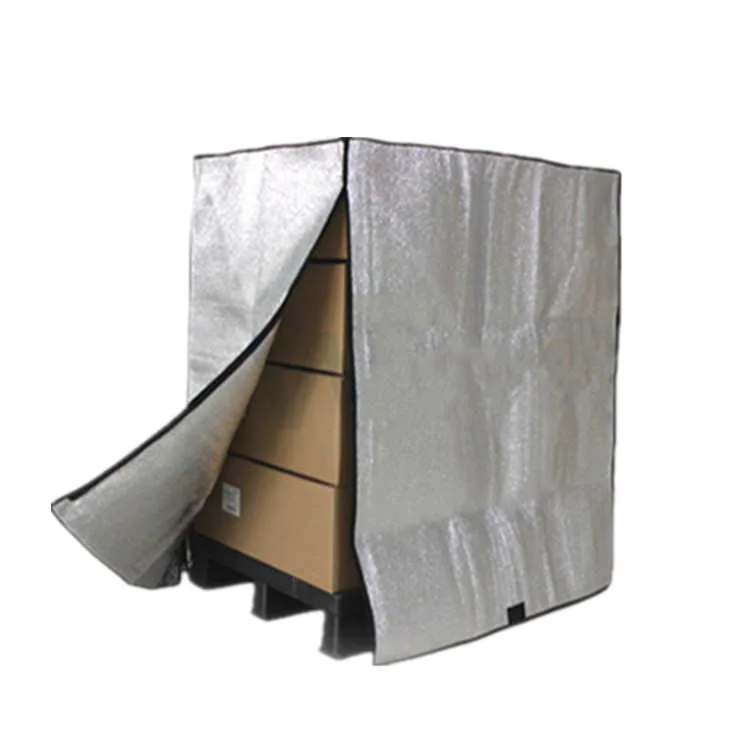
The cover architecture includes outer face, insulating core, inner face, seams, corners, closure, top, base, access, identification, and integration with the pallet. Each part can change heat flow or execution. Suppliers should explain intended function without converting component properties into finished-system guarantees.
A reflective exterior is useful against radiant gain under relevant conditions. It does not stop heat moved by air or contact. Insulation slows conduction but can be bypassed by gaps and compressed areas. A close fit can reduce air exchange but might obstruct labels or inspection. An access flap supports operations but creates a closure that has to be consistently restored.
For chemical use, architecture also includes contamination behavior. Smooth surfaces may be easier to inspect, yet seams and edges can retain residue. Some materials may be attacked by the chemical or approved cleaning agent. Ask for exact material information and scoped compatibility evidence. If fire behavior, static control, or liquid resistance matters, specify the scenario and test method. Do not rely on unqualified adjectives.
Choose size from the loaded pallet envelope and work method. Include package tolerances, bulge, corner boards, top cap, straps, and projections. Check operator reach and mechanical handling. A custom fit may improve consistency but increases item complexity; an adjustable fit can support several builds but creates variation. The correct balance depends on the pallet portfolio and consequences of misuse.
Determine whether the cover is single use, limited reuse, or part of a managed closed loop. Reuse architecture may need durable surfaces, identifiable units, repairable features, and defined cleaning resistance. But durability alone does not create a safe loop. The consignee, reverse logistics, segregation, and quarantine process have to exist.
Demand Evidence in Layers
Start with component documentation to understand construction, then move toward finished-cover and route evidence. A material coupon can support a comparison between layers. A finished-cover test reveals seams and geometry. A loaded comparison shows how the payload changes response. A route-representative protocol connects the configuration to the decision. Operational monitoring checks whether real use stays inside the assumptions.
At each layer, ask what was tested and what inference is justified. Record material batch or cover identity, production status, dimensions, load, starting state, external profile, radiation and airflow where relevant, floor and base, sensor locations, device calibration, data interval, number of runs, deviations, and acceptance rule. If the result is confidential, arrange a controlled technical review rather than accepting only a headline.
Test against an appropriate comparator. An uncovered but otherwise equivalent pallet can quantify the cover's incremental effect. Another cover or an operational control can support an alternative decision. Ensure comparable starting conditions and exposure. A warmer control pallet can make the proposed cover look better without the cover being responsible.
Measure quantities that answer the product decision. Under-cover air, container surface, product, and surrogate temperatures are not interchangeable. Use a documented sensor map and calibrated devices appropriate to the purpose. Preserve raw data and event times. State how uncertainty and spatial variation affect acceptance.
Do not turn a result into an unconditional duration. A claim only applies to the configuration and boundary conditions it represents. If the test supports routine exposure but not a long delay, record both findings. The delay belongs to the exception plan, not to creative wording.
Use official or recognized standards only within scope. ISTA publishes thermal transport test resources for defined distribution systems, but a parcel-oriented profile may not describe palletized chemical freight. A standard method improves repeatability when appropriate; it does not replace the chemical criterion, pallet geometry, or route model.
Put Supplier Control Into the Technical Approval
Supplier qualification for a passive cover should focus on the attributes that sustain the evidence. Create a purchase specification for materials or defined construction, dimensions and tolerances, seam and closure methods, access locations, base, identification, workmanship, allowed repairs, storage, and care. Include the exact production item tied to the trial.
Ask the supplier to describe incoming material control, in-process checks, finished inspection, nonconformance handling, traceability appropriate to the product, and change notification. Do not invent certifications the supplier must hold unless the business has a verified requirement. A useful audit question is how the supplier would prevent an apparently similar substitute film, foam, closure, or adhesive from entering production without review.
Request production samples before the volume release or establish another risk-appropriate first-article check. Compare them with the approved configuration for fit, materials, workmanship, closures, access, and identity. A beautiful prototype from a development bench does not demonstrate repeatable production.
Define receiving controls that operators can perform. Confirm item and size, inspect for tears, delamination, incomplete seams, damaged closures, contamination, moisture, and incorrect identification. Dimensional sampling may be appropriate. Thermal verification can occur periodically or after changes according to risk rather than on every receipt.
Make commercial scaling conditional. Price, minimum order quantities, lead time, customization, spares, packaging, and delivery schedule are supplier-specific questions. Add the internal costs of training, application, storage, inspection, cleaning, returns, losses, monitoring, and exception handling. The lowest cover price can create the highest process cost if fit is inconsistent.
Helpful decision tools
Check the details before you choose packaging
These quick tools can help you compare route risk, sizing needs, coolant choices, and packaging details before you request a quote.
Packaging Selector
Compare insulated packaging options by product, route, and temperature need.
Find packagingCompliance Checklist Generator
Build a practical checklist for packaging review, shipping, and documentation.
Build checklistInsulation Material Drop Resistance
Review drop resistance and handling factors before choosing insulation materials.
Check resistancePilot the Operating Process, Then Release the Product
A pilot should begin at the conditioning or staging point and end after receipt, not at the laboratory door. Representative operators build and inspect the pallet, apply the cover, scan and move it, perform expected handovers, open it if required, refit it, and remove it. Quality and safety observers record workarounds, visibility issues, damage, and time pressure.
Use launch monitoring when justified to compare field exposure with the test model. The plan defines device locations, calibration status, sampling, download, alarm or review criteria, missing-data handling, and decision authority. Monitoring is not a substitute for protection and should not create uncontrolled electrical or access issues around the chemical.
Train people on the reason for each critical step. "Close the flap fully" is easier to follow when handlers understand that an open path changes the tested boundary. "Do not cover a stained drum" connects the thermal process to package safety. Avoid asking operators to decide product stability; give them observable stop conditions and escalation contacts.
Release documentation should include the approved product and package, pallet drawing, cover item, application instruction, required access, starting condition process, approved lanes or stages, monitoring, and exception flow. It should also state exclusions, such as unapproved pallet heights, mixed products, specified dangerous goods, uncontrolled export routes, or contaminated covers as applicable.
Field feedback should be reviewed early. An apparently minor issue, such as a closure that opens during a scan, may invalidate thermal assumptions. Correct design or workflow before expanding the program. A successful temperature trace does not excuse a blocked label or unsafe inspection.
A Disruption Reveals Whether the System Is Real
Consider a hypothetical launch shipment of palletized drums on an approved ambient road lane. The cover fits, labels remain accessible, and route evidence supports the routine movement. At a cross-dock, a carrier changes equipment and the pallet misses its connection. The likely dwell will exceed the passive-use boundary.
The shipping instruction names this event. The terminal places the pallet in a reviewed protected area without removing the cover, records the time and cover condition, and alerts the route owner. The technical team reviews the exposure and monitoring information. If the protected option is unavailable, the plan identifies a temperature-managed recovery or return decision. The driver or dock worker is not asked to guess product suitability.
During inspection, a handler notices moisture near one drum. The response switches immediately from thermal delay to the chemical incident procedure. Personnel isolate the pallet and follow the SDS, site emergency process, and required protective measures. The cover is treated as potentially contaminated. Thermal performance is no longer the priority.
After the event, the team confirms whether the carrier change was foreseeable, whether terminal instructions were accessible, and whether the approved-use file needs revision. It reviews data without claiming that one sensor proves every drum's condition. Product disposition remains with the authorized function.
This scenario exposes the value of a layered system. The cover buys passive margin, the protected location controls a delay, monitoring informs review, and safety procedures take over for suspected leakage. No single component is asked to perform another's job.
Reject Claims That Collapse Important Distinctions
"Temperature controlled" is incomplete if the product is passive. Ask whether it merely slows heat exchange or uses active regulation. "Maintains temperature" is incomplete without a range, load, starting state, profile, duration, measurement point, and acceptance rule. "Tested" is incomplete without the protocol and production link.
"Suitable for chemicals" is too broad. Ask which surfaces were assessed against which substances, concentrations, contact modes, durations, and temperatures. "Waterproof" does not prove chemical compatibility, and "reusable" does not establish cleanability after a spill. "Anti-static" or "fire resistant" needs a relevant method and complete construction.
"Compliant" is especially risky. The cover does not classify the chemical, authorize the receptacle, create training, prepare shipping papers, or satisfy every mark, label, placard, stowage, segregation, or temperature-control rule. Compliance belongs to the shipment and operation under applicable requirements, not to a generic pallet accessory.
"Bulk shipping" must also be unpacked. A marketing phrase about volume does not resolve whether the actual containers are regulatory bulk packagings. Ask the shipper's dangerous-goods professional to document the determination.
Finally, reject environmental claims without boundaries. Recyclable material may not be locally accepted. Reusable material may not return. A lower product weight may not overcome losses or cleaning. Require a defined comparison before publishing percentages or absolute statements.
Finish With an Approval Memo That Operations Can Use
The final decision should fit on a concise approval page backed by evidence. It names the product, package, pallet, cover, route stages, starting process, allowed openings, evidence reference, monitoring, operating boundary, contingency, reuse or disposal route, owners, and change triggers. This is the control that accompanies the physical item.
Approve only what the evidence supports. Expand later through deliberate review. If a new lane has longer holds, a different load, or another transport mode, treat it as a change, not an administrative extension. If events repeatedly approach the boundary, improve the route or move to a system with greater control authority.
Approval FAQ
What is the most important question for a first supplier meeting?
Ask the supplier to explain which finished-cover configuration and test conditions support the proposed use on your actual pallet and route. This opens the discussion about materials, fit, payload, profile, sensor locations, and limitations. A supplier that begins with those conditions is giving you more useful information than one that begins with a universal duration.
Can pallet covers replace preconditioning?
No. A passive cover preserves a starting state only by slowing change. It cannot be relied on to bring the chemical to the correct condition. Define how the product and packaging are conditioned, how adequate time is established, and what measurement or release check confirms the starting state.
When should the cover be retested?
Retesting or other technical review may be needed after changes to materials, seams, dimensions, closures, pallet geometry, package, payload, starting process, cleaning, route, carrier, mode, or ambient profile. The level of work depends on risk and the relationship to prior evidence. Define triggers in change control before launch.
Who owns an excursion decision?
The authorized product or quality function should own disposition using the approved procedure and relevant product knowledge. Logistics supplies route events, monitoring supplies measured conditions, and safety or dangerous-goods personnel address hazards and compliance. A cover supplier or driver should not independently declare affected chemical acceptable.
About Tempk
For buyers building this decision system, Tempk is associated with temperature-controlled packaging and cold-chain solutions and can help explore passive pallet-cover configurations. We can work from a defined pallet and route so fit, access, cover construction, and verification questions remain concrete. We do not position a cover as an automatic qualified shipping system, a dangerous-goods compliance device, or a substitute for SDS requirements and internal product approval.
Share your product-and-package brief and route-and-operations brief with Tempk to start a focused cover discussion before samples, testing, or volume purchasing.