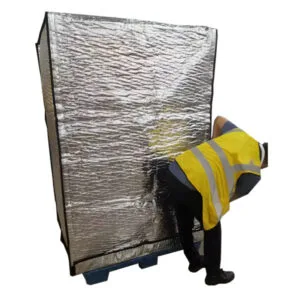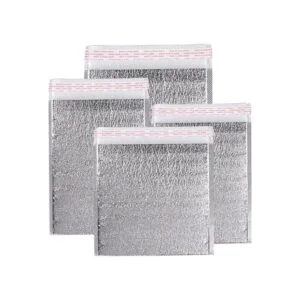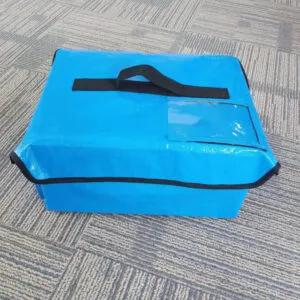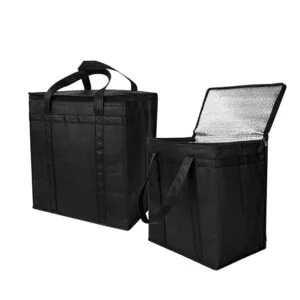
A Five-Gate Method for Pallet Thermal Blankets for Hazardous Materials Shipping
A thermal cover should never be the first item approved on a hazardous-material pallet. The first approvals concern the material, authorized packaging, hazard communication, route, and carrier. Only then can pallet thermal blankets for hazardous materials shipping be assessed as secondary protection against defined ambient exposure. They cannot replace UN-specification packaging when required, classification, segregation, marks, labels, documentation, training, emergency arrangements, or carrier acceptance.
Procurement teams can manage the decision through five gates: legal fit, thermal need, physical integration, evidence, and operational control. A candidate moves forward only when it clears every gate. This method prevents a strong thermal result from hiding a dangerous-goods defect and prevents a compliant bare package from being wrapped in a poorly designed cover.
Gate 1: Is the Completed Unit Legally and Operationally Admissible?
Freeze the blanket discussion until a trained responsible person has defined the dangerous goods. Record the UN or identification number where applicable, proper shipping name, class or division, subsidiary hazard, packing group when assigned, quantity, physical state, concentration, and mode. Confirm the authorized packaging instruction, special provisions, quantity limits, route restrictions, and any carrier or operator variations.
Under the United States Hazardous Materials Regulations, the offeror is responsible for proper classification and description and for determining that the packaging is authorized. Core communication requirements appear in 49 CFR Part 172 and shipper packaging requirements in Part 173, with additional rules for air, vessel, and highway modes. The IATA Dangerous Goods Regulations guide air shipments and include carrier variations and acceptance requirements. ADR and national rules may apply to European road movements. Always use the current provisions for the actual lane.
Now inspect the proposed covered assembly. Ask:
Will every required mark, hazard label, orientation mark, identification, and document pouch remain visible?
If information is hidden, have the applicable overpack marking and labeling requirements been correctly addressed?
Does the cover interfere with vents, valves, pressure-relief devices, closures, lifting points, tie-downs, or emergency access?
Is consolidation allowed, and are compatibility and segregation requirements still met?
Has the carrier accepted the cover, fastening method, inspection access, and completed presentation?
In the United States, 49 CFR 173.25 addresses authorized overpacks and the reproduction of required marks and labels when they are not visible, including use of the “OVERPACK” marking in stated situations. The exact determination depends on the assembly. Do not treat a clear pocket or copied label as a universal solution.
Gate 1 fails if the cover hides communication, changes an authorized configuration without approval, blocks a package safety feature, or cannot be accepted by the operator. Thermal testing should not proceed until these issues are corrected.
Gate 2: What Exact Exposure Is the Cover Supposed to Moderate?
Write a one-sentence use statement. A good example is: “The cover is intended to slow heat gain during outdoor air-cargo build-up and a missed-connection delay after a pallet leaves a controlled truck.” A poor example is: “The cover keeps chemicals at the right temperature.” The first can be tested. The second has no defined product limit, ambient condition, duration, or route segment.
Build a time-ordered exposure record. Include pre-staging, loading, security, cross-dock dwell, customs, transfer between controlled assets, door openings, unpowered container periods, carrier inspections, delays, and receiving. Use lane data, facility observations, weather records, and carrier input where available. Separate shaded ambient exposure from direct solar loading and note conductive contact with floors or equipment.
Define why temperature matters for the material. Product quality, package pressure, viscosity, brittleness, phase behavior, and transport safety are different concerns. Limits must come from an approved product and dangerous-goods assessment. A cover supplier should not select them.
Some dangerous goods have specialized control or emergency temperatures, may generate heat, or require ventilation. Passive insulation is not an active cooling system and can retain internally generated heat. Such materials require a specific regulatory and process-safety approach. Gate 2 fails if the organization is trying to use insulation as a substitute for required active control, approved stabilization, refrigeration, ventilation, or an emergency plan.
Gate 3: Does the Cover Fit the Pallet and Its Safety Functions?
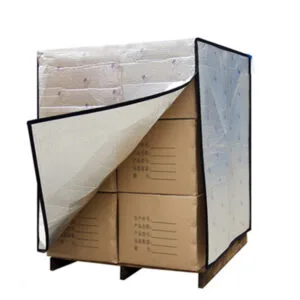
Measure the completed unit load. Nominal pallet dimensions omit height, overhang, bulging cartons, drum rings, corner protectors, stretch-wrap folds, top irregularities, label locations, and access clearances. Record both normal and maximum production dimensions. Specify whether a base pad or skirt is part of the design.
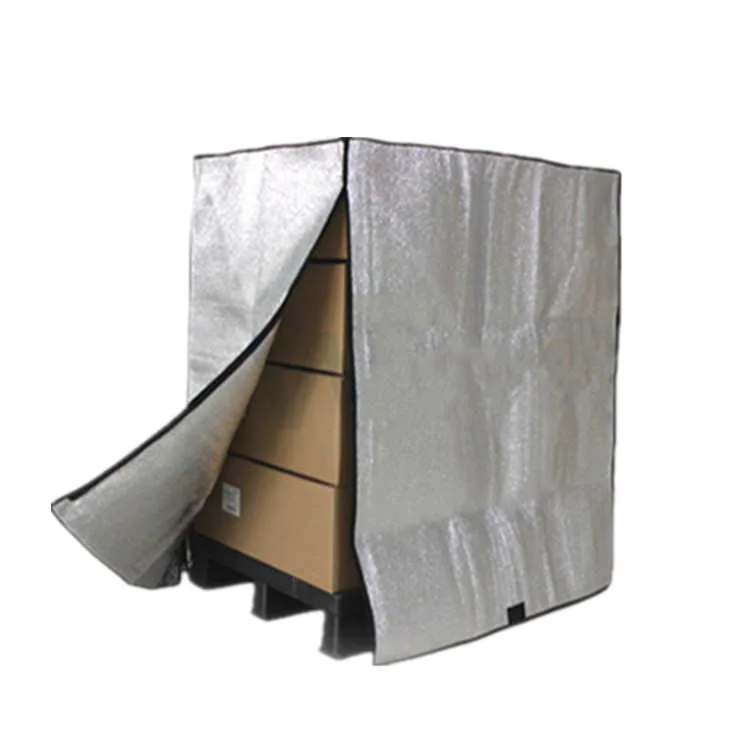
Each construction feature should answer a risk:
| Feature under review | Decision it must support | Failure to look for |
|---|---|---|
| Reflective exterior | Reduce defined radiant exposure | Dirt, abrasion, wrong orientation, unsupported performance claim |
| Insulating layer | Resist conduction through faces | Compression, wetting, inconsistent thickness, shedding |
| Seam and closure | Limit air exchange and stay secured | Thermal bridge, gap, snag, unplanned opening |
| Interior surface | Protect outer packages during use | Abrasion, incompatibility, contamination, static concern |
| Base treatment | Address lower-edge air leakage or floor path | Forklift interference, trapped liquid, unstable skirt |
| Access and label zone | Preserve inspection and communication | Covered marks, blocked valves, inaccessible documents |
The design review should include foreseeable leakage. A general thermal blanket is not spill containment. Determine whether its material could react with, absorb, spread, or conceal escaped contents and how responders would remove or isolate it. Flammable atmospheres, static-sensitive operations, ignition sources, and contaminated-cover disposal require site- and material-specific assessment.
Ergonomics is part of fit. A heavy or tall cover that requires staff to climb, reach over drums, or stand in forklift lanes creates a different risk. Conduct a task observation with representative workers and personal protective equipment. Gate 3 fails if safe, repeatable installation cannot be demonstrated.
Gate 4: Does the Evidence Match the Claim?
Translate the use statement into a protocol. Identify the cover revision, production construction, pallet and payload, starting condition, ambient profile, solar component if relevant, duration, openings, sensor map, calibration status, logging interval, repetitions, control configuration, and acceptance criteria. Approve the protocol before running it.
Heat moves through radiation, convection, and conduction. Reflective surfaces principally address radiant exchange; insulating layers resist conductive paths and internal air movement; closures and skirts affect air exchange. Corners, seams, fasteners, and compressed areas act as bridges. The pallet base may behave differently from the sides. A credible study measures the assembled system rather than extrapolating from one layer.
Use payloads that represent the intended load’s mass, heat capacity, geometry, and packaging. A pallet of dense liquids may respond slowly, while a low-mass pallet with large voids can respond faster. If a surrogate is used, justify why it is conservative or representative.
Map likely hot or cold points as well as a core reference. Capture ambient exposure and, when solar risk matters, an appropriate surface or radiant indicator. Synchronize sensors. A logger is an evidence tool, not thermal protection. Its reading represents its location and accuracy; it does not certify every package.
Helpful decision tools
Check the details before you choose packaging
These quick tools can help you compare route risk, sizing needs, coolant choices, and packaging details before you request a quote.
Route Risk Checker
Review lane conditions before selecting packaging for real operating requirements.
Check route riskInsulation Material Reference
Compare insulation material choices for different cold chain packaging needs.
Compare materialsIce Pack Calculator
Estimate gel ice pack quantity for chilled shipments and practical route planning.
Estimate ice packsThermal standards can provide discipline. ISTA Standard 7E includes profiles for thermal testing of parcel-delivery insulated shipping containers, and Standard 20 provides a design and qualification process. A flexible full-pallet cover may require a different justified protocol or route-specific qualification. Citing a standard name without demonstrating scope is not enough.
Read claims literally. “Reduced heat gain in the tested configuration” may be supported. “Protects all hazardous materials for a fixed number of hours” almost never follows from one study. Gate 4 fails if the report omits the payload, profile, sensors, cover configuration, or acceptance criteria; relies only on flat-material data; or turns a limited trial into a universal guarantee.
Gate 5: Can Operations Keep the Approved State?
Approval exists on paper; control exists on the dock. Write an SOP that identifies the approved cover and revision, pallet limits, orientation, pre-use inspection, installation sequence, closures, label zones, access points, sensor placement, seal use, removal, and storage. Include clear stop conditions for tears, wetting, contamination, delamination, missing tags, wrong dimensions, hidden communication, warm or cold release conditions, or route changes.
Add a completed-unit release check by trained dangerous-goods staff. Inspect after the blanket is fully installed. Confirm packaging condition, marks, labels, orientation, overpack treatment where applicable, documents, segregation, vents, valves, closures, straps, and carrier presentation. This order catches problems that a bare-pallet inspection misses.
Define exception ownership. Logistics handles missed connections and equipment events; dangerous-goods specialists handle packaging and communication deviations; quality evaluates thermal excursions and qualification scope; safety manages leaks or exposure; the carrier decides acceptance under its rules. A phone list is not enough. Write the information each function needs and the authority to hold or reject a shipment.
At receipt, inspect before discarding evidence. Record cover condition, openings or broken seals, package damage, leakage, bulging, label legibility, logger status, and temperatures required by the approved plan. A stable sensor reading does not authorize acceptance of a damaged hazmat package. A damaged cover does not automatically mean the product failed; follow the defined assessment.
Gate 5 fails when the system depends on unwritten expertise, cannot trace cover revision, has no response to damage, or credits protection during route segments where the cover is removed.
The Tender Should Define Reuse, Stop Rules, and a Controlled Result
Once the gates are defined, the request for quotation becomes more useful. Provide the supplier with the pallet envelope, label and access map, route exposure, handling constraints, use model, cleaning expectations, and proposed test objective. Do not disclose sensitive dangerous-goods information beyond what is appropriate, but provide enough for safe technical review.
Require a construction bill of materials or controlled layer description, dimensional tolerances, seam and closure details, production inspection points, and change-notification process. Ask for thermal evidence in full context, not a single headline result. Request relevant information for flammability, static, chemical compatibility, moisture behavior, cleaning, and disposal so internal specialists can assess it. These documents do not confer dangerous-goods approval; they support the buyer’s review.
Evaluate sample-to-production consistency. Check finished dimensions, mass where useful, seam placement, closure strength, surface condition, label windows, and identification. Agree on acceptable repairs and defects before volume supply. A seemingly minor switch in film, foam, adhesive, thread, or closure can change thermal behavior or safety suitability.
Commercial comparisons should include installation labor, storage volume, carrier handling, cleaning, return transport, loss, inspection, repair, and retirement. Avoid assuming an unverified reuse count or fixed thermal duration. Compare options against the same approved function.
Reuse and Sustainability Pass Through the Same Gates
Reuse can reduce discarded material on a closed loop, but it can also add return freight, cleaning, losses, and complex laminates. Define the functional unit as one successfully protected, compliant pallet movement. Then account for cover manufacture, trips actually achieved, return network, cleaning, repairs, replacement parts, and end-of-life route.
Every reuse begins with inspection. Establish limits for tears, crushed insulation, stains, chemical exposure, damaged reflectivity, seam failure, missing closures, and unreadable identity. A contaminated cover should enter the hazardous-material response and waste process appropriate to the contaminant, not an ordinary laundry stream.
Track individual covers if the risk and value justify it. Identity helps link inspection, repairs, cleaning, and revision. It does not replace physical examination or prove performance. A reused cover must still pass Gates 1 through 5 for the intended shipment.
Four Automatic Stop Decisions
Some conditions should stop the release without a debate about thermal benefit:
The dangerous goods are not correctly classified, described, packaged, marked, labeled, documented, or accepted for the mode.
The cover blocks required communication, ventilation, pressure relief, handling, inspection, or emergency access.
The material has a safety-critical temperature-control requirement that the proposed passive configuration has not been specifically approved to meet.
The thermal claim cannot be traced to a representative configuration and relevant profile.
These stops keep the hierarchy intact. The purpose of a thermal cover is to add a margin to a sound shipment, never to make an unsound shipment look complete.
Conclusion: A Release Decision That Can Survive Audit
Pallet thermal blankets for hazardous materials shipping are ready for use only when the organization can answer five questions with records: Is the completed unit admissible? Is the exposure defined? Does the cover integrate safely? Does the evidence support the limited claim? Can operations preserve the approved state?
If the answer to any question is uncertain, hold the project at that gate. The disciplined result is a narrower but more defensible use case: a specified cover, applied to a specified pallet, for a specified route condition, under an SOP that protects every dangerous-goods obligation.
About Tempk
Shanghai Tempk Industrial Co., Ltd. operates Tempk as a cold-chain packaging brand. Our official product information includes thermal pallet covers, insulated packaging and boxes, coolants, and PCMs, while solution pages describe packout review, logger-position planning, and validation-plan support. For hazardous-material shipping, this scope may inform evaluation of an outer thermal layer against defined geometry and exposure. It does not extend to classification, authorized dangerous-goods packaging, marks, documents, routing, emergency response, or carrier approval; qualified shipment parties retain those decisions.
Start with the proposed use statement, complete pallet drawing, access rules, and test boundary. Tempk can then discuss a narrowly scoped thermal-packaging review.