


Sweating and condensation
Temperature swings and wet liners can damage retail appearance and make labels difficult to read.
Cheese shipments need a buffered chilled route that avoids sweating, odor transfer, freeze marks, and retail-pack compression. The right layout depends on whether the payload is blocks, wedges, sliced packs, or premium retail cartons.
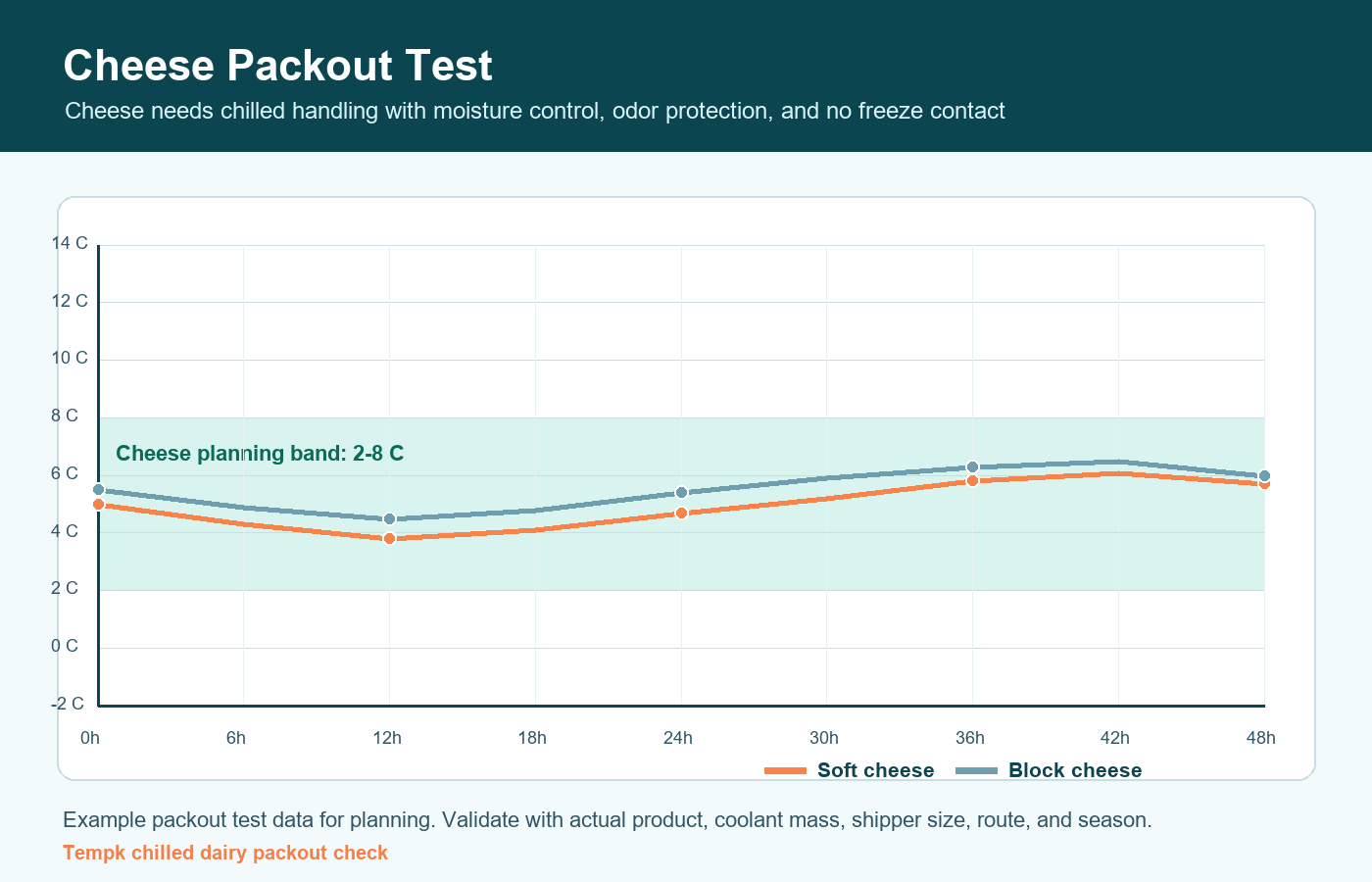
A dairy shipment should be judged by both temperature and arrival condition. The packout below gives a practical starting point before lane testing and customer handoff checks.
Temperature swings and wet liners can damage retail appearance and make labels difficult to read.
Cheese may need separation in mixed parcels, especially when shipped with strong-smelling foods or absorbent packaging.
Direct cold contact or a tight carton can mark retail packs and change texture.
| Route condition | Temperature intent | Packaging setup | Preliminary coolant range | Receiving check |
|---|---|---|---|---|
| Short chilled delivery, 4-8 h | Chilled handling based on cheese type; prevent direct freeze contact. | Insulated carton, moisture sleeve or liner, small conditioned coolant, protected center cavity. | About 0.5-1.2 kg for a 1-3 kg cheese payload. | Package dryness, texture, odor, label clarity, and handoff time. |
| Warm parcel route, 8-24 h | Buffered chilled route that controls heat without creating sweating or cold marks. | EPP or insulated carton, moisture/odor barrier, side/top conditioned gel packs or PCM separated from cheese packs. | About 1.2-2.8 kg for a 3-8 kg payload. | Carton pressure, surface sweating, odor transfer, minimum temperature, and remaining coolant. |
| Extended or mixed-load route, 24-36 h | Validated chilled route with stronger moisture and odor separation. | Higher-performance insulation, sealed liner or odor barrier where needed, stable center cavity, logger near cheese and coolant side. | About 2.5-4.5 kg for a compact cheese shipper; confirm by test. | Logger curve, freeze marks, package dryness, texture, odor transfer, and remaining coolant. |
Use these ranges for sampling and quotation. Final coolant mass should be confirmed with the actual product temperature, unit count, package size, shipper volume, route duration, ambient profile, and receiving requirement.
Blocks, wedges, sliced packs, and retail cartons need different cavity support and moisture protection.
Conditioned coolant should manage air temperature without pressing a cold surface onto the cheese package.
Use liners, bags, or separators when the lane creates condensation or includes mixed products.
Receiving should check temperature, sweating, odor transfer, carton pressure, texture, and remaining coolant.
These are the visible and operational issues the packout should reduce before the shipment reaches the receiver.
Use the test curve as a working comparison, then validate with the actual product, coolant mass, insulation, route duration, and season. For dairy, also check leakage, condensation, package pressure, texture, odor, and remaining coolant.
Use these pages to compare nearby dairy routes, select coolant, and check route risk before sampling.
Share the product form, target temperature, payload count, carton size, route duration, ambient condition, courier handoff, and receiving checks. Tempk can help compare gel packs, PCM, EPP, insulated cartons, liners, inserts, and logger placement.