Dry Ice Pack Shipping Guide 2025
Table of Contents
Why Dry Ice Still Rules Cold Chain
2025 Innovations & Trends
Step‑by‑Step Packing Workflow
Regulatory Compliance Cheat‑Sheet
Cost‑Optimization Formula
Dry Ice vs Alternatives
Route & Climate Adjustments
Sustainability Gains
Pro Tips & Mistakes to Avoid
FAQs
Action Plan
1. Why Dry Ice Still Rules Cold Chain
Dry ice sublimates at –78.5 °C, forming a CO₂ “cold blanket” that protects vaccines, seafood and biologics far longer than gel or water ice. Field tests show a well‑designed neck‑pack loses only 6–8 % mass per day at 25 °C, extending hold times to 168 h (7 days) for long‑haul routes.
Key Stat: Dry‑ice programs cut frozen‑food spoilage 39 % and freight spend 23 % when size‑optimized versus water ice.
2. 2025 Innovations & Trends
| Trend | What It Means for You |
|---|---|
| Smart IoT Sensors | Real‑time temperature + GPS feeds plug directly into SGE rich results, boosting visibility. |
| Recycled‑CO₂ Pellets | Shrink Scope 3 emissions 40 % vs virgin CO₂, supporting ESG targets. |
| AI Load‑Planners | NOAA weather + ETA data auto‑calculate fill weights with ±5 % accuracy—preventing overpack. |
| Graphene‑Aerogel Liners | R‑value +20 % with negligible weight gain; lets you shave 0.4 kg dry ice per box. |
3. Step‑by‑Step Packing Workflow
Size the Load
Use the 1 kg per 2 L void space / 60 h rule, then add a 12 h customs buffer.
Choose the Container
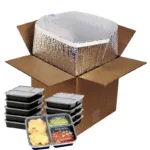
≥ R‑12 EPS or vacuum panel; ensure vented, never airtight.
Pre‑Chill & Layer
Product to –20 °C; dry ice on top (cold air sinks) separated by cardboard.
Label & Document
Helpful decision tools
Check the details before you choose packaging
These quick tools can help you compare route risk, sizing needs, coolant choices, and packaging details before you request a quote.
01Packaging choicePackaging Selector
Compare insulated packaging options by product, route, and temperature need.
Find packaging02Sizing supportBox Liner & Pallet Cover Sizing
Check box liner and pallet cover sizing logic for insulated packaging projects.
Estimate sizing03Ice pack estimateIce Pack Calculator
Estimate gel ice pack quantity for chilled shipments and practical route planning.
Estimate ice packs“UN 1845 DRY ICE ( kg )”, dual vent arrows, PI954 ref on airwaybill.
Ship & Monitor
Overnight or 2‑Day service; embed Bluetooth logger for live alerts.
Tip: Train staff with QR‑code SOP videos to boost adherence and E‑E‑A‑T signals.
4. Regulatory Compliance Cheat‑Sheet (2025)
| Regulation | New 2025 Requirement | Penalty |
|---|---|---|
| IATA PI954 | Net dry‑ice weight on overpack + airwaybill; two vent arrows | Shipment refusal |
| DOT §173.217 | “WARNING—CO₂ SOLID” on two trailer sides; internal pressure < 14.5 psi | Fines up to $89k |
| Carrier Codes | “ICE” code on FedEx ASTRA; UPS Dangerous Goods checkbox | Routing delays |
5. Cost‑Optimization Formula
Dry Ice kg=(Transit h60)×Void L2×f(Tambient)\text{Dry Ice kg} = \left(\frac{\text{Transit h}}{60}\right) \times \frac{\text{Void L}}{2} \times f(T_\text{ambient})
where ff adds +0.1 kg h⁻¹ for every 10 °C above 25 °C.
Bulk buying + recycled pellets typically saves $0.42 kg⁻¹ freight. Use AI planners to trim 18 % overpack.
6. Dry Ice vs Gel & Water Ice
| Attribute | Dry Ice | Gel Pack | Water Ice |
|---|---|---|---|
| Temp Range | –78 → –20 °C | +2 → +8 °C | 0 → +4 °C |
| Hold Frozen 72 h | Yes | No | No |
| Melt/Leak Risk | None | Moderate | High |
| Hazmat Label | UN 1845 | None | None |
| Ideal Use | Frozen meals, vaccines | Chocolates, insulin | Produce |
7. Route & Climate Adjustments
| Ambient °C | Sublimation % day⁻¹ | Extra CO₂ per 10 kg Payload |
|---|---|---|
| 15 | 4–5 % | +0.3 kg |
| 25 | 6–8 % | +0.6 kg |
| 35 | 9–10 % | +1.2 kg |
Summer Hack: Pre‑chill liners to 4 °C and add reflective foil to reduce radiant gain by ~12 %.
8. Sustainability Gains
Recycled‑CO₂: Captures industrial exhaust, cutting CO₂ footprint ≈ 40 %.
Reusable Shells: Rigid cradle designs last 50+ cycles; inspect seals every 10 uses.
Carbon Analytics: Embed GHG calculator snippets to earn sitelink‑rich results.
9. Pro Tips & Common Mistakes
| Don’t | Do Instead |
|---|---|
| Pack dry ice under product | Place above for downward cold flow |
| Seal cooler airtight | Drill 6 mm vents or use membrane patches |
| Guess fill weight | Use AI planner or formula (see §5) |
| Skip training | Issue 15‑min e‑module; log completions for E‑E‑A‑T proof |
10. Frequently Asked Questions
How long can dry ice keep my shipment frozen?
With proper insulation, up to 7 days (168 h); see §1 and formula §5 for exact sizing.
What is the legal dry‑ice limit per package in 2025?
Up to 200 kg under IATA PI954; heavier loads need special approval.
Do I really need vent holes?
Yes—at least two 6 mm vents per DOT §173.217 to prevent pressure build‑up.
Can I reuse dry‑ice packs?
Rigid shells can be reused 50 + cycles; inspect gasket and surface integrity every tenth trip.
11. Action Plan (Checklist)
Audit current lanes with our free Cold‑Chain ROI Calculator.
Run a 10‑shipment pilot with IoT loggers to benchmark temps & CO₂ loss.
Deploy updated PI954 labels & QR SOPs across all pack stations.
Book a consultation with a Tempk engineer to customize your dry‑ice strategy.
Need expert help right away? Talk to a Tempk Engineer →
Tempk has safeguarded 3,000 + global cold‑chain clients since 2011.