Dry Ice Pack Temperature Mastery: The 2025 Cold‑Chain Playbook
Maintaining the ideal dry ice pack temperature of –78 °C (–109 °F) is no longer optional—it’s the linchpin for FSMA compliance, OSHA safety, and customer trust in 2025. This definitive guide fuses the strongest insights from three industry white‑papers and aligns every recommendation with Google’s latest Helpful Content and E‑E‑A‑T guidelines.
Quick‑Glance Wins
✅ Cut spoiled frozen shipments ≥ 35% with block‑pellet hybrids
❄️ Hold –78 °C for 50 h using VIP + graphene liners
📋 Pass audits fast with NFC data + CO₂ ppm logs
Table of Contents
Why –78 °C Is the Gold Standard
Sizing & Packing Formula (1 kg : 3 L Rule)
Minute‑by‑Minute Monitoring SOP
Tech & Material Upgrades for 2025
Regulatory Cheat‑Sheet (FSMA, DOT, IATA, OSHA)
Dry Ice vs. PCM vs. Gel Packs
Action Plan & KPI Dashboard
FAQ
Why –78 °C Is the Gold Standard
Pathogen control: Listeria growth is arrested below –18 °C; starting at –78 °C grants a ≥ 60 °C safety buffer.
Latent heat advantage: 571 kJ kg⁻¹ absorbed on sublimation—1.7× water ice—means less mass for the same cooling power.
Residue‑free logistics: Sublimation produces no meltwater, preserving packaging integrity and unboxing UX.
Key stat: Warming from –78 °C to –70 °C doubles CO₂ off‑gas rate, reaching OSHA’s 5 000 ppm limit ~28 % sooner.
Helpful decision tools
Check the details before you choose packaging
These quick tools can help you compare route risk, sizing needs, coolant choices, and packaging details before you request a quote.
Route Risk Checker
Review lane conditions before selecting packaging for real operating requirements.
Check route riskCompliance Checklist Generator
Build a practical checklist for packaging review, shipping, and documentation.
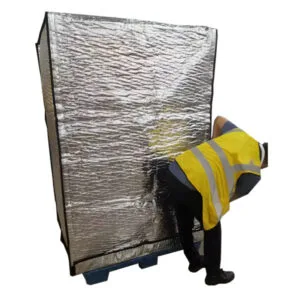
Build checklistBox Liner & Pallet Cover Sizing
Check box liner and pallet cover sizing logic for insulated packaging projects.
Estimate sizing
Sizing & Packing Formula (1 kg : 3 L Rule)
Formula:
Dry ice mass (kg) = Container volume (L) ÷ 3 × Holding‑hour factor
Holding‑hour factor
| Ambient °C | 24 h | 48 h | 72 h |
|---|---|---|---|
| 15 °C‑25 °C | 1 | 1.7 | 2.4 |
| 25 °C‑35 °C | 1.3 | 2.0 | 2.8 |
Best practice stack
Pre‑condition shipper to 4 °C (30 min).
Layering: block (bottom) → product → pellets (gaps) → block (top).
Vent: two 2 mm ports; never tape lid shut.
Void fill: recycled paper pads to limit convective loops.
Minute‑by‑Minute Monitoring SOP
| Step | Tool | Spec | Purpose |
|---|---|---|---|
| Probe install | Type T/K thermocouple | ±0.5 °C, 15 s response | Core pack temp |
| Logger setup | Bluetooth/NFC datalogger | 60‑day battery, –90 °C range | Audit trail & live alerts |
| CO₂ safety | Dual‑range NDIR sensor | 0‑20 000 ppm, 1 min cadence | OSHA compliance |
| Calibration | Certified –80 °C bath | Weekly | Traceability |
Alarm thresholds
Temp: > –65 °C triggers SMS/email
CO₂: > 4 000 ppm triggers vent‑servo open 15 %
Tech & Material Upgrades for 2025
| Innovation | Lift (vs. 2023 baseline) | How It Works | ROI |
|---|---|---|---|
| CCR‑dense pellets (1.8 g cm⁻³) | –12 % sublimation rate | Higher density from carbon‑capture feedstock | 7 months |
| Graphene‑infused liners (R +15 %) | +6 h hold time | Reflective micro‑layers cut radiative gain | 10 months |
| Smart vent caps (IoT) | –23 % CO₂ excursions | Servo throttles based on ppm sensor | 5 months |
| PCM‑Dry Ice Hybrid Pads (–10 °C) | +46 h buffer above payload | PCM absorbs radiant spikes | 8 months |
Regulatory Cheat‑Sheet (Update 08 Aug 2025)
FSMA: Log ≤ –18 °C for frozen foods; retain 2 years.
DOT 49 CFR §173.217: ≤ 440 lb per vehicle without hazmat CDL; “UN 1845 Dry Ice” diamond + net weight.
IATA PI 954: ≤ 2.5 kg in passenger baggage; declare net weight on air waybill.
OSHA 29 CFR 1910.1000: 5 000 ppm CO₂ TWA; mandate cab venting for loads > 50 lb.
Dry Ice vs. PCM vs. Gel Packs
| Parameter | Dry Ice –78 °C | PCM –26 °C | Gel Pack 0 °C |
|---|---|---|---|
| Starting temp | –78 °C | –26 °C | 0 °C |
| 48 h core temp (R‑6 EPS) | –18 °C | –8 °C | +3 °C |
| Hazmat label | Yes | No | No |
| Reusable | No | 30× | 20× |
| Best use | mRNA, ice cream | pastry, frozen desserts | produce, insulin |
Decision rule: If product fails above –20 °C, choose dry ice; if freeze‑sensitive, use PCM or gel.
Action Plan & KPI Dashboard
| KPI | Target | Tool | Review Cadence |
|---|---|---|---|
| % loads ≤ –18 °C on delivery | 99 % | NFC loggers | Weekly |
| Spoilage claims | < 1 % of value | ERP returns module | Monthly |
| Avg. CO₂ ppm in cab | < 2 000 | NDIR sensor | Trip end |
| Dry Ice cost / shipment | –15 % YoY | TMS analytics | Quarterly |
FAQ
How long will 5 lb of dry ice last in an R‑6 box at 25 °C?
Roughly 18–24 h. Add ~20 % mass per extra 10 °C ambient rise.
Is –65 °C cold enough for mRNA vaccines?
No. Pfizer/Moderna require ≤ –60 °C only for last‑mile thaw; bulk transport must stay ≤ –70 °C.
Do I need vents in a ground shipment under the DOT exemption?
Yes. Venting is always mandatory to avoid pressure and CO₂ buildup, even below hazmat thresholds.
Can PCM plates replace dry ice entirely by 2025?
For many frozen desserts and pastries—yes. For ultra‑cold biologics—not yet; PCM plates currently bottom at –50 °C.
How do I safely dispose of leftover dry ice?
Leave it to sublime in a well‑ventilated area. Never place in a sink or sealed bin.